A pole, a purification tank and a brush can all be individually suitable and still make a poor water-fed pole system. The parts become a system only when the source water can be treated at the required workload, the treated water reaches the brush at usable output, the pole reaches the glass from a safe working position, and the complete rig fits the vehicle and maintenance routine.
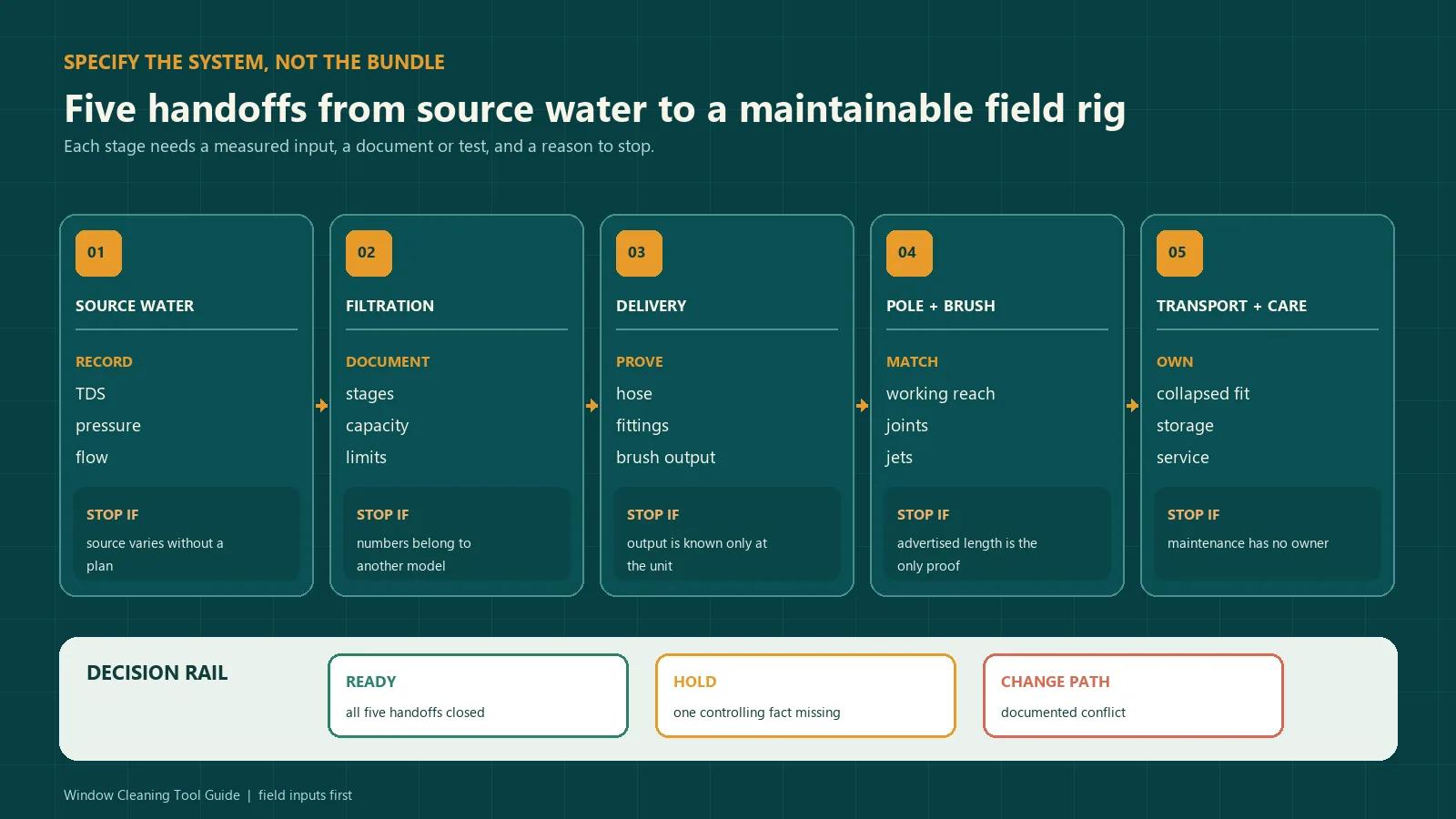
Build the shortlist in that order. Measure feed-water TDS and estimate demand first. Compare the filtration class and exact documents second. Prove delivery at the brush third. Only then freeze pole, hose, brush, transport and service details. If one controlling handoff is unknown, hold the candidate rather than letting a product label fill the gap.
Specify the chain before shopping the parts
Treat the system as five linked decisions:
- Source water: feed TDS, source access, pressure/flow and the date and location of the measurement.
- Filtration: DI or a multi-stage path, documented capacity, operating range, monitoring and consumables.
- Delivery: hose length and diameter, fittings, pump or membrane conditions, number of poles, brush jets and output at the point of work.
- Pole and brush: actual working reach, pole construction, clamps, angle adapter, brush and compatible connections.
- Transport and maintenance: collapsed dimensions, loaded mass, drainage, freeze protection, resin/filter replacement and access to spares.
The useful outcome is not “best system.” It is one of three records:
- Ready to shortlist: every controlling field is supported by a current document or a measurement from the intended work.
- Hold: the route may work, but a missing water, output, reach, compatibility or service field could change it.
- Change path: a documented requirement conflicts with the source, workload, job, vehicle or maintenance capacity.
The Pure Water Systems guides cover the treatment side of this decision. The Water-Fed Poles guides cover reach and components. This guide joins those branches so neither is selected in isolation.
Start with a water-and-work record
Record the water and workload before opening product comparison tabs:
- feed-water TDS, test method, location and date;
- expected pure-water gallons per workday and workdays per month;
- tap, tank or other source, including whether the source changes between jobs;
- available source pressure and flow, measured in the arrangement you expect to use;
- highest glass, set-back or obstruction, and the operator’s real standing position;
- number of simultaneous poles and the longest intended hose route.
TDS is a measurement of dissolved material in water. It is useful for comparing treatment burden, but it does not identify every dissolved substance or predict the exact service life of any resin. XERO’s current TDS guidance recommends DI for source water below 100 ppm and a multi-stage system above 100 ppm because harder water can consume DI resin faster. That is XERO’s vendor guidance, not a universal industry boundary. Use it to decide which documents and costs deserve comparison, then use the selected system’s manual and measured output to operate it.
Workload changes the meaning of the same source-water number. Occasional low-volume work can make portability and a simple service routine more valuable. A regular high-volume route can make resin consumption, membrane output, reject water, filter changes and downtime more important. Do not label either path economical until the gallons and replacement assumptions are on the same page.
Filtration capacity is only the first handoff
Choose a treatment class to investigate, not a winner, from the source record.
| Starting scenario | Route worth documenting | Evidence needed before a shortlist | Reason to hold |
|---|---|---|---|
| Lower feed TDS and occasional demand | DI-only may deserve the first comparison | Named resin/tank capacity, output-TDS monitoring, storage directions and expected monthly gallons | Capacity is borrowed from another resin or vessel, or demand is unmeasured |
| Higher feed TDS or regular demand | Compare multi-stage RO/DI with DI-only operating burden | Membrane input/output conditions, prefilter and DI stages, reject-water route, pump requirements, consumable schedule and actual demand | Only the purchase price is known |
| Long hose, multiple poles or high output demand | Compare a delivery-capable system, not just treatment capacity | Source pressure/flow, documented system output, hose/jet configuration and simultaneous-pole conditions | Output is known only at the machine, not at the intended brush setup |
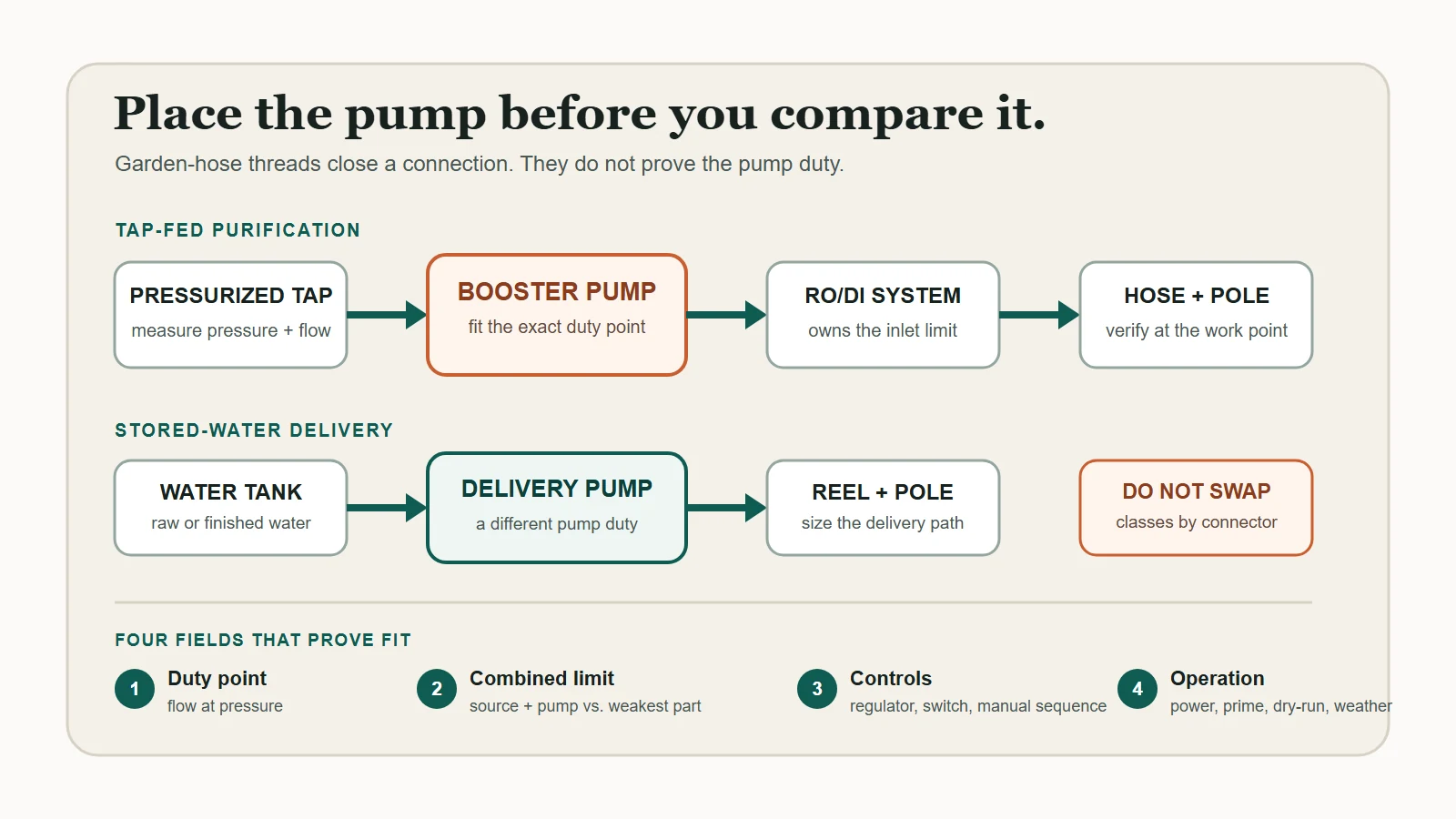
| Remote work or no reliable tap | Compare storage and delivery as part of the system | Tank volume, loaded vehicle mass, pump power/output, fill plan and water needed for the workday | The vehicle, refill route or working-day water budget is unresolved |
A DI capacity estimate answers “roughly how much source water can this documented combination treat under its stated conditions?” It does not answer “will this rig provide the required water at the glass all day?” Real service life can change with source-water chemistry, flow, channeling, storage and the exact resin or system. XERO’s DI Tank documentation therefore pairs capacity information with instructions to keep its resin hydrated, avoid freezing and test both supply and pure water at each job. Keep those instructions bound to that product and verify the current manual for any other candidate.
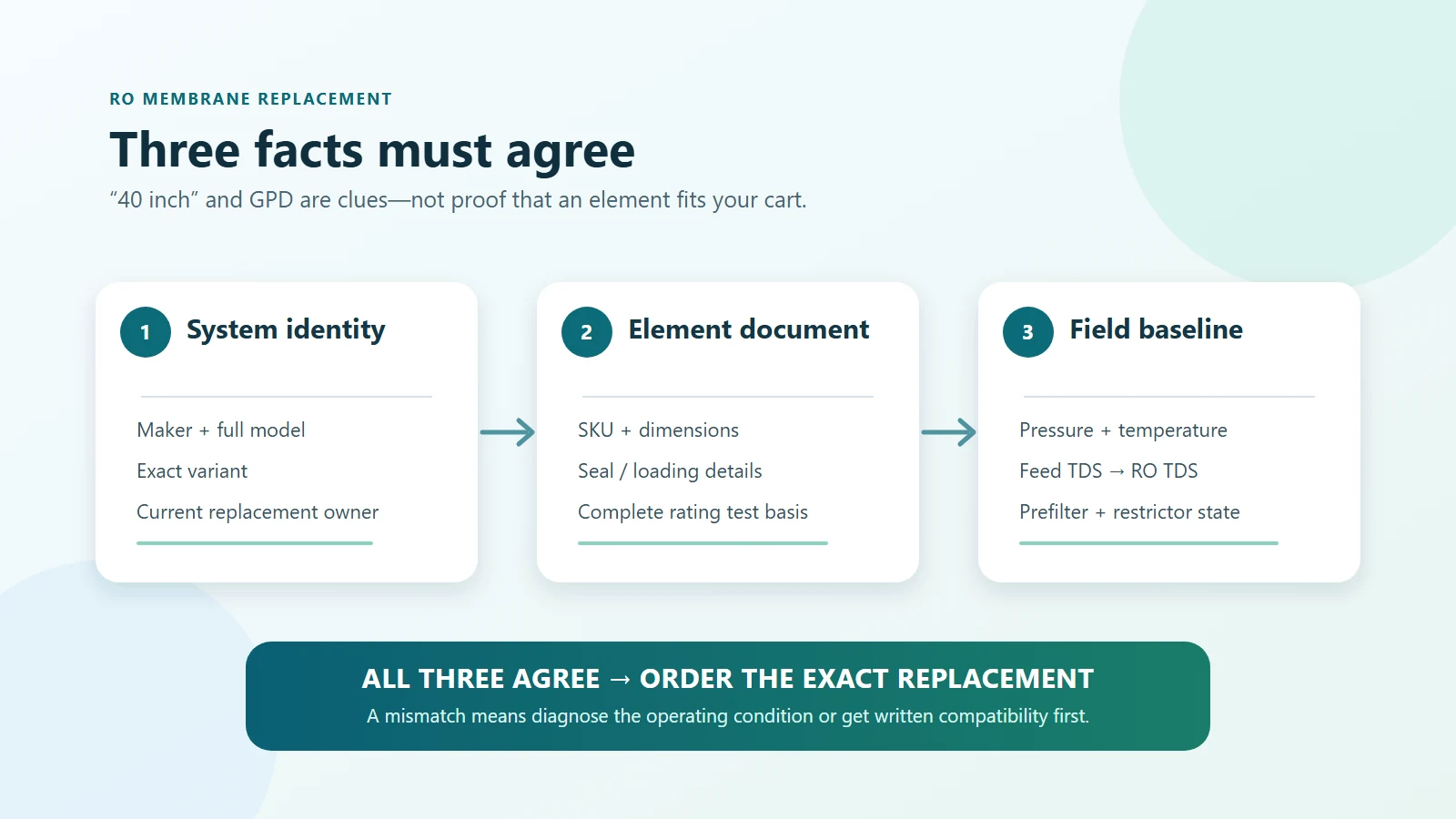
For a multi-stage candidate, copy each stage rather than writing “RO/DI” as if it were a complete specification. Record the prefilter, membrane, DI stage, input conditions, claimed or documented output, monitoring points, reject-water requirement and replacement triggers. XERO’s XERO Pure page, for example, publishes consumable guidance for that named product. It is evidence for evaluating that system, not a replacement schedule for every RO/DI unit.
Prove delivery at the brush
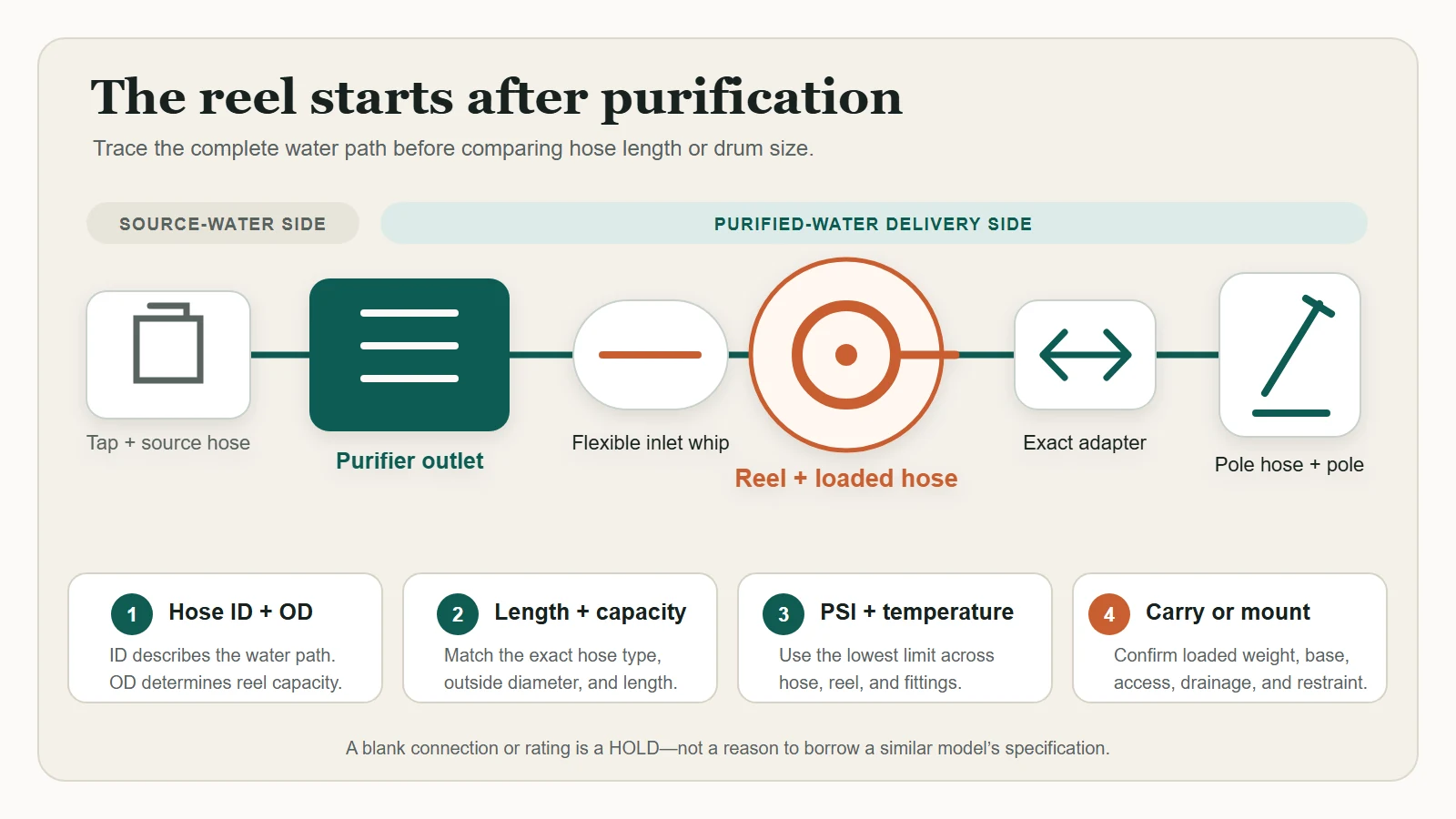
The treatment device is not the end of the water path. Hose, connectors, valves, jets, elevation and simultaneous demand sit between the outlet and the glass. The useful proof is delivered output in the configuration you intend to use.
For one candidate, draw the route from source to brush and label:
- source connection, supply hose and permitted input condition;
- every treatment stage and monitoring point;
- pump, controller, bypass or pressure-limiting component, if used;
- main hose length and inside diameter, plus each fitting or reel;
- pole hose, shutoff and brush-jet configuration;
- one- or multiple-pole operation;
- the point where output purity and flow will be checked.
Unger’s HydroPower Ultra manual provides a model-specific example of why commissioning and output checks matter: it has the operator connect the system, pressurize it gradually, adjust water flow, inspect hoses and leaks, and monitor output TDS for the named equipment. Its thresholds and procedure belong to that manual. The transferable decision rule is to obtain the matching commissioning, monitoring and stop instructions for the exact candidate instead of inventing them.
If the seller publishes only treatment capacity, ask for the missing delivery facts. If the pole or brush vendor publishes a hose and connector system, verify that it can connect to the selected treatment and delivery equipment without undocumented adapters or reduced flow. A bundle is convenient only when the interfaces are explicit.
Check at the intended work point, not only beside the machine. A short test hose on the ground does not reproduce the longest planned hose route, raised pole, chosen jets or a second pole. There is no useful universal flow number for this page to prescribe: brush design, technique, equipment and work differ. Define the required evidence with the exact manufacturers and the real job.
Choose working reach, not the biggest pole label
Pole length is a downstream constraint. It cannot repair inadequate water delivery, and its advertised size does not describe the full working situation.
Start with the highest glass, then record horizontal set-back, rooflines, landscaping and the position from which the operator can actually work. Compare that task with the manufacturer’s definition of pole length or reach. Do not silently add operator height or assume every section will be used with the same stiffness and control.
Window Cleaner Resource’s current water-fed-pole explainer identifies the usual assembly—pole, hose, clamps, angle adapter and brush—and distinguishes telescopic and modular-style construction. That is useful component anatomy. Exact section count, clamp design, material, compatible hose and fittings, brush threads, load and extension guidance still come from the candidate.
Collapsed length and handling can disqualify a pole that reaches the glass. Measure the vehicle door, rack or interior storage path; allow for the brush, hose and protective storage actually planned. Record the mass of the working assembly rather than the bare pole when the manufacturer provides the needed component data.
Reach also creates a job-site boundary. OSHA’s IWCA alliance resources include water-fed-pole safety material, and Gardiner’s safety guidance raises hose, conductive water, overhead and operator-capability hazards. Those resources do not approve a specific site. If the intended work cannot be reconciled with current safety guidance, local requirements and the operator’s capability, change the access method or obtain competent site-specific advice before buying around the problem.
Freeze one complete candidate on one sheet
Use one copy of this sheet for each exact system. A category label, dealer bundle name or memory of a sales call is not a source.
| Field | Record for the exact candidate | Evidence that closes the row | Hold when |
|---|---|---|---|
| Feed water | TDS, location/date, source access, pressure and flow | Your measurement method and source record | The intended source is unknown or variable without a plan |
| Workload | Gallons per workday, workdays per month and simultaneous poles | Route estimate, tank or refill record, or measured pilot use | Demand is a guess with no conservative basis |
| Treatment path | DI or named stages in a multi-stage system | Current product page and matching manual | “Pure water system” is the only specification |
| Capacity and output | Documented capacity/output and applicable input conditions | Named table, curve or manual for the exact configuration | A number was copied across resin, vessel or model |
| Monitoring | Feed/output test locations, normal check and stop or change rule | Matching manual and required meter specification | No rule says how measured output changes operation |
| Delivery | Pump/controller, hose sizes and lengths, reel, fittings and valves | System diagram and compatible component documents | Output is proven only at an easier configuration |
| Brush end | Pole hose, angle adapter, brush, jets and connections | Compatible part specifications | Threads, hose, jets or shutoff remain assumed |
| Working reach | Highest glass, set-back, operator position and candidate extension | Real site dimensions plus pole documentation | Advertised length is being treated as proof of access |
| Transport | Collapsed rig dimensions, loaded mass and secure storage | Vehicle and storage measurements plus component data | The assembled system cannot be carried or secured as planned |
| Maintenance | Resin, filters or membrane; flushing, drainage, storage and freeze limits | Current manual, consumable list and available storage | The required routine or spare supply has no owner |
| Safety and site | Hose route, people or vehicles, overhead or electrical and local constraints | Current safety guidance and a site-specific plan | A hazard is being solved only by buying a longer pole |
Mark the sheet Ready to shortlist only when every row is supported and the documents refer to the same configuration. Mark it Hold when one missing fact could change treatment, output, reach, compatibility or operating burden. Mark it Change path when the source, workload, site, vehicle or maintenance capacity conflicts with the documented system.
This record separates two kinds of evidence. A measured feed TDS, hose route or vehicle opening is a field fact. A permitted input condition, output specification, replacement trigger or pole configuration is a manufacturer fact. Neither can substitute for the other.
Buy in dependency order
When the sheet is complete, commit money in the same order as the physical chain:
- Freeze the source-water and workload record.
- Select the treatment class that deserves exact-model comparison.
- Verify treatment capacity, input/output conditions, monitoring and consumables.
- Prove the full delivery path for the intended hose, brush and number of poles.
- Match actual working reach, component interfaces and handling.
- Confirm transport, storage, maintenance and the job-site boundary.
If the candidate fails, replace the first failed handoff rather than compensating with a larger bundle. A different resin vessel may change the treatment burden; it does not solve a vehicle limit. A pump may change delivery; it does not prove pole compatibility. A longer pole may change reach; it does not approve the hose route or site.
The final shortlist should therefore contain fewer systems and better records: an exact model and configuration, the current documents used, the measured work inputs, every required interface and one named owner for any unresolved question. That is enough to compare brands later without letting a bundle name decide the job.