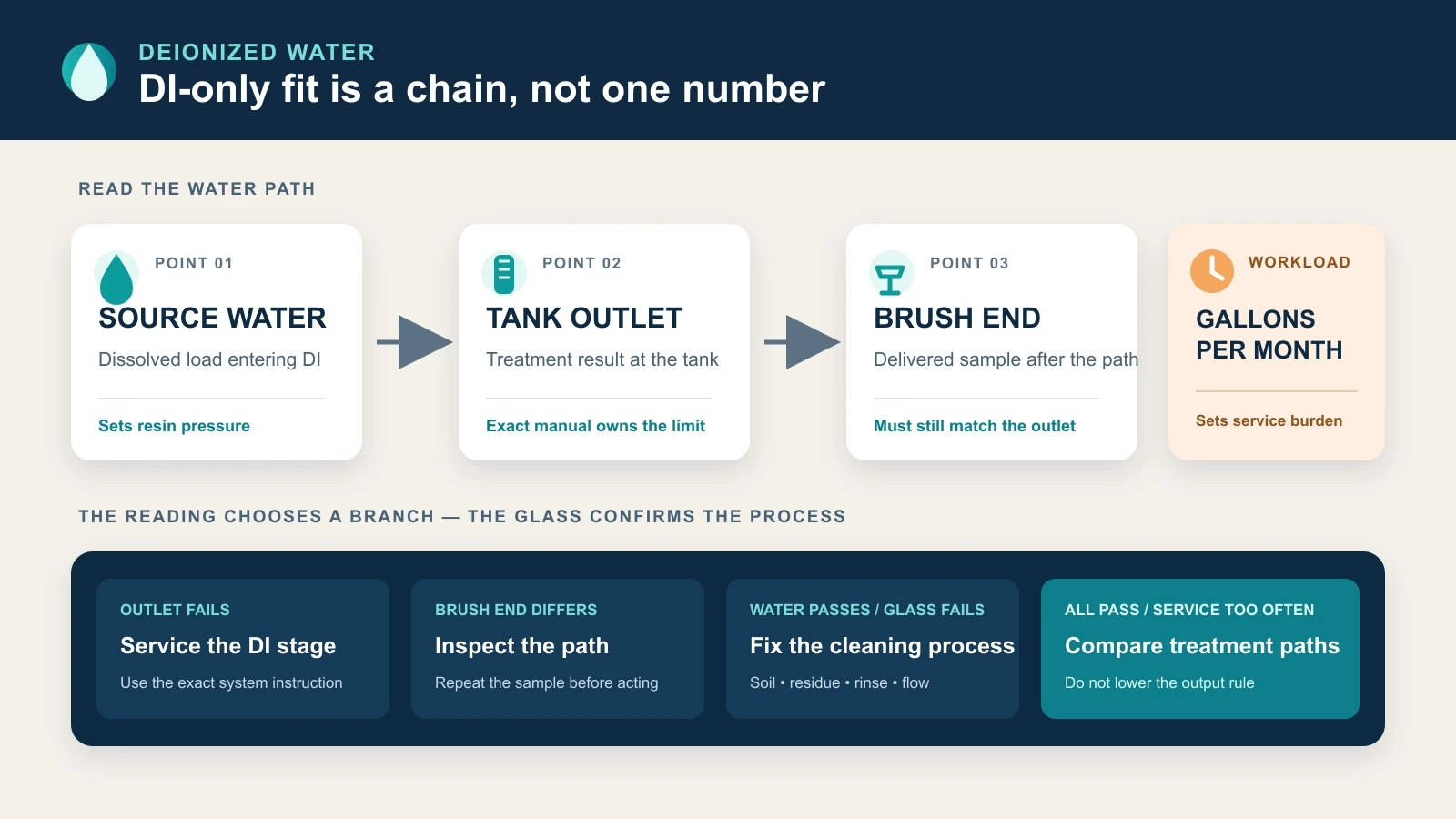
DI has a narrow job in a water-fed window-cleaning system: reduce the dissolved-ion load in the water that passes through it. It does not remove soil from glass by itself, prove that the delivery path stayed clean, or turn one low meter reading into a guarantee about the dried finish.
The short answer: DI-only is a fit only while three conditions remain true. The exact equipment stays within its documented output limit, the real number of gallons does not create an unacceptable resin-service rhythm, and water that passes the treatment check is paired with adequate cleaning and rinsing at the glass. Keep those decisions separate so the first failed condition—not a broad TDS rule—chooses the next move.
Make TDS answer only the dissolved-solids question
A field TDS reading is useful because it turns water load into a number that can be compared before and after treatment. The USGS water-science glossary notes that specific conductance can be used to approximate total dissolved solids. EPA conductivity guidance explains why that approximation has limits: conductivity responds mainly to dissolved inorganic ions, changes with temperature, and uses an empirical conversion rather than identifying every substance in the sample.
| Signal | What it answers | What it cannot certify |
|---|---|---|
| Source TDS | Dissolved load entering the DI stage at that source and time | Resin interval, delivered output or the dried finish |
| Tank-outlet TDS | Whether treatment meets the exact equipment instruction at the sample point | What arrives after the hose and pole path |
| Use-point TDS | Whether the delivered sample still matches the outlet sample | Soil removal, rinse coverage or surface condition |
| Finished glass | Whether the complete cleaning process produced the required result | Which upstream component caused a failure |
Unger’s HydroPower Ultra manual keeps those questions separate in its own troubleshooting. It lists incomplete cleaning, detergent residue, insufficient water flow and water purity as different possible causes of stains or smudges. A reading can therefore clear or fail the water-treatment branch without diagnosing the whole job.
Read the water before and after the delivery path
Use the same meter, sampling method and stable operating condition for three readings. Follow the meter and equipment instructions rather than inventing a cross-brand procedure.
- Source: sample the water supply that will feed the job.
- Tank outlet: sample where the exact system tells you to monitor treated water.
- Use point: sample after the hose and pole path you plan to operate.
Repeat an unexpected result before acting. If the tank outlet misses the named instruction twice under the required setup, the treatment branch has failed. If the outlet is inside the instruction but the repeated use-point sample is higher, the difference appeared after the treatment outlet or in the sampling process. Inspect those two possibilities before replacing resin that is still producing an acceptable outlet sample.
XERO’s current DI Tank page tells operators of that named tank to test both supply and pure water at each job, use the tank upright, keep its resin hydrated and prevent freezing. Bind those facts to the XERO tank. Another vessel or cartridge needs its own operating and service document.
Keep the date and source, all three readings, equipment and resin identity, gallons through DI since the last service, and the exact output instruction in one record. That makes a later change interpretable instead of turning it into another guess about the resin.
Put the work month beside the readings
Source TDS describes load; gallons through DI describe how often that load is applied. A low-volume route can make a portable DI tank practical even when a larger treatment system exists. The same source water on a high-volume route can turn otherwise acceptable output into frequent resin changes, interruptions and stock pressure.
Do not convert that into a universal source-TDS cutoff. XERO currently positions its DI tanks for softer-water or occasional work and uses its own TDS guidance to begin a multistage comparison at a named point. That is a vendor screening rule. The operating decision still depends on the actual vessel, resin, gallons and measured output.
For the arithmetic, use the DI tank resin service-interval guide. It binds a named capacity relationship to monthly gallons and lets the exact outlet instruction override the forecast. This page uses the resulting interval only as one fit signal; it does not repeat or generalize that formula.
Let the failure location choose the next move
| Observed pattern | What the evidence supports | Next move |
|---|---|---|
| Outlet and use point meet the exact instruction; service rhythm and finish are acceptable | DI-only remains plausible for this recorded source, setup and workload | Keep logging readings and gallons; reopen the choice when an input changes |
| Tank outlet misses the exact instruction | The treatment branch has not passed | Follow the named system’s service and troubleshooting instructions |
| Outlet passes; repeated use-point sample differs | The change appears after the outlet or in the sample method | Repeat the method, then inspect the delivery path before blaming resin |
| Both water samples pass; dried result is poor | A low water reading has not solved the cleaning process | Inspect soil removal, residue, rinse coverage, flow and the surface |
| Output passes; resin service is too frequent for the route | DI works technically but the treatment path may not fit the workload | Compare another treatment path without weakening the output rule |
A number from a named manual is not portable. XERO support currently tells users of its DI system to change resin when readings move over 10 ppm. Unger’s HydroPower Ultra manual describes 0 ppm as pure for that system and directs a resin change when its reading rises to 10 ppm. These are useful examples of an exact-system service point, not a universal permission to run every system to 10 ppm.
Keep DI-only only while three conditions survive
Keep the DI-only path when treatment output, operating burden and the cleaning process all pass independently. If the outlet fails, follow the exact system’s service path. If delivery changes the reading, resolve the downstream path. If the water readings pass but the finish does not, work on the cleaning process. If the service burden fails while output remains good, reopen the treatment choice.
The complete water-fed pole system guide puts that treatment choice beside source access, flow, hose, brush-end delivery, pole reach, transport and maintenance. Carry the readings and workload record into that decision. They identify which part of this setup still fits and which part must change.