A handleless valve at a commercial property can make a four-way water key look like an easy insurance purchase. It is small, inexpensive-looking gear, and every cross-shaped version seems to promise four chances to fit.
The current product pages tell a different story. Window Cleaning Resource lists a XERO key with a 7/16-inch triangle, a 1/2-inch circle, a 5/16-inch large square and a 1/4-inch small square. B&K publishes a four-way key for square stems in 1/4, 9/32, 5/16 and 11/32-inch sizes. Both have four arms. They are not the same pattern.
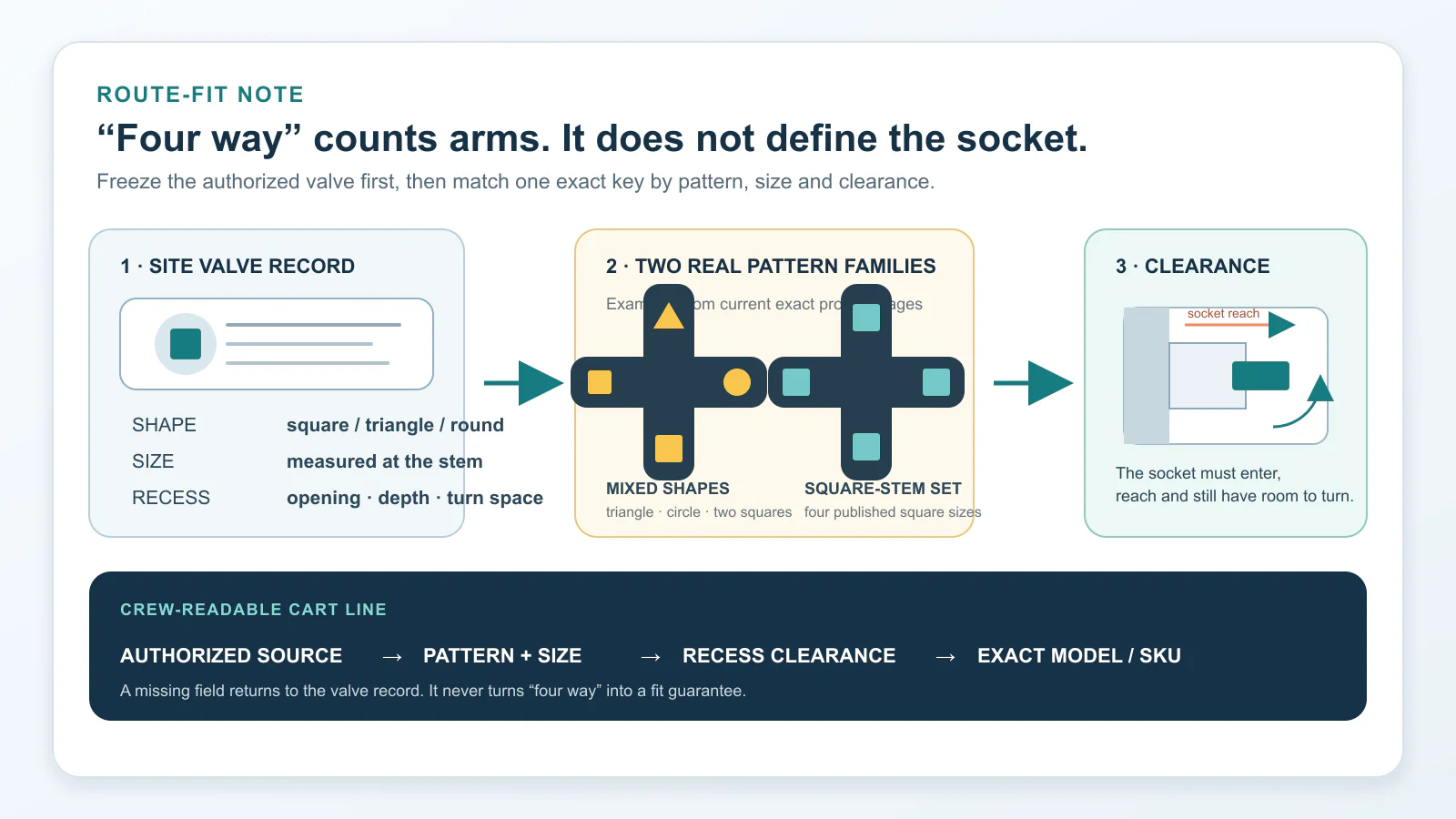
Treat “four way” as an arm count, not a fit specification. Before ordering, confirm that the property has authorized the water source, then record the exposed stem’s shape and size along with the space around it. The key must match all three: geometry, nominal size and recess clearance.
Photograph the valve, not the product aisle
Start with the water source named by the property contact, work order or site plan. A key that physically engages a valve does not grant permission to use it. If the approved source is not clear, the purchase decision is on hold before tool fit matters.
For an authorized valve, take a straight-on photo that shows the stem and enclosure, plus a side view that shows how far the stem sits behind the face of the box or sleeve. Put a ruler in the same plane as the feature being measured. Perspective can make a square look tapered and can turn a shallow recess into a misleadingly open space, so a photo is a record—not a substitute for an actual measurement.
| Site field | What to record | Why it changes the purchase |
|---|---|---|
| Authorized source | Property contact, work order or other site reference | Keeps tool fit separate from permission to draw water |
| Stem geometry | Square, triangle, round or not confidently identified | Eliminates keys whose opening shape cannot engage the stem |
| Stem size | Measured across the faces or diameter, with the method noted | Lets the nominal product size become a candidate rather than a guess |
| Recess opening | Narrowest opening the tool must enter | A cross arm or thick socket may be blocked before reaching the stem |
| Stem depth | Face of enclosure to usable stem | Tests whether the socket can reach far enough |
| Turning envelope | Obstructions around the key’s arms | A socket can engage yet still lack room to rotate |
| Valve condition | Intact, rounded, corroded, damaged or uncertain | A damaged valve belongs with the property or plumbing owner, not a more forceful tool choice |
Do not “confirm” an uncertain shape by trying several keys under load. The shopping decision only needs a clear record. Valve operation, repair and damage control stay with the site owner or qualified trade responsible for that water source.
Four arms can hide two different patterns
Current listings show why the generic name is not enough. Read every opening as part of one exact product, and keep the shape paired with its published size.
| Exact current listing | Published opening or stem pattern | Published nominal sizes | What remains open |
|---|---|---|---|
| XERO 4 Way Water Key, SKU 241-24-06 | Triangle, circle, large square, small square | 7/16, 1/2, 5/16 and 1/4 inch respectively | Socket depth, arm envelope, material, markings and turning clearance |
| J. Racenstein Four-Way Water Key, SKU 55-251 | Four connections; page text does not expressly name each opening shape | 1/4, 9/32, 5/16 and 11/32 inch stems | Exact geometry, internal depth, turning envelope and MPN |
| Danco 4-in-1 Sillcock Key, model 80442 | Four female socket arms; individual shapes are not stated in page text | 1/4, 9/32, 5/16 and 11/32 inch valves | Internal geometry, socket depth and turning envelope |
| B&K 4-way Stem Key, item 151-015 | Square stems | 1/4, 9/32, 5/16 and 11/32 inch sillcock sizes | Socket depth, arm envelope and individual size markings |
| Steelman 4-Way Sillcock Key, model 61383 | Four-way deep-well socket design; individual shapes are not stated in page text | 1/4, 9/32, 5/16 and 11/32 inch sillcock sizes | Internal shape and the actual usable socket depth |
That table is not a ranking. It is a warning against borrowing facts across listings. The B&K page gives direct support for square stems; it does not prove that J. Racenstein, Danco or Steelman uses the same internal geometry. Steelman’s laser-etched markings can help identify an arm in the field, but markings do not make the socket fit. Likewise, the XERO mixed pattern may cover a shape absent from a square-stem set while omitting 9/32 and 11/32-inch square sizes.
Save the exact brand, model or item number and SKU with the pattern. A cart line that says only “four-way key” discards the evidence that made the choice defensible.
The recess can veto the right nominal size
Nominal size answers only one question: can the socket opening plausibly engage the stem? A recessed valve adds at least three more dimensions.
First, the socket body must pass through the enclosure opening. Second, its usable depth must reach the stem before the surrounding arm hits the wall, box or bonnet. Third, the cross needs enough clear space to turn. Overall product length and width do not reveal the internal depth of an individual socket.
This matters because the current pages often use helpful but incomplete phrases. J. Racenstein says its tool fits inside a stopcock bonnet sleeve, but publishes no exact socket depth or turning envelope. Steelman calls model 61383 a deep-well design and publishes overall dimensions of 5.50 by 4.20 by 0.70 inches, yet the page still does not state usable socket depth. “Deep well” therefore earns a measurement request, not an automatic fit result.
| Site observation | Product evidence needed | Result if evidence is missing |
|---|---|---|
| Stem is flush and clear on all sides | Correct shape and nominal size | Keep as an exact fit candidate; site authority and valve condition still apply |
| Stem sits behind a narrow face opening | Socket outside profile and reach | Measure before ordering |
| Stem is deep inside a bonnet or box | Usable socket depth plus arm clearance | Obtain a drawing or exact dimensions; broad fit wording is insufficient |
| Nearby wall, pipe or cover blocks a cross arm | Turning envelope for the exact tool | Choose another authorized access tool or hold |
| Stem is rounded, broken or heavily corroded | Property or plumbing disposition | Do not solve damage by choosing more leverage |
The featured diagram turns those measurements into a simple cross-section: opening width gets the socket into the recess, usable depth reaches the stem, and the clear radius lets the key move. All three must belong to the same site and the same exact product.
Permission and water delivery are separate checks
Even a physically matched key closes only the valve-tool question. It does not establish that the crew may use the source, that the valve is serviceable, or that the available water will support the job.
Keep the handoff in this order:
- The property identifies the approved source and any access conditions.
- The site record closes stem geometry, nominal size and recess clearance for one exact key.
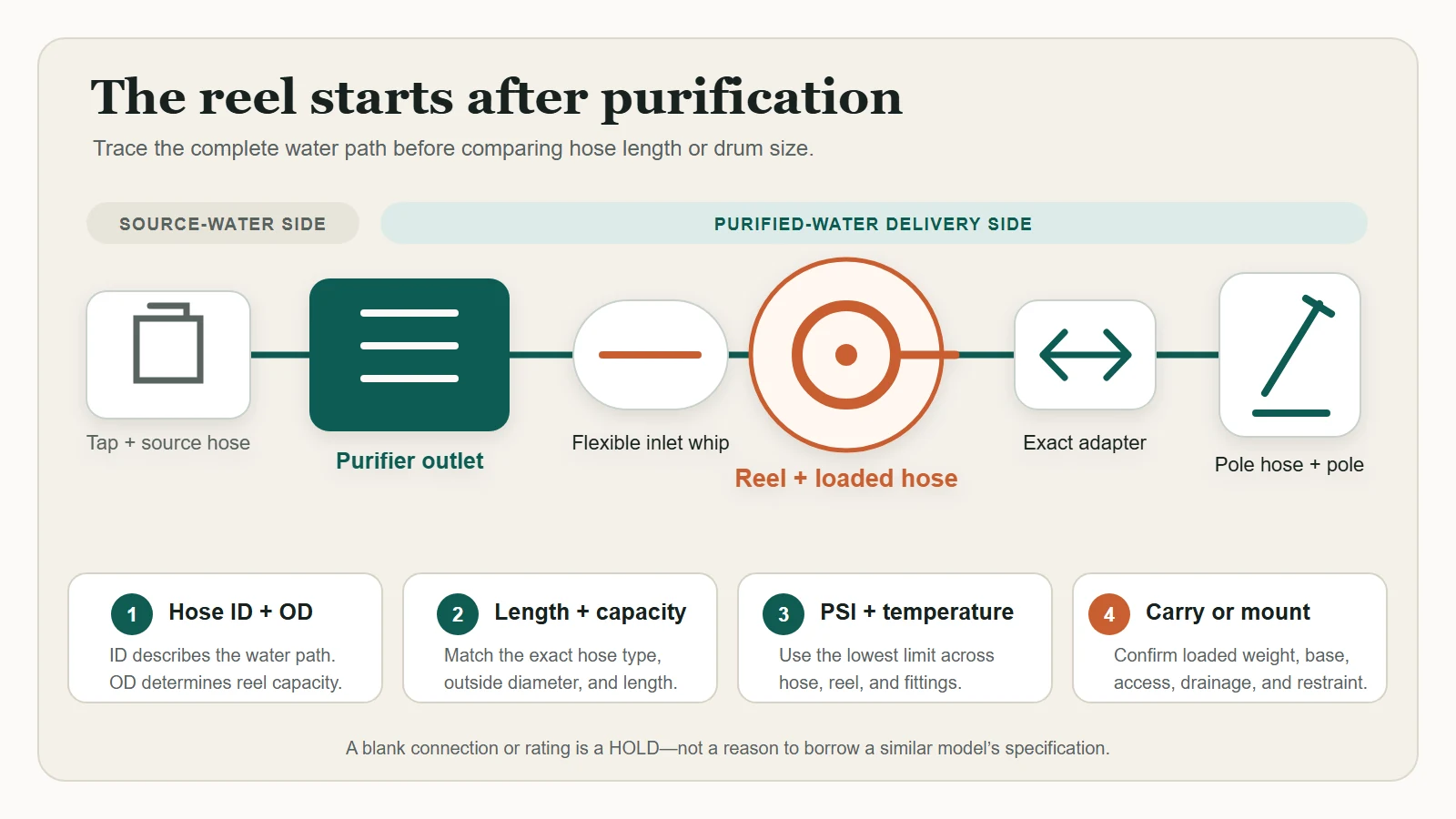
- The outlet, hose thread, seals and quick-connect family are traced through the site’s guide to garden hose quick-connect fittings.
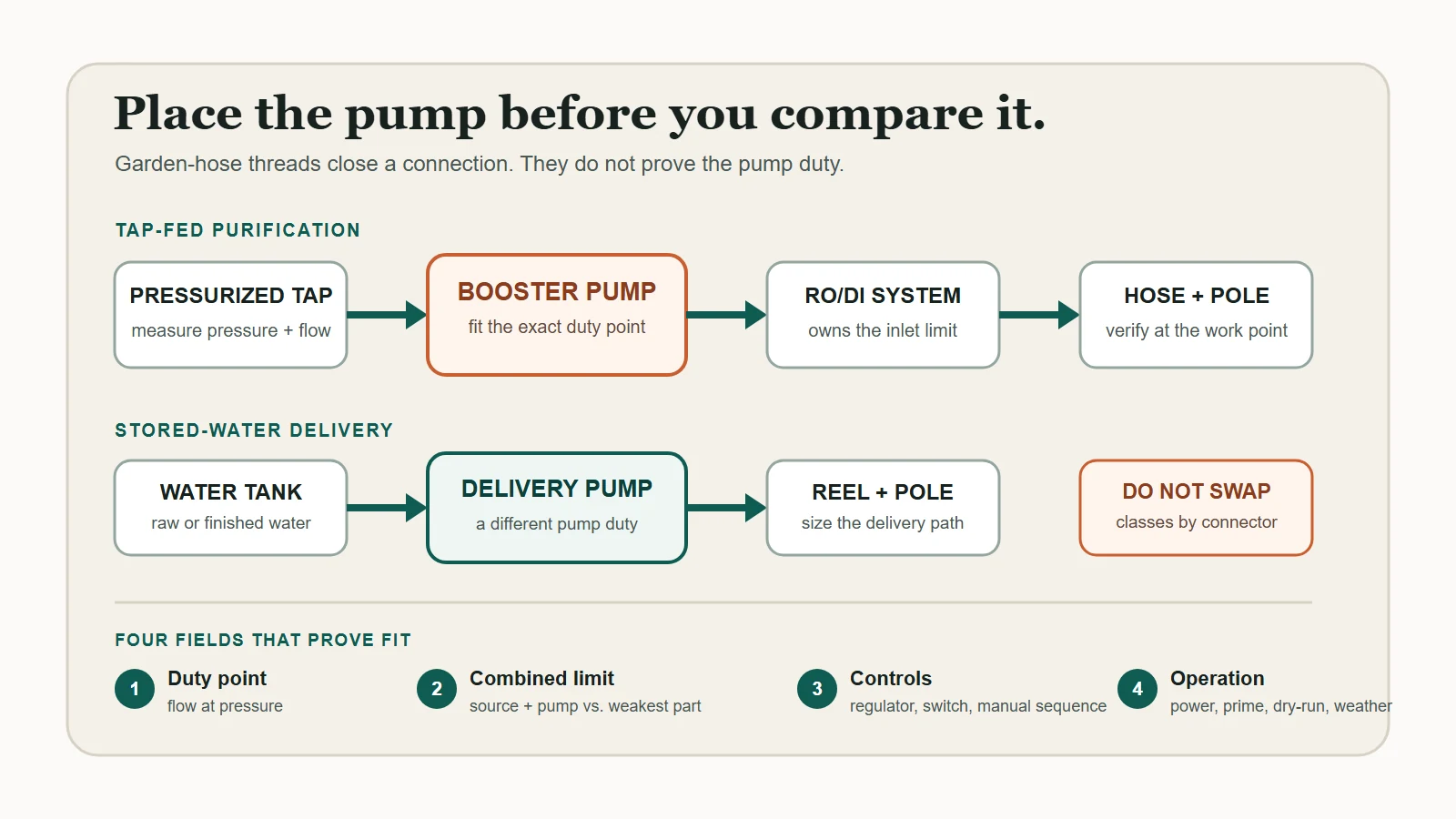
- Source-water quality, pressure, flow, filtration, hose and pole demand return to the water-fed pole system guide.
A mismatch at step three does not mean the key was wrong; it means the downstream connection remains unresolved. Low flow or unsuitable source water is not corrected by a different valve key. Keeping the layers separate makes the route easier to troubleshoot and prevents a small hand tool from carrying claims that belong to the whole system.
Turn the site photo into one cart line
Write the proposed purchase so another crew member can understand it without seeing the original valve:
Authorized north service-wall sillcock / square stem measured across flats / nominal size recorded / recess opening and stem depth recorded / clear turning radius recorded / exact brand and model / matching square socket and published size / usable socket depth confirmed or still missing.
That is a format, not a filled example. Each measurement must come from the real authorized source, and each product field must come from the exact current listing.
| Outcome | When it is honest | What happens next |
|---|---|---|
| Match exact pattern and clearance | Authority, stem geometry and size, recess and exact product dimensions agree | Add the identified key to the route record, then close the hose and system path |
| Measure valve and recess | Authority exists, but a site or product dimension is missing | Collect that one measurement or drawing before ordering |
| Obtain another authorized key | The approved valve is known, but the candidate pattern or clearance conflicts | Ask the property or supplier for the correct identified tool; do not improvise |
| Hold the water-access plan | The source is not authorized, the valve is damaged, or identity remains uncertain | Use another approved source or resolve the site issue before relying on the route |
The finished cart line should make sense to the crew member who never stood at the wall box. If that person still has to guess what “four way” means, the useful work is back at the valve record—not in another product tab.