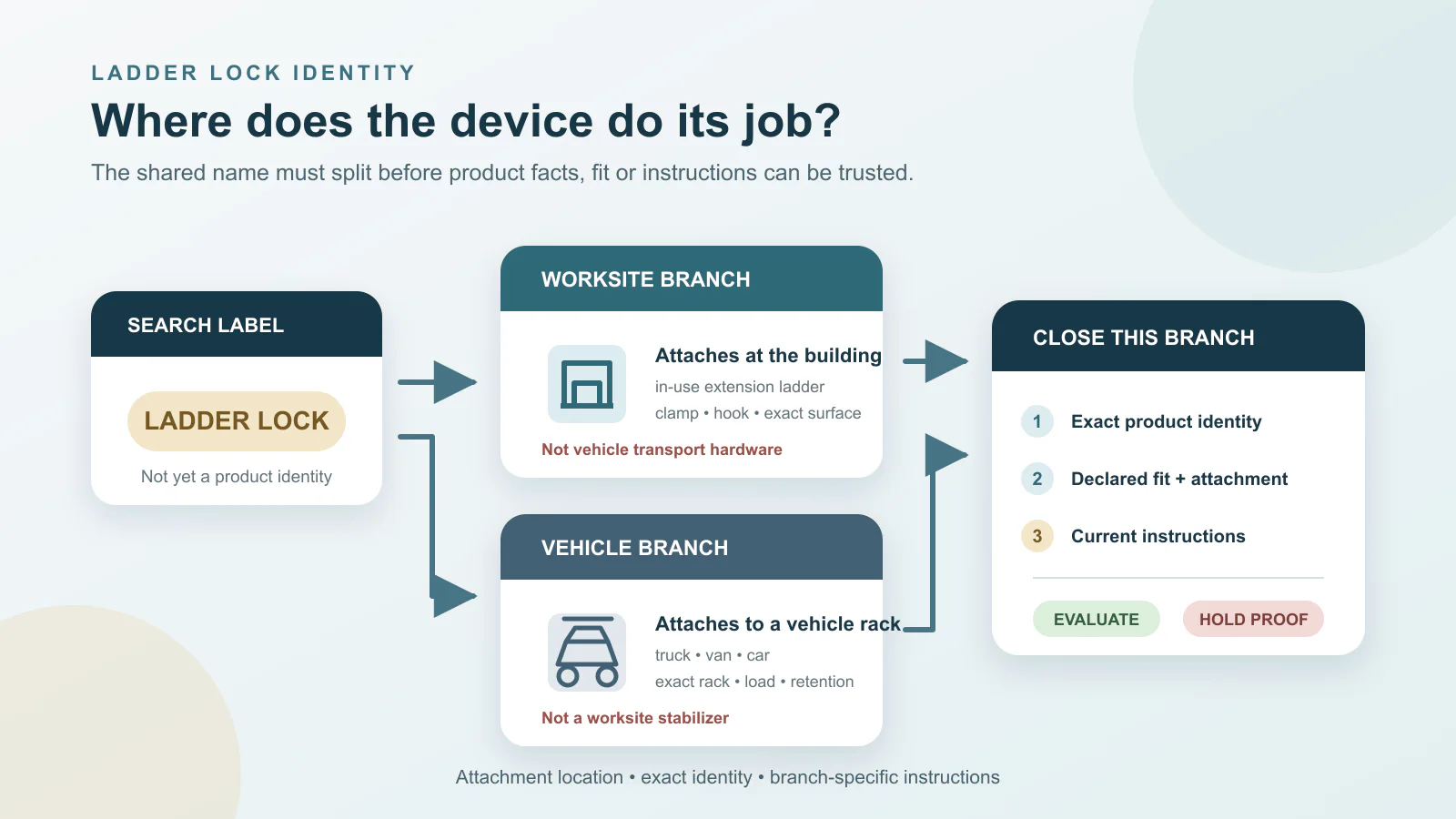
Search for a ladder lock and you can land on two purchases that never do the same job. Window-cleaning suppliers use the name for a clamp-and-hook device intended to reduce side-to-side movement of an extension ladder at a building. Vehicle-equipment brands use it for hardware that retains a ladder on a truck, van or car rack.
One is considered while the ladder is in use. The other is considered before the vehicle moves. Neither product class inherits the other’s fit, instructions or safety claims.
Start with one plain question: where will this device be attached while doing its job? If the answer is still “to the ladder,” the product is not identified well enough to buy.
Sort by where the device attaches
| What the current page says | Product class | Evidence needed next |
|---|---|---|
| A clamp or hook connects an in-use extension ladder to a gutter, drip edge, overhang, flashing, plywood or tubing | Worksite lateral restraint | Exact product identity, ladder fit, permitted attachment, current instructions, restrictions and site approval |
| A rack or locking arm holds a ladder on a truck, van or car | Vehicle ladder rack | Exact rack variant, vehicle/rack fit, ladder and load scope, mounting, retention and inspection instructions |
| A cable or padlock only deters theft | Theft deterrent only | A separately documented load-restraint system; theft wording cannot supply it |
The label is especially risky because “lock” sounds like a complete result. It is not. It may describe a product name, a moving part or a theft feature. The current owner has to say which problem the exact device is designed to solve.
The same name does not make the listings equivalent
The two specialist worksite listings look related, but their current identity fields do not close the relationship.
| Current owner | Exact identity visible now | Declared job | Still not exposed on the opened page |
|---|---|---|---|
| Window Cleaning Resource | Ladder Lock; SKU 238-60-01; manufacturer part number L1344 | Reduce side-to-side movement of an extension ladder at named building surfaces | Exact manufacturer manual, rated capacity, ladder fit matrix, full restrictions and inspection criteria |
| J. Racenstein | Seller label ProTool; SKU 73-109; UPC 00669893039056; MPN blank | Secure an extension ladder against side-to-side movement at named building surfaces | Exact manufacturer relationship, manual, rated capacity, ladder fit matrix, full restrictions and inspection criteria |
| LadderLock | Current vehicle-rack family with truck, van and car paths | Retain and lock ladders on a vehicle rack | Selected model, exact vehicle/rack fit, ladder/load scope, mounting and inspection instructions |
The shared name and similar seller descriptions are not authority to copy an instruction, identifier or restriction from one listing to the other. Record the URL and every available identifier before asking whether the product fits. If a seller cannot connect the cart item to the current instructions, hold the purchase.
A worksite lock closes only one movement problem
Window Cleaning Resource says its L1344 listing is for extension ladders and names plywood, metal overhangs, drip edge, wall cap flashings, gutters and tubing as possible attachment surfaces. Its short seller Q&A says the yellow clamp grips a gutter while a hook loops over one ladder rail and is tightened. J. Racenstein publishes a similar scope for its 73-109 listing.
Those are seller descriptions, not a complete site decision. They do not establish that a particular gutter or flashing is strong enough, that the exact ladder rail fits, that the base is controlled, or that the job permits this attachment. They also do not prove the two listings are the same manufactured device.
The broader window-cleaning ladder decision must already have an exact ladder type and label, total load, support, traffic, electrical exposure and a responsible site owner. A ladder standoff is another separate accessory; its arms, span and contact zone cannot be substituted for a clamp-and-hook restraint simply because both products sit near the top of a ladder.
Current OSHA 1910.23 requires ladders in its general-industry scope to be used on stable and level surfaces unless secured or stabilized against accidental displacement. It also addresses slippery surfaces and ladders exposed to traffic. OSHA 1926.1053 contains separate construction-scope requirements. Which rule applies and how the site complies are employer and site questions—not properties conferred by a product name.
OSHA has also explained, in an interpretation about a different ladder-retainer product, that it does not approve or endorse specific devices. The device discussed there is not either product on this page; the useful boundary is that actual conditions, strength and use still matter. A seller’s “safety” wording cannot be converted into “OSHA approved.”
Until the exact worksite item has a current manual or equivalent manufacturer authority covering fit, permitted attachment, restrictions and inspection, keep the cart on hold. This page stops before installation because a text summary is not the missing instruction.
Vehicle hardware needs a different proof set
The current LadderLock manufacturer page routes shoppers to truck, van and car racks. It says some products are stand-alone racks while others attach to an existing rack, and describes a swinging arm that keeps a ladder secured in place. That is enough to identify the vehicle-rack branch. It is not enough to select a model for an unnamed vehicle and load.
Freeze the vehicle, existing rack if any, exact rack model, ladder count and dimensions, declared load limits, mounting method, retention instructions and inspection points. If the page only promises theft deterrence, find the separately documented load-restraint path. If it only names a family, hold until the exact rack variant is identified.
A vehicle rack cannot stabilize a ladder at a facade. A worksite clamp cannot secure cargo on the road. The physical object may include a lock in both cases; the controlling evidence is still different.
Let the missing field route the purchase
| What is actually closed | Result | What happens next |
|---|---|---|
| Worksite class, exact identity, exact ladder fit, permitted attachment and current instruction set | Evaluate the documented worksite device | Employer/site owner evaluates it inside the existing ladder plan |
| Worksite listing but manual, fit, restriction or identity evidence is missing | Hold for documentation | Ask the seller or manufacturer for the exact current document; do not borrow another listing’s facts |
| Vehicle-rack class, exact variant, vehicle/rack fit, ladder/load scope and current instructions | Evaluate the documented vehicle rack | Evaluate that rack for that vehicle and load under its exact instructions |
| Vehicle family only, or a theft lock without documented retention scope | Hold the exact rack variant | Select and document the real rack/load system before checkout |
| The site needs another way to control ladder movement, but this exact product cannot close | Use another competent stabilization path | Return the condition to the qualified employer/site owner instead of improvising hardware |
Add the device to the broader professional window-cleaning tool plan only after its class, exact identity and branch-specific instructions are named. If the cart line still says only “ladder lock,” the cart is not ready.