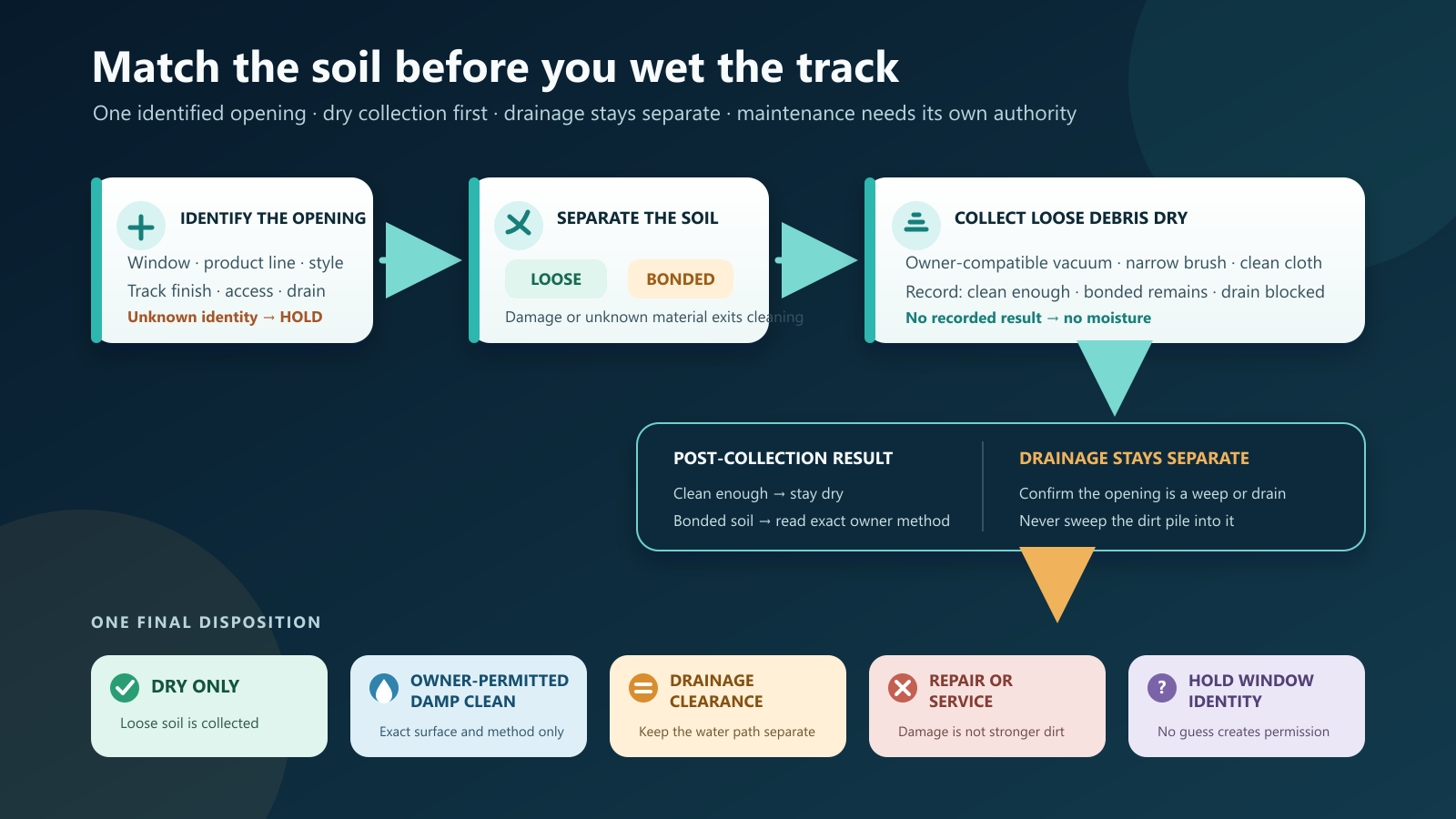
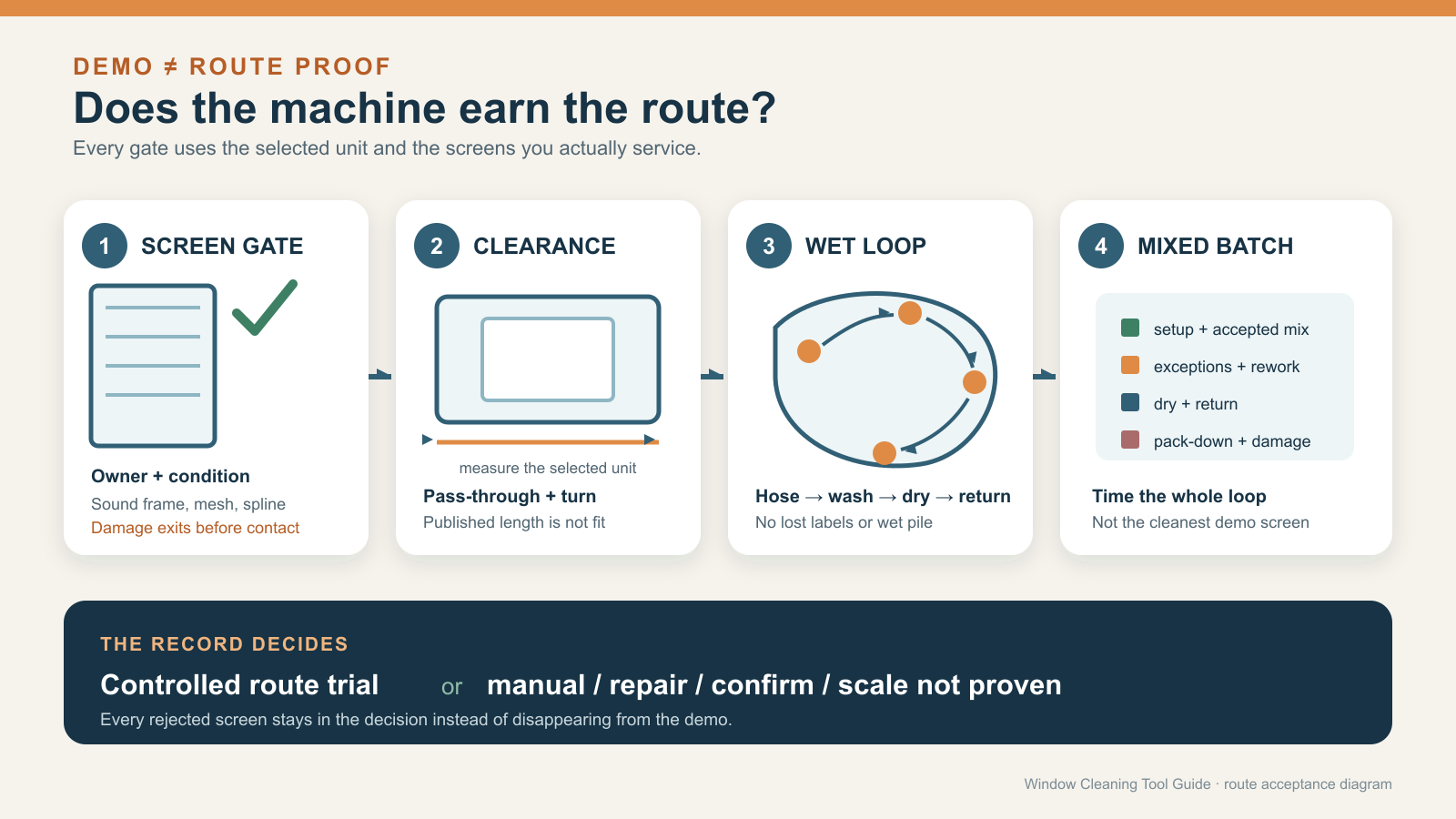
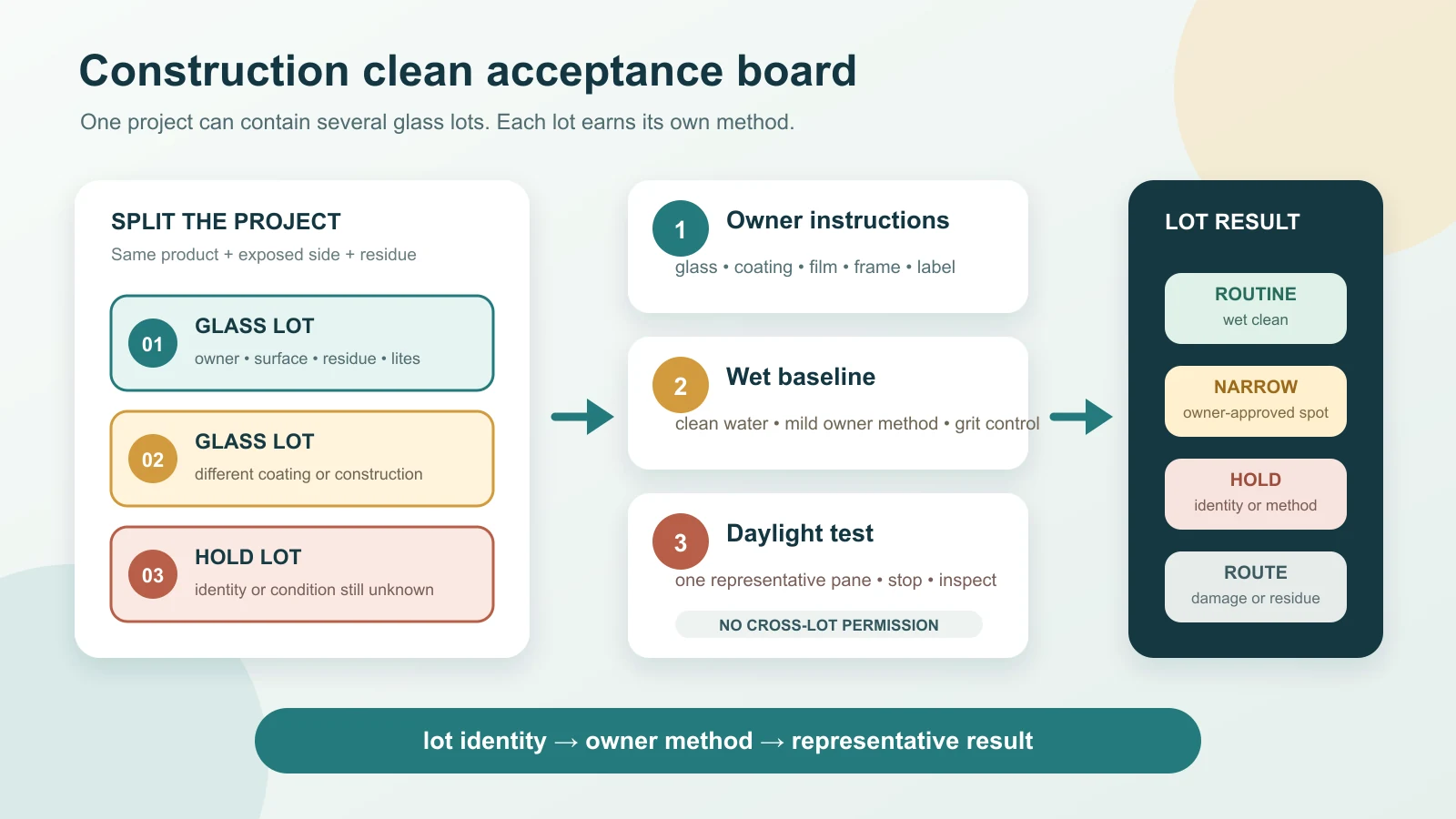
A 24-foot window does not tell you which ladder to buy. It does not say whether the job permits a ladder, where a non-self-supporting ladder can bear, what total load belongs on the label, or whether aluminum is excluded by electrical exposure.
Start by trying to keep the work on stable ground. If a ground-based high-window method can complete the full task, a ladder does not enter this purchase. If it cannot, hand the access method to the person responsible for the site and the work. A failed ground path is not ladder authorization.
Only then compare a ladder designed for the required work position. Record the exact manufacturer, model and label; the person-plus-equipment load; the working configuration; the bearing points; traffic; and electrical exposure. Reach comes after those fields, not before them.
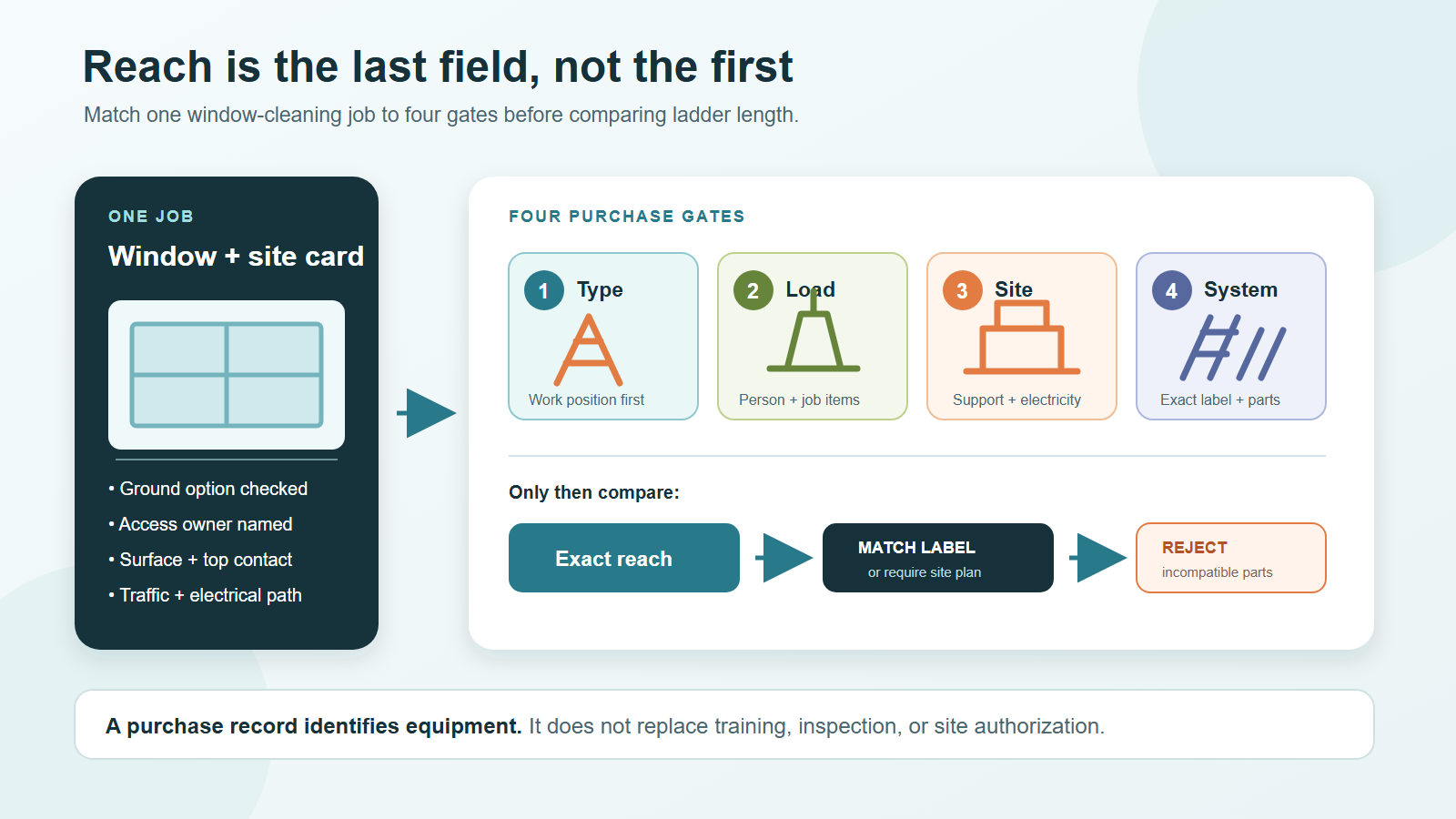
A height number leaves four purchase questions open
Use one job, not a future mix of buildings, as the unit of comparison. “Second-story residential windows” is still too broad if one opening is over a level driveway and another is behind a sloped bed or below an overhead line.
| Gate | Record for this job | If it is missing |
|---|---|---|
| Access owner | Who determines the applicable rules, job authorization and site plan | Stop shopping; the method is not authorized |
| Work position | Self-supporting, non-self-supporting, exact sectional system, or ground method | Do not compare lengths across families |
| Total load and label | Person plus carried or placed tools, equipment and materials against one exact label | A user-weight or duty-word comparison is incomplete |
| Site conditions | Surface, top contact, traffic, electrical exposure and exact system compatibility | Return the job for a site access plan |
This separates equipment buying from the broader professional window-cleaning tool setup. A complete squeegee, washer and detailing stack does not own the access decision, and a ladder cannot repair a missing site owner.
Choose the ladder family from the work position
Current OSHA 1910.23 says ladders must be used only for the purposes for which they were designed. That makes type the first product field. A stepladder, extension ladder and special-purpose sectional system are not three prices for the same reach.
| Provisional path | Evidence needed before a candidate survives | Do not infer |
|---|---|---|
| Ground method | The full wash, rinse or wet-and-dry sequence remains controllable from stable ground | That a longer pole solves every obstacle or electrical path |
| Self-supporting ladder | Exact manufacturer purpose and a work position that uses the ladder as designed | That the top step is a working position or that folded/leaning use is permitted |
| Non-self-supporting ladder | Exact label, working configuration, stable surface and authorized top support/contact | That the glass, frame, corner or facade is a bearing point |
| Sectional window-cleaning system | Exact family, base, centers, top, assembled limit and permitted accessories | That similar-looking sections or tops interchange |
A traditional tool pole remains a separate path. Use the window-cleaning extension pole guide when a washer or squeegee can complete suitable work from the ground. Do not join poles, substitute a ladder for an uncontrolled pole path, or treat either method as proof that the site permits the work.
Turn the label into a loaded job
The same OSHA ladder rule defines maximum intended load around the employee plus the tools, equipment and materials carried or placed on the ladder. A buyer who compares only body weight has left the job out of the rating decision.
Write the load as a job inventory before evaluating the exact manufacturer’s rating. Include the operator in working clothing and every item the job puts on the ladder: tools, containers, equipment, materials and any manufacturer-permitted carrying system. If a field is unknown, leave it unknown. Do not make a capacity pass from a guessed “light tool bag.”
| Record field | What belongs in it | What cannot replace it |
|---|---|---|
| Exact identity | Manufacturer, family, model, label photo and selected configuration | A retailer category or a similar product image |
| Total intended load | Person plus the tools, equipment and materials assigned to this job | Body weight alone |
| Declared rating/capacity | The exact current manufacturer label for that model | A family-level claim copied from another size |
| Working configuration | Manufacturer-permitted section or extension state and documented working length | Nominal length plus operator reach |
| Job margin | A pass determined by the employer’s applicable rule and exact label | Rounding unknown items down to fit |
The current NIOSH Ladder Safety App page describes task/user-based selection of a minimum duty rating. The same page now says the app is not receiving updates. Treat it as supporting context, not the sole authority for a current purchase: the exact label, applicable rules and site owner still control.
Sectional parts are a system, not spare length
A sectional ladder search can make bases, centers and tops look like interchangeable pieces. They are not a pile of spare length. OSHA 1910.23 also prohibits tying or fastening sections together to gain length unless they were specifically designed for that use.
The current Metallic Ladder window-cleaning family shows how specific the record becomes. The manufacturer lists a six-foot base; four- or six-foot center sections; and named six-, seven- and eight-foot top options, including an exact V-groove option. It states that this family stacks to a maximum 21 feet of vertical height and describes the sizes for a 70-degree angle. Those figures belong only to that current family. They are not a formula for another brand, an unnamed used section or a mixed stack.
| System field | Exact Metallic example | Purchase boundary |
|---|---|---|
| Base | 6 ft with rubber pads or swivel shoes | Match the exact base and site support; do not borrow a shoe claim |
| Center | 4 ft or 6 ft center section | Verify family/generation compatibility before adding a section |
| Top | 6 ft open or V-groove, 7 ft open, or 8 ft open | Top shape does not authorize the proposed window or corner contact |
| Assembled limit | Up to 21 ft vertical height for the named family | Not a universal reach value or permission to exceed the exact system |
| Accessory | Named V-groove top and ANSI-rated leveling-leg options | Require exact compatibility and installation authority |
If a proposed stack needs an unnamed “universal” part, a section from another line, field-drilled hardware or temporary fastening, reject the system rather than asking reach to justify it. The same rule applies to shoes, levelers, tops, stabilizers and other accessories: similar geometry is not compatibility evidence.
A valid purchase still needs a site owner
Support and electrical conditions can reject a technically correct model. OSHA 1910.23 requires stable and level surfaces unless the ladder is secured or stabilized, addresses ladders exposed to traffic, and requires both top rails of a non-self-supporting ladder to be supported unless it has a single-support attachment. The product page cannot decide whether a sill, mullion, corner, frame or facade is an approved bearing point.
Electrical exposure is also a material choice, not a note added after checkout. OSHA 1910.333 requires nonconductive siderails where an employee or ladder could contact exposed energized parts. This article cannot determine voltage, de-energize equipment or set the site’s electrical controls. If that authority is missing, an aluminum candidate does not close.
| Result | Use it when | What happens next |
|---|---|---|
| GROUND METHOD FIRST | A permitted pole/tool path can complete the task from stable ground | Specify that exact ground system; do not add a ladder to the job |
| MATCH EXACT LADDER AND LABEL | Access is authorized and type, exact label/load, working configuration, support, electrical and system fields all close | Retain the model/label record with the employer’s site and operating controls |
| SITE ACCESS PLAN REQUIRED | Support, traffic, electrical conditions, applicable rules, operator or work position remain unresolved | Return the job to the responsible employer/site authority before purchase |
| REJECT INCOMPATIBLE SYSTEM | Sections/accessories do not have exact current compatibility or the proposed ladder is not designed for the use | Remove that candidate; do not improvise missing length or fit |
Inspection and training remain operating responsibilities. OSHA 1910.30 places covered training before use and calls for retraining when conditions, equipment or demonstrated knowledge change; OSHA 1910.23 addresses inspection and withdrawing defective ladders. A purchase record can preserve the right equipment identity. It cannot qualify the operator or authorize tomorrow’s site.