“High window” describes a location, not a cleaning system. An interior pane above an atrium floor, an exterior second-story window above open ground and a recessed window behind a porch roof can appear in the same product search. They do not need the same pole, cleaning head or water route.
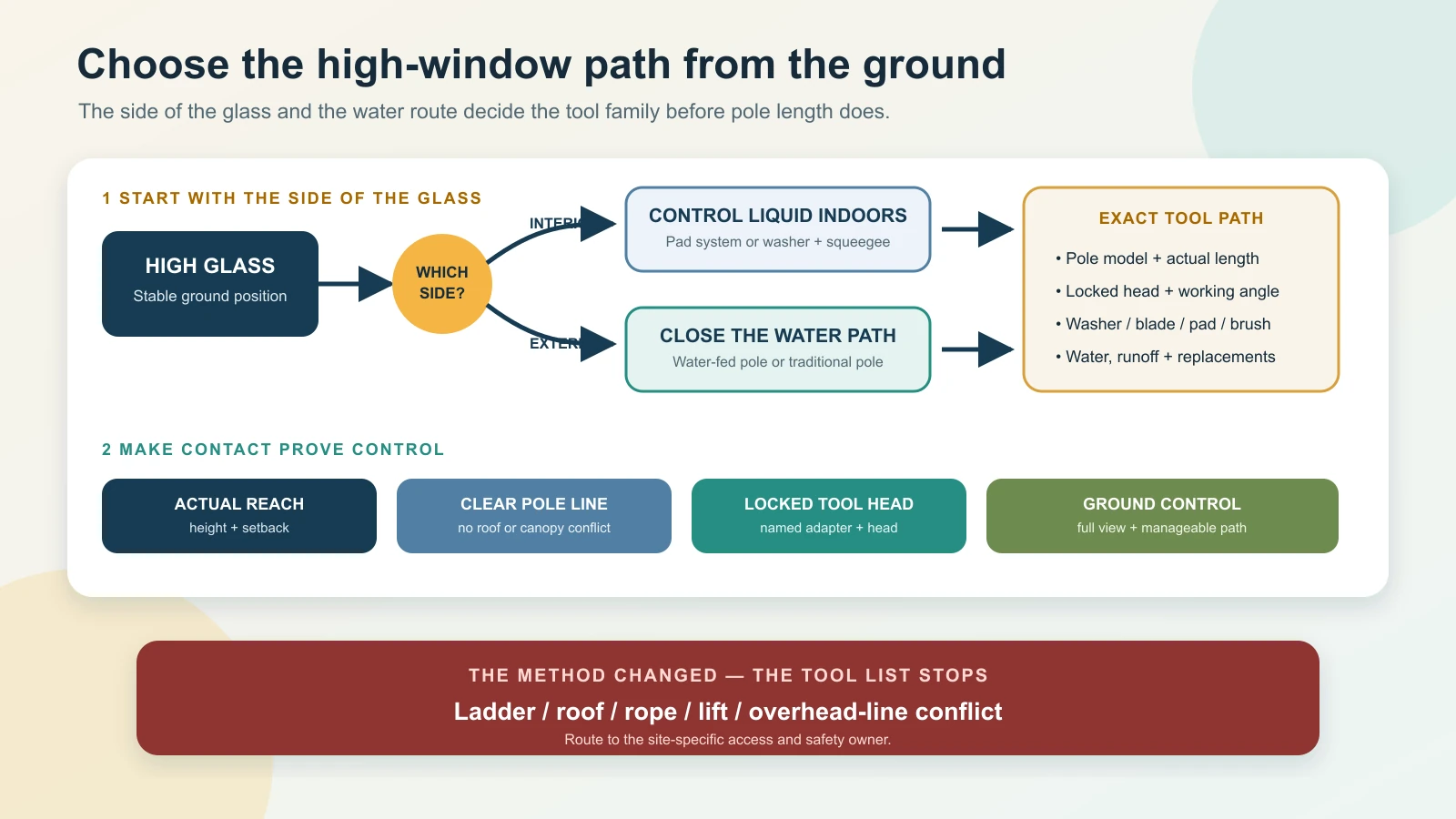
This guide covers tools used while the operator remains on stable ground. Start with the side of the glass and where the liquid will go. Then prove actual reach, a clear pole line, an exact head connection and control of the full task. If the method changes to a ladder, roof, rope, scaffold or lift, the tool list ends and a site-specific access plan begins.
A high window is three different tool problems
Do not choose the longest product first. Choose the provisional path:
| Glass and site condition | Ground-based path | Complete path must include | Do not proceed when |
|---|---|---|---|
| Interior glass where spray and runoff must be limited | Low-moisture pad system | Exact pole, locked pad holder, compatible pad, controlled liquid delivery and floor protection | The surface method is unknown or the head cannot be seen and controlled |
| Interior or exterior glass where wetting and water removal can be managed | Traditional washer-and-squeegee pole | Exact pole, washer, squeegee, angle/head adapter, bucket/liquid plan and replacement rubber/sleeve | The attachment is improvised or the final edge cannot be reached from the same ground position |
| Exterior glass with a suitable pure-water supply and runoff route | Water-fed pole system | Purification, hose, pole, angle adapter, brush, jets and a verified standing/working line | Water delivery, electrical clearance, surface permission or pole control is unresolved |
| Any glass that requires the operator to leave stable ground or enter a controlled fall-access method | Separate access plan | Competent site lead, appropriate access system and applicable rules | A longer pole is being used to avoid naming the real access requirement |
The table does not declare one method “best.” It prevents a short indoor system, a traditional pole and a water-fed system from being ranked as though they solve the same job.
Indoors, choose where the liquid goes
High interior glass makes water management part of the tool specification. Floors, walls, furniture, electronics and people may sit below the pane. A hose-fed brush designed to rinse an exterior facade does not become an indoor system because it can physically reach.
For light soil and routine fingerprints, a purpose-built pad system can keep the liquid close to the head. Unger’s current Indoor Glass Cleaning PDF lists Stingray configurations at 3, 5 and 10 feet, including named short and long extensions, pads and cleaner. It describes an enclosed nozzle intended to keep cleaning liquid on the glass. Those facts identify a system; they do not approve it for an unknown coating or establish that ten feet reaches a particular pane.
A traditional washer and squeegee can make sense when the full wet-and-dry sequence remains controllable. Ettore’s All Purpose kit #17050 lists a 12-inch squeegee, 10-inch microfiber washer and 5-foot REA-C-H pole with a Click-Lock tip. That is a bounded short-reach kit, not a template for every high interior. The buyer still needs to know how the head locks, whether the squeegee can finish the upper and lower edges from the same standing area, and where the used liquid will go.
Treat swapping heads as part of the route. If the pole must come down between the washer and squeegee, reserve space for the complete lowering path and prevent the wet head from crossing occupied or sensitive areas. If a pad, washer or chemical is not approved for the glass, film or coating, pause until the manufacturer or installer supplies a method.
Outside, a water-fed pole needs the rest of the system
A water-fed brush is not a standalone high-window tool. The path begins at the water source and treatment, continues through hose and pole, and ends at the exact brush and outlets. XERO’s current water-fed pole overview describes extendable poles carrying purified water through hose to a brush. It also distinguishes actual pole length from sellers’ “reach” conventions. Keep that distinction attached to the named product; do not transfer one brand’s label rule to another.
Before choosing a pole, record:
- the highest brush contact point and the horizontal setback from the real standing area;
- the manufacturer’s actual extended length for the selected sections;
- the pole, angle adapter, brush and hose connection for one generation;
- the purification and delivery path at the job;
- the runoff route and surface-specific cleaning permission; and
- the inspection and replacement path for pole sections, clamps, hose and brush parts.
Use the height-and-setback pole-length check for the first two fields. It treats straight-line span as a geometric floor, not a product recommendation. A pole can be long enough on paper and still fail here because a canopy moves the standing point, the working angle is not controllable or the required configuration is not documented.
XERO’s water-fed safety and selection page tells buyers to consider work duration, window height, site condition and purified-water delivery, and warns against choosing more pole than the job needs. It also calls for inspection of carbon sections and clamps before use. Those are useful acceptance questions for the named tool family. They do not create a universal safe height.
Make contact prove control
Nominal reach answers only whether a tool might touch the pane. Ground-based eligibility also requires a clear raising/lowering line, a head that stays positively attached, a view of the contact area and enough control to complete—not merely begin—the cleaning sequence.
Write five values beside each candidate:
- Actual pole configuration: the installed sections and physical extended length, not an unexplained “overall reach.”
- Standing envelope: the specific stable area from which the whole pane can be worked, including required setback.
- Tool-head identity: exact cone, thread, Click-Lock, angle adapter or other named interface.
- Completion movement: how the washer, blade, pad or brush reaches the top, sides and bottom while the operator remains in that envelope.
- Return path: how the pole is lowered, heads are changed and wet parts are moved without crossing an uncontrolled area.
Manufacturer detail can expose a hidden variant problem. Ettore’s current product #42004 page identifies an aluminum pole with a tapered clamp and Click-Lock tip and says that tip is non-replaceable. Ettore’s broader REA-C-H range page says professional tips and sections are replaceable and explicitly says extension poles cannot be combined to make one long pole. The right response is not to pick the more attractive statement. Record the exact model and its own replacement path.
If the proposed setup needs a second pole taped on, an unnamed universal adapter, a head held only by friction or an operator-height allowance added to an undefined reach label, it has not passed the control test.
An obstacle changes the path, not just the angle
Porch roofs, awnings, deep sills, planted beds, fences and recessed panes move the lower end of the pole away from the wall. A swivel, angle adapter or gooseneck may change the brush or blade angle, but it cannot erase the longer span or create a clear line through a solid obstruction.
First redraw the standing position around the obstacle. Then ask whether the pole manufacturer documents the selected head and adapter for that range and generation. Unger’s high-access compatibility PDF, for example, lists HFNLC, NLCLA and NLTHR as distinct adapters across classic and nLITE tool paths. Similar shape is not evidence that the pieces interchange.
An angled skylight or roof window does not automatically belong in the ground branch. It stays here only when the pane can be fully seen, the approved head meets it at a documented angle, the whole movement remains clear and the operator never changes footing or access method. Otherwise the result is not “buy a more flexible head.” It is “this ground path did not close.”
When the access method changes, this guide ends
Two conditions stop product selection immediately.
The first is an unresolved overhead electrical path. For covered U.S. workplaces, OSHA 1910.333 requires protective measures near overhead lines and treats objects without an appropriate insulating rating as conductive for the rule. For unqualified persons, it specifies a 10-foot approach distance at 50 kV or below and a larger distance above that voltage. This page does not determine line voltage, de-energize equipment or replace a workplace electrical plan. If the pole’s full raising, working or lowering envelope could enter the controlled area—or the voltage and clearance are unknown—do not set the pole.
The second is a fall-access change. Ladder work, a roof position, leaning through an opening, rope descent, scaffolding and lifts are not attachments for a ground pole. OSHA’s personal fall-protection rule shows that window-cleaner positioning and fall systems have their own anchorage, equipment and use requirements in covered workplaces. This guide gives no setup instruction for those systems. Route the job to a trained professional responsible for the site-specific access method and applicable rules.
Ground-path stop: if reaching the glass requires improvised elevation, entry into traffic, loss of a stable standing area, an unresolved overhead-line envelope or a fall-protection system, stop choosing pole accessories. The job has become an access decision.
Leave with one path result
| What the evidence shows | Result | What to specify next |
|---|---|---|
| High interior glass; liquid can be controlled; exact pad head and extensions reach with full view | Interior pad path | Exact kit, extension count, pad, cleaner, surface permission and replacement pads |
| Washer and squeegee can complete the pane from one stable ground envelope | Traditional pole path | Exact pole, adapter, washer, blade, working angle, liquid route and replacement rubber/sleeve |
| Exterior glass; pure-water delivery, runoff, exact reach and complete pole/brush path all close | Water-fed path | Carry the measured geometry into the exact pole-system comparison |
| The product name is known but the tip, adapter, actual length or service parts are not | Pause on tool identity | Resolve the exact model and connection; do not fill the gap with a family claim |
| The pole envelope conflicts with overhead lines or the electrical condition is unknown | Stop for electrical control | Use the site’s qualified electrical and access lead before equipment selection resumes |
| The operator must leave stable ground or use a ladder, roof, rope, scaffold or lift | Stop for an access plan | Route the work to a trained professional responsible for the site-specific access method |
The path that survives belongs inside the broader professional window-cleaning tool setup. Add it to the accepted job only with its consumables, replacements and access boundary. A longer pole is useful when it completes that path; it is not a substitute for naming where the path ends.