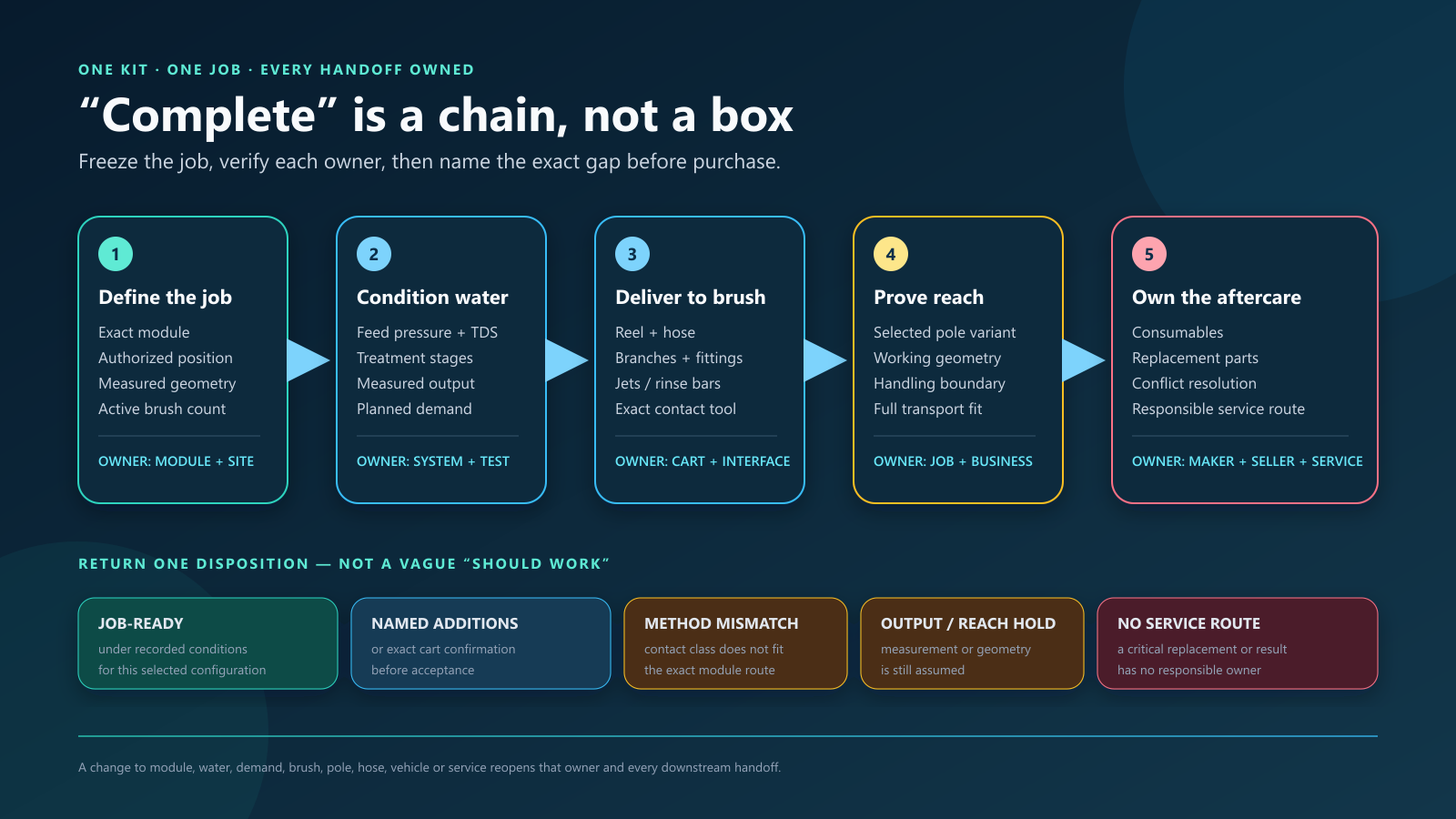
A brush can match the dirt and still be wrong for the pole. “Nylon,” “hybrid” or “boar hair” says nothing about whether the socket locks to your angle adapter, whether the adapter belongs to your pole generation, or whether the hose can feed the selected jets.
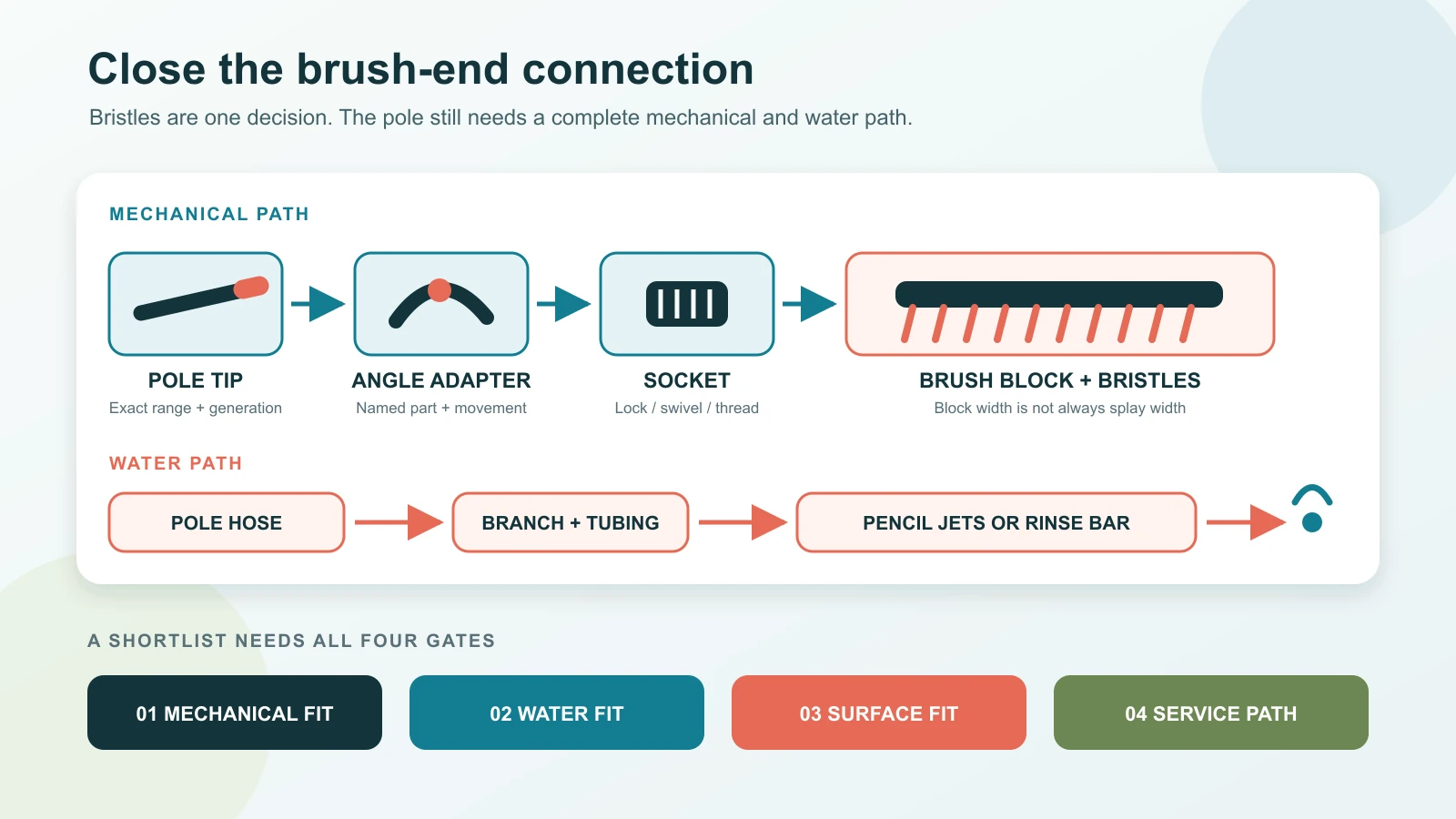
Trace two paths before choosing bristles. The mechanical path is pole tip → angle adapter → socket → brush block. The water path is pole hose → branch connector and jet tubing → pencil jets or rinse bar. A candidate reaches the shortlist only when those paths, the approved surface method and the replacement-parts path all close for the same exact variant.
That order prevents an easy shopping mistake: solving the visible contact surface while leaving the hidden connection to chance.
Write the brush-end path in order
Start with the pole already owned or shortlisted. Record its exact range, generation and tip interface rather than its brand alone. Then copy the angle adapter’s part name, the brush socket offered on the selected variant and every part between the pole hose and the outlets. “Compatible,” “European thread” or “complete” is not a substitute for that sequence.
Current brush pages show why the chain matters. The XERO Nylon Brush presents Fast Lock, Fast Lock Swivel and Euro Thread as separate socket choices. It also offers pencil-jet and rinse-bar configurations. Those are different interface and feed decisions on one product page—not evidence that any combination fits an unnamed pole.
Build one row per candidate:
| Connection field | Evidence to record | Hold the candidate when |
|---|---|---|
| Pole identity | Exact range, generation and tip interface | The listing names only the brand or maximum reach |
| Angle adapter | Exact part, generation and movement range | A visually similar adapter is being assumed |
| Brush socket | Fixed, swivel, lock type or exact thread | The selected dropdown or SKU is not shown |
| Brush geometry | Block width plus listed or bristle-splay width | One width is presented without its measurement basis |
| Water branch | Pole-hose size, branch fitting, tubing and outlet type | The brush has jets but the connection to the hose is unknown |
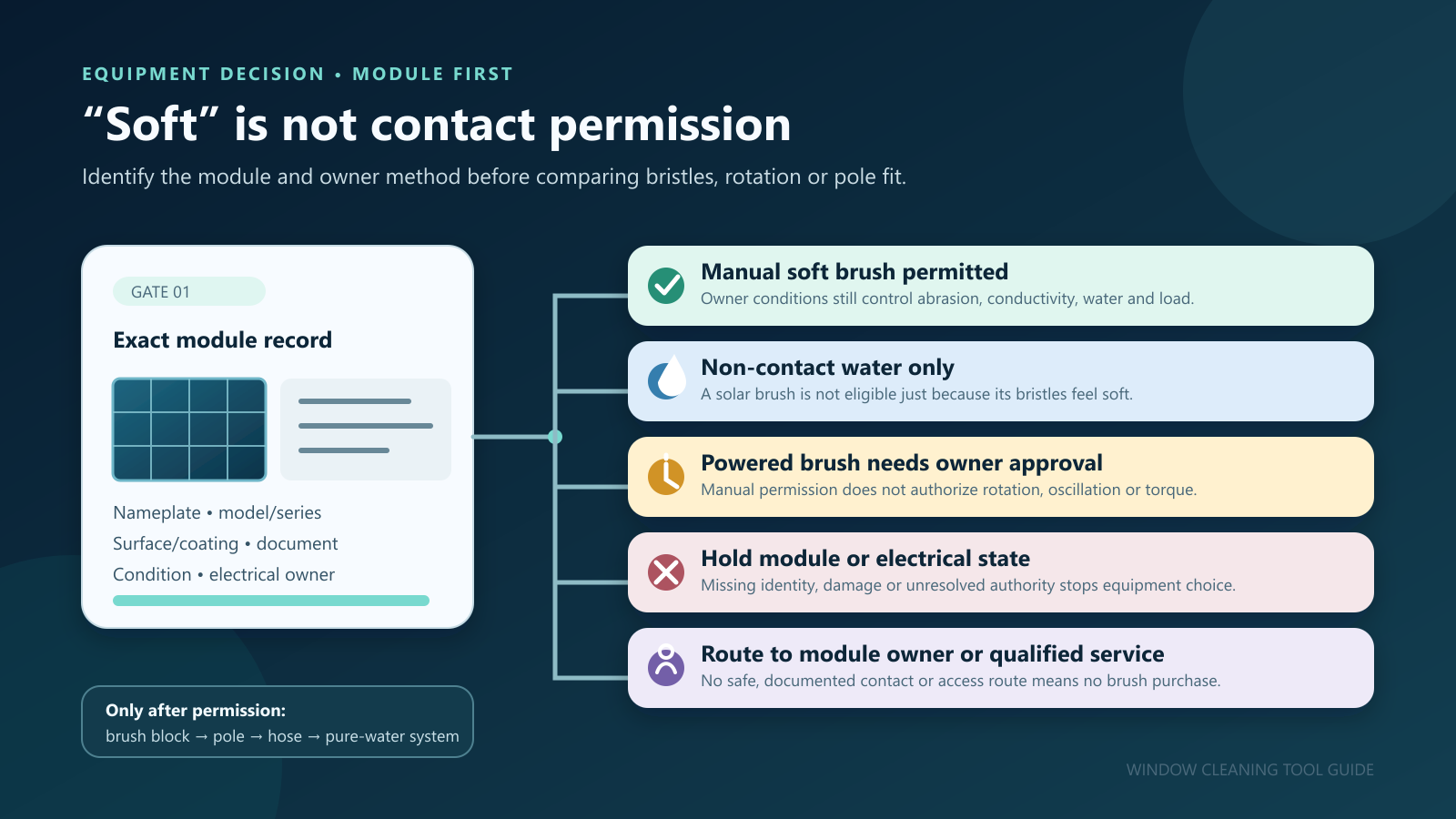
| Surface method | Permission for the exact surface or coating | “Soft” is being treated as universal approval |
| Service path | Replacement block, jets, adapter and fittings | A wear part cannot be identified for that generation |
Two outcomes are deliberately separate. An unknown adapter or socket is HOLD_MECHANICAL_PATH. A brush that attaches but has unresolved tubing or feed hardware is HOLD_WATER_PATH. One kind of fit cannot compensate for the other.
Let bristles answer only the soil question
Bristle construction changes the contact package, but manufacturer categories are not a shared performance test. The XERO Hybrid Brush, for example, is described as inner boar-hair bristles surrounded by nylon. Its nylon and hybrid pages both let a buyer combine bristle construction with width, outlet and socket choices. That makes the construction a selectable field; it does not make it a universal winner.
Use three evidence levels:
- Published construction: copy the exact material and trim description for the exact brush. The Ionic Double-Trim Residential Brush is identified as part P0583, a 12-inch double-trim monofilament-nylon brush with two embedded jets. That is a useful, bounded specification.
- Surface authority: check the surface, coating, film or panel owner’s current cleaning-method limits. A seller’s general brush description cannot approve every controlled surface.
- Same-system trial: after documentary fit and method permission pass, compare remaining brushes on the same accepted job with the same pole length and water supply. Record what that trial establishes for that setup, not a site-wide “best bristle” claim.
If construction is published but the surface method is not, mark HOLD_SURFACE_OWNER. Do not convert “soft,” “natural” or “scrubbing” language into an unwritten scratch-safety promise.
Treat brush width as a wet-end load choice
The number attached to a brush may not describe the rigid block. XERO states on its nylon, hybrid and boar-hair pages that the listed 12- or 18-inch measurement is based on bristle splay rather than the block itself. Keep that note with the number. A 12-inch block on another page is not automatically the same geometry as a 12-inch splay measurement.
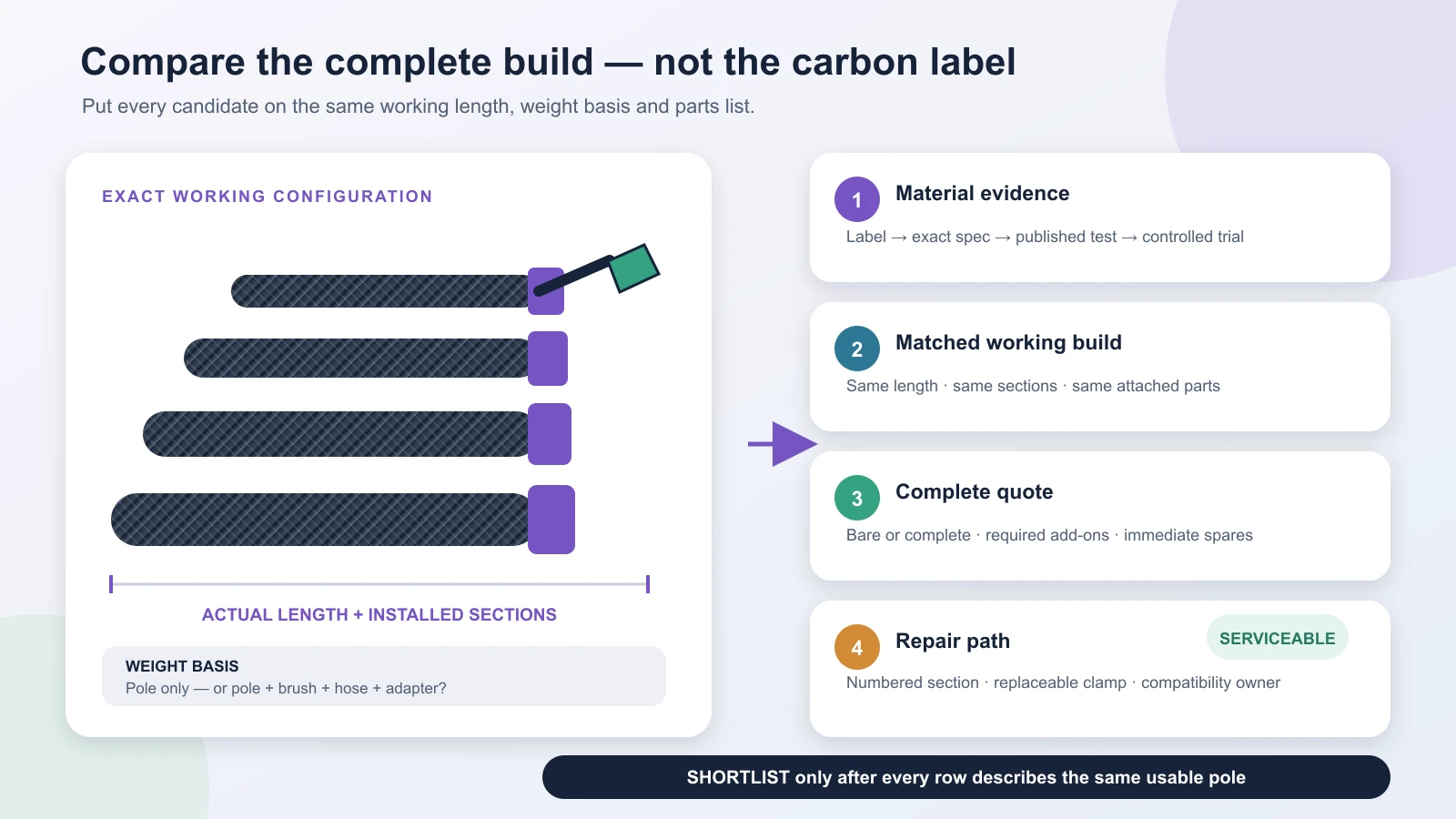
Record both values when they are published, along with the exact brush or complete brush-end mass. A wider envelope may contact more glass per pass, but it also changes edge clearance and places a different assembly at the end of the pole. Without a shared mass basis and a controlled working comparison, “wider is faster” is an unsupported conclusion.
The practical decision is job-shaped. Narrow panes, frames and divided areas can make unused width a control problem; open repeat glass may make a larger envelope worth testing. Neither condition overrides the pole’s connection limit or the operator’s ability to place the brush at the required working reach. If the selected width changes the socket, outlet count or included hardware, treat it as a new variant and rebuild the row.
Choose jets only after the feed path is known
Outlet count describes distribution hardware, not the complete delivery result. XERO’s nylon page specifies two built-in pencil jets for its 12-inch option and four for its 18-inch option, with a rinse bar also selectable. Its Boar’s Hair Brush lists four built-in pencil jets and warns that fittings may vary. Those details are reasons to inspect the branch, not permission to assume it is complete.
For the selected SKU, write down:
- pencil jets, another named jet, or rinse bar;
- outlet count and position;
- jet-tubing size;
- T- or Y-branch identity;
- pole-hose size and terminating fitting; and
- every included and separately required part.
Then connect that branch to the actual source, filtration, hose run and operating method. The complete water-delivery path owns that broader calculation. This brush guide does not invent a universal flow threshold or claim that more outlets create adequate brush-end output.
Once the full path is known, a same-setup observation can answer a narrower question: does water distribute across the chosen brush at the normal working position without the operator changing the accepted method? If not, diagnose the feed path, outlets and source as one system. Swapping bristles cannot repair a starved branch.
Prove the socket, swivel and adapter as one interface
Cross-brand fit requires an exact mechanical statement. Ionic says its P0583 brush works with its adjustable angle cranks and Grafter heads, and with other brands when they use a German/European thread fitting. The condition after “when” is the useful evidence. “Fits other brands” without the fitting condition would not close the interface.
Named adapters are equally important inside one manufacturer’s range. Unger’s nLITE compatibility sheet lists the NFK28 Power Brush Complete, NGS30 angle adapter and NLCLA Classic Acme Thread Adapter as distinct identifiers. Its Generation 2 spare-parts sheet separates a Gen 2 pole-adapter element from a brush-adapter element. The presence of an adapter family does not establish interchange with an unnamed pole generation.
Freeze the interface as a sentence: “Exact pole and generation connects to exact angle adapter, which connects to exact socket on exact brush variant.” Attach a manufacturer diagram, compatibility row or written confirmation that proves every handoff. If the sentence contains “probably,” “looks like” or an unnamed universal adapter, the candidate stays on mechanical hold.
Swivel is also a selected interface, not a free adjective. Confirm whether movement belongs to the socket, angle adapter or both; whether the lock still uses the required part; and whether a replacement is sold for that exact arrangement. A movement feature that cannot be installed or serviced has no comparison value.
Freeze one brush specification that can be installed
The finished record should fit on one line without dropping qualifiers:
Installable brush record: exact pole/generation + pole-tip interface + angle adapter + brush/socket variant + block and splay widths + bristle construction + jet or rinse-bar option + branch tubing/fittings + published assembly-mass basis + approved surface method + replacement-parts path.
Issue one disposition before price enters the decision:
| Evidence pattern | Disposition | Next move |
|---|---|---|
| Mechanical chain, water chain, surface method and service path all close for the same variant | SHORTLIST | Compare only matched complete variants; run the same-system observation if handling or distribution still separates them |
| Socket, adapter or generation is inferred from appearance, brand or an incomplete compatibility phrase | HOLD_MECHANICAL_PATH | Obtain an exact part-level fit statement |
| Brush attaches, but tubing, branch fittings or delivered feed remains unresolved | HOLD_WATER_PATH | Complete the hose-to-outlet record and resolve system output |
| Surface permission is missing, or a controlled method conflicts with the proposed brush | HOLD_SURFACE_OWNER | Obtain the surface owner’s method or choose an approved method |
| Required adapter, jets, brush block or wear fittings have no identifiable replacement path | REJECT_SERVICE_PATH | Select a serviceable variant or document a viable replacement owner |
Only SHORTLIST rows belong in the broader water-fed pole selection guide. That guide decides how brush connection, working reach, pole construction, transport and service agree as one pole. Here, the narrower job is complete when the brush can be named, attached, fed and maintained without a guess.