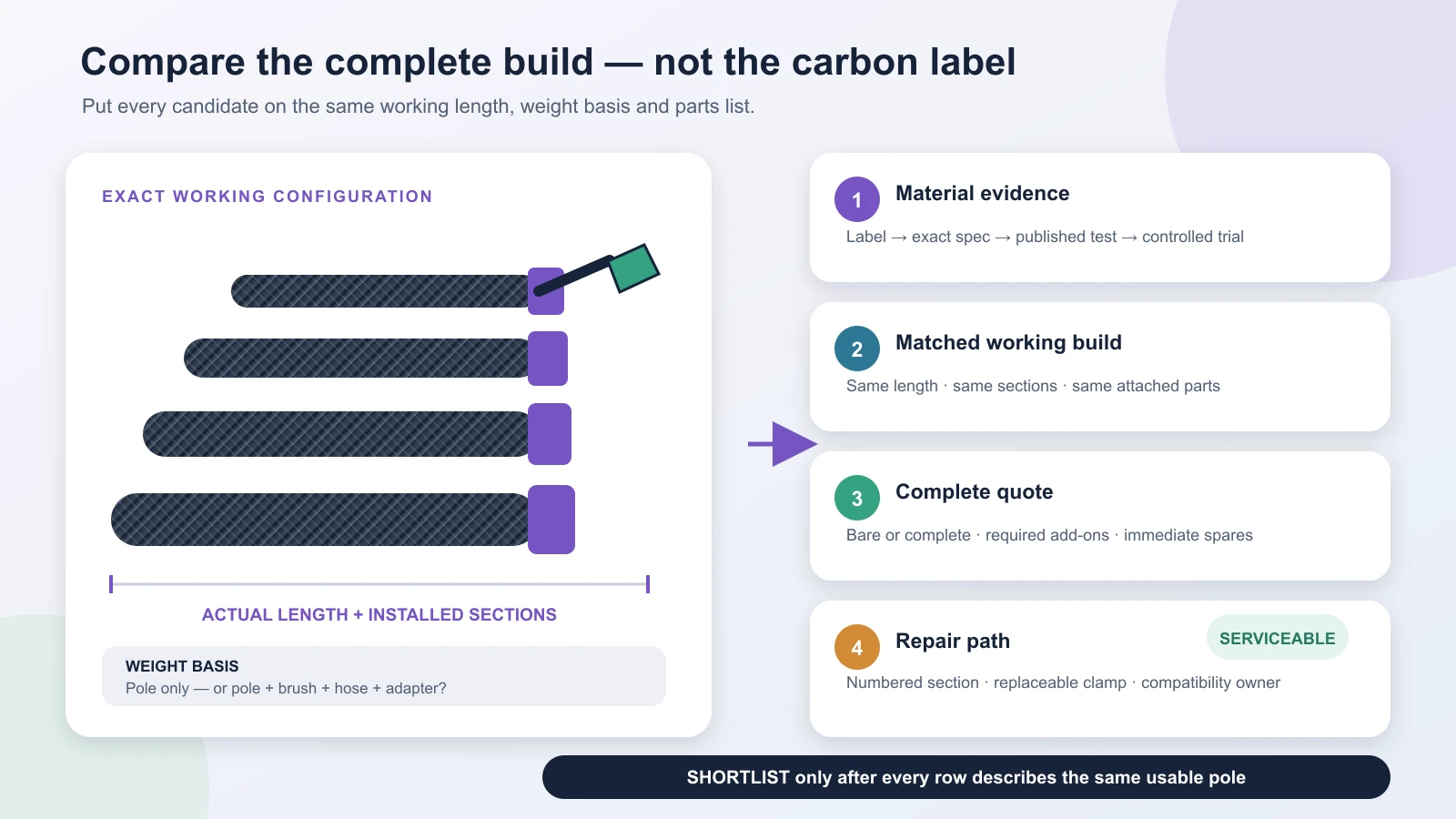
Carbon fiber is one field in a pole specification, not a verdict. If two listings both say “carbon fiber,” you still do not know whether their published weight covers the same length, includes the brush, uses the same number of sections or describes the configuration you will extend on a normal job.
Build the comparison in the opposite direction. Freeze the required working length first. Then record the exact pole, sections and attached parts at that length; identify what the weight includes; separate measured specifications from material marketing; and confirm how a damaged section or clamp is replaced. Only identical rows belong in the same price comparison.
Put every carbon claim on an evidence rung
“Full carbon,” “high modulus,” “ultra high modulus” and “24K” can identify a manufacturer’s material class. They do not, by themselves, report how a finished pole was tested. The tube wall, section diameters, overlaps, clamps, extended length and brush-end assembly all remain part of the working structure.
| Evidence rung | What you can record | What it does not prove | Comparison action |
|---|---|---|---|
| Material label | The exact wording used for that model | Finished-pole weight, deflection, durability or control | Describe; do not rank |
| Exact model specification | Actual length, collapsed length, weight, sections and included parts | A fair cross-brand result when the weight basis differs | Normalize the configuration |
| Published test | Test configuration, load, position, method and result | Performance outside the stated setup | Compare only matching methods |
| Controlled job trial | The same brush, working length and repeated movement on an accepted job | Universal handling for another operator or configuration | Use for the buyer’s final fit |
Unger’s nLITE brochure, for example, publishes separate Carbon Composite and Carbon 24K classes with 100 GPa and 210 GPa fields. Tucker describes standard, high-modulus and ultra-high-modulus families in its carbon-pole explanation. Those are useful descriptions inside each named range. Neither page supplies a shared, cross-brand finished-pole test that lets the labels become one stiffness ranking.
Freeze the working configuration before reading the weight
Use the length you will actually extend, not the maximum available model. If that number is still an assumption, complete the height-and-setback pole-length check first. A material comparison built at the wrong length solves the wrong job.
One model family shows how quickly the build changes. The XERO Pro Basic page lists its 30-foot option at 29 feet actual length, 4.27 pounds and six sections; its 40-foot option at 39 feet, 5.70 pounds and eight sections; and its 50-foot option at 49 feet, 8.60 pounds and ten sections. The page labels those figures “pole weight” while selling both bare and complete variants. Until the weight basis is confirmed for the selected variant, do not silently add its number to a cross-brand chart.
Tucker’s HM-50 page is more explicit about inclusion: it lists 46 feet full extended height, 50 feet reach, nine sections and 7 pounds with brush attachment. That does not make the two brands directly comparable. It demonstrates why the words beside the number are part of the number.
| Field | Required entry | Hold when |
|---|---|---|
| Identity | Brand, exact model, generation and selected variant | The page mixes old and current versions |
| Working build | Actual extended length and exact sections installed | Only model-name reach is available |
| Weight basis | Pole only or pole plus named brush, hose, adapter and fittings | The included assembly is not stated |
| Material claim | Manufacturer’s exact wording and any stated numeric field | A reseller has shortened or upgraded the wording |
| Stored build | Collapsed length or longest permitted separated piece | Transport fit has not been measured |
Make stiffness a test question, not an adjective contest
A buyer cares about where the brush goes when the pole is extended, not which adjective sounds strongest. Ask what configuration supports the claim: actual length, number of sections, overlap or extension layout, brush-end mass, pole orientation, applied load and measured movement. If a result is published, keep its units and test method beside it.
When a page provides only a material class or an unqualified “stiff” claim, record it as a manufacturer claim. Do not manufacture a score from model name, carbon weave appearance, price or weight per foot. Weight divided by length can describe one ratio, but it cannot stand in for finished-pole stiffness because it removes section geometry and the test conditions from the decision.
If possible, compare finalists through the same supplier demonstration, rental or return-compatible evaluation. Use the working length and brush assembly already frozen, repeat the same raise, place and lateral-movement task, and record only what that trial establishes for the operator. Without a controlled comparison, the honest output is “stiffness winner not established,” not a confident ranking assembled from incompatible catalog prose.
Price the usable build, not the bare tube
The quote must describe the same operational result. XERO’s Pro Basic page separates a bare pole from a complete option that includes hose, brush, bumper, angle adapter and fittings. Tucker’s HM-50 listing names a brush, pole tubing, quick-connect fittings, gooseneck and an adapter among the included parts. A bare price and a ready-to-work price answer different questions even when both listings use the same length label.
Comparable quote: exact pole variant + required sections + brush-end assembly + hose and fittings + transport-required parts + immediately required spares. Record quote date, region, tax and shipping treatment separately. Do not rank totals until the included build matches.
Keep future flexibility outside the initial total unless the job plan already needs it. An optional higher extension is not “savings” if it makes daily work heavier; a smaller initial pole is not less capable when a documented add-on path can cover a later, real contract. Conversely, an expansion promise has no value until the exact add-on sequence and compatibility are documented.
Score the repair path before a section breaks
Carbon construction does not eliminate clamps, end protection, hose wear or impact damage. The business question is how much of the working assembly must be replaced and how quickly the exact part can be identified.
XERO’s sections and add-ons page says individual sections can slide off for replacement and a clamp can be replaced without buying a whole section. It also documents an important sequencing limit: the 50-foot Pro Basic add-on is intended to stack onto the 40-foot build, not directly onto the 30-foot pole. Its separate Micro Ultra replacement page offers numbered sections for that exact high-modulus family. These facts support repairability for the named system; they do not prove that parts cross to another range.
For each finalist, record the section-numbering rule, current replacement-section path, clamp replacement, warranty owner and exclusions, and whether a common wear part can be stocked. Treat “lifetime” or similar language as a warranty term that still needs its current conditions—not as proof that damage, misuse or downtime disappears.
Issue one disposition for the complete build
| Evidence pattern | Disposition | Next move |
|---|---|---|
| Same working length, same weight basis, complete parts list, repair path and adequate claim evidence | Shortlist | Compare matched quotes and, if needed, run the same working trial |
| Carbon grade is named but weight basis, configuration or test method is missing | Hold | Ask for the missing exact field; do not fill it with another model |
| Ready-to-work build requires undocumented adapters, extensions or unavailable repair parts | Reject or rebuild the quote | Normalize the complete compatible assembly |
| Overhead electrical exposure or another site method remains unresolved | Stop | Resolve the site and access method before material selection |
The electrical stop is material-specific, not fine print. Gardiner’s water-fed-pole guidance states that carbon-fibre poles are good conductors of electricity and that water or wet equipment can preserve a risk even where handle sections are described as insulated or isolating. This page does not set a clearance or approve protective equipment. An unresolved overhead condition ends the comparison.
Carry only the surviving exact build into the broader water-fed pole selection guide. Material, working reach, brush connection, transport and service must agree in one specification. “Carbon fiber” remains useful on that sheet—but it never gets to erase the fields underneath it.