A length of pole hose is inexpensive until it is already routed through every section of a water-fed pole. At that point, cutting it in the wrong place or for the wrong valve creates a repair job that the product price never shows.
The current Uni-Valve Pro instructions make the cut real: one route begins with a two-foot piece, connects that short piece to a specific side of the valve, and feeds it through the pole first. Before following that sequence, identify the exact cart and prove the tubing and assembled valve can use the intended route.
The short answer is to install only when one record closes all of these fields: exact regional model or SKU, standard versus softwash identity, permitted fluid, internal tubing, actual hose ID and OD, any named hose exclusion, section-one clearance, clip set, short-side orientation, brush-end exit and service access. If one field is unknown, do not cut yet.
The cart line must name the actual valve
Uni-Valve Pro is a product family name, not enough of an order line by itself. The current XERO page identifies SKU 074-24-03-XP. The current WindowCleaner page uses SKU 074-24-03. Ex-ceed’s own site presents a Uni-Valve Pro series and separately lists a UniValve Pro Softwash product.
That does not mean the two US SKU strings describe incompatible hardware. It means their identity has to stay attached to the selected seller and region. It also means the separately named softwash product cannot lend chemical permission to the standard cart.
| Pre-cut field | Copy from current product information | Confirm on the actual setup |
|---|---|---|
| Cart identity | Seller, region, product name, SKU or code | Package and selected listing match |
| Fluid scope | Standard pure-water or separately named softwash product | Intended water or chemistry route |
| Tubing route | Internal tubing required | Hose is actually routed internally |
| Hose | Published notation and explicit exclusions | Measured ID, measured OD and hose family |
| Pole passage | Stated section and exit route | Valve body, clips and hose pass the exact path |
| Orientation | Cut length, short side and valve side | Enough brush-end hose remains before cutting |
| Service | Grease or current service method | Access remains possible after installation |
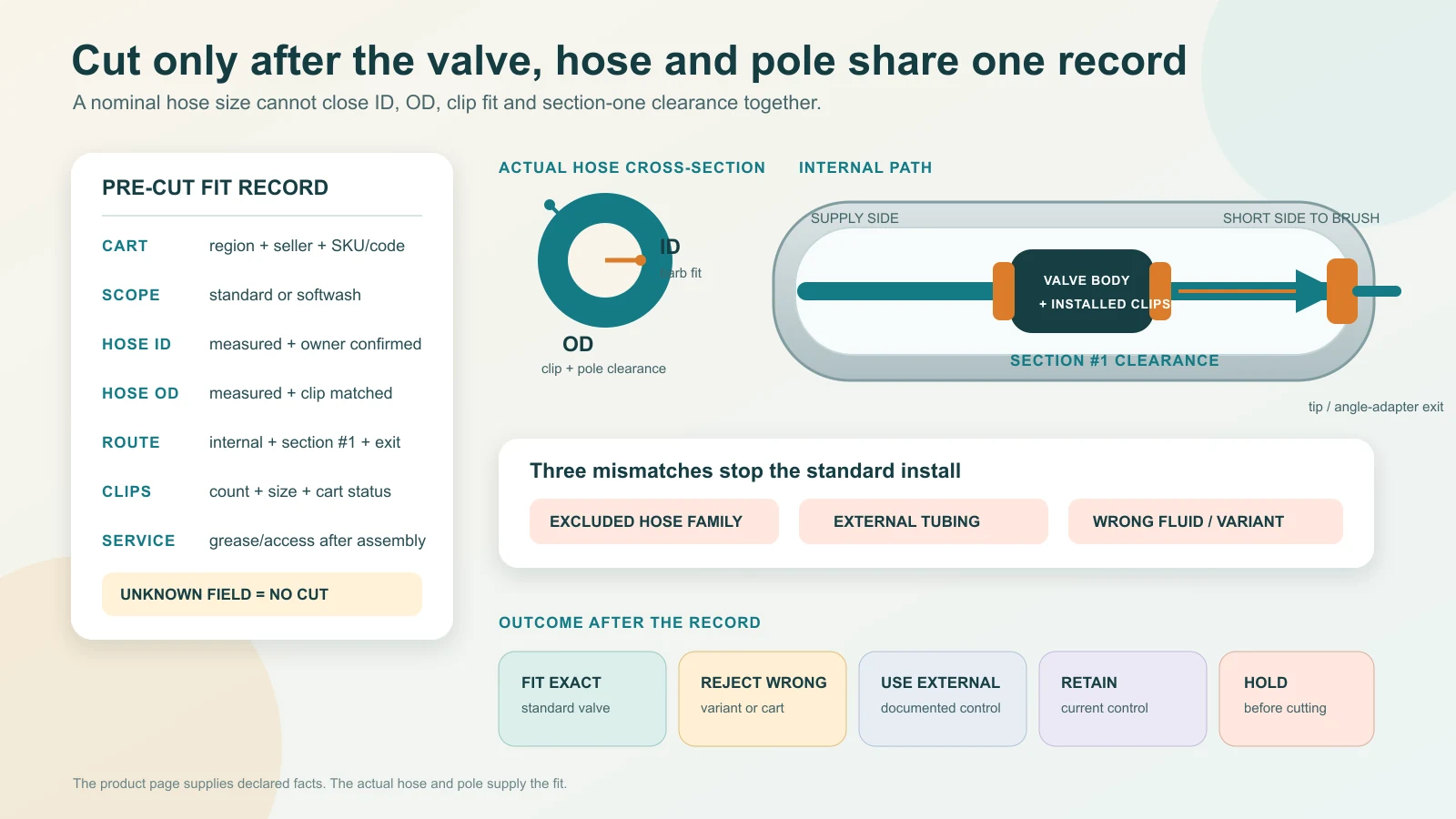
The record is deliberately more specific than a compatibility claim. It gives the supplier something exact to confirm and gives the installer a reason to stop before a mismatch becomes a cut hose.
Put ID and OD in separate boxes
Hose dimensions create the easiest mistake on this purchase. The current XERO page says the valve installs on 5/16 hosing, but the captured page does not label that figure as inside diameter or outside diameter. WindowCleaner’s installation copy also says 5/16-inch tubing, while a current answer on the same page separately states a 3/16-inch inner diameter.
Those two values may belong to different dimensions of one hose, but the pages do not explicitly make that mapping. Do not complete it from memory. Record the selected seller’s wording exactly, measure the actual tubing with the tubing maker’s accepted method, and keep two fields.
| Hose field | What it controls | What cannot replace it |
|---|---|---|
| Inside diameter | Barb engagement and the selected valve’s hose claim | OD, nominal name or a product photo |
| Outside diameter | Clip fit and clearance through the pole | ID or fits-5/16 wording without a role |
| Exact hose family | An explicit product inclusion or exclusion | Matching color or approximate dimensions |
The family field matters because XERO currently says this valve is not compatible with XERO High Flow Hose. WindowCleaner likewise excludes High Flow hosing. An explicit exclusion remains a rejection even if a quick measurement or similar label looks promising.
This is narrower than the site’s water-fed pole hose reel guide. That page sizes the long delivery line, reel capacity and transitions. Here, ID and OD are used only to decide whether one small valve assembly belongs inside the pole.
Walk the assembly through section one
A barb can fit the hose while the assembled valve still cannot travel through the pole. XERO says the Uni-Valve Pro is for internally tubed poles and sits in section #1. Its current route feeds the valve and hose through the pole, then brings the hose out through the pole tip or angle adapter.
Turn that description into a physical path before cutting. Start at the base opening. Follow the internal route into section one. Account for the valve body’s widest point, the installed clips rather than bare barbs, every constriction between sections, and the exit through the exact tip or angle adapter. Finish at the brush-end hose allowance. The path also needs access to the current grease or service point after the pole is assembled.
The water-fed pole guide covers working reach, pole material, brush and the whole brush-end connection. A pole that fails those larger requirements does not become a good choice because this valve can fit inside it.
No product page can close the actual clearance from a pole name alone. If the pole manufacturer does not publish a route and the assembled envelope cannot be checked without an unauthorized modification, the fit result remains open.
Keep the short side facing the brush
Once the physical path is plausible, copy the current instruction for the selected model rather than installing from this article. The current XERO and WindowCleaner sequence describes a two-foot short piece connected to the barb nearest the U in Uni-Valve, with the remaining pole tubing on the opposite barb. The short piece goes through the pole first toward the tip or angle adapter.
That orientation is purchase information because it changes where the irreversible cut belongs. Before the cut, lay out the complete route and mark the brush side, supply side, valve side, exit component and hose allowance. Also confirm whether the selected cart supplies the needed clamps or merely refers to them in the installation copy.
Regional carts are not interchangeable evidence for that last field. One current UK listing requires three 5 mm O-clips. That is useful for its UK code; it does not establish the clip size or package contents of a US SKU. The clips must fit the actual hose OD and still pass the pole path.
Treat chemistry as a model change
The standard and softwash names need separate rows. Ex-ceed currently lists a specifically named UniValve Pro Softwash product. The current UK listing for the standard UniValve Pro says pure water only and not to use chemicals.
The safe reading is not that every regional standard cart has identical wording. It is that chemistry is a product-identity question, not an assumption to make from a similar body. If the intended route is more than pure water, stop the standard-valve decision and obtain the exact chemistry-compatible model, hose, seals, instructions and worksite authority from the relevant manufacturers and site authority.
The upstream water-fed pole system guide explains the complete filtration and delivery chain. This valve does not change what fluid the system is allowed to carry.
The tug is only an on-off control
The operating promise is simple: tugging the hose toggles the water. The valve sits near the brush inside the pole, so the operator can change state without walking back to an upstream tap.
That convenience does not turn the valve into a booster pump, regulator or flow-balancing device. WindowCleaner’s current Q&A explicitly says it does not increase flow or pressure. XERO’s page describes on/off control. Route pressure, flow at the jets, pump behavior and filtration performance remain properties of the whole system.
Likewise, a seller’s water-saving statement is not a forecast for a route. Savings depend on how often flow would otherwise remain on, system output and operator behavior. The fit decision needs no productivity or payback claim.
An external shutoff may be the better component when tubing is external, the internal path is obstructed or service access would be poor. If that choice changes upstream fittings, the garden-hose quick-connect guide shows why thread, mating family and valve behavior still need their own record.
A no-cut result can be the right result
Use Fit the exact standard valve only when the selected standard cart, pure-water scope, internal hose, measured dimensions, exclusion check, assembled pole path, clips, orientation and service access all agree. Then hand the current product instructions and exact record to the responsible installer.
Use Reject the wrong variant when standard and softwash identities or regional facts have been mixed. Use Use a documented external control when the pole carries hose externally or the internal envelope cannot pass. Use Retain the current control when the existing shutoff already serves the route without creating a new cut and service point.
Anything else is Hold before cutting. That is not indecision. It preserves the hose while the seller, pole manufacturer or actual measurement closes the one field that can still change the result.