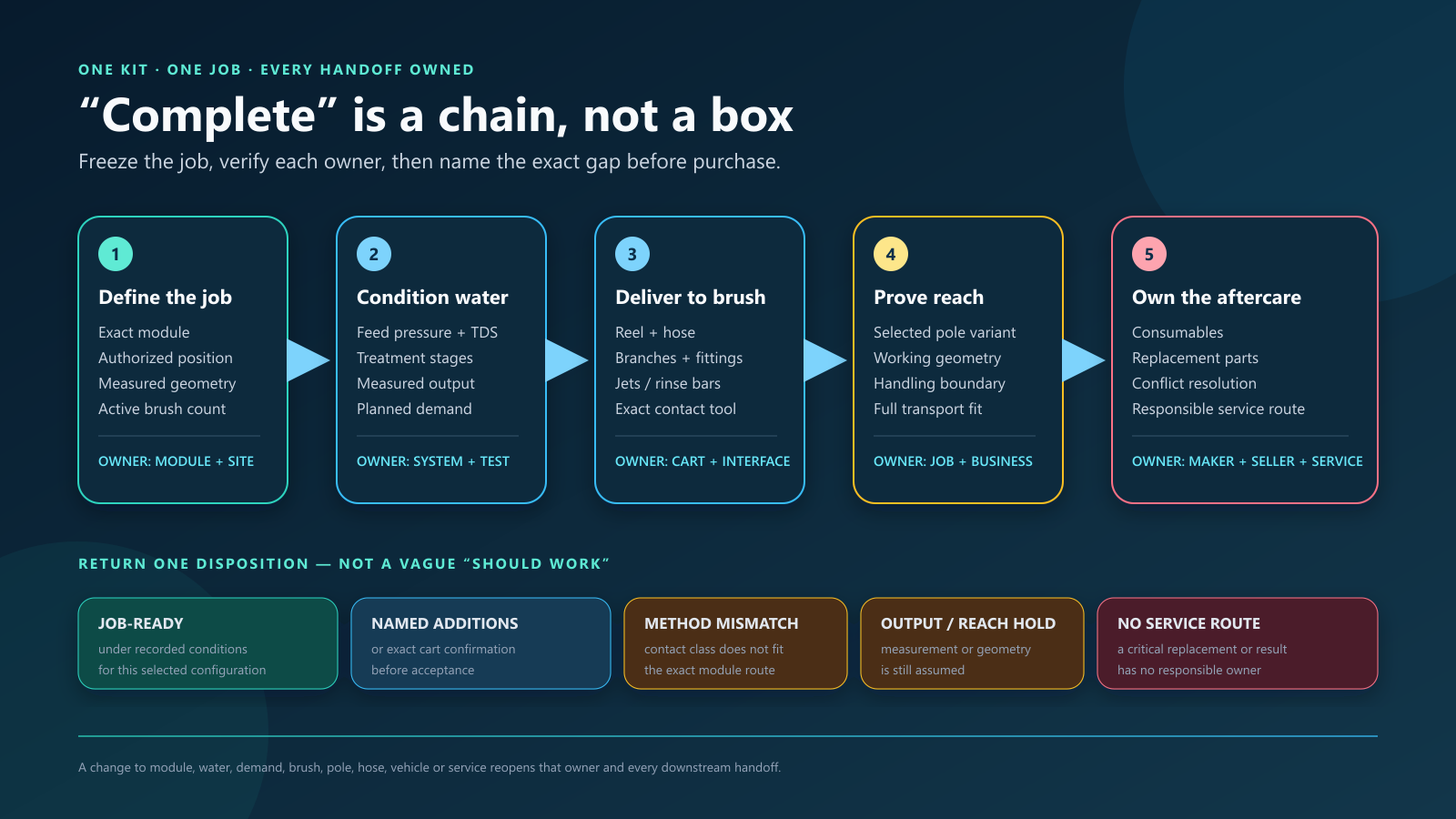
A brush can have soft bristles, a solar label and a connection that fits your water-fed pole—and still be the wrong contact tool for the module in front of you. The deciding document is not the brush page. It is the current cleaning instruction for the exact module.
That distinction changes the answer before shopping begins. Canadian Solar’s current v3.1 installation manual conditionally allows gentle manual soft contact on modules within its scope. The currently hosted First Solar Series 4 guide prohibits bristle contact on Series 4A anti-reflective-coated modules. “Soft” is therefore a product description, not a universal permission class.
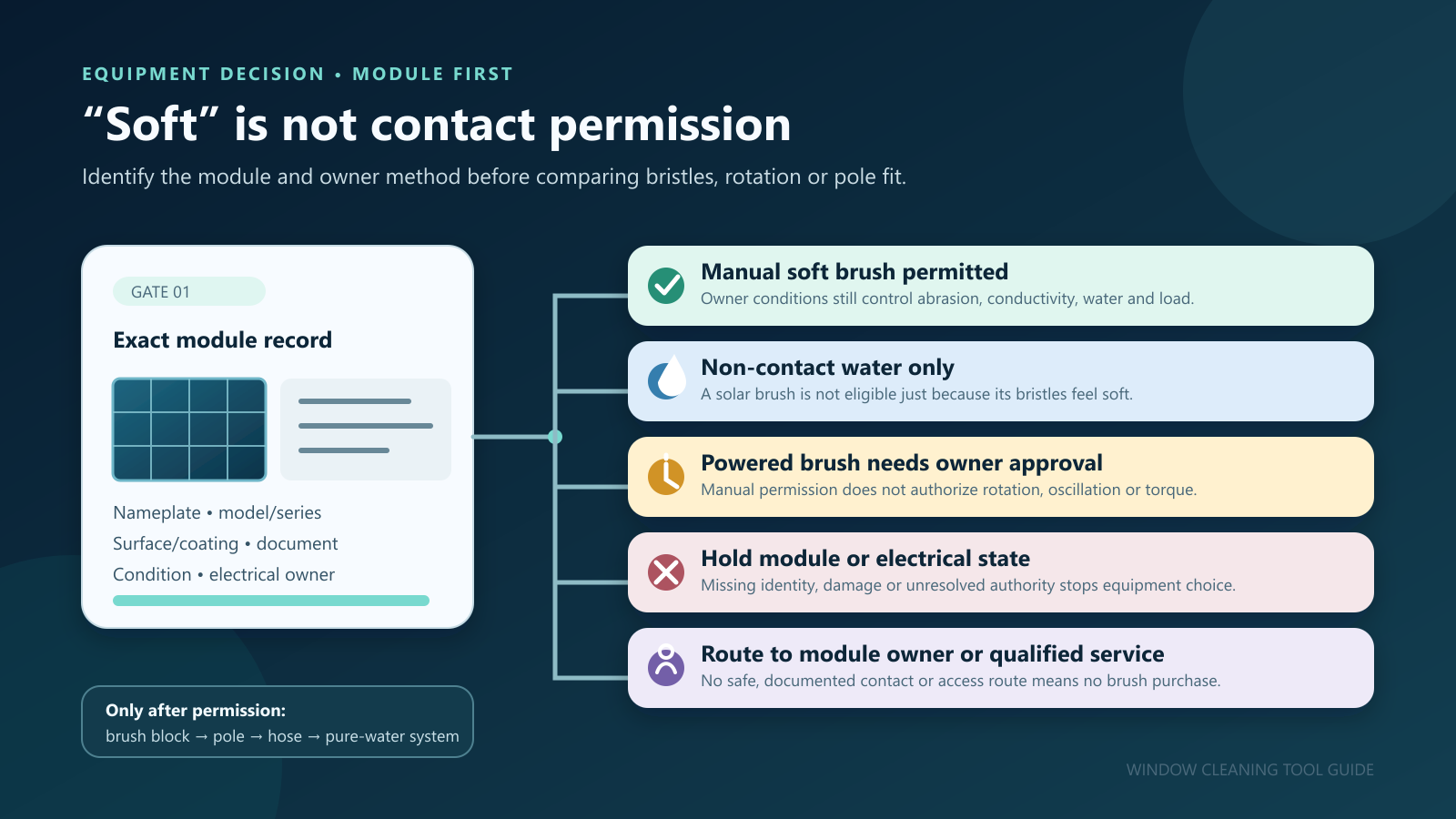
| What the owner record shows | Brush decision | Disposition |
|---|---|---|
| The exact module and current manual allow qualifying gentle manual brush contact, and every named condition is closed | A candidate may enter the abrasion, conductivity, load and connection checks | Manual soft brush permitted |
| The exact module owner permits water without brush, mop or squeegee contact | Keep the bristle brush out of the job | Non-contact water only |
| Manual contact may be allowed, but rotation or powered agitation requires a separate decision | Do not borrow manual permission | Powered brush needs owner approval |
| Nameplate, model, coating, current document, condition or electrical authority is unresolved | No contact equipment is selected | Hold module or electrical state |
| The documented method or a safe, authorized ground-access route is absent | Do not turn a purchase decision into access or electrical advice | Route to module owner or qualified service |
The same soft brush can be allowed on one module and prohibited on another
Start with the nameplate. Record the manufacturer, complete model or series and serial or project reference that connects the installed module to its owner documents. Add the front surface or coating, the current cleaning document and revision, visible condition and the party responsible for the array’s electrical state. A work order that says only “solar panels” cannot close the contact decision.
Canadian Solar’s Installation Manual v3.1 lists the module families in its scope. Its cleaning section says noticeable dirt may be addressed with a gentle soft cloth, sponge or soft-bristle brush. For wet agitation, the tool must be nonconductive and nonabrasive. That is a conditional route for those modules—not evidence that every module accepts a brush.
The currently hosted First Solar Series 4 User Guide reaches the opposite answer for Series 4A anti-reflective-coated modules. Its basic guidance allows low-pressure non-contact water and a limited number of dry soft-cloth-mop cleanings, while rejecting wet contact and dry bristle brushes, sponges and squeegees. It also points to the owner’s PD-5-804 cleaning instructions. A generic brush guide cannot overrule that dependency.
| Exact owner scope | Stated contact class | What it does not authorize |
|---|---|---|
| Canadian Solar families listed in v3.1 | Conditional gentle manual soft contact; wet agitation must meet the owner’s nonconductive and nonabrasive requirements | A different model, unverified surface, rotating brush or unknown localized load |
| First Solar Series 4A anti-reflective-coated modules | Low-pressure non-contact water; limited dry soft-cloth-mop route under the owner guidance | Wet brush contact, dry bristle contact or transfer to another First Solar series |
| Unidentified or mixed array | None until each module group is bound to its controlling owner | Choosing the method used on the easiest-looking row |
Condition sits beside identity. Broken glass, burn marks, exposed conductors, loose connections or an unresolved array state are not brush-selection problems. They send the job to the responsible module and electrical owner. This page does not provide a shutdown sequence, energized-work instruction, ladder plan or roof-access method.
“Soft” has three separate tests
Bristles can feel soft against a hand without proving the three things the job actually needs: compatible surface contact, suitable electrical construction for the owner’s wet method, and an acceptable load on the module. Those are separate fields. One seller adjective cannot close them together.
| Test | Evidence needed | Fail-closed result |
|---|---|---|
| Nonabrasive contact | The exact owner requirement plus evidence for every contacted surface—glass, coating, frame, seal or other named material | Hold the brush; do not use hand feel or “solar-safe” copy as proof |
| Electrical construction | The exact owner’s tool requirement and the complete wet-contact assembly, not merely one pole section or bristle bundle | Return to the electrical or module owner; no inferred protection |
| Localized load | Owner-approved loading boundary for the chosen brush, angle, movement and powered state | Do not invent a downforce value or infer it from brush weight |
Canadian Solar’s v3.1 manual names glass, EPDM, silicone, aluminum and steel in its nonabrasion boundary. It also warns that localized heavy loads can create cell-level microcracks. The manual does not turn those statements into a universal brush-force number. If the proposed setup needs a loading value that the opened sources do not publish, technical confirmation remains the right next step.
The full assembly matters. A seller may describe a glass-fiber outer pole section as less conductive than a carbon-fiber alternative. That comparison does not certify the hose, adapter, brush block, wet surface, operator position or site controls for an energized hazard. Keep electrical authority with the array owner rather than converting material copy into a safety rating.
Manual contact and powered rotation are different purchases
A manual soft brush and a powered rotating head may share bristle material, but they do not apply it in the same way. Rotation, oscillation, torque, repeated passes and added downforce change the contact method. Approval for one does not silently cover the other.
Canadian Solar’s v3.1 manual explicitly sends rotating-brush methods to its technical service team in advance. That produces a clear purchasing stop: if the proposed product is powered, obtain an answer tied to the exact module and method before comparing motor size, brush speed or production claims. “A soft brush is allowed” is not that answer.
For First Solar Series 4A, the published basic guidance already keeps bristle contact outside the stated method. A powered-brush demonstration, seller guide or successful job on a different module cannot manufacture an exception. If an owner provides a project-specific method later, preserve the exact document, scope and revision instead of rewriting the general rule.
This separation also prevents a false commercial shortcut. A powered system may be marketed around speed, labor or yield recovery. Those claims do not establish module permission, and this page does not estimate cleaning frequency, recovered energy, service time or payback. The first useful commercial fact is whether the proposed contact class can enter the job at all.
Water, heat and force stay attached to the method
Once a module owner permits contact, keep the operating conditions attached to that same permission. Do not combine one manufacturer’s brush allowance with another’s pressure statement, a seller’s rinse-bar layout and a generic chemical recipe.
Within its stated wet-cleaning method, Canadian Solar v3.1 calls for low-mineral water near neutral pH, limits water pressure, tells users to avoid the hottest hours and warns against dry scraping and localized heavy loads. First Solar Series 4A uses a different method boundary: its basic wet route is non-contact. The values are not interchangeable because the surfaces and owner instructions are not interchangeable.
| Record field | Close it with | If it is missing |
|---|---|---|
| Module identity and surface | Nameplate, project record and current module-owner scope | Hold module identity |
| Condition and electrical authority | Owner-defined inspection and the responsible site/electrical party | Hold or qualified service |
| Manual contact class | Exact current cleaning document and surface scope | No brush selected |
| Powered/rotating status | Explicit technical-owner permission for the proposed method | Owner approval required |
| Water, temperature and load boundary | The same module owner’s method plus job-specific evidence | Do not borrow another owner’s values |
Write the result per identical module group, not once for an entire mixed site. A replacement row, a different coating or an updated product family can change the controlling document. If the array cannot be separated into reliable groups, the permission card returns a hold rather than selecting the least restrictive rule.
Only then solve the pole connection
After the module returns an eligible manual-brush class, product specifications finally become useful. They tell you what must connect, not whether the module accepts the contact.
| Exact listing | Published configuration | Still unresolved |
|---|---|---|
| Tucker Alpha Solar XL Brush SKU 003-22-147 |
17 inches long, 3 inches high, 1.7 pounds, synthetic bristles, full-length rinse bar, quick-release swivel and #1-clamp interface | Module permission, abrasion and load evidence, selected-pole fit, hose/flow result and field performance |
| XERO Solar Pole package SKU 209-20-726 |
23-inch nylon/boar-hair hybrid brush, Fast Lock, 100-foot high-flow hose, six jets or two rinse bars, with listed 18-, 24- and 30-foot pole configurations | Module permission, complete electrical boundary, working reach, handling, water demand and field performance |
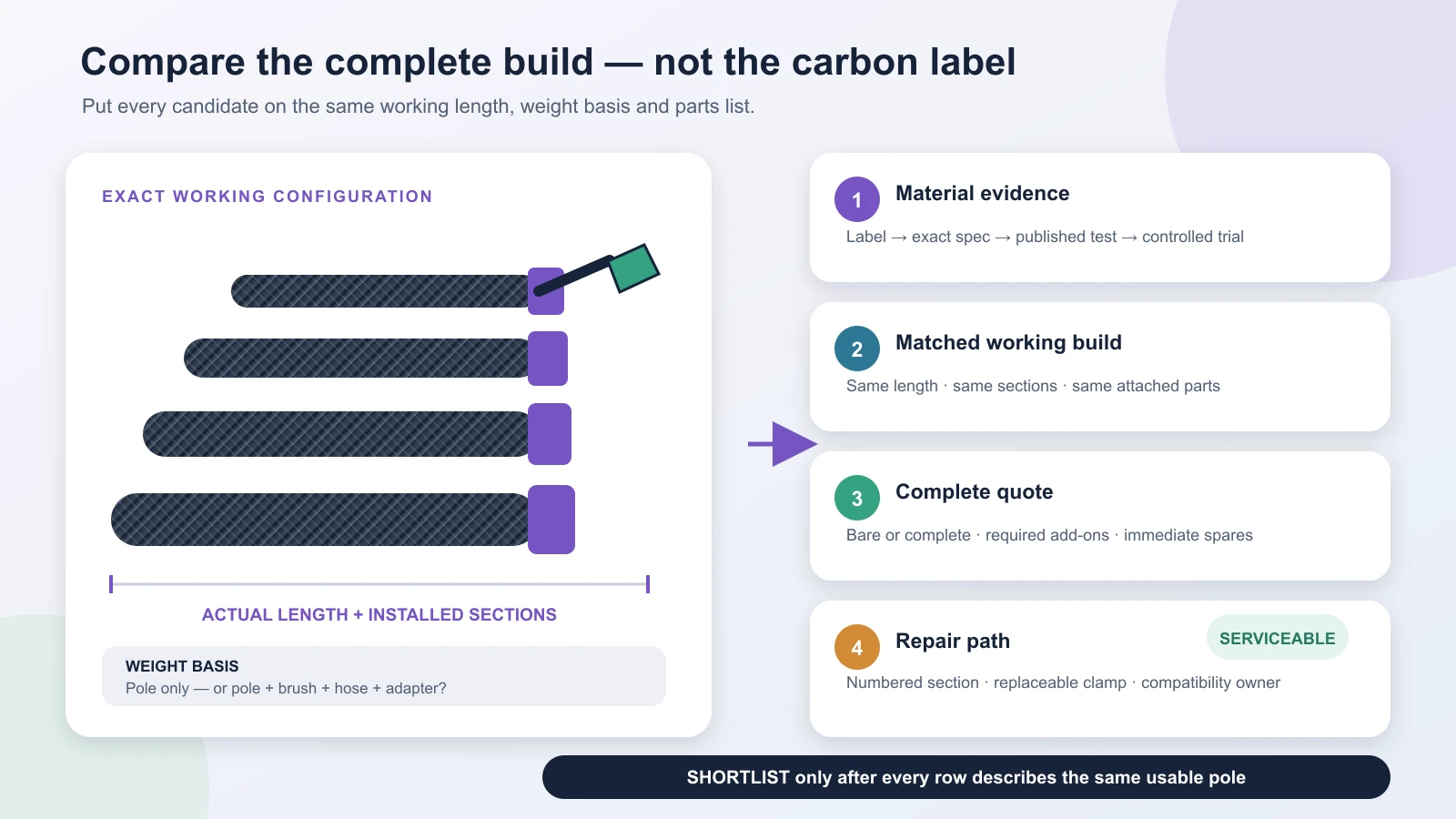
The current Tucker Alpha Solar XL listing identifies a specific brush and clamp path. The current XERO Solar Pole listing identifies a different brush, adapter, hose and rinse arrangement. Neither page supplies independent proof of coating compatibility, contact force, cleaning effectiveness or module-warranty fit, so the table is deliberately not a winner-and-loser comparison.
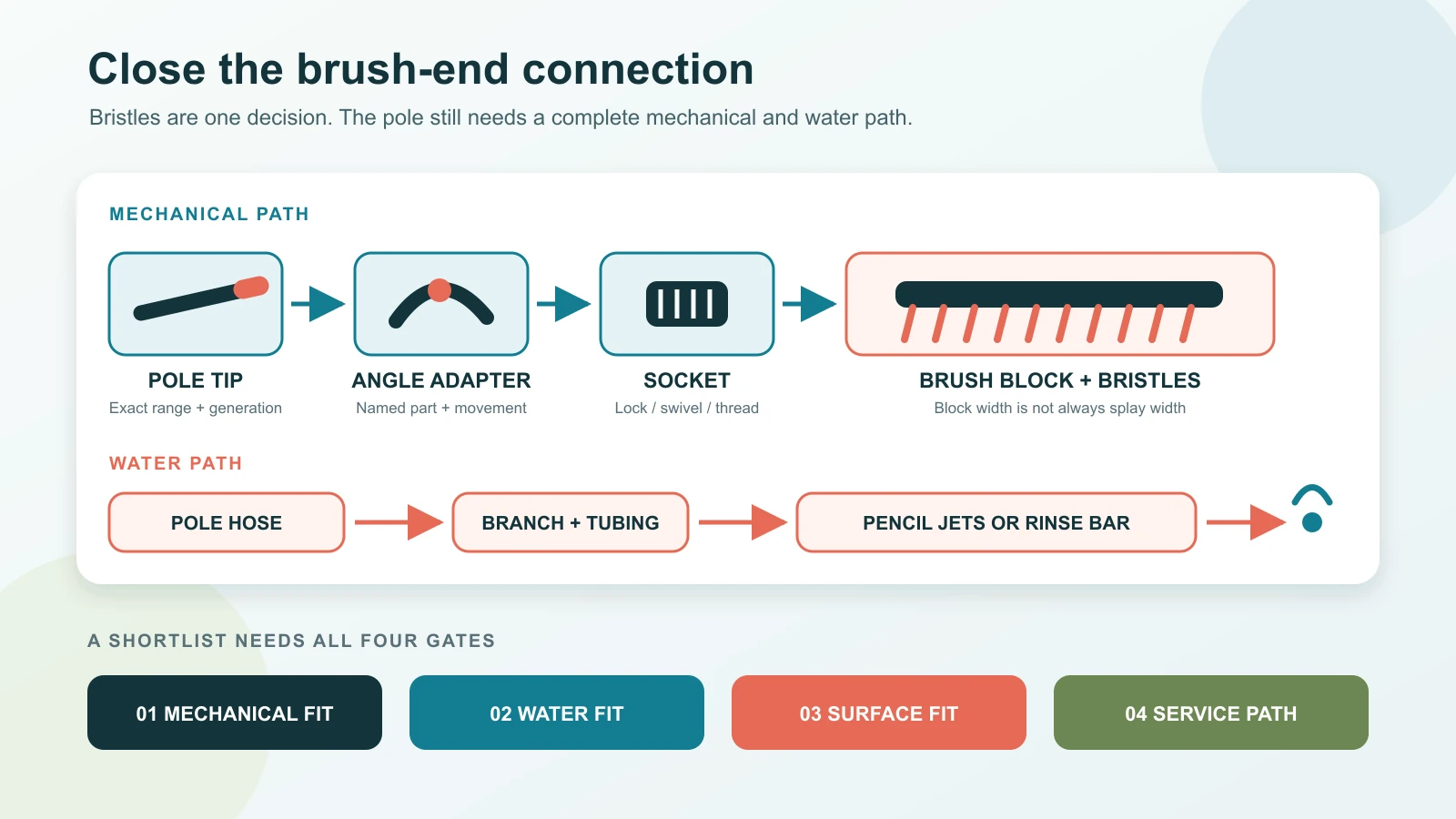
Send an eligible brush to the water-fed pole brush guide for the block, socket, angle adapter, clamp, hose, branch, jet and rinse-bar chain. Send working reach, pole material and handling to the water-fed pole guide. Send filtration, flow and pure-water capacity to the water-fed pole system guide.
That handoff preserves the buying sequence: exact module owner, contact class, manual or powered permission, operating conditions, then mechanical and water fit. A brush that fails the first four gates never becomes compatible at the clamp. If the documented method or an authorized ground-access route is missing, the useful result is not a longer pole—it is the module owner or qualified service route.