Loose grit is usually the easiest part of a dirty window track. Add water too early and it becomes the brown paste that gets pushed into corners, around rollers and across drainage openings. The tool decision therefore starts before a brush or vacuum touches the opening.
Record the window manufacturer and product line, the operating style, the track or sill finish, access, visible drainage openings and the soil you can actually see. Then separate material that can be collected dry from film that remains bonded. That order turns a shelf of gadgets into a short, defensible route.
| What the first inspection shows | Tool role now | Route |
|---|---|---|
| Loose dry dust, sand, hair or insect debris; exact owner permits light dry contact | Collect with an owner-compatible vacuum, narrow brush or clean dry cloth | Dry collection first |
| A film remains after loose material is removed and the owner publishes a matching damp method | Use only that surface, solution, applicator and drying boundary | Owner-permitted damp clean |
| A known weep or drainage opening is blocked | Keep it separate from the general dirt pass and follow its owner method | Drainage clearance |
| Corrosion, failed finish, bent hardware, a jam or unidentified bonded material | Do not escalate brush stiffness or chemistry | Repair or service |
| Product, finish, opening function or care instructions cannot be established | No contact method is selected | Hold window identity |
The first tool is the window label, not the brush
A track is not a material specification. The same word can describe an exposed vinyl channel, painted frame surface, metal insert, sliding-door rail, casement hardware path or the edge of a screen system. A brush that fits the groove may still be wrong for the finish or for the moving parts beside it.
Find the product label, order record or owner manual before turning appearance into identity. Record the manufacturer, product line and operating style on the work note. Add which side is accessible, whether a screen or sash blocks the path, and which slots or holes the owner identifies as drainage. If a screen must move, keep that movement with the screen-removal guide; a convenient corner is not a removal instruction.
Pella’s window-care guide tells readers to clean tracks before the glass and points to a soft brush or vacuum for track debris. Its broader frame and screen advice also varies by product. That is the useful pattern: an owner can establish a dry first move without declaring every Pella track—or every brush—interchangeable.
Access is a stop condition, too. Do not force a sash, roller or retainer merely to fit a nozzle into a corner. A narrow gap can justify a smaller attachment; it cannot justify unowned movement of the window assembly.
Split what can be collected dry from what is bonded
Look at the soil before choosing contact. Loose sand, dust, hair and insect debris can be lifted or swept toward collection. Greasy film, paint, corrosion, sealant, adhesive or an unidentified crust is a different problem. A brush may expose it, but harder scrubbing does not turn it into ordinary dirt.
The important distinction is collection versus displacement. A narrow brush can release particles from a corner, yet it may simply move them to the next channel. A vacuum can collect particles, yet its head may not reach behind hardware and a dry-only unit cannot receive liquid. A cloth can pick up the last fine dust, yet a contaminated cloth can drag grit across a finish. The microfiber-cloth guide owns cloth selection and contamination control; this page owns when that cloth enters the track route.
| Exact tool or role | Published fact | What still needs an opening-level decision |
|---|---|---|
| XERO Track Cleaner | The current specialist listing identifies SKU 067-14-01, MPN TR-001, a wooden handle and stiff plastic bristles | Finish permission, usable contact angle, debris capture, durability and actual result |
| ProTool Brush for Window Track | The current seller identifies SKU 25-502 and stiff bristles; its two-inch and three-inch wording does not clearly name the same dimension | Measure the selected brush if clearance matters; do not borrow another listing’s geometry |
| NICE TrackVac | The current listing identifies SKU 359-60-01, three heads, two modes, USB-C power and dry-only use | Head fit, filter service, charge fit for the route and the collected result |
| Clean dry microfiber | A cloth can lift remaining fine dust after larger particles are collected | Keep it free of embedded grit and assign it only to a compatible finish |
The product rows are descriptions, not a ranking. The XERO Track Cleaner listing and J. Racenstein brush page describe specialist stiff-bristle tools, but neither can authorize contact on an unidentified coating. The NICE TrackVac listing explicitly keeps that product dry. Its seller Q&A about power, charge, runtime and a washable filter helps with product identification; it does not prove how completely the unit will clean your route.
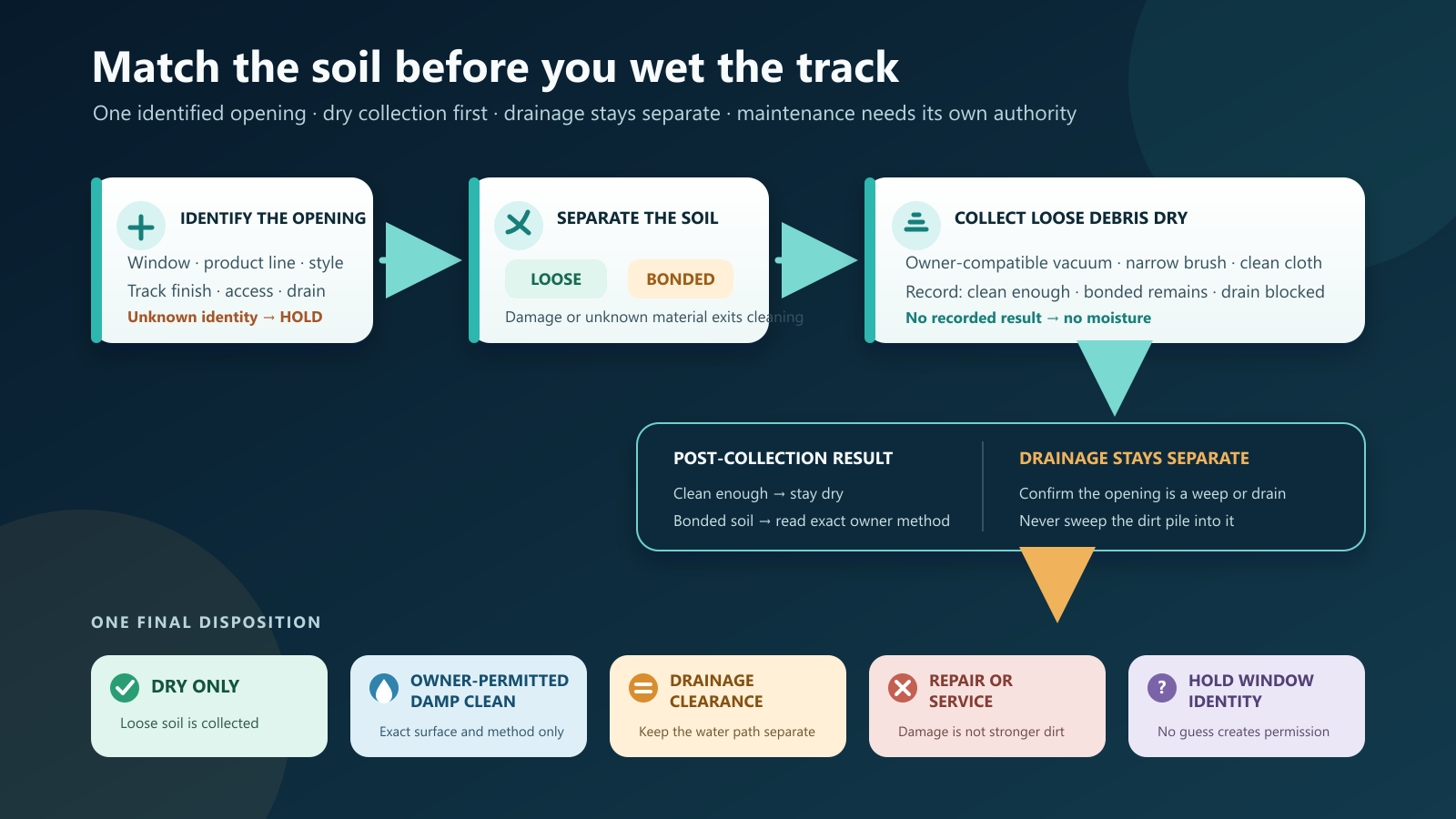
After the dry pass, write down what changed. “Looks better” is too vague. Use one of four observations: clean enough; bonded soil remains; a known drainage opening remains blocked; or damage or unidentified material is visible. That line determines whether water has any job at all.
Moisture begins where the window owner says it does
A damp follow-up is not a universal second step. It begins only when the exact window owner identifies the surface and permits the proposed solution and contact. Keep the owner, product line and method together; do not assemble a new recipe from one company’s soap, another company’s brush and a third company’s solvent exception.
| Window owner scope | Dry or damp boundary | Restriction that changes tool choice |
|---|---|---|
| Pella matching products | Soft brush or vacuum for track debris; matching frame care may use warm soapy water | Methods vary by product; glass spot-solvent wording does not transfer to tracks or frames |
| Milgard matching windows and doors | Vacuum tracks; mild nonabrasive soap and water for matching frame care; inspect weep holes | The broad care guide rejects razors, putty knives, abrasive pads, caustic or petroleum cleaners and high-pressure hoses |
| Simonton matching vinyl | Mild detergent with a soft cloth or soft-bristle brush, followed by thorough drying | No high-pressure washer or listed strong, solvent or abrasive cleaners |
| Marvin matching products | Remove sand, dirt and dust from sills and tracks and keep components dry | Avoid strong chemicals, high-alcohol cleaners, abrasives and scrapers |
The source scopes matter more than a familiar ingredient. Milgard’s care tips support vacuuming tracks, clearing debris and checking weep holes. Its care guide sets the broader abrasive, cleaner and pressure boundaries. A Milgard sliding-door article also mentions steel wool in a narrow sequence. Those statements do not justify a sitewide steel-wool recommendation; when an exact product document and a general owner source appear to conflict, stop and get the instruction for that installed product.
The same rule keeps solvent advice in its lane. A window page may permit a product for a spot on glass while rejecting it on frames, seals or finished components. “Safe for glass” is not a track-finish specification. Likewise, steam and a pressure jet add heat, force and water migration that a soft-brush or damp-cloth direction never implied.
Simonton’s vinyl care and Marvin’s care guidance show why a material or brand name must stay attached to its method. Their restrictions are useful when the installed product matches; they are not a combined formula for every track on the route.
Keep the drainage path out of the dirt pile
A slot at the lower frame may be a weep opening, a fastener access, a manufacturing feature or part of a moving channel. Identify its function before inserting a brush, pick or nozzle. If the owner calls it a drainage opening, treat its condition as a separate line on the work note rather than sweeping the general dirt pile toward it.
The Pella Owners Manual directs owners within named product scopes to keep weep openings clear and use a small soft brush. Milgard likewise tells owners to inspect weep holes and use a soft brush when needed. Neither instruction turns every hole into a drain or authorizes a hard pick, compressed-water blast or improvised enlargement.
Collect loose material around the opening first. Then check whether the identified passage is visibly clear under the owner’s method. If bonded material remains, the hole’s function is uncertain or water appears where it should not, return a drainage-clearance or service result. Do not hide the uncertainty by adding enough water to make the opening appear to flow.
This separation also improves the next visit. “Track cleaned” cannot tell a crew whether a drainage issue was inspected. “Dry debris collected; left weep still blocked; owner method required” can. The record preserves the distinction between cosmetic soil and a component that may affect water management.
Close the track before anyone reaches for lubricant
A clean, dry track can be the finished state. Lubricant is not a reward for completing the cleaning pass, and a stiff or noisy window is not proof that more product belongs in the channel. Hardware wear, a bent part, debris behind a component or the wrong lubricant can all produce a different service problem.
Some owners publish narrow maintenance directions. The Marvin Ultimate Modern owner manual, for example, describes a dry brush and a dry lubricant only if needed for named casement and awning track maintenance, while rejecting oily lubricants. That is authority for those matching products, not for a sliding-window rail that merely looks dry.
| Disposition | Use it when | What closes the opening |
|---|---|---|
| Dry collection only | Owner-compatible dry contact removes the loose soil and no blocked drainage, damage or bonded material remains | Record the tool role and clean, dry result |
| Owner-permitted damp clean | Bonded soil remains and the exact product owner permits the surface, liquid, applicator and drying method | Follow that method, dry the components and record the result |
| Drainage clearance route | A known weep or drainage opening remains blocked or its owner method is separate | Use the exact drainage instruction or send it to the product owner/service path |
| Repair or service | Corrosion, failed finish, bent hardware, a jam, leakage or unidentified bonded material remains | Stop cleaning escalation and assign the responsible repair owner |
| Hold window identity | The product, finish, drainage function or method cannot be established | Retrieve the label, order record or current owner document before contact |
Once the role has survived that route, place it in the broader professional tool setup: a vacuum or brush for a defined dry collection job, a clean cloth for a defined finish, and no automatic bottle of lubricant beside them. The result is smaller than a gadget roundup and more useful on the next opening—one tool, one contact boundary and one recorded reason to stop.