A 500-pill roll represents 1,250 gallons of mixed cleaner on paper. That can be useful inventory for a busy route, or a very long storage commitment for a small one.
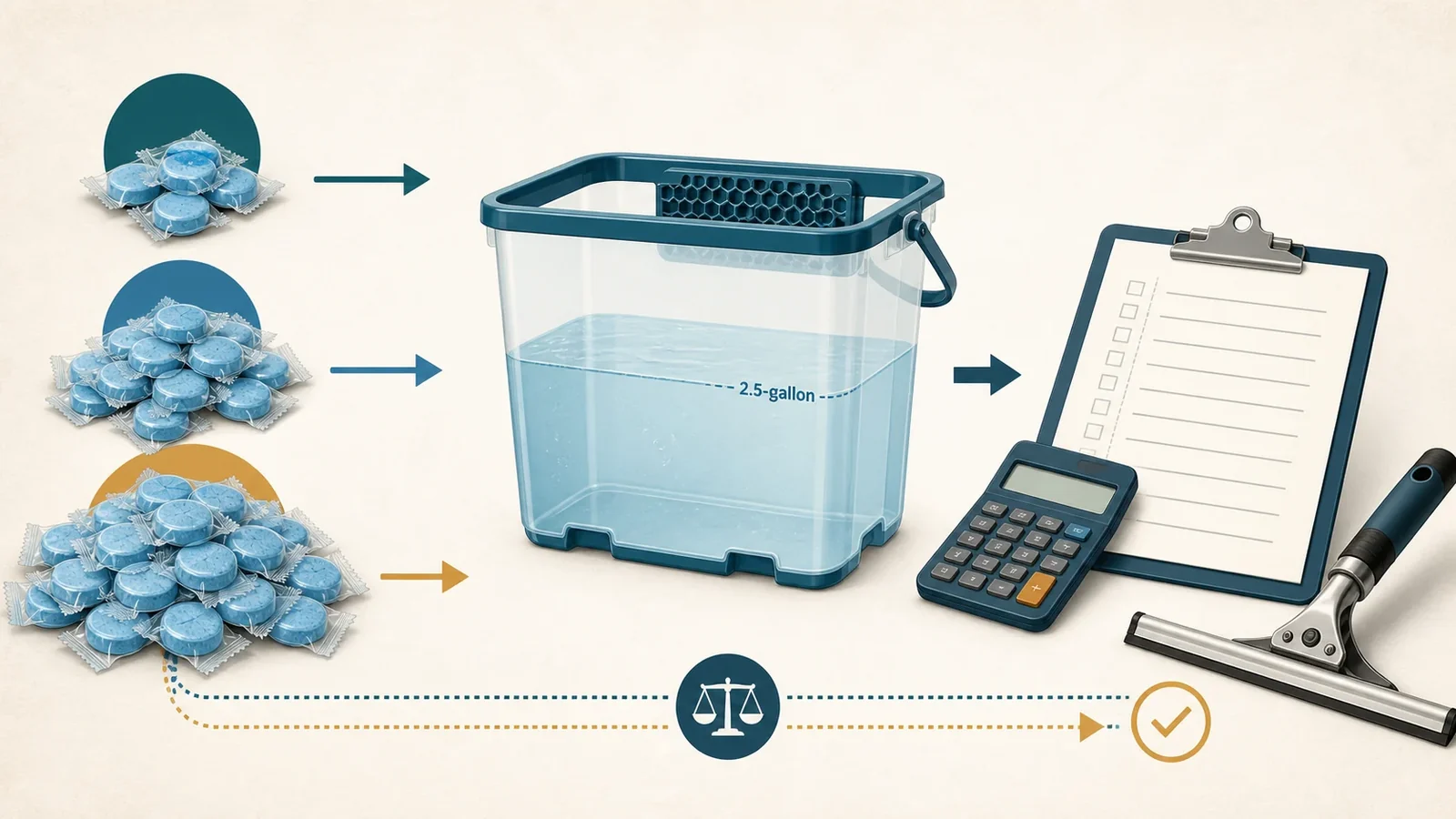
Unger’s current US catalog and chemical page use one straightforward direction: one pill with 2.5 US gallons of water. At that rate, 10 pills represent 25 gallons, 100 represent 250, and 500 represent 1,250. Those numbers describe batch yield—not shelf life, surface approval, cleaning performance or the right quantity for a particular business.
Before choosing a count, write down the exact seller offer, the manufacturer part or seller SKU, the number of pills that will actually arrive, and the route’s measured gallons per week or service cycle. If any of those is still a guess, the pack comparison is not finished.
Start with the offer that will arrive
The current Unger US chemical page names 100- and 500-pill packs. The 2025 product catalog identifies PL100 as 100 pills in ten strips of ten, PL500 as 500 pills in five rolls of 100, and PLBTL as 1,200 pills in twelve bottles of 100. It also shows case quantities, which belong to distributor packaging rather than the count inside one named unit.
Current specialist pages add a different layer. WindowCleaner.com presents 10, 100 and 500 selections and identifies PL10 on the 10-count selection. Windows101 currently exposes 10- and 100-count variants under its own C832 and C833 seller SKUs. A current Unger catalog also lists a 10-pack inside a named professional kit. None of those facts allows a buyer to assume that every “10 pack” is the same standalone manufacturer unit.
| Visible offer or part | What the current source establishes | What the order still needs |
|---|---|---|
| PL100 | Official catalog: 100 pills, ten strips of ten | Seller unit count and whether a displayed case quantity is relevant to this cart |
| PL500 | Official catalog: 500 pills, five rolls of 100 | Delivered inner-pack form and current label |
| PLBTL | Official catalog: 1,200 pills, twelve bottles of 100 | Confirmation that this bulk unit—not a single bottle—is the exact offer |
| Seller 10-count | Current specialist offer; WCR identifies PL10 while Windows101 uses seller SKU C832 | Seller, SKU or part, delivered count and packaging retained as seller-owned facts |
| 10-pack inside a named kit | Current catalog confirms kit inclusion | No inference that the kit component is the same standalone retail unit |
The purchase record must keep seller, seller SKU, claimed manufacturer part, delivered count and inner packaging in separate fields. A listing title alone is not enough. Keep this line item inside the complete professional window-cleaning setup, where the bucket, washer, squeegee and access route are owned separately.
One pill creates three very different stock commitments
The stable arithmetic is:
pill count × 2.5 US gallons = documented batch gallons
To connect that yield to a route, first measure the gallons mixed during a real service period. If the route uses exactly 10 gallons per week, it consumes four whole 2.5-gallon batches, or four pills per week.
| Count record | Documented gallons at 2.5 gal per pill | Example at exactly 10 gal per week | Decision before ordering |
|---|---|---|---|
| 10 pills | 25 gallons | 2.5 weeks | Resolve the seller-specific unit and delivered package |
| 100 pills | 250 gallons | 25 weeks | Confirm PL100 versus seller SKU and storage period |
| 500 pills | 1,250 gallons | 125 weeks | Prove package integrity, dry storage and document horizon |
| 1,200 pills | 3,000 gallons | 300 weeks | Confirm PLBTL bulk identity and obtain any missing long-horizon guidance |
Those week counts are inventory arithmetic, not expiry promises. They omit spills, damaged packages, training batches and route changes. If the needed batch is not a whole multiple supported by the current direction, do not assume that a pill may be split or that the formula may be scaled. Check the current product instructions or ask the manufacturer.
This is where the 10-count offer can have decision value even though it is not part of the same official catalog ladder: it creates a smaller, seller-specific inventory record. Whether that is the right purchase depends on the delivered identity and measured consumption, not on an unsupported claim that smaller or larger is always better value.
Yield cannot approve the pane
The current Unger The Pill US/Canada/Mexico safety data sheet identifies the product as a non-aerosol glass cleaner. It does not turn a calculated yield into permission for every transparent surface.
Before assigning the product to a route, identify what the cleaning side exposes: ordinary glass, installed window film, a factory or field-applied coating, flexible vinyl, plastic or an unresolved layer. The owner of that film, coating or glazing product controls its care. The site’s glass-cleaner-for-tinted-windows guide begins with that installed-film record; a “non-toxic” or “glass cleaner” product description cannot replace it.
The document match matters for workplace handling too. Unger’s current accessible sheet, revised May 11, 2022, lists PL100 and PL500 among its article numbers, uses the signal word “Warning,” classifies serious eye irritation and directs hand washing plus protective gloves and eye protection. The workplace owner still controls actual use and PPE, but the pack record should identify the exact current SDS rather than borrowing a sheet from another cleaner or region.
For a route that needs a different cleaner form or primary-cleaner decision, the window-cleaning-soap batch page owns that comparison. This page does not promote The Pill from one exact tablet option into a universal soap choice.
Dry storage is the hidden pack-size test
PL100 and PL500 are described as individually packaged in the current catalog, but inner wrapping does not create a published shelf life. The SDS says to store the product at moderate temperatures in a dry, well-ventilated area and to protect it from moisture. The current catalog also says not to use it in freezing temperatures.
That changes the meaning of a 125-week or 300-week paper horizon. If the storage location, vehicle cycle or inventory system cannot keep the exact delivered package dry and within the current product boundaries, the larger count has not passed merely because the per-pill arithmetic looks tidy. If the expected stock period extends beyond any shelf-life or package-integrity information you can verify, ask Unger or the seller for the current controlling record before ordering that horizon.
Record opened and unopened storage separately. A sealed inner strip, an opened roll and loose seller-repacked tablets are not the same evidence. On delivery, confirm the count, inner packages and current label against the order instead of assuming that the product photo represents every variant.
Make the reorder line survive the seller page
A useful route record can fit on one line:
Unger The Pill — seller and offer date — seller SKU — manufacturer part if confirmed — delivered pill count — inner-pack form — current one-pill/2.5-gallon direction — measured gallons per service period — pills per period — estimated service periods — SDS revision — dry storage location — exposed-surface owner — received date.
When all of those fields agree, the buyer can retain that exact pack as a candidate. If the seller count or part is ambiguous, confirm the delivered unit. If route consumption is unknown, measure it before selecting a stock horizon. If the surface owner or current SDS does not match, hold the cleaner rather than letting the pack-size calculation answer a different question. If verified storage cannot cover the calculated horizon, compare a smaller exact offer or obtain current manufacturer guidance.
The next buyer should be able to reproduce why the count was chosen even if a merchant changes its variant selector, price or product photo.