A capful is not a unit. One technician’s cap may be another technician’s half-ounce, and a fast squeeze from a nearly full bottle will not match a squeeze from the last inch of concentrate. Even if both buckets look equally blue or foamy, nobody can reproduce what was mixed.
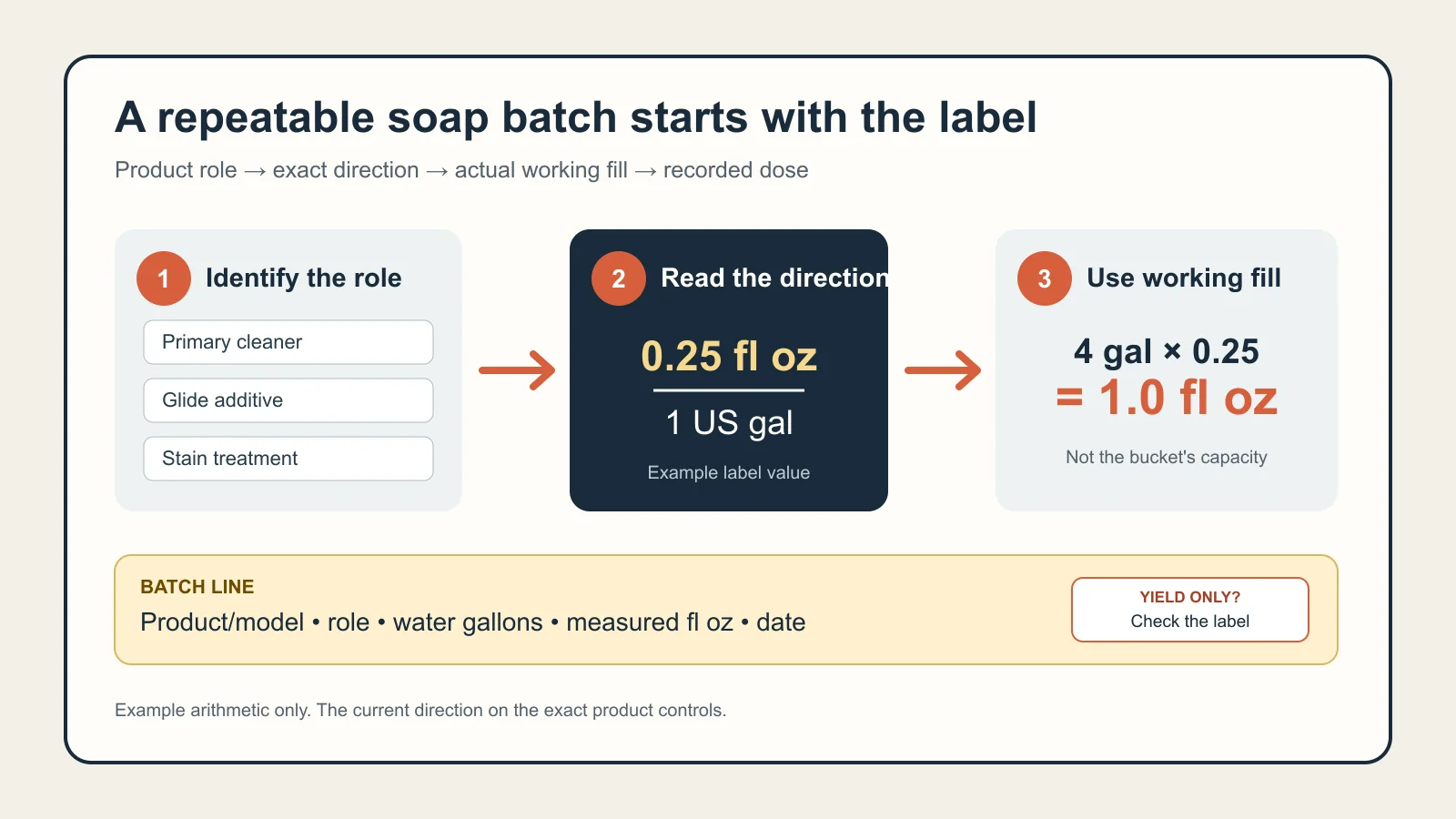
Use four facts instead: the exact product, its role, the manufacturer’s current fluid-ounces-per-US-gallon direction, and the water actually placed in the bucket. The calculation is simply:
working gallons × stated fluid ounces per gallon = fluid ounces of concentrate for this batch
If a bottle states 0.25 fluid ounce per gallon and the working fill is 4 gallons, the batch receives 1 fluid ounce. A 6-gallon bucket does not turn that into a 6-gallon batch. If the product role is unclear, the label gives only an approximate yield, or the glass has instructions that exclude the product, stop before calculating.
This is one line inside a complete traditional window-cleaning setup, not a substitute for choosing the washer, squeegee and access method. The bucket guide owns tool fit and working fill; this page begins after the actual gallons are known.
Start with the bottle, not the bucket
“Window cleaning solution” is a shelf category, not a single job. A primary cleaner, a glide additive and a stain-removal treatment can appear on the same manufacturer’s page while doing different work. Their numbers are not interchangeable.
| What the current product says it is | What the number means | Batch disposition |
|---|---|---|
| Primary window or glass cleaner | Base concentrate direction for the named cleaning task | Calculate from the exact per-gallon direction and working fill |
| Glide additive | Addition to an existing cleaning setup | Do not use its ratio as proof that it replaces the primary cleaner |
| Hard-water stain remover or other treatment | A separate restoration or contaminant task | Follow that product and surface direction; do not solve it by adding ordinary soap |
| Role missing or bottle not identified | Nothing reliable can be attached to the ratio | Hold the batch until product and role are known |
Titan Laboratories makes the distinction visible. Its current page calls Glass Gleam-3 and Glass Gleam-4 cleaners, while Glass Gleam-Glide is explicitly a glide additive. Glide’s 0.1-ounce-per-gallon recommendation can be calculated only as an additive line; it cannot be silently promoted to the cleaner line.
Write the exact family or model before the amount. “Ettore 30116” or “Titan GG4 current product” preserves the source. “Blue soap” does not.
Convert one label line into one batch
Keep both units in the written calculation. Suppose the exact direction is 0.25 fl oz per 1 US gal and the bucket holds 3 US gal for today’s route:
3 US gal × 0.25 fl oz/US gal = 0.75 fl oz
The gallon units cancel, leaving the concentrate quantity. That makes a transcription error easier to see than “three quarters” written without context.
Measure the water rather than inferring it from bucket size. A manufacturer may sell a 6-gallon bucket, but its capacity is only a ceiling. If the practical working fill is not known yet, use the bucket selection and load guide to settle the longest wet tool, water amount and actual load first. Then bring that working-fill number here.
Do not convert an approximate yield into a label direction. Unger’s current EasyGlide 0400 page says the 32-ounce product makes about 25 gallons. Dividing 32 by 25 produces about 1.28, but that is arithmetic on a rounded marketing yield, not a published mixing instruction. Read the current bottle or formal direction instead.
Current directions span 0.1 to 2 ounces per gallon
The table applies current manufacturer directions to four common working fills. It is not a performance ranking. A smaller dose does not prove better value or cleaning, and rows with different roles are not substitutes.
| Exact current product | Declared role and direction | 2 gal | 3 gal | 4 gal | 6 gal |
|---|---|---|---|---|---|
| Titan Glass Gleam-3 | Primary cleaner — 0.1 fl oz/gal | 0.2 oz | 0.3 oz | 0.4 oz | 0.6 oz |
| Titan Glass Gleam-4 | Primary cleaner — 0.25 fl oz/gal | 0.5 oz | 0.75 oz | 1 oz | 1.5 oz |
| Space Cowboy Window Soap | Primary cleaner — 0.5 fl oz/gal | 1 oz | 1.5 oz | 2 oz | 3 oz |
| Crazy Larry’s Window Cleaning Concentrate | Primary cleaner — 1 fl oz/gal | 2 oz | 3 oz | 4 oz | 6 oz |
| Ettore Squeegee-Off 30116 | Primary cleaner — 1–2 fl oz/gal | 2–4 oz | 3–6 oz | 4–8 oz | 6–12 oz |
| Titan Glass Gleam-Glide | Glide additive — recommended 0.1 fl oz/gal | 0.2 oz | 0.3 oz | 0.4 oz | 0.6 oz |
| Unger EasyGlide 0400, 32 oz | Primary cleaner — page says about 25 gal yield; exact dose not shown | Check label | Check label | Check label | Check label |
Ettore’s current page supplies the 1–2-ounce range. Titan supplies the 0.1-ounce GG3, 0.25-ounce GG4 and separate 0.1-ounce Glide directions. Crazy Larry’s states 1 ounce per gallon, while Space Cowboy states a half-ounce per gallon for the base bucket mix. Those figures belong to the named current products. They are not a blended recommendation for “window soap” in general.
The spread is itself useful. It shows why a capful, color target or remembered squeeze cannot travel safely between brands. Recalculate when the bottle changes even when the bucket and route stay the same.
A range needs a recorded starting point
Ettore’s 1–2 fl oz/gal direction creates a legitimate interval. Preserve it. For a 3-gallon working fill, the stated interval is 3–6 fluid ounces; it is not automatically 4.5 ounces.
For repeatability, begin with the lower stated endpoint unless the current direction or a documented route condition gives a reason to use another point inside the allowed range. Record the chosen amount before cleaning. If it is changed, record the second amount and the reason rather than describing both batches as “the normal mix.”
A practical line could read:
Ettore Squeegee-Off #30116 — primary cleaner — 3.0 gal water — 3.0 fl oz concentrate — Aug 23 — lower label endpoint
Preference language also needs restraint. Crazy Larry’s current page gives a one-ounce-per-gallon base direction and then permits adding or diluting to preference. Space Cowboy gives a half-ounce base direction and separately mentions drops on the mop. The matrix keeps the base bucket direction because optional adjustments are different events. If used, log them separately and remain inside the current product instructions.
More soap cannot repair the wrong problem
When the base mix is recorded and the result is unsatisfactory, name the problem before changing the dose.
If a squeegee leaves one line repeatedly at the same blade position, inspect and clean the rubber and retention system. The squeegee-rubber fault guide separates debris, edge damage and loose retention before authorizing a replacement; pouring more concentrate into the bucket does not close those faults.
If the complaint is hard-water deposit, adhesive, paint, construction debris or another non-routine contaminant, ordinary soap may be the wrong product role. Move to the exact glass or window supplier’s cleaning instruction and the treatment product’s current label. Do not use a manufacturer’s broad “safe for glass” marketing sentence as permission for every coating, tint film, low-e exposure or unknown surface.
If the product is correct but there is excessive residue, foam, drag or another mix-related symptom, compare the recorded amount with the exact current direction first. Change one documented variable at a time. Do not combine concentrates unless the label explicitly permits it, and do not improvise a vinegar or dish-soap addition on top of a commercial formula.
The product label controls use. The current safety data sheet for Unger EasyGlide controls handling, storage and response information for that product family. One manufacturer’s SDS cannot be applied to a different bottle.
Keep the batch line with the bottle
The useful result is not a favorite ratio. It is a batch that a second person can reproduce without asking what “a little” meant.
Record five fields where the concentrate is stored or on the route sheet:
- exact product and model or family;
- product role;
- actual US gallons of water;
- measured fluid ounces of concentrate, including whether it is a range endpoint;
- date and any label-authorized adjustment.
Recheck the line when the bottle, label, product role, working fill or surface task changes. If only an approximate yield is available, the next action is to read the current label—not to calculate a more precise-looking number from weaker evidence.
That is the whole batch discipline: identify, read, multiply and record. The arithmetic takes seconds; the exact product name is what keeps those seconds from producing the wrong mix.