A deionized water tank can be correct on resin volume and still arrive unable to join the route. The hose adapters may not close the exact inlet-to-outlet path. The cylinder may be too tall to remain upright where you planned to use it. A published weight may not say whether it describes an empty shell, a resin-filled tank or an operating tank. The larger version may have no declared carry handle.
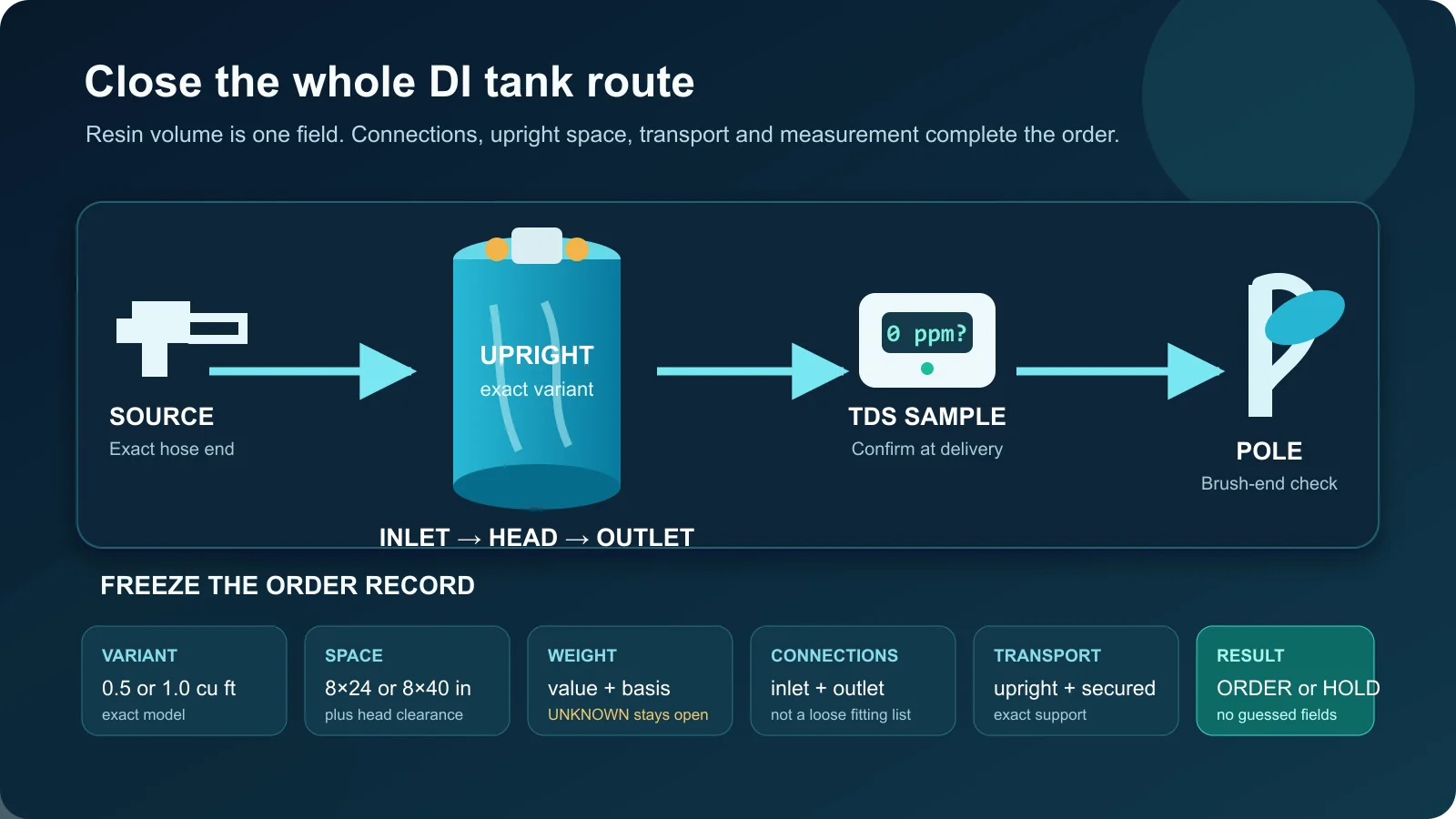
Treat “half cubic foot” or “one cubic foot” as one field in an order record, not the order itself. Before checkout, freeze the exact variant, outside dimensions, declared weight and its basis, included fittings, documented port direction, required orientation, included resin and transport support.
If the filtration path is not settled, hold the tank. If a required adapter is missing, add the exact fitting. If the tank cannot remain upright and secured on the route, solve that before ordering. The valid outcomes are order the exact tank, add a missing fitting, add transport support, hold the system path, or hold an unresolved specification.
Put the system decision ahead of the tank
A stand-alone DI vessel is a system choice before it is a hardware choice. Feed-water TDS and expected water use determine whether DI-only deserves comparison or whether RO/DI should carry the load. The water-fed pole system guide owns the complete filtration, hose, pole and monitoring architecture; the RO/DI system selector turns feed TDS, workload and resin capacity into the comparison path.
Do not reverse that sequence by buying a large tank and assuming extra resin makes DI-only suitable. A bigger vessel changes resin inventory and physical burden. It does not remove dissolved solids before the resin, create a membrane stage or prove acceptable operating cost. If TDS or expected water use is still an estimate, the correct result is hold the system path and measure first.
Draw the connection path before comparing vessels
Write the wet route as a literal chain: tap or source, supply hose, tank inlet and head, upright resin bed, tank outlet, delivery hose, pole hose, brush, and brush-end TDS sample. Each handoff needs an exact answer attached to the selected model.
| Route point | Evidence to record | If the field is missing |
|---|---|---|
| Source to supply hose | Actual faucet or hose end, interface and any exact-model pressure control | Hold the connection; do not infer from a garden-hose label alone |
| Tank head and ports | Current diagram or instruction identifying inlet, outlet and flow direction | Return HOLD_EXACT_SPEC |
| Tank to delivery hose | Exact adapter on the selected tank and exact receiving hose end | Return ADD_MISSING_FITTING |
| Operating position | Outside dimensions, head and hose clearance, stable upright location | Do not assume the tank can run on its side |
| Vehicle and route | Exact handle, support or restraint and the condition of the published weight | Return ADD_TRANSPORT_SUPPORT |
| Point of delivery | Accessible product-water and brush-end sample locations | Add a measurement point; do not assume outlet equals brush end |
A broader manufacturer DI tank operating guide notes that each tank size has an intended flow range. That is a reason to obtain the exact compact tank’s formal flow and pressure document, not permission to transfer industrial values to window-cleaning equipment. When an exact range is absent, keep it unknown.
XERO’s two current sizes change more than resin volume
The current XERO DI tank product page gives a useful example of why variant identity matters. Its half-cubic-foot and one-cubic-foot tanks differ in height, declared weight, internal water volume and included transport support—not only resin volume.
| Order field | Half cubic foot | One cubic foot | What the field decides |
|---|---|---|---|
| Resin volume | 0.5 cu ft | 1.0 cu ft | Exact refill family and input to resin planning |
| Outside dimensions | 8 × 24 in | 8 × 40 in | Minimum cylinder envelope; extra head and hose clearance still required |
| Declared weight | 25 lb; basis not stated | 47 lb; basis not stated | A source fact, not yet a loaded route weight |
| Declared internal water volume | 4 US gal | 8 US gal | Vessel volume only—not pure-water output or resin life |
| Included hose fittings | 3/4-in garden-hose-to-female-swivel adapter; garden-hose-male-to-3/4-in-NPT-male fitting | Same two fittings listed | Box contents; inlet/outlet mapping remains to be documented |
| Resin included | Yes | Yes | Whether the first order is a filled product or an empty-vessel plan |
| Operating orientation | Upright | Upright | Required job-site space and support |
| Included carry support | Nylon handle listed | No included handle declared | Whether transport support remains an open order line |
These are declared product facts, not a best-tank verdict. The page does not state the basis of the 25- and 47-pound figures in the captured specification. Its text lists two included fittings without labeling their exact inlet/outlet mapping. Keep those fields open rather than completing the record from appearance. A current specialist product page corroborates the dimensions, fittings, resin, handle and upright-use requirement, but a seller Q&A is still not a formal port or transport document.
A published weight without a basis is not a route load
“25 lb” looks precise, but precision is not the same as completeness. The operational question is what condition was weighed. A dry shell, a tank filled with resin, and a water-filled operating tank are different loads. If the source does not say, write 25 lb — basis unknown. Do not add an assumed amount of water or advertise a loaded weight the manufacturer did not publish.
The same discipline applies to volume. Four gallons inside a vessel is not “four gallons of output.” Resin capacity and feed TDS determine a planning estimate; measured product water determines whether the actual system is still meeting its target. Internal volume only describes the vessel and possible retained water.
This matters in the vehicle. A handle can identify a feature supplied with one variant, but it does not publish a safe loaded carry limit, prove comfort or replace a restraint. The absence of a declared handle on the larger variant is an unresolved transport field, not evidence that any improvised strap is compatible.
Close the order line in the vehicle, not the cart
Walk the exact cylinder to the place where it will operate and travel—on paper before it arrives. For the 8-by-24-inch tank, reserve more than 24 inches of real vertical envelope because the head, attached hose and bend radius need space. For the 8-by-40-inch variant, repeat that check at 40 inches. Product dimensions are not installation-clearance allowances.
Next, decide how the tank remains upright at the job and how it is secured between jobs. “Keep upright during use” does not mean “drive with water in it” or “rest it loose against other tools.” Use only a support or restraint documented for the exact tank and vehicle arrangement. If none is documented, return ADD_TRANSPORT_SUPPORT rather than improvising a universal answer.
Now close the two wet connections. Copy the included fitting names into the record, then obtain a diagram or current exact-model instruction that maps tank inlet and outlet. Compare each side with the source hose and delivery hose already owned. A same-size thread, a similar brass part or another brand’s photo does not prove that direction, sealing surface and intended use match.
An order line that is ready should contain: brand and exact variant; resin volume; diameter × height; declared weight and basis; head/port document; source-side adapter; delivery-side adapter; upright operating space; resin included; route support or restraint; formal pressure/flow reference; and unresolved fields. If any essential field still says unknown, the clean result is a hold—not a more confident product adjective.
Hand measurement back to the meter
The tank record ends where water-quality operation begins. A TDS plan needs feed water, product water and point-of-delivery coverage. A fixed inline reading cannot automatically prove the brush-end result after every downstream hose and connection; a handheld sample may be needed there. The TDS meter guide for window cleaning owns that choice.
Resin life is also a separate question. The DI tank resin-life guide uses feed TDS, vessel capacity and expected water use to create a planning interval. The RO/DI selector owns the DI-versus-RO/DI comparison. Neither calculation turns the tank’s internal 4- or 8-gallon water volume into output capacity, and no seller threshold becomes a universal replacement rule.
Keep this hardware line with the tank: exact variant — resin volume — dimensions — declared weight/basis — inlet document — outlet document — upright location — included resin — transport restraint — TDS sample points — date. Another technician can inspect it when the route, hose, vehicle or product page changes. The cylinder is ready to order only when the line describes the whole route, not just the amount of resin inside it.