A six-gallon label sounds like freedom from refills. It also represents about 50 pounds of water when filled to six US gallons—before the bucket, washer, squeegee, soap or debris is added. Capacity tells you what the container can hold. It does not tell you what to carry.
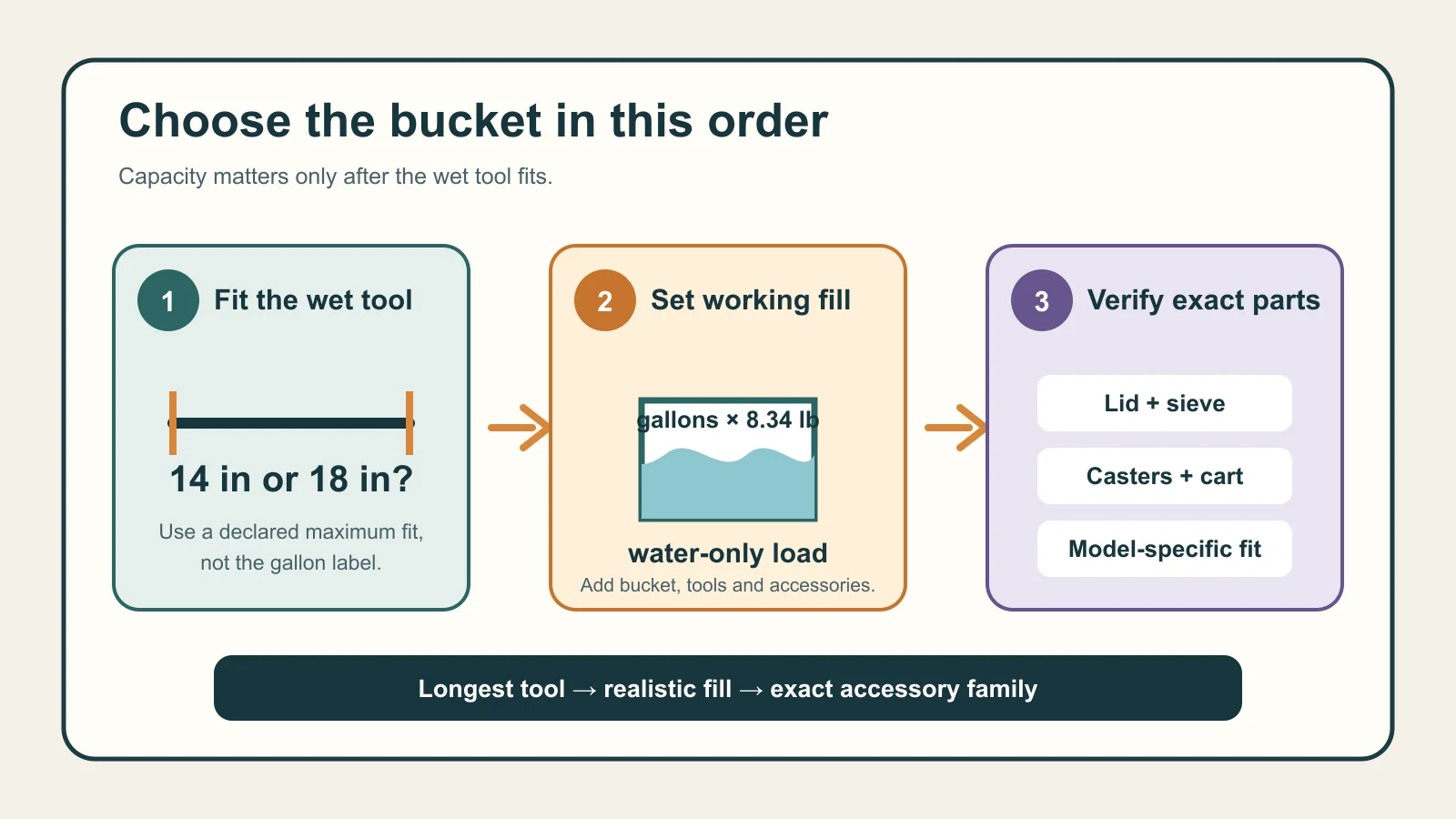
A compact bucket creates the opposite failure. It may be light and easy to store, yet reject the 18-inch washer you already chose. Two numbers should therefore exist before brand comparison begins: the assembled length of the longest tool that must enter the water, and the number of gallons you expect to use between fills.
Use those numbers to eliminate buckets, estimate the working load and then verify the exact lid, sieve, caster, clip or cart family. The bucket belongs in a broader professional window-cleaning tool setup only after all three parts agree.
The longest wet tool decides which buckets stay in the comparison
Measure the complete washer or squeegee you plan to dip, including any ends that make it longer than its nominal working width. This is a bucket measurement, not a recommendation for which squeegee belongs on the glass. If that tool choice is still open, finish the complete squeegee fit and replacement path first.
Now require a manufacturer statement that the bucket accommodates that length. A gallon figure cannot close this field. Neither can the outside length of the bucket: walls, corners, clips and internal shape can change the usable opening.
The current Ettore #82222 page says its 3.5-gallon compact bucket fits most 14-inch squeegees and washers. That creates a compact candidate for a tool record at or below the declared fit, with the word most preserved. Current Unger DB02 and Libman #1066 pages explicitly state up-to-18-inch tool fit. Sörbo describes model 2086 as an 18-inch-long bucket, but that is a product dimension rather than an explicit maximum tool length, so this field remains open for that exact cart.
If a window-cleaning starter kit already includes a washer or squeegee, copy its exact model and assembled length rather than treating “bucket included” as proof that every selected tool fits. The bucket decision begins after the wet-tool list is real.
Rated capacity is a ceiling, not a carrying plan
The U.S. Geological Survey uses about 8.34 pounds per US gallon of water. Multiply the intended working fill by 8.34 to expose the water-only load.
| Working fill | Approximate water-only load | What the number does |
|---|---|---|
| 2 US gal | 16.7 lb | Establishes the water portion before the bucket and tools. |
| 3 US gal | 25.0 lb | Makes a partial fill comparable across different rated capacities. |
| 3.5 US gal | 29.2 lb | Shows the water at the published maximum of a 3.5-gallon bucket. |
| 4 US gal | 33.4 lb | Gives a working-fill example inside a six-gallon container. |
| 6 US gal | 50.0 lb | Shows why maximum capacity is not automatically the carry plan. |
This is arithmetic, not a safe carrying limit. Add the published empty bucket weight where it exists, then add the actual tools, accessories, cleaning solution and debris. Unger publishes 3.0 pounds for DB02, so a four-gallon fill produces about 36.4 pounds for water plus the empty bucket, before everything else. Ettore publishes 1.78 pounds for #82222; at 3.5 gallons, water plus the empty bucket is about 31.0 pounds before tools.
Choose the working fill from the job, refill access, movement plan and your applicable workplace procedures. The useful comparison is not “Which bucket holds the most?” It is “Which bucket accepts the tools while carrying only the water this part of the route needs?”
Measurement marks help repeat a chosen fill; they do not choose it. Unger declares marks on DB02, and Libman declares easy-read fill lines on #1066. When the exact bucket has no published scale, measure the water separately rather than inventing a line from the rim.
Current buckets close different parts of the record
The four examples below are not ranked. Each manufacturer page closes a different set of fields and leaves a different question for the buyer.
| Exact current product | Declared tool and capacity fields | Movement, storage and accessory fields | Still unresolved from the captured page |
|---|---|---|---|
| Unger DB02 6 Gallon Heavy Duty Bucket | 6 gallons; tools up to 18 inches | 3.0 lb empty; measurement marks; two pour spouts; accepts casters | Exact caster model, lid, sieve and reliable full dimensions |
| Ettore #82222 3.5-Gallon Bucket | 3.5 gallons; most 14-inch squeegees and washers | 1.78 lb; 12 D × 12 W × 11 H inches; compact handle-equipped form | Lid, sieve and rolling accessory family |
| Libman #1066 Window Cleaning Bucket | 6 gallons; squeegees up to 18 inches | Easy-read fill lines; 18.25 × 10.75-inch rectangular footprint published | Empty weight, full height and accessory family |
| Sörbo 2086 Bucket with Clips | 6 gallons; 18-inch product length, not treated here as maximum tool fit | Integrated tool clips; named Leif Cart path; declared compatibility with Pulex bucket lids | Explicit maximum tool length, water-transport seal and other accessory fit |
The compact-versus-full-size split is now concrete. A declared 14-inch fit can close a compact route only when every wet tool fits it. A declared 18-inch fit keeps larger washers in the comparison, but the selected working fill still controls load. An accessory-rich record can simplify a mobile setup, but it does not repair an unknown tool fit or prove a lid will hold water in a moving vehicle.
Product dimensions matter twice. First, they decide whether the empty bucket fits its storage position. Second, the selected lid, clips or casters can change the stored envelope. Use the assembled storage measurement when clearance is close; the bare-bucket footprint is not enough.
An accessory name is not a compatibility record
Write each required accessory next to the exact bucket model. “Add lid” is incomplete. The record needs the lid family or part number and a manufacturer statement that it fits that bucket. Apply the same rule to a sieve, wringer, caster set, holder, clip or cart.
Unger DB02 accepts casters, but the captured manufacturer page does not name the exact caster model. That is a useful compatibility direction, not a finished order. Sörbo 2086 closes more of its movement path by naming the Leif Cart and declares compatibility with Pulex bucket lids. Those claims remain inside that exact product record; they do not prove another bucket accepts those parts.
A lid claim also needs the right verb. “Compatible” means the named lid is declared to fit. It does not mean leakproof, approved for carrying water in a vehicle or safe to stack under other equipment. If the work requires premixed water between jobs, obtain an explicit transport claim for the exact container or move the water in a separate purpose-specified sealed vessel and fill the work bucket on site.
Clips and sieves solve different jobs. A clip parks a named tool at the rim. A sieve or wringer changes how excess liquid is handled. Do not substitute one because both appear under “bucket accessories,” and do not infer that either is included unless the exact variant lists it.
Write the bucket as an operating specification
A purchase is ready when it can be written without category words doing the work:
Exact bucket model — longest wet tool and assembled length — manufacturer-declared maximum tool fit — working fill in US gallons — water-only load — empty bucket weight or UNKNOWN — storage envelope — exact lid/sieve/caster/clip/cart — unresolved transport condition.
That line produces four practical outcomes. Use compact 14-inch when every wet tool is inside a declared 14-inch fit and the working fill covers the planned segment. Use fits 18-inch when the manufacturer explicitly closes the larger tool length and the working fill remains acceptable. Use stationary full-size when a larger bucket fits the work but does not need to be carried full or rolled. Use mobile accessory verification when the result depends on an exact caster, cart, lid or holder that still has to be matched.
Stop at the first invented field. An unknown empty weight can remain unknown if you weigh the exact bucket before setting a load plan. An unknown lid family must be closed before that lid enters the order. An 18-inch exterior dimension must not be rewritten as 18-inch tool fit.
The useful window cleaning bucket is therefore not the one with the largest number on its label. It is the exact container that accepts the real tools, holds the chosen working fill, fits its storage position and moves only through accessories the manufacturer actually connects to it.