Open the exact product page you intend to buy. Copy its contents into a blank note, then temporarily hide the words starter, professional, essential and complete. Those words do not say which work the box can finish.
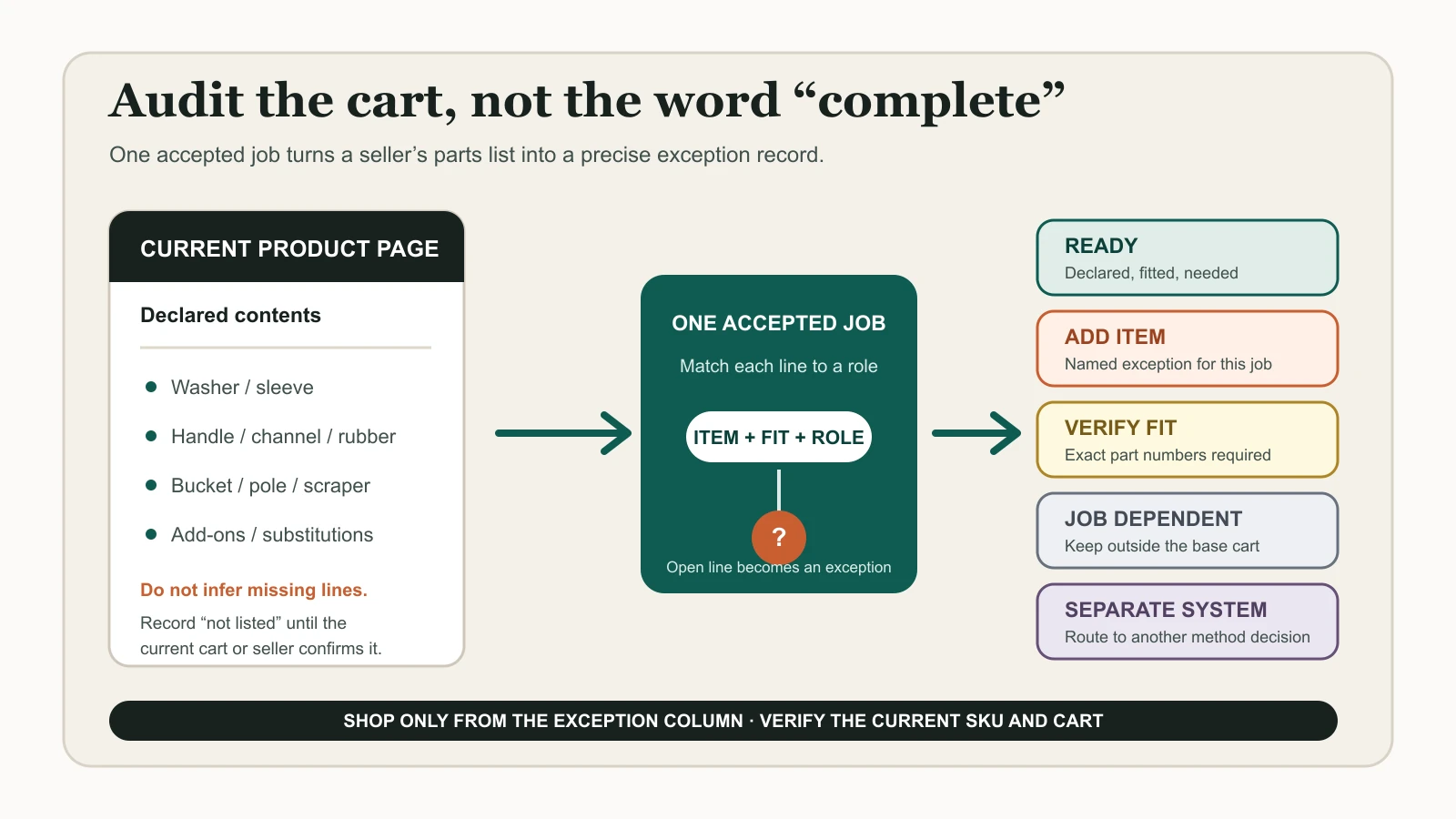
For a first paid job, the useful question is not “How many pieces are included?” It is “Which required job functions have an exact item, which need an add-on, and which still depend on fit or scope?” Give every line one of five marks: ready, add item, verify fit, job dependent or separate system. The exception rows become the shopping and supplier-question list.
The product title is not a scope statement
A kit can be complete for a two-tool wash-and-squeegee core, a household task, a portable storefront setup or a much broader traditional toolkit. Current product pages use the same “starter kit” language for all of those shapes. The label is not wrong; it is simply not your job specification.
Write one sentence above the copied parts list. For example: “Interior and exterior ground-reachable glass, using a traditional washer and squeegee, with no water-fed work, elevated access method or specialist restoration included.” Change that sentence to match the work you will actually accept.
If you have not defined that work yet, use the broader professional window-cleaning tool setup first. This page starts one step later: an exact kit is already on screen, and the task is to reconcile its current contents against that one job.
The scope sentence keeps useful omissions separate from unnecessary purchases. A pole is not missing when every pane in the accepted job is reachable by hand from the working floor. A scraper is not automatically required because a kit includes one. A pure-water system is not a “missing accessory” for a traditional job; it is another operating system.
Give every line item one of five marks
| Mark | Use it when | What you write next |
|---|---|---|
| Ready | The exact item is declared in the current box, belongs to the accepted job and any required connection is documented. | Record the model, size and role. |
| Add item | The job needs the function and the page explicitly sells the item separately, or the item is not listed in the declared contents. | Name the item and reason; keep “not listed” as the evidence wording. |
| Verify fit | A pole, handle, channel, rubber, washer, adapter or replacement must join another exact component and the connection is not closed. | Ask for part numbers or a written compatibility answer. |
| Job dependent | The item is useful only for a surface, contaminant, reach condition or service not included in every job. | Keep it outside the base order until that condition is accepted. |
| Separate system | Adding the item would change the cleaning or access method rather than finish the same kit. | Route it to its own equipment and scope decision. |
One wording rule matters: if a product page does not list an item, write not listed, not not included. A retailer may bundle something at checkout, change a variant or substitute a part. The current cart—not an inference from silence—owns the final answer.
Current starter kits leave different blanks
The examples below are not rankings. They show why the audit has to follow exact declared contents rather than a piece count.
| Current kit page | What the page declares | Exception the audit exposes |
|---|---|---|
| Unger Pro Starter Kit 2in1, AKG10 | One 35-cm washer and one 35-cm squeegee. The page says the rubber is replaceable and the tools can be combined with telescopic poles. | This is a two-tool cleaning core. A pole and spare rubber are options mentioned by the page, not items it declares inside the two-piece kit. |
| Ettore Starter Professional Kit #2506 | A 14-inch washer; 8-, 12- and 18-inch channels; three replacement rubbers for each listed size; scraper and ten blades; 8-foot pole. | The page separately directs the buyer to combine the kit with buckets. Towels, cleaning liquid and the carrying plan still have to be reconciled with the job rather than assumed from “complete.” |
| Ettore Welcome Kit #2508 | Two handles, 12- and 18-inch channels, 10- and 18-inch washers, and a SideKick holster with belt. | The page directs buyers to microfiber cloths. Its use sequence also calls for a bucket and solution, but neither is declared in the kit details shown on the page. |
| Rubbermaid Commercial 6-Piece Kit #2221951 | 14-inch squeegee, 14-inch washer, bucket, lid, 4-inch scraper and 48–72-inch Quick-Connect handle. | The named glass microfiber cloth is explicitly sold separately. The handle’s declared system fit is HYGEN Quick-Connect, so an existing non-HYGEN head needs its own proof. |
| IPC Kristalset | Three channel sizes with handles/rubber, replacement rubber, scraper parts, 14-inch applicator, sponge, offset adapter and a 2 × 1.25-m telescopic pole. | IPC warns that not all features are available for all variants. The page supplies a strong list, but the ordered variant still owns the answer. |
| LTWC Essentials Starter Kit | Pole, two complete squeegees, washer, bucket-on-a-belt, 6-gallon bucket and scraper. | The current page declares temporary handle and scraper substitutions and says the bucket lid is sold separately. Reopen the current cart before treating the displayed list as frozen. |
These pages also show why “more pieces” is a weak comparison. Three channel widths may be three useful options, but they still occupy one job function: removing water. A bucket and lid close a different function. A replacement rubber closes another. Count operating roles and unresolved exceptions, not objects in the photograph.
Reconcile one paid job against the box
Use the table below with the scope sentence still visible. The example assumes ordinary traditional glass cleaning from stable ground. It does not add water-fed work, a different access method or specialist surface restoration.
| Job function | Evidence to copy from the exact page | If the line stays open | Mark |
|---|---|---|---|
| Wet and agitate the glass | Washer T-bar/sleeve or complete washer, including size | Name the missing washer assembly; record cleaning liquid separately if the workflow needs it and the page does not list it. | Ready or add item |
| Remove the water | Handle, channel and rubber that form one documented assembly | Ask which channel/rubber fits the handle; do not treat an extra channel as an extra complete squeegee. | Ready or verify fit |
| Detail edges and keep clean cloth available | Exact cloth or towel item and its intended role | Add clean detail cloths when the job needs them and the page lists none or sells them separately. | Ready or add item |
| Carry liquid and separate wet tools | Bucket/container, lid if required, and any holster or wet-tool holder | Add only the carrying pieces the route needs; a holster does not replace a solution container. | Ready or add item |
| Recover from a common wear item | Correct replacement rubber, sleeve or other model-specific consumable | Identify the exact replacement family and quantity instead of buying a generic spare. | Ready, add item or verify fit |
| Remove unusual residue | Exact scraper/pad, protected replacement part and surface permission | Keep the item conditional until the contaminant and glass/coating method are known. Inclusion in a kit is not permission for every pane. | Job dependent |
| Reach glass from the accepted ground position | Exact pole plus the head/adapter connection used by the chosen washer or squeegee | Resolve the complete attachment and job geometry. If the work changes access method, stop treating it as a kit add-on. | Verify fit, job dependent or separate system |
| Use purified water at a brush | Treatment, delivery hose, pole, brush, fittings and monitoring for one complete path | Move the requirement to a complete water-fed-system decision; a traditional pole in the box does not close it. | Separate system |
Run the table against the exact kit, not against the category. For Ettore #2506, the replacement-rubber line has declared stock while the bucket is an explicit add-on. For Rubbermaid #2221951, the bucket/lid line is declared while the named detail cloth is separate. For Unger AKG10, the washer and squeegee core can be ready while carrying, liquid, replacement stock or reach remain separate lines according to the job.
That is the whole advantage of reconciliation: the same item can be unnecessary for one accepted job and a genuine blocker for another. The table produces a small, defensible add-on list rather than a universal beginner inventory.
Close the interface lines before checkout
An open fit question is not an invitation to buy a bag of adapters. Send the seller or manufacturer three exact questions:
- “For the exact SKU in my cart today, what items and substitutions will ship?”
- “Which exact part number connects this named washer, squeegee or adapter to this named pole or handle, and is that connector included?”
- “Which replacement rubber, sleeve and blade part numbers fit the included components, and what replacement quantity is declared in this kit?”
Save the answer with the order record. This is especially important when the page warns about variants or temporary substitutions, or when a mixed-brand kit combines a pole, head and channel from different product families.
If height or an obstruction changes the accepted job, use the ground-based high-window tool paths before asking which adapter to add. If the desired method sends purified water through a brush, specify the complete water-fed pole system instead of stretching a traditional kit into another system.
Buy from the exception column, not the piece count
Your final decision should fit one of five plain outcomes:
- Order as listed when every function in the scope sentence is ready and the current variant is confirmed.
- Order with named add-ons when the only open rows are precise, compatible items such as the declared bucket, cloth or correct replacement stock.
- Pause for variant or fit when the cart can change, a substitution is active or a connection lacks exact part-number evidence.
- Split the purchase into a separate system decision when water-fed work or another access method has entered the job.
- Hold that job scope when the surface method, reach condition or operating system is not defined well enough to specify equipment.
Copy only the add item rows into the shopping list. Copy the verify fit rows into the supplier message. Leave job dependent items outside the base cart until the accepted work makes them necessary. Once those exception columns are empty or deliberately routed elsewhere, the word complete no longer has to do any work.