Put the belt catalog aside for five minutes. Write down the tools that must stay on your body during one ordinary traditional window-cleaning route: the exact washer, squeegee or squeegees, scraper if the accepted work calls for it, and the cloths you need between trips to the main bucket or vehicle.
That list—not the number of loops in a product photo—is the load. A belt is ready to order only when every item has a documented place, wet tools cannot quietly soak the dry stock, and an edge does not share an open pouch because the cart ran out of slots.
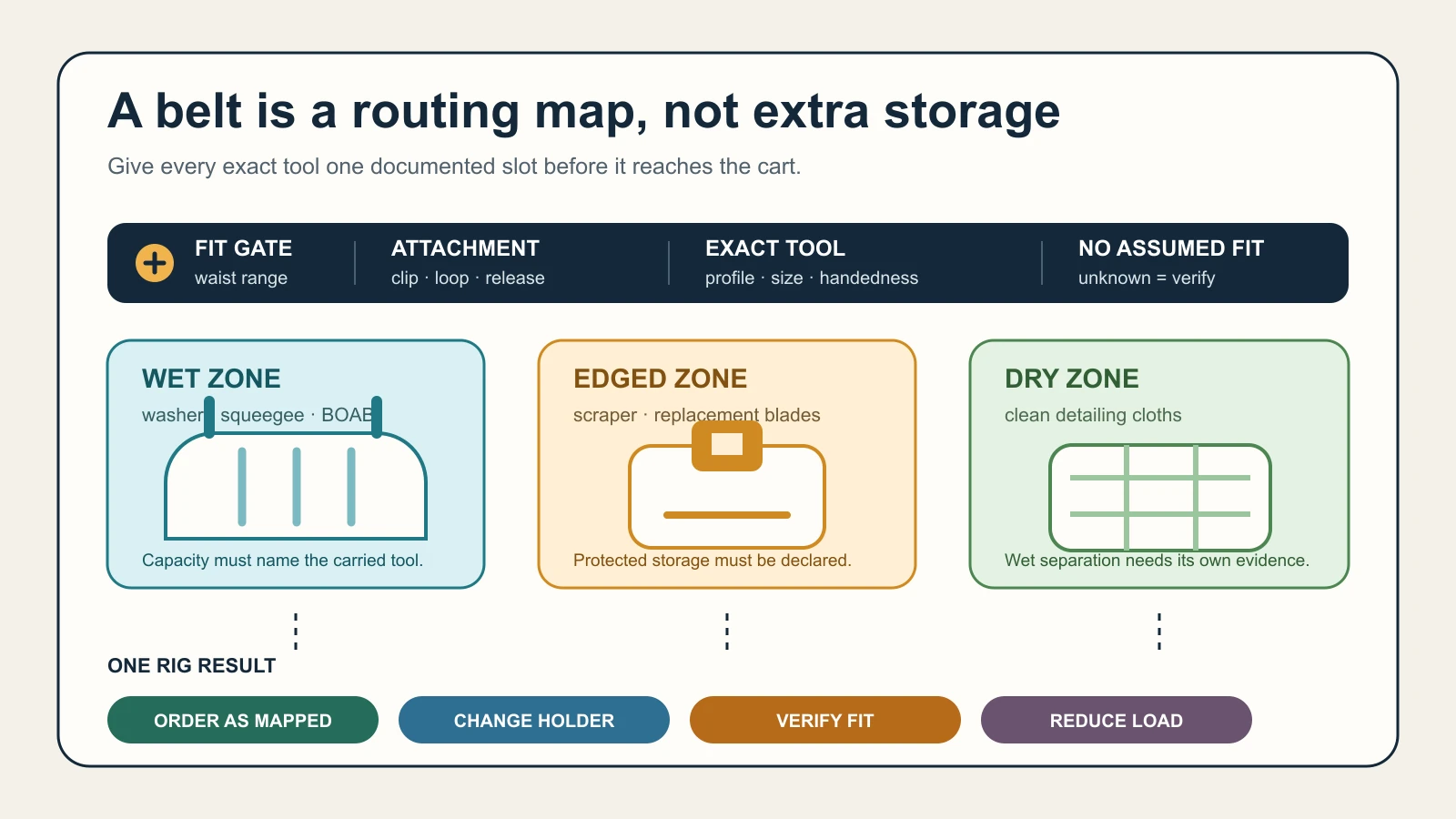
Use four outcomes. Order as mapped means every carried item has an owned slot and the belt fit is closed. Change holder means the layout works but one holder does not. Verify fit means the maker’s wording stops short of your exact tool or attachment. Reduce load means the waistline is carrying something that belongs in the main bucket, bag or vehicle.
Empty the belt before you shop for it
The complete equipment list and the belt load are different records. A route may need spare rubber, extra cloths, cleaning liquid and an extension tool, but that does not mean every reserve item belongs at the waist. Start with what must be retrieved while moving between ordinary ground-level panes. Keep replenishment stock elsewhere.
Make the first pass brutally short:
- Name each tool by model or at least by exact handle/channel profile and size.
- Mark whether it will be wet, must stay dry, or has an edge that needs a dedicated holder.
- Note which hand normally retrieves it; this is a placement input, not proof that a holder reverses.
- Move every “just in case” item off the belt until a real job function brings it back.
If you are still deciding which tools the job requires, build the broader professional window-cleaning tool setup first. The belt comes after the accepted work and tools, not before them.
Give wet, dry and edged tools different addresses
A BOAB or side bucket is a wet zone. A washer can return there carrying solution; a squeegee may share a model’s declared holder. A towel pouch is a dry zone only when its design or your own separate arrangement protects clean cloths from that wet return path. A scraper and replacement blades form an edged zone: the storage has to declare the role rather than borrow an open pocket.
Those zones do not have to be three bulky accessories. They do have to be three explicit answers.
- Wet: Which exact holder accepts the washer and squeegee profiles? Does the ordered attachment use a fixed loop, removable clip or another mechanism?
- Dry: Which compartment owns clean detail cloths, and what keeps the wet washer from entering it?
- Edged: Which exact holster or protected pocket owns the scraper and replacement blades?
This is where current manufacturer details matter. Unger’s window-cleaning catalog describes its ErgoTec pouch as having three waterproof compartments for separating dry and damp cloths. Ettore’s current Utility Pouch instead declares two pockets for 6-inch scrapers and a hidden replacement-blade pocket; its page does not make the same moisture-separation claim. Both descriptions are useful, but they close different slots.
Make every slot prove its job
Complete one row per carried item. “Universal,” “professional” or “fits most” can stay in your notes, but none of those words closes the exact-tool column.
| Carried item | Required zone | Proposed holder | Evidence that closes the slot | If evidence is missing | Result |
|---|---|---|---|---|---|
| Exact washer/T-bar and sleeve | Wet | BOAB or declared washer holder | The maker names a washer, and the actual profile enters, seats and releases in the reader’s ground-level dry fit. | Record the profile and holder model; ask for written fit or change holder. | Ready or verify fit |
| Exact squeegee handle/channel | Wet | Declared squeegee slot | The maker names a squeegee; slot opening and depth work with the exact profile. | Do not infer wide- or slim-channel fit from category wording. | Ready or verify fit |
| Clean detailing cloths | Dry | Separate cloth compartment | The manufacturer declares separate dry/damp storage, or the reader assigns a physically separate dry pouch. | Add or change the pouch; do not share the wet reservoir. | Ready or change holder |
| Scraper used by the accepted job | Edged | Exact scraper holster/pocket | The product page declares the scraper size and protected storage. | Keep it off the belt until the exact holder is named. | Ready or verify fit |
| Replacement blades | Edged | Closed blade pocket/container | The product page declares replacement-blade storage. | Add protected storage or move blades to replenishment stock. | Ready or reduce load |
| Extra channel or second squeegee | Wet | Additional declared slot | Holder capacity and the exact profile are both closed. | Decide whether the second size earns its place on this route. | Ready, verify fit or reduce load |
| Small accessory | As used | Loop or closed pouch | The belt provides a documented attachment and the item cannot escape during the dry run. | Assign a different owner or remove it. | Change holder or reduce load |
The row is not complete because a merchant photograph looks plausible. It is complete when the exact item, holder and attachment produce one defensible answer. If a product page is silent, write verify fit rather than filling the gap with a brand assumption.
Exact specifications eliminate false matches
Manufacturer pages often provide enough information to reject a bad cart even when they cannot prove the final personal fit.
| Current source | What it actually declares | What that changes in the card |
|---|---|---|
| Ettore Tool Belt #2044 | Nylon construction, quick-connect buckle, a leather cloth loop and declared use with Ettore holsters; “44-inch” appears in the product name. | The Ettore-system attachment is documented, but the page does not supply a captured minimum adjustment range or prove another brand’s clip. |
| Ettore SideKick #02041 | Holds a scrubber and squeegee; detachable-clip and non-detachable-loop variants; reversible left/right use. | The cart must name the attachment variant. Exact tool profile still receives a fit check even though the page describes broad brand accommodation. |
| Ettore Utility Pouch #50135 | Two pockets for 6-inch scrapers and a hidden pocket for replacement blades. | It can own those edged-tool rows; it cannot be labeled a dry-towel pouch from this source alone. |
| Unger ErgoTec Belt BSTBT | 32–50 in / 80–130 cm, padding, four clips and quick-release closure. | The reader can compare an actual waist range and available clip count before worrying about accessories. |
| Unger “The Belt” UB000 | 2-in / 5-cm nylon webbing, two additional tool loops and a side-release buckle. | Webbing width and loops are closed; waist range is not present in the captured catalog section. |
| Unger BOAB and ErgoTec Pouch | BOAB roles include squeegees, washer, scraper and liquid; the pouch declares three waterproof compartments for dry/damp cloth separation. | The products close different wet and dry jobs. They still do not prove every third-party tool profile or the reader’s preferred layout. |
These are examples, not a ranking. Their value is the contrast between what the source says and what a buyer might assume. A named capacity closes a role. A size range closes one fit field. A detachable variant changes removal behavior. None of them automatically closes cross-brand compatibility, total loaded weight or personal comfort.
The same distinction prevents the belt page from swallowing the starter-kit audit. A starter kit asks whether the job functions are present in the box. This card assumes the carried tools are already chosen and asks where each one lives.
Run the rig dry, on the ground
Remote product research cannot tell you how an exact loaded layout sits on your body. Treat that as a user-owned observation, not a claim from this guide. Assemble the exact belt and holders without liquid and keep the check at ground level.
- Put each intended tool in its assigned slot. Anything without a slot goes back on the table.
- Release and reconnect every removable holder using the ordered attachment variant. Record a failed or ambiguous connection as verify fit.
- Walk, turn, bend and kneel as your ordinary ground-level work requires. Note contact, uncontrolled movement or a tool that cannot be retrieved and returned without looking away from the task.
- Remove the washer and squeegee in the planned sequence, then return them. Do not redesign the rig around an item that belongs in replenishment stock.
- Confirm that dry cloths and protected blades still have their own closed locations after the wet-tool slots are occupied.
This dry run does not certify field use, ladder work or comfort over a full day. It does something narrower and more useful before purchase: it exposes a slot that exists in the catalog but fails with the exact tool, attachment or wearer.
Remove anything that cannot earn a slot
Now issue one result for the whole map.
- Order as mapped: the belt fit, every attachment and every carried item have an exact owner; wet, dry and edged zones remain distinct.
- Change holder: the carried load is justified, but one capacity, attachment or compartment does not perform the required job on paper or in the dry fit.
- Verify fit: the layout may work, but exact model/profile, attachment variant, waist range or handedness evidence is still open.
- Reduce load: an item duplicates another role, has no stable owner or belongs with reserve stock rather than on the body.
Do not solve an unowned tool by adding a generic pouch. Either name a holder that documents the role or move the item off the belt. The finished rig should look smaller than the catalog because every remaining slot has a reason to exist.