A line of water behind the squeegee does not automatically mean “buy new rubber.” A grain of debris on the edge can travel with the tool. A missing end clip can let an undamaged strip creep sideways. Technique or insufficient wetting can also leave water without creating a parts problem.
Start with one controlled check. Clean and dry the rubber edge, inspect it under side light, make sure it sits evenly in the channel, then run it over a small, fully wetted section of ordinary glass. Note whether a remaining line starts at the same point on the blade. A persistent line that follows a visible nick or rounded spot supports replacement; a strip that moves in the channel points to retention first.
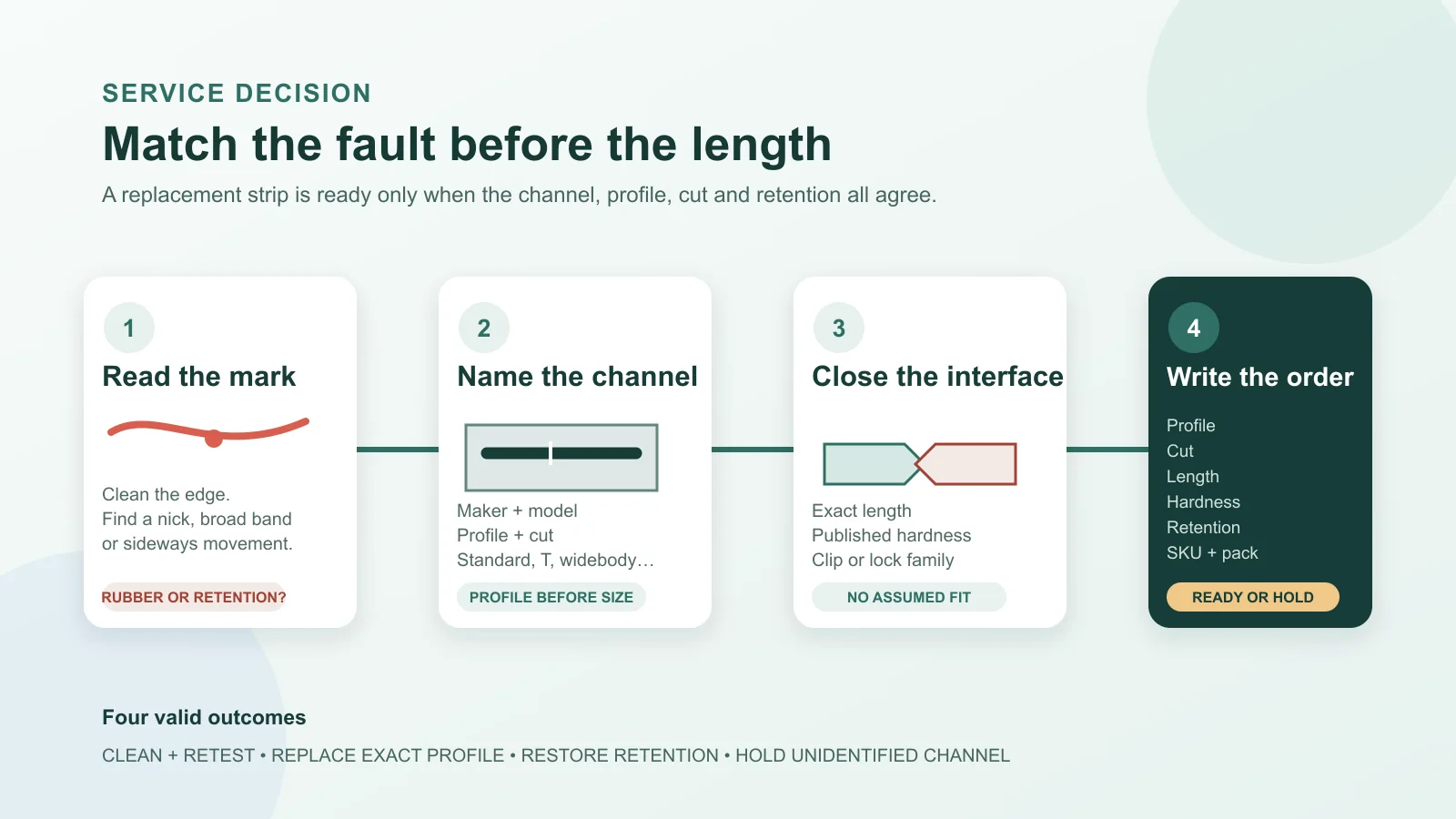
Only then write the order. The sequence is existing channel maker and model, rubber profile, cut type, length, manufacturer-declared hardness option, clip or locking method, exact replacement SKU and pack. Length is not first because several incompatible profiles are sold in the same nominal lengths.
If the complete squeegee is not yet identified or serviceable, finish the complete squeegee and pane-fit decision before shopping for its consumable. Rubber selection begins with a known channel, not a loose strip measured on a desk.
Read the mark against the blade, not the calendar
A current specialist rubber category says there is no standard time for replacing squeegee rubber. That is the useful part of the timing answer: a daily, weekly or pane-count rule would ignore edge damage, contamination, storage, workload and the channel holding the rubber.
Use the observed fault to decide which part of the tool deserves attention.
| What you observe after cleaning the edge | Check next | Buying disposition |
|---|---|---|
| One narrow water line repeatedly starts at the same position, and that position has a visible nick or rounded edge | Mark the location on the channel and confirm the defect follows the rubber rather than the glass | Replace only after the exact profile, cut, length and product family are known |
| A broad band or changing patch remains, with no visible edge defect | Recheck wetting, contamination on the glass and the way the tool is being held | Clean and retest; this result does not yet authorize a rubber order |
| The rubber creeps sideways, protrudes unevenly or will not stay centered | Inspect the exact channel’s end clips, SmartClips or locking structure | Restore the documented retention parts before judging the rubber |
| A new strip buckles, slides or requires force to enter | Compare its cross-section and cut with the old strip and the manufacturer’s channel record | Hold the installation; same length has not proved compatibility |
This is a purchasing diagnostic, not a complete squeegee-technique lesson. The point is to avoid replacing a consumable before the evidence points to it. Ettore’s current replacement page connects rounded or damaged edges with streaking, but a manufacturer product claim cannot eliminate every other cause on the reader’s glass.
The channel profile is the part number you cannot skip
Remove the old strip only after recording the channel. Photograph the handle and channel markings, write the maker and model family, and look at the strip end-on. The cross-section is the profile. The way that profile is trimmed for a particular channel is the cut.
Ettore maintains separate pages for standard Master Rubber and T-shaped rubber. The T-shaped product is specifically for extruded T-style channels and has its own 14-, 18-, 22-, 24-, 30- and 36-inch variants. Buying an 18-inch standard strip because the channel is 18 inches closes the ruler field and leaves the interface wrong.
Moerman creates another visible split. Its current NXT-R page lists a standard cut for its stainless-steel and aluminum channels and an Original Liquidator cut for the Liquidator design. Both product paths include 10-, 12-, 14-, 18- and 22-inch choices, yet the product references differ. The six-inch option appears on the Liquidator path, not the listed standard set.
Sörbo’s Natural Firm product identifies a profile made for Sörbo widebody channels. Its length selector spans 5 through 36 inches. That breadth does not turn a widebody strip into standard-channel rubber; it only means the widebody family is sold in many lengths.
When the old channel has no readable model and the profile cannot be matched to current manufacturer documentation, stop at hold unidentified channel. A retailer’s “fits many” or “common channel” wording is not a substitute for the exact interface.
Soft, hard and all-season labels stay inside one product family
Hardness is a variant choice after the channel and cut are known. It is not a normalized league table across brands.
Unger is unusually specific in its current US product catalog: the listed soft rubber is Shore 52 ± 3 and the hard rubber is Shore 60 ± 3. The catalog associates soft with colder temperatures and uneven surfaces, while hard is associated with warmer temperatures and large, smooth surfaces. Those values belong to that Unger family; they do not supply missing Shore numbers for Ettore, Sörbo or Moerman.
Sörbo labels the current widebody product in this comparison “Natural Firm” and positions it for warmer conditions. Moerman calls NXT-R an all-season natural-rubber family and does not publish a Shore value on the captured product page. Ettore’s current Master Rubber page does not expose a soft/hard choice or Shore value in the captured specifications.
Record the exact wording the manufacturer publishes. If the existing channel accepts more than one documented hardness, choose within that same family for the real working conditions and retain the exact variant on the order. Do not convert “hard,” “firm,” “soft” and “all-season” into a cross-brand ranking.
Five replacement paths make “18 inch” an incomplete order
The rows below are compatibility records, not recommendations. Each closes certain fields and leaves the reader to identify the exact channel already in hand.
| Current replacement family | Profile / cut | Published lengths and hardness | Retention or unresolved order field |
|---|---|---|---|
| Unger ErgoTec soft and hard rubber | Standard ErgoTec family; exact compatible Unger channel still required | Soft: 6, 10, 12, 14, 16, 18, 22, 36 and 42 in; hard: 14, 16, 18, 22 and 36 in. Shore 52 ± 3 soft or 60 ± 3 hard | Exact channel determines the clip system and part number |
| Ettore World Famous Master Rubber | Standard Master profile for Ettore squeegee channels | 6, 8, 10, 12, 14, 16, 18, 20, 22, 24, 30 and 36 in; hardness not published on the captured page | Exact Ettore channel and clip/lock still required; do not infer third-party fit |
| Ettore T-Shaped Rubber | T-shaped profile for extruded T channels | 14, 18, 22, 24, 30 and 36 in; hardness not published on the captured page | Channel identity is essential; Ettore notes that it currently does not sell compatible T-shaped channels |
| Sörbo Natural Firm Rubber | Sörbo widebody profile | 5, 6, 8, 10, 12, 14, 16, 18, 20, 22, 24, 26, 30 and 36 in; firm variant | Exact widebody channel and current SKU; standard-channel fit is not claimed |
| Moerman NXT-R | Separate standard and Original Liquidator cuts | Standard: 10, 12, 14, 18, 22 in; Liquidator: 6, 10, 12, 14, 18, 22 in; all-season family, Shore value not published | Pick the cut before the size; every listed length maps to a specific product reference |
Long strips and rolls can reduce the number of stocked sizes only after the profile is proven compatible. Ettore’s Master Rubber instructions permit trimming excess for a precise fit. That does not authorize reshaping a standard cross-section into a T, widebody or Liquidator profile, and it does not prove a cut strip will use the correct retention system.
Package quantity is the final commercial field, not an estimate of life. Sörbo offers the captured firm variants as singles, 12-packs or a gross; Moerman lists ten pieces per NXT-R polybag. Choose stock from the number of identified tools and the operating policy you actually use. The package does not tell you how many days a strip will last.
A moving blade may need a clip, not new rubber
Rubber must remain in the position intended by its channel. If it slides sideways, replacing it with an identical strip may reproduce the same failure when the clip or locking part is missing.
Ettore’s current #1253 brass end clips are a useful exact example. The manufacturer says they hold rubber in its standard aluminum, brass and stainless-steel channels and sells them in a pack of 12. That scope does not extend to every T-shaped, widebody, clipless or third-party channel.
Unger likewise documents different retention arrangements across its channel families, including traditional clips and SmartClips. The brand name is not enough to choose between them. Record the precise channel model, then use the replacement diagram or product page for that channel.
Before installing, compare the number and type of clips removed with the manufacturer record. If a clip is absent or damaged and the rubber edge itself has no visible defect, the honest outcome is restore retention. If the channel is bent, the lock will not engage or the correct parts cannot be identified, hold the service decision rather than stretching, shimming or forcing a consumable into place.
Put the service parts on one bench-check line
A ready order should survive a check beside the disassembled tool:
Existing handle and channel maker/model — channel profile — rubber cut — exact length — published hardness variant or UNKNOWN — retention system and replacement part — exact rubber SKU — pack quantity.
That line produces four practical outcomes. Clean and retest means the edge was contaminated but not visibly damaged and the retention system stayed fixed. Replace exact profile means the edge fault persisted and every compatibility field is closed. Restore retention means a documented clip or lock needs attention before the strip is blamed. Hold unidentified channel means a maker, profile, cut or part remains an assumption.
Readers who still need to choose the whole tool should return to the complete squeegee guide; buying replacement stock cannot repair a poor pane fit or an unidentified assembly. In the broader professional window-cleaning tool setup, the service record belongs next to the exact squeegee, not in a generic consumables bin.
Stop at the first invented field. An 18-inch measurement proves only length. A black strip proves neither compound nor profile. A “universal” merchant label cannot override a current manufacturer channel record. The correct squeegee rubber replacement is the one whose interface, cut, size and retention can all be named before the package is opened.