A dark pane can hide three different purchase records. It may have architectural film applied to one face, color built into the glass product, or a treatment that nobody on the job has identified. A cloth reaches those surfaces before it reaches the word tint.
Choose a glass cleaner for tinted windows from the exact film or glass owner—not from a universal ammonia rule. For applied film, match the manufacturer, product, installed side, cure state and current care sheet. For integral or factory-tinted glass, use the window or glass-product record. When the surface is unknown, keep the cleaner off the route.
The bottle still matters, but it is the second record. Its full product name, current label and workplace safety document must describe the same cleaner that the surface owner accepts. “Tint-safe,” “ammonia-free” and a successful patch on an unknown pane cannot close the first record.
Find the surface your cloth will actually touch
Start with the cleaning side of the pane. Film is commonly installed on an interior face, but location alone is not proof. Look for the building, window and installation records; ask the installer or responsible owner; and preserve the exact film name when it is available. A visible edge or splice can support that investigation without identifying the product by itself.
| Surface record | Evidence that must close | Who owns cleaner permission | Honest outcome |
|---|---|---|---|
| Known applied architectural film | Manufacturer, product, installed side, installation date and current care or warranty record | Exact film owner, with installer or warranty owner where required | Follow the named film-care route |
| Known integral or factory-tinted glass; no applied film identified | Exact window or glass product, exposed face and any separate coating or treatment | Window, glass or exposed-treatment owner | Use that glass-product route |
| Unknown tint or unresolved surface layer | No reliable product record yet | The party able to identify the installed product | Hold cleaner and contact tools |
| Known film with open cure, lifted edge, damaged surface or failed splice | Installation acceptance, damage disposition and permitted maintenance route | Installer, film manufacturer, warranty or building owner as the exact record requires | Installer or damage review |
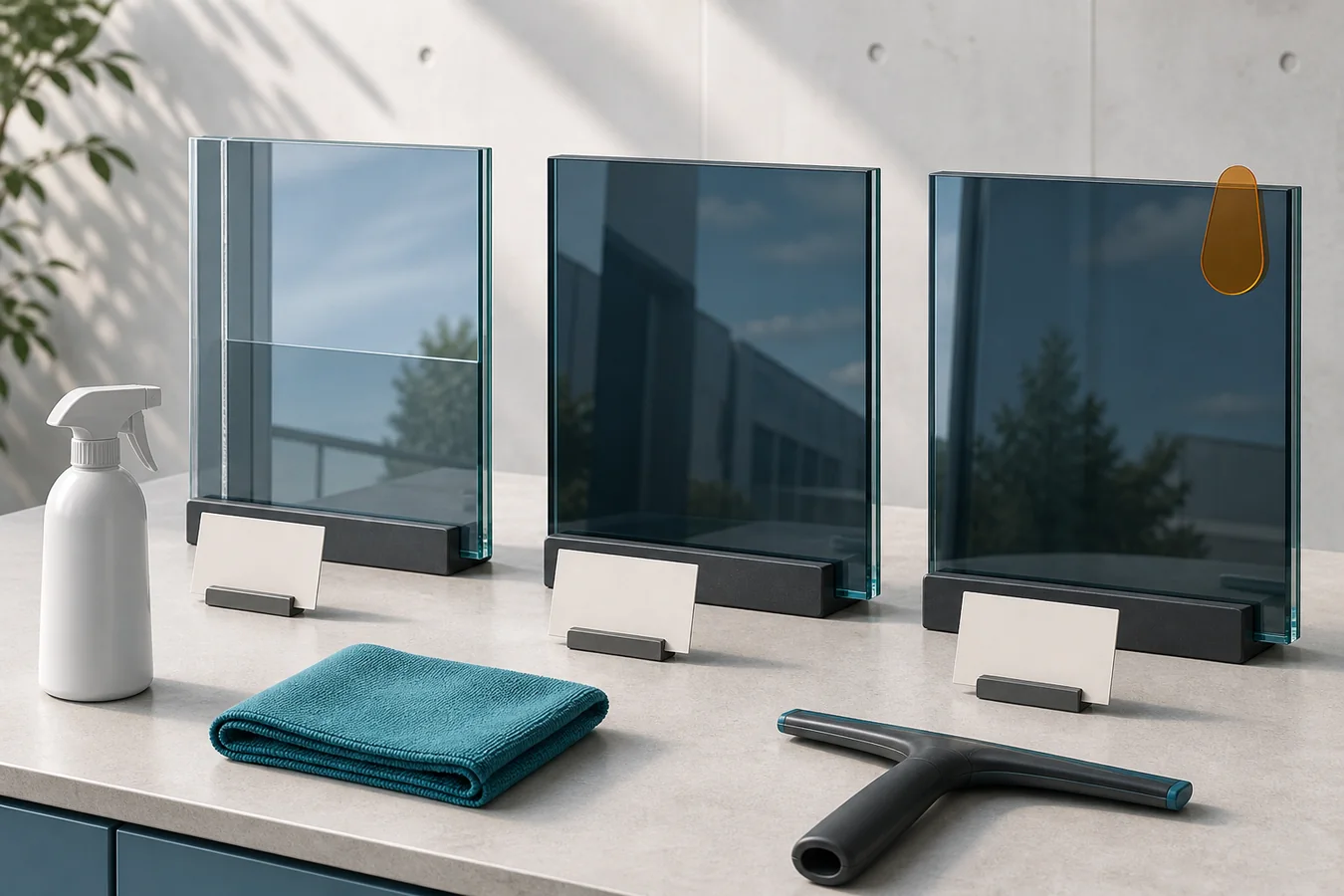
This classification happens before chemistry. A cleaner approved for ordinary glass does not leap over an applied film to reach the substrate. Conversely, a film-care document does not automatically govern tinted glass that has no applied film. The exposed product owns the next question.
“Ammonia-free” is a product claim, not the film record
Current professional-supply articles from WindowCleaner.com and J. Racenstein reflect a familiar shopping shortcut: avoid ammonia when cleaning tint. That caution is easy to remember and can narrow a product search. It still does not identify the installed film or replace its current instructions.
The current 3M care bulletin for its named Window Films shows why the owner record must come first. It lists Windex Original or a similar glass cleaner among acceptable routes, alongside 3M Cleaner Concentrate #1, isopropyl alcohol diluted with water, and water with a few drops of dish soap. Those are 3M-owned directions for the films in that document. They are not permission for another film, and they should not be rewritten as a universal recipe.
The reverse shortcut also fails. The current Windex Ammonia-Free product page can establish the identity and formula claim of that named cleaner. It does not identify the film on a customer’s window or approve that cleaner under someone else’s warranty.
Keep the two records adjacent. On the cleaner side: full product name, package or SKU, current label, exact regional safety data sheet and any named-surface claim. On the window side: film or glass product, cleaning face, current care sheet and responsible owner. If the candidate is Sprayway, the site’s Sprayway product-code guide separates no-ammonia foam from ammoniated mist and other products before the film owner gets the final vote.
The cure clock belongs to the installed film
A cleaner can be acceptable for routine care and still be premature on a new installation. Cure is part of the film record, not a date copied from a different manufacturer’s article.
3M’s current bulletin says to wait approximately 30 days before inspection or washing after its named films are applied. Madico’s current care guidance also gives a 30-day wait in its context. LLumar’s architectural-film FAQ explains that drying time varies with weather, glass and film product. These statements can all be accurate because they do not own the same installation.
The job record therefore needs the installation date, exact product and the instruction or installer acceptance that releases that film to routine cleaning. If the date is unknown, the film still looks hazy or wet, an edge is lifting, a splice is disturbed, or the installer has supplied a different care window, route the pane back to that owner. Do not use a patch test to declare cure or warranty acceptance.
This boundary also protects quoting. A routine cleaning line should not quietly absorb inspection of a failed installation or repair of film damage. Record the condition, photograph it when the site owner permits, and leave disposition with the installer, manufacturer, warranty or building owner named by the job.
Sharp and abrasive tools leave the route
Cleaner permission does not automatically approve the thing that spreads or removes it. The current 3M bulletin rejects knives, scrapers, brushes and abrasive cleaning materials on its named films, and it also warns against vigorous rubbing and heavy pressure. Its positive routes name nonabrasive paper, clean soft cloth or microfiber, or a clean synthetic sponge and rubber squeegee. It also calls for care at film splices and separation of exterior and interior cleaning materials.
LLumar’s current FAQ similarly keeps hard, sharp and metal objects away from film. Madico’s guidance names nonabrasive cleaner with soft paper, cloth or synthetic sponge, followed by soft cloth or a squeegee. Read each as an instruction for its own film context; do not combine the most convenient pieces into a new cross-brand method.
A buyer should record the actual contact set, not just “soft tools”:
- cloth or paper type, clean-stock owner and whether it is separated from exterior dirt;
- sponge or scrub material, exact product identity and the film owner’s abrasive boundary;
- squeegee material and condition, plus how edges and splices stay outside damaging contact;
- any scraper, blade, brush or melamine pad proposed for a spot—and the exact instruction that would have to admit it.
A white melamine pad can feel soft while remaining an abrasive contact. The Magic Eraser on glass guide owns that separate surface-and-pad decision. An unknown mark, adhesive or deposit may need its own diagnosis; more pressure is not a cleaner-selection result.
Write the cleaner beside the film owner
A reusable purchase record can fit on one line: [exact pane and cleaning side] — [applied film, integral tint or unresolved layer] — [manufacturer/product and current care record] — [installation/cure state] — [exact cleaner, label and SDS] — [accepted contact tools] — [edge, splice and damage disposition] — [named owner and outcome].
That line has four honest endings:
- Exact film-owner route: the installed film, current instructions, cure state and permitted cleaner/contact set agree.
- Owner-accepted cleaner candidate: one exact product survives the film or glass owner’s current scope; performance remains a separately observed route result.
- Installer or damage review: cure, edge, splice, haze or damage prevents routine cleaning from closing the job.
- Unidentified-tint hold: the exposed product or responsible owner is missing, so neither formula marketing nor a hidden patch can approve contact.
Only the first two endings add a cleaner and contact set to the professional window-cleaning equipment plan. A cleaner earns that place when its bottle record and the window’s care record meet on the same named surface—not when a reassuring word on either one stands in for the other.