The word Sprayway is not the formula. The product number on the can is.
That distinction matters because two current commercial products answer the ammonia question in opposite ways. SW050 is a no-ammonia clinging foam. SW043 is explicitly an ammoniated glass cleaner delivered as a clear mist. Both sit under the same brand, and both use a 20-ounce can with 19 ounces of net contents.
So “Is Sprayway glass cleaner ammonia-free?” has no reliable brand-level answer. Read the can, match its current documents, then ask whether the exposed glass, film, coating, treatment or plastic permits that exact cleaner.
Two same-size cans give opposite ammonia answers
The current SW050 technical sheet identifies item SW-050, UPC 0 41911 00050 5 and a no-ammonia formula. It describes a white clinging foam in a 20-ounce can with 19 ounces net.
The current SW043 technical sheet identifies item SW-043, UPC 0 41911 00043 7 and an ammoniated formula. It describes a clear, ammonia-fragranced mist in the same nominal can and net-content sizes.
These are not conflicting descriptions of one product. They are facts about two exact products. The manufacturer’s current commercial family lists them separately, alongside other Sprayway cleaners. The conflict appears only when a merchant snippet, supply-room note or memory reduces all of them to the brand name.
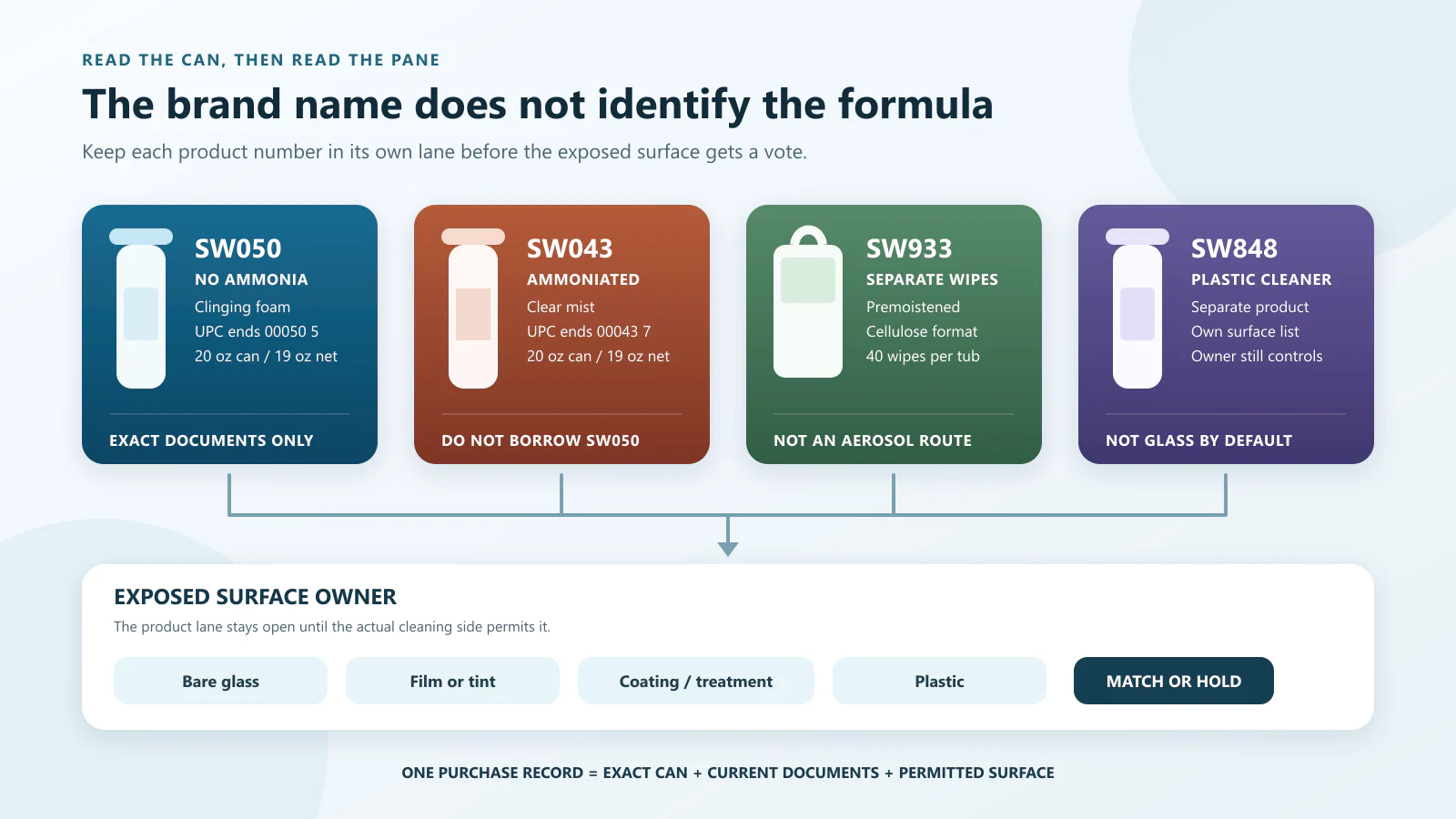
This also changes how a buyer evaluates a listing. “Ammonia-free Sprayway” is useful only if the merchant and delivered can both resolve to the no-ammonia product. “20-ounce Sprayway glass cleaner” is not enough because the two current commercial sheets use that same can size. The product code and UPC carry more decision value than the shared dimensions.
The UPC gets you out of the brand trap
A product photo or the familiar blue-and-white design is a weak buying record. Before reordering, photograph or transcribe the product number, full product name, can size, UPC and current label. For workplace use, keep the exact regional safety data sheet with that same identity.
| Identity field | Why it belongs in the record | What it must not be replaced with |
|---|---|---|
| Product number and name | Separates SW050 Glass Cleaner from SW043 Ammoniated Glass Cleaner, SW933 wipes and SW848 Plastic Cleaner | “Sprayway,” “glass cleaner” or a package-color description |
| Can size and UPC | Distinguishes packages that can look similar in a merchant result or supply room | Ounces alone; SW050 and SW043 share the same 20-ounce-can/19-ounce-net format |
| Current label and technical sheet | Owns the selected product’s formula class, directions and declared surfaces | Directions from another Sprayway cleaner |
| Exact regional SDS | Connects the selected workplace product to its safety and control document | The first Sprayway SDS returned by search |
The document trap is real. A hosted Sprayway SDS identifies a 15-ounce retail product as SW0536Retail, product number 1000028796. That document can identify its named product; it cannot silently become the SDS for SW050 or SW043. If the code on the can and the code in the document do not agree, the document set is still open.
The pane gets the final vote
An exact no-ammonia identity answers a formula question. It does not approve every surface that looks like glass.
First identify what the cleaning side actually exposes: ordinary bare glass, an installed window film or tint, a factory or field-applied coating, a protective treatment, flexible vinyl glazing, plastic, or an unresolved layer. Keep the current care owner for that product with the cleaner record. If the pane identity is uncertain, the site’s glass-identification guide explains why a corner mark can answer one construction question without identifying every surface treatment.
Film is a good example of the ownership boundary. 3M’s care document for its named window films supplies its own nonabrasive cleaning rules and rejects vigorous rubbing, heavy pressure and abrasive cleaning materials. A glass-cleaner can cannot rewrite that film owner’s instructions. Other film products can have different current documents, so the 3M guidance is not a universal film recipe either.
A protected or coated pane needs the same discipline. The Invisible Shield guide keeps new-coating selection separate from maintenance of an already protected surface. “No ammonia” does not prove that a cleaner maintains that coating, preserves its warranty or belongs in its care route.
Plastic is not a loophole. PLZ publishes SW848 as a separate Plastic Cleaner with its own declared surface list. That is a reason to preserve the exact product and installed-plastic owner, not permission to move an aerosol glass-cleaner claim onto acrylic, polycarbonate or flexible vinyl. For Eze-Breeze panels, use the manufacturer-owned vinyl care route instead of treating the panel as generic glass or generic plastic.
Foam, mist and wipes belong to different route roles
Once the exact product and surface permission close, delivery form still affects the operating record.
SW050’s foam and SW043’s mist are different applications, not stylistic descriptions. Record which form the current label directs, where overspray could land, which adjacent frames, seals or finishes must be protected, the named applicator and removal method, and the ventilation, PPE and other workplace controls assigned by the exact label and SDS. Do not turn “clinging” or “high coverage” into a promised yield, labor saving or streak result without a measured route trial.
SW933 Glass Cleaner Wipes are another separate product: the current sheet describes an ammonia-free premoistened cellulose wipe, 40 per tub. A wipe changes storage, single-use material and disposal questions; it does not inherit aerosol directions merely because the brand and cleaning task overlap.
For a business that mixes bucket solution for routine window work, the window-cleaning soap batch sheet owns dilution and working-fill decisions. An aerosol spot product and a repeatable bucket batch can occupy different roles. Recording those roles prevents an occasional product from quietly becoming the undocumented default for every pane.
Keep product performance out of the purchase record until the route measures it. Fragrance, foam persistence, wiping effort, residue, material consumption and rework can matter operationally, but current technical sheets and merchant language are not this crew’s field result.
Make the next delivery prove itself
A useful record fits on one line: exact product number and UPC; formula and delivery form; label, technical sheet and SDS revision; exposed surface and its care owner; permitted method; and the result observed on the route. Save a photo of the delivered can when it arrives. If a replacement shipment changes the code or documents, reopen the decision before restocking vehicles.
| Record that closes | Honest result | What happens next |
|---|---|---|
| SW050 code, current documents and exposed-surface permission all agree | SW050 foam candidate | Use only inside the exact label and surface-owner method; measure route results separately |
| SW043 code, ammoniated identity, current documents and surface permission all agree | SW043 ammoniated-mist candidate | Keep its formula explicit in purchasing and crew records rather than calling it generic Sprayway |
| Exact SW933 or SW848 identity and the relevant wipe or plastic-surface owner agree | Separate wipe or plastic-cleaner candidate | Follow that product’s own documents; do not borrow aerosol facts |
| Can code, label, exact SDS, exposed layer or owner permission is missing or mismatched | Product or surface hold | Resolve the named record before use or reorder |
| The surface owner directs another nonabrasive cleaner or method | Owner-approved alternative | Build that method into the professional equipment setup instead of forcing a Sprayway product into the job |
The reorderable decision is not “Sprayway works.” It is “this exact can, with these current documents, is permitted on this named surface.” That sentence survives a merchant-page change, a supply-room mix-up and the next person who has to buy the product.