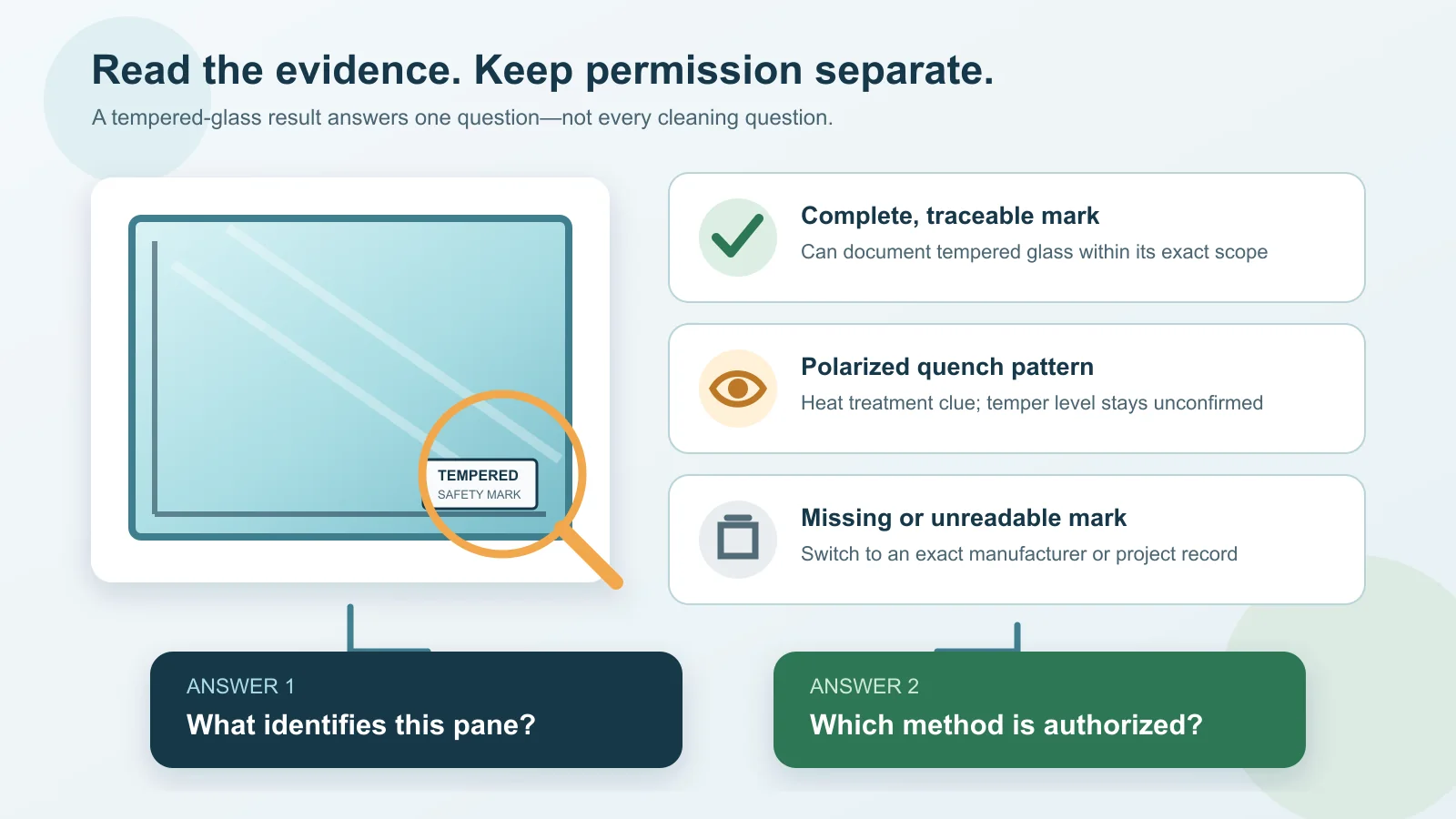
If you can read a complete mark in a corner of the pane, copy every character before trying another clue. A tempered safety code or a matching product record can document the pane. A faint pattern visible through polarized lenses can show heat treatment, but it cannot tell you whether the glass reached the fully tempered level.
If no mark is visible, the pane does not become ordinary glass. Clean only enough to inspect it by a method already allowed for the window, look at every corner from both sides, and then move to the manufacturer, fabricator or project record. Sound, a smooth-looking edge, reflections and deliberate breakage are not substitutes for that evidence.
There is one more split that matters on a cleaning job: tempered-glass identity does not authorize a scraper, steel wool or polishing compound. The exposed coating, film, laminate and current cleaning instruction still need their own answer.
Pane identification belongs near the front of a professional window-cleaning tool setup. It decides which questions must be closed before a specialty tool enters the job; it is not a tool recommendation by itself.
Start with the corner—but copy every character
Photograph the full pane and a close view of the mark. Record the room or elevation, which side you viewed, the corner and the exact text. Do not transcribe only the word that looks familiar. Manufacturer names, safety-standard designations and words such as tempered or heat-strengthened can have different jobs in the same small mark.
The National Glass Association’s heat-treated glass production guideline describes permanent marks made by laser, ceramic frit or sandblast methods. It also distinguishes safety-glazing identification from a non-safety mark that may be used on heat-strengthened glass. That is why “I found a stamp” is not yet the same result as “this pane is documented as tempered safety glass.”
| What is visible | What to record | Strongest result available now |
|---|---|---|
| Complete tempered safety mark with a traceable manufacturer or product context | Full text, pane location, side, corner and photograph | Documented tempered |
| Complete mark explicitly identifying heat-strengthened or non-safety heat-treated glass | The exact wording without shortening it to “tempered” | Heat-treated; not documented here as tempered safety glass |
| Partial, painted-over or unreadable mark | Image and every legible character | Identity still unknown |
| No mark after a nonabrasive inspection of all corners from both sides | Where and how the pane was inspected | Move to product or project records |
Multiple lites in one opening deserve separate entries. Do not copy the result from one pane to its neighbor: replacement history, glass type and accessible surface can differ within the same elevation.
A heat-treatment clue is not a tempered-glass verdict
Heat treatment can leave optical stress patterns, often called quench patterns. They may become more visible through polarized sunglasses or when polarized light is reflected in the scene. This is useful evidence, but it has a strict ceiling.
The NGA Engineering Standards Manual says those patterns indicate that glass was heat-treated. It also says the pattern cannot determine the degree of temper, mechanical strength or expected break pattern. In practical terms, polarization can move the record from “no evidence” to “heat treatment observed”; it cannot move it to “fully tempered confirmed.”
| Clue | Maximum supportable conclusion | What it cannot close |
|---|---|---|
| Complete tempered safety mark matched to the pane/product | Documented tempered within that mark’s scope | Exposed coating, film, laminate or cleaning method |
| Explicit heat-strengthened or non-safety mark | Heat-treated as stated | A tempered safety-glass identity |
| Quench pattern viewed through polarization | Heat treatment observed | Temper level, strength or break pattern |
| Edge appearance, reflection or sound | A visual or auditory observation only | A traceable glass identity |
| Breaking or striking the pane | Not an identification route for an installed pane | A safe, usable job decision |
A clue can be worth recording without becoming a verdict. Keeping that distinction prevents a common mistake: combining several weak observations until they feel like one strong document.
When the mark is missing, switch from looking to records
The NGA’s architectural-glass cleaning bulletin notes that a logo may identify a supplier and may indicate tempered, heat-strengthened or laminated glass—but the lack of a logo does not mean the glass was not heat-treated. A universal “no stamp means annealed” rule therefore fails.
Use the narrowest record that actually belongs to the pane: the window manufacturer and product information, a fabricator record, the glazing schedule or another project document that can be matched to that exact opening. Record who owns the information and the model, unit, project or location used for the match. A document about a similar-looking window is not a match.
Manufacturer rules can help, but they stay inside the manufacturer’s product line. Andersen’s current support page tells owners to look for a tempered safety code in a corner of the glass, commonly near an SGCC mark. It says that absence of the code likely means an Andersen product is not tempered and directs conflicting cases back to Andersen. That is a useful Andersen disposition, not permission to apply the same absence rule to every brand.
| Available record | Use it when | If the match fails |
|---|---|---|
| Named manufacturer identification support | The brand and exact product or unit can be established | Contact that manufacturer; keep identity unknown |
| Fabricator mark or order record | Its code can be matched to this pane/unit | Do not borrow the identity from another lite |
| Project glazing schedule or closeout record | The opening and revision are unambiguous | Return to the project/glazing owner |
| No traceable record | No stronger evidence exists | Identity remains unknown |
Keep pane identity and tool permission on separate lines
A pane can be conclusively tempered while its cleaning side remains unidentified. The safety mark does not tell you whether an exposed low-e or anti-reflective coating, an applied film, a laminated construction or another treatment governs the surface. It also does not tell you which contaminant is present.
This is where identification hands the job to the correct decision owner. If a blade is being considered, use the separate window-scraper surface and fit decision. Adhesive belongs to the sticker-removal route. Metal fiber belongs to the grade-0000 glass decision, and material-removal work belongs to the cerium oxide and restoration comparison.
| Record line | Evidence that belongs here | Permitted result |
|---|---|---|
| Pane identity | Exact permanent mark or an exact manufacturer/fabricator/project match; polarization may supply heat-treatment evidence only | Documented tempered; heat-treated / level unconfirmed; or identity unknown |
| Exposed surface | Named glass/window construction, side, coating, film or laminate information | Surface owner identified, or surface still unknown |
| Cleaning method | Current instruction for that surface and the exact contaminant/tool path | Use only the named owner-approved method, or method not yet authorized |
The NGA cleaning bulletin recommends identifying the glass product and any exposed coating before choosing a procedure. It treats a razor as a last possible option, especially on heat-treated glass—not as a benefit conferred by tempering. The distinction is simple: glass identity describes the pane; an instruction owner authorizes the contact method.
Finish with two answers, not one
| Pane identity result | Cleaning-permission result | Next action |
|---|---|---|
| Documented tempered | Exact exposed-surface method is documented | Use only that named method within its scope |
| Documented tempered | Surface or method is unknown | Keep the tool out of the job until the owner closes the method |
| Heat-treated; temper level unconfirmed | Any state | Do not relabel it as fully tempered; continue the identity/record route |
| Identity still unknown | Only ordinary nonabrasive care is documented | Stay inside that care instruction; do not use identity as a shortcut |
| Identity still unknown | No exact method is documented | Return the pane to the manufacturer, fabricator, project or glass owner |
The useful job note is not “tempered?” followed by a checkmark. It is two sentences: this mark or record identifies the pane as… and this current owner instruction permits the next contact method… If either sentence cannot be completed, leave that line open instead of turning a clue into permission.