A cleaning robot does not start at the product page. It starts at one uninterrupted travel strip on the array.
That strip has an exact module, slope, panel orientation, frame and gap pattern, row end, placement point and recovery route. A robot is a candidate only when its contact method is permitted and the machine can complete that whole strip with its water, power and control connections intact.
Begin with the array record, then compare machines. A speed or daily-capacity claim cannot repair a missing module permission, an impassable gap or a robot that the crew cannot safely place and recover.
The module manual can reject the robot before the array does
“Solar panel” is not a compatibility specification. Keep the exact module manufacturer, model family and current cleaning manual with the quote.
The current Trina Vertex manual describes a dry-cleaning robot only conditionally: it calls for a soft plastic brush that does not scratch the glass or aluminum frame and says the robot’s weight should not be too large. It supplies no universal numeric weight ceiling. Canadian Solar’s current module manual requires advance consultation with technical service before rotating brushes are used. It also warns that localized heavy loads from improper equipment can cause microcracks and that dry rubbing can cause micro-scratches. LONGi allows automatic cleaning equipment only when its stated requirements are followed and directs uncertainty back to LONGi.
Those are three separate module-owner positions, not votes to average. Written permission for one module family does not move to a neighboring array. If the exact manual is missing, or if brush class, wet/dry method or operating mass cannot be reconciled with it, the robot comparison stops.
The site’s soft-brush solar-panel guide owns that contact-method decision in detail. Carry its result into this robot decision; do not recreate permission from a robot seller’s scratch-free language.
Six kilograms and 82 kilograms are different jobs
Current machines bearing the same category label create very different work:
| Machine record | Current published contract | What it changes at the array |
|---|---|---|
| IFBOT X3 | 6.2 kg; autonomous dry/vacuum cleaning; 0–45°; four-hour battery | A relatively portable dry branch, but module permission, placement, edge behavior and regional service still need closure |
| Tucker RTM PRO | 60 kg; remote control; maximum 25°; four-hour battery; 30 m remote | Crew handling, support, recovery and remote sight line become central; the current US page is unavailable |
| SolarCleano F1 | 82 kg; remote wet/dry operation; 25° wet limit; gaps up to 70 cm; 13–15 mm hose; about two-hour battery | Water and hose drag join mass, gap, placement, recovery and cross-row transfer as first-order inputs |
These are manufacturer-published fields, not a performance test and not a ranking. Even values within one product family can change: SolarCleano’s current F1 page and its current catalog do not align on every field. Freeze the version and ask the seller to confirm the quote specification.
An “up to” production number belongs after this comparison, not before it. A lighter autonomous dry machine, a 60 kg remote machine and an 82 kg wet/dry machine do not share a crew plan merely because all clean photovoltaic glass.
Draw one complete travel strip across the array
Choose a representative strip, but make it complete. Start where the robot will actually be placed. Trace its path over each panel and frame transition, across every gap or change in plane, through the steepest permitted tracker position, to the row end. Then trace the recovery path and the move to the next row.
Record the panel orientation, row length, slope range, frame height, inter-panel gaps, missing modules, clamps, cable exposure, tracker joints and edge geometry. Add the robot’s operating mass—not just shipping mass—plus its contact system and edge-sensing boundary. A vendor’s maximum gap is useful only when the real gap is measured in the same way and the surrounding transition is also supported.
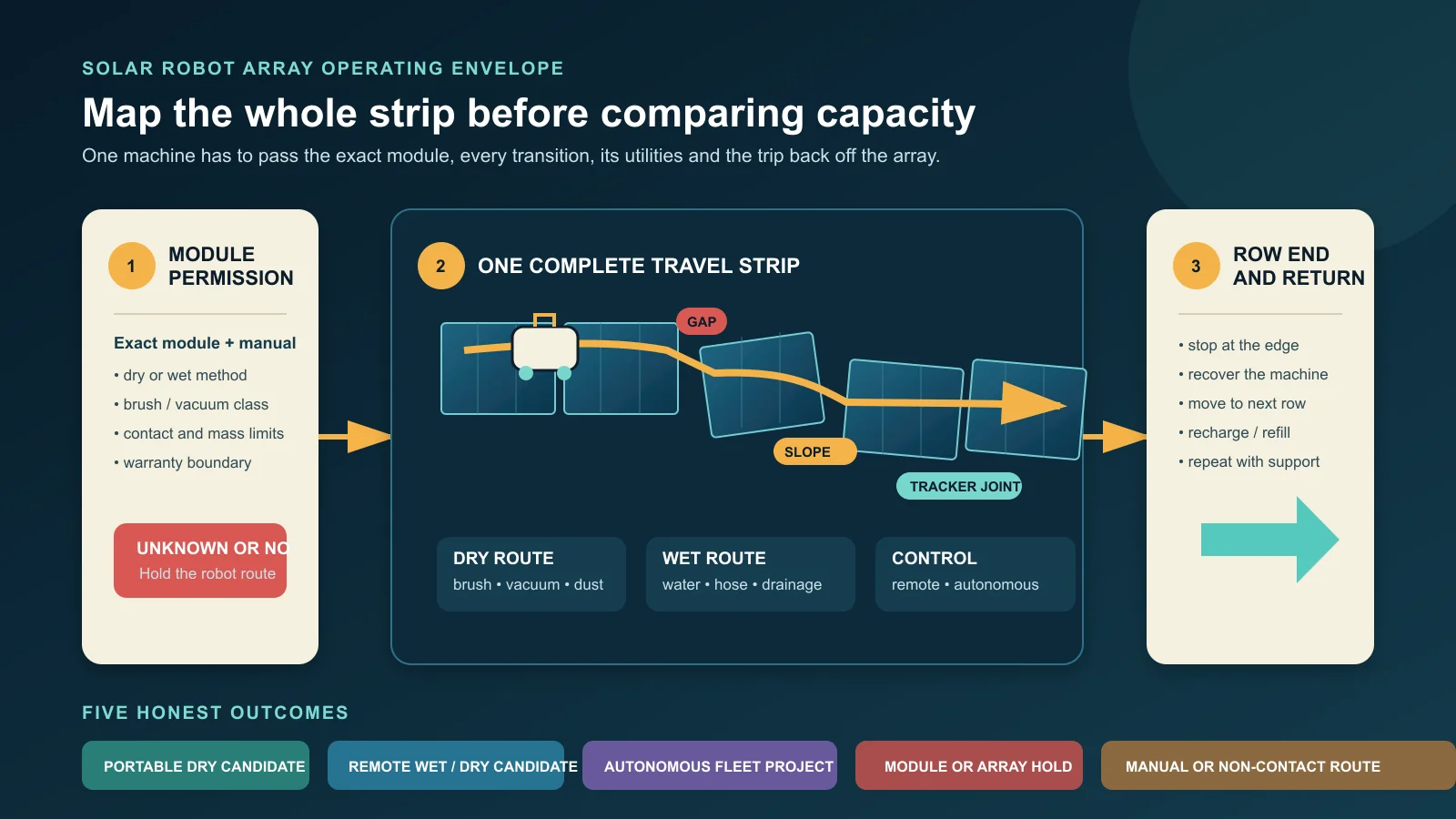
The map has no average-array shortcut. One unsupported transition breaks the strip. That may produce a different robot route, a manual section between robotic passes or a full hold; it does not become safe because most of the row is flat.
Tracker arrays need a recorded operating position and an owner for that position. The cleaning equipment seller does not automatically control the tracker, structural support or electrical state. Keep those responsibilities with the array’s qualified parties rather than turning this purchase guide into an operating procedure.
A wet robot brings its hose onto the panel
Wet and dry are separate routes even when one machine offers both.
A dry route still needs approved brush or vacuum contact, dust handling, consumable life and a plan for soiling that the permitted method cannot remove. Battery duration must cover a real strip plus recovery margin; a headline runtime does not say how many placements, turns or transfers the job contains.
A wet route adds water quality, supply pressure and flow, connection size, hose length, hose mass and drag, drainage and refill location. The hose has to follow the robot without snagging a frame, loading a connection, crossing an unsupported edge or defeating recovery. Where purified water remains appropriate, the water-fed pole system guide helps size the upstream treatment and flow path; it does not approve hose movement on a photovoltaic array.
The solar-panel cleaning kit guide remains the better route when the job is fundamentally a manual pole-and-brush package. Robot fit should not be manufactured by hiding the manual work, transfer equipment or water hardware outside the quote.
The job repeats at every row break
One successful pass is not yet a working system. Count what happens after it:
- transport the machine to the array and support its operating mass;
- place it at the first valid entry point;
- maintain control, power and any hose through the full strip;
- stop and recover it at the far end, including a fault or low-battery case;
- move it across the real row separation without using modules as an improvised walkway or support;
- recharge, replace or clean brushes and suction components, refill water and resume;
- obtain parts and technical support in the region where the machine will work.
Repeat that sequence for the number of strips and physical zones on the site. A remote-control range must work with the operator’s actual position and sight line. Autonomous return behavior still needs a reachable recovery point. A modular machine that can be carried in sections still needs a documented assembly, lifting and support plan.
This is where capacity claims often shrink into a logistics question. The decisive number may be transfers per day, crew handling events, hose resets, charges or inaccessible rows—not square meters per hour.
Ask for an array demonstration, not a capacity promise
Send the supplier the exact module/manual, the strip measurements, photos or drawings of transitions, the permitted tracker position, utility route and placement/recovery plan. Ask for a written configuration and an array-specific demonstration plan that the module, site and electrical authorities permit. The demonstration should show the least forgiving valid strip, a normal row end, controlled recovery and the real cross-row move.
Record the quoted model and version, operating mass, brush or vacuum class, wet/dry configuration, supported slope and gap definition, control range, battery package, hose requirements, consumables, warranty exclusions, regional parts and service. Do not replace a missing value with a related model’s specification.
| Evidence after mapping | Honest outcome | Purchasing direction |
|---|---|---|
| Exact module permits the dry contact; the lightweight machine, strip, placement, recovery, battery and service all close | Portable dry robot candidate | Request the exact dry configuration and array demonstration |
| Module and site permit wet or dry contact; mass, slope, gap, hose/control and transfer routes close | Remote wet/dry robot candidate | Quote the full deployment package, not the machine alone |
| The array was designed or can be professionally integrated for autonomous equipment, with docking, utilities and recovery owned | Autonomous fleet project | Treat it as an array-integration project with named technical owners |
| Module method, operating mass, transition, tracker position, site authority or recovery remains unknown or unsupported | Module or array hold | Resolve the named record before comparing output or price |
| The robotic route adds unsupported contact, handling or transfer while an approved manual method can complete the work | Manual or non-contact alternative | Return to the professional equipment setup guide and build the permitted job instead |
The useful buying record is therefore not “robot: yes.” It is “this model, in this configuration, can complete this documented strip and return under these permissions.” If a seller cannot help close that sentence, its capacity number is not yet purchase evidence.