The Invisible Shield pint and Invisible Shield PRO 15 are not two sizes of the same purchase. Window Cleaning Resource lists the standard 16-fluid-ounce product as SKU 037-30-01, manufacturer part 337-53006. Its separate 32-ounce PRO 15 page uses SKU 328-30-05. Unelko also presents the standard coating and professional PRO 15 as different products.
That split controls the rest of the decision. A label, safety sheet, application instruction or warranty belongs to the exact product it names. The limited 15-year warranty is a PRO 15 record with registration, maintenance and exclusions; it is not a benefit that travels backward to the standard pint.
For one glass job, choose the product record first. Then close the installed-glass owner, existing coating and damage, clean-and-dry preparation, current label and exact safety sheet, application conditions, maintenance plan and—if PRO 15 warranty is part of the quote—the registration route. Any missing owner or document is a hold, not a reason to blend the two product pages.
The pint and PRO 15 create different receipts
Both products sit inside the same brand family, beside cleaners, limescale removers and maintenance products. A brand-family page is useful for navigation. It is not a job record.
| Purchase record | Current commercial identity | Evidence you may attach | Evidence that remains separate |
|---|---|---|---|
| Standard Invisible Shield | WCR 16 fl oz; SKU 037-30-01; MPN 337-53006 |
The selected bottle’s current label, exact SDS and standard-product application instructions | PRO 15 part numbers, professional data sheet, 15-year limited warranty and registration |
| Invisible Shield PRO 15 | WCR 32 oz RTU; SKU 328-30-05; Unelko spec lists US quart part 54215 |
Current PRO 15 label/SDS, data sheet, application record, maintenance and warranty registration | Standard-pint seller estimates and any cleaner, restorer or bundle document |
The standard seller page says a pint covers approximately 500 square feet and applies to a clean, dry surface with a soft padded cloth. The PRO 15 manufacturer sheet gives an average above 1,000 square feet per quart, while warning that coverage varies with the glass and application method. Those are product-owner estimates, not a field yield forecast. Do not use either number to quote material before the exact product and job method are fixed.
There is also a live document problem. WCR’s SDS index links one file under the name “Invisible Shield,” but the PDF identifies a 2018 European product numbered 17230 and calls it a cleaning agent. That does not prove it is the current US safety sheet for either SKU above. Record the document identifier, region and revision next to the cart. If they do not match, ask the manufacturer or seller for the exact sheet and hold the chemical line.
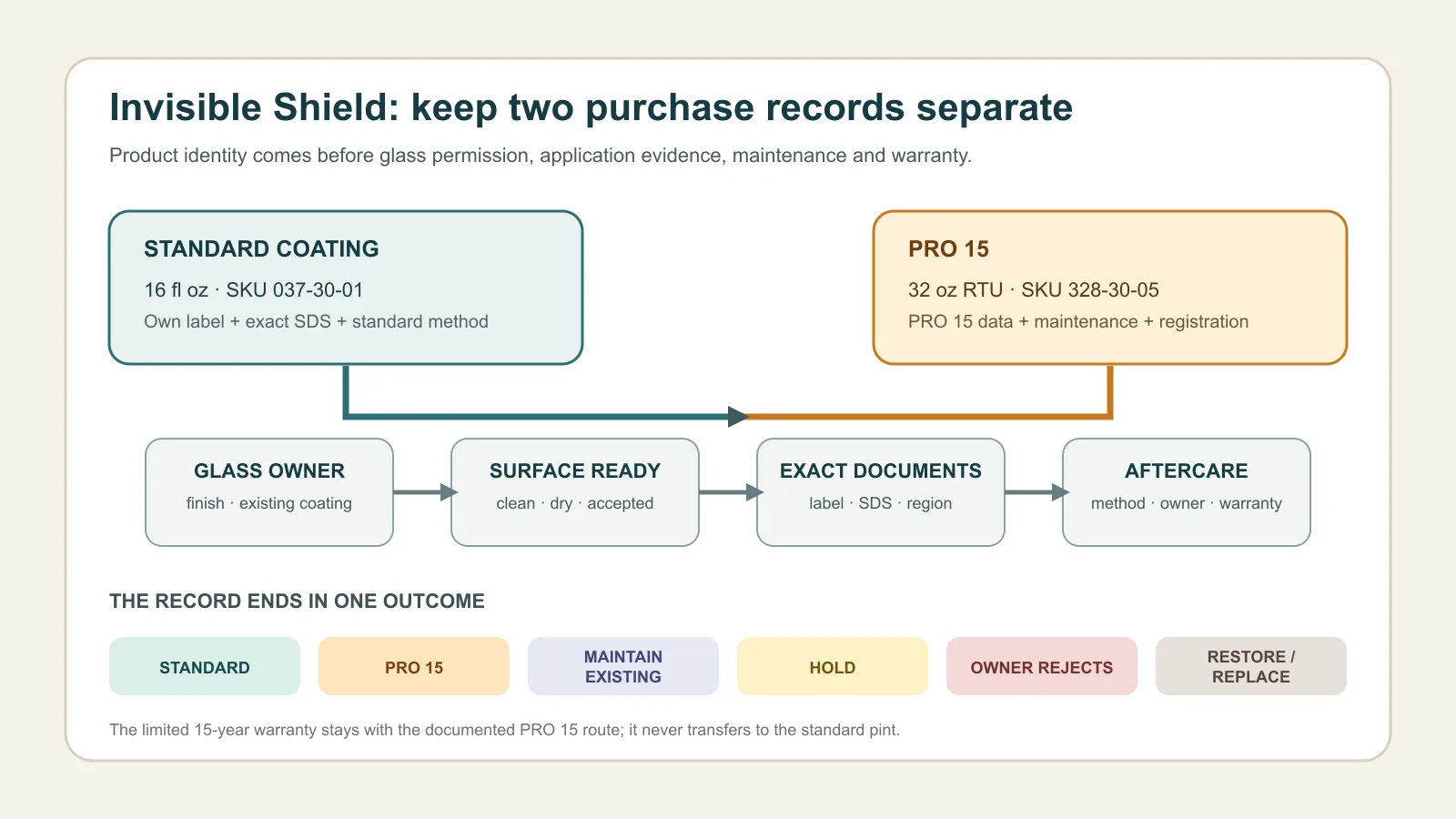
The two lanes meet only after product identity. The shared gates do not make the records interchangeable; they show the questions that either purchase must answer.
Coating cannot hide unfinished glass work
A coating service begins with what is already on the pane. Dirt is one condition. Mineral deposits, etched haze, scratches, prior sealant, film, factory treatment and damaged glass are different conditions with different owners.
Unelko’s PRO 15 specification requires glass to be thoroughly clean and dry before application. That is an acceptance state, not the name of a bottle. The record should say what was removed, what remains visible, whether another coating is present, which glass-side method was permitted and who accepted the application surface.
If a deposit-removal job is still open, keep it in the restoration branch. The site’s Bio-Clean decision separates removable mineral deposits from glass that remains etched or hazy. The OneRestore page keeps a restoration chemical outside the everyday bucket. If the job has entered material removal, the cerium-oxide route has its own training, heat, coating and optical-result controls. Adding Invisible Shield to the cart does not close any of those decisions.
This matters commercially. A customer asking for “protection” may actually be asking for old damage to disappear. The coating quote should not inherit that promise. Either the glass reaches an owner-accepted clean, dry application state, or restoration/replacement remains a separate line with its own outcome.
The glass supplier may already own the aftercare
Some glass arrives with factory-applied protection, specialty treatment or a care document. That owner can change both the sale and the recurring cleaning method.
Precision Glass describes its factory-applied Invisible Shield protection and directs users toward nonabrasive care. Its document says daily squeegeeing is unnecessary and can gradually harm the protective barrier. Unelko’s current PRO 15 maintenance guidance likewise excludes abrasive cleansers, pads, brushes, scrapers and razor blades from protected glass.
Those instructions belong to the protected products they name. They do not prove that every squeegee harms every pane, or that a cleaner may add a new coating to any glass. They prove why the installed-glass record comes before the upsell.
If the pane is already protected, the correct sale may be compatible maintenance rather than another coating. If its owner rejects field treatment, stop. If the owner permits renewal, preserve the exact renewal product and method instead of assuming that any bottle carrying Invisible Shield is equivalent.
This owner check also prevents an internal contradiction. An ordinary abrasive deposit-removal method that was acceptable before coating may be forbidden after coating. The service history must therefore travel with the glass, not live only on the bottle used that day.
PRO 15 needs an application record, not a promise
PRO 15 has more documentation than the standard cart, which is useful only if it remains attached to the exact job. The current manufacturer application protocol and data sheet support a concise application record:
| Field | What the current PRO 15 owner establishes | What the job still has to prove |
|---|---|---|
| Product | Professional PRO 15, exact container and current documents | Cart, label and SDS identifiers all match |
| Application surface | Glass is thoroughly clean and dry | Existing soil, deposits, coating and damage have a named disposition |
| Conditions | No hot direct-sun application above 90°F/32°C; no wet or rainy application; no application above 90% humidity | Actual surface temperature, weather and humidity are acceptable for the work window |
| Method | A saturated applicator or fine-mist spray, overlapping wipe/polish, drying, coverage completion and haze removal | Site authority, exact tools, contamination control and the selected label are closed |
| Completion evidence | Full coverage and a water-repellency check | The record states what was observed without promising future duration or appearance |
The current spec includes reapplication for complete coverage; the protocol says a second coating may be used if necessary. Preserve that wording as product-specific direction, not a universal “two coats” sales promise. Likewise, a contact-angle target in a manufacturer protocol is quality-control evidence within that method, not proof that every pane bonded correctly or that a quoted lifetime has begun.
Safety follows the same identity rule. PRO 15 is described as a flammable liquid in its current manufacturer materials. The responsible worksite owner selects handling, ventilation, protection, storage and disposal from the exact current label/SDS and real exposure. This page cannot turn a product-family name into a site safety plan.
Fifteen years is a maintenance contract
Unelko calls the PRO 15 term a limited 15-year warranty. The current warranty page ties it to application and maintenance as directed, the original purchaser or end user and registration. It excludes misapplication, misuse, abrasive or harsh cleaners/tools, neglect, prior damage, weathering and abrasion. The stated remedy is replacement product needed for reapplication; labor and equipment costs are excluded.
That is materially different from “the coating lasts 15 years.” Put the application date, treated area, product, original owner/end user, dealer or applicator record, registration evidence and anticipated maintenance into the quote file. If those fields will not be owned, do not sell the warranty as a service outcome.
The same page makes another useful correction: protected glass is not self-cleaning. Cleaning frequency follows soil, use and exposure. Compatible nonabrasive maintenance is part of the operating cost, even when cleaning becomes less frequent. A weekly shower schedule and a semiannual exterior inspection are different service assumptions, not one brand rule.
For the standard coating, use only the warranty or guarantee that the current standard-product owner actually supplies. PRO 15’s registration form, term and remedy cannot be borrowed to make the pint easier to sell.
Price the route you can document
The quote can now end in a commercial disposition instead of a vague recommendation.
| What is closed | Disposition | What belongs in the quote or work order |
|---|---|---|
| Standard product, exact label/SDS, glass permission, accepted preparation and standard-product method | Standard coating candidate |
Exact SKU/container, preparation boundary, application method, maintenance owner and no PRO 15 warranty language |
| PRO 15 product, exact label/SDS, glass permission, accepted preparation, conditions, method, maintenance and registration route | PRO 15 candidate |
Exact product/area, application evidence, original owner/end user, registration and limited-warranty terms |
| Existing protected glass has a current owner-approved care route | Maintain existing protection |
Exact cleaner/tool restrictions, frequency owner and renewal trigger; no new coating unless authorized |
| Product, region, label or SDS identifiers do not match | Hold product or documents |
Obtain the exact current document before ordering or scheduling chemical work |
| Installed-glass owner rejects new coating or field renewal | Glass owner rejects coating |
Use the owner’s care route or route the question back to that owner |
| Deposits, etching, scratches, old coating or damage prevent accepted preparation | Restore or replace first |
Close the separate restoration/replacement result before reopening a coating quote |
In the professional equipment plan, the coating line belongs after glass identity and restoration—not inside a generic chemicals bundle. The smallest complete record names the exact product, exact glass, condition before work, preparation acceptance, matching label/SDS, application evidence, aftercare owner and warranty route.
That record is also the sales boundary. If it supports the standard pint, quote the standard product. If it supports PRO 15 and its obligations, quote PRO 15. If it supports only maintenance or a hold, the brand name does not turn that answer into a coating sale.