Bio-Clean is not a complete product ID. Current sellers show a 20-ounce WST20, a 40-ounce WST40-1-1, a 48-ounce listing with SKU 85-700 and MPN B52-01, and a product description on that same 48-ounce page that calls it WST40. C.R. Laurence also sells a separate 16-ounce WSR1 under the Bio-Clean name.
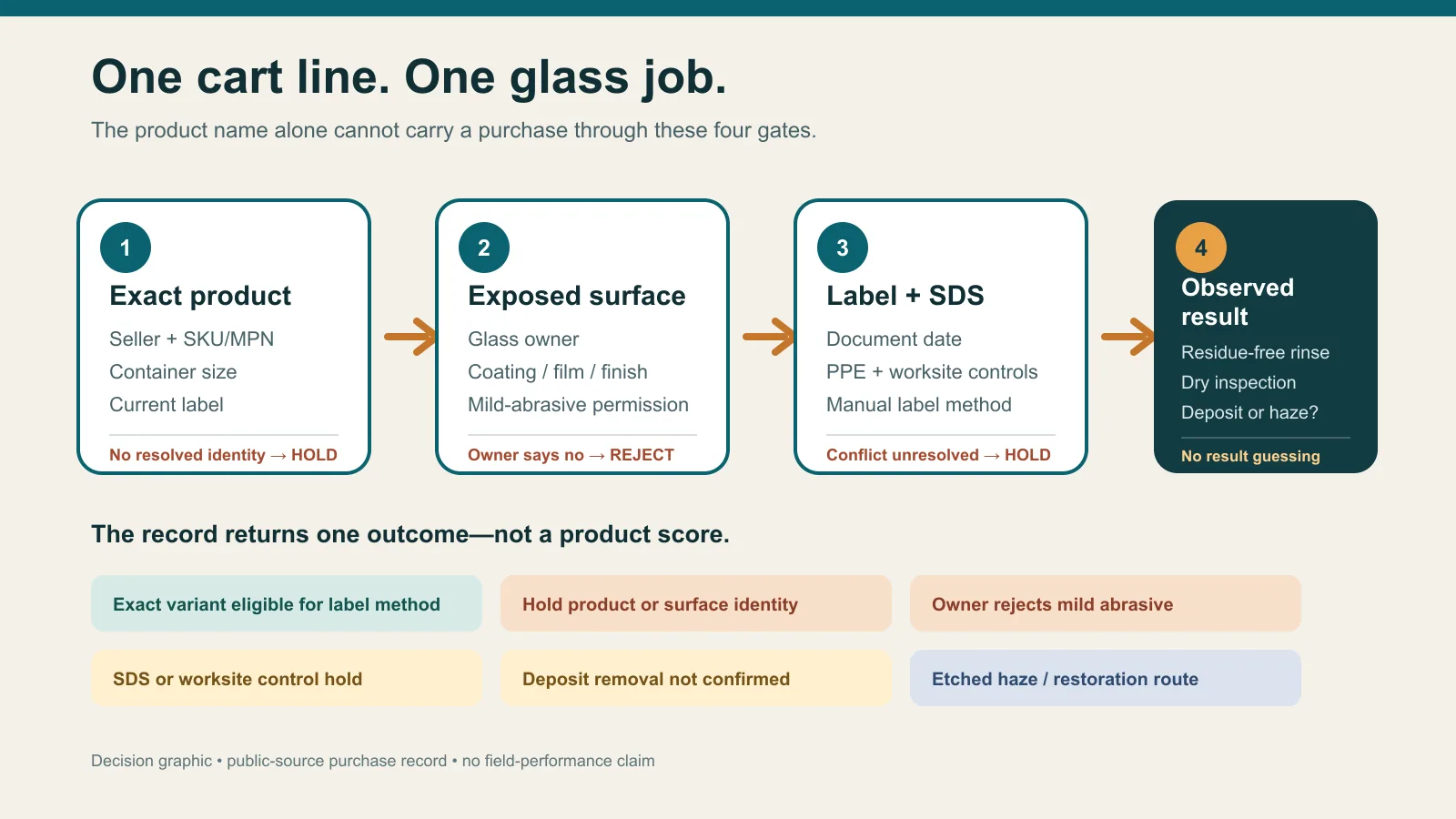
Before ordering, copy the exact container, cart code and current label into the job record. If those three do not describe one product, stop there. Once the product is settled, the exposed glass surface must permit a mild abrasive, the current label and safety sheet must agree with the worksite controls, and the job must have a complete rinse-and-inspect route. Bio-Clean may remove surface deposits; it cannot be assumed to repair glass that remains etched or hazy after the deposit is gone.
Put the container on the record before the stain
The current pages are useful precisely because they disagree. They reveal where a generic “Bio-Clean” order can lose its owner.
| Live record | What it identifies | What it leaves open |
|---|---|---|
| Bio-Clean Products 48-ounce page | WST48, 48-ounce tub, product-owner directions and warning |
Whether its facts apply to a 20- or 40-ounce cart line |
| Window Cleaning Resource | 20-ounce WST20 and 40-ounce WST40-1-1 variants |
The exact label shipped with the selected option |
| J. Racenstein 48-ounce page | SKU 85-700, UPC 736846949950, MPN B52-01, 48 ounces |
Why the description calls this item WST40 |
| CRL Bio-Clean Water Stain Remover | CRL item WSR1, 16 fluid ounces |
Any equivalence to the Bio-Clean Products WST line |
The useful purchase record is not “one bottle of Bio-Clean.” It is closer to seller — cart SKU/MPN — container size — label product name — label date or revision — linked safety sheet. A larger or cheaper listing is not a substitute until those fields resolve to the same product.
This distinction matters beyond inventory. The current Bio-Clean Products 48-ounce page describes an abrasive-based product. The live CRL WSR1 page owns a different item number and contents. Similar copy is not enough reason to transfer a formula, warning or result from one line to the other.
The glass owner gets the veto
Bio-Clean’s surface list is not permission to touch every window. The current product owner says to use it only on surfaces unharmed by a mild abrasive. J. Racenstein’s current 48-ounce listing goes further: it tells buyers not to use the product on coated, filmed or treated glass, paint, automotive paint or anything that can be scratched by an abrasive.
That puts the installed glass record ahead of the stain. Capture the manufacturer or glazing owner, product or assembly, cleaning-side surface, and any coating, applied film, tint, protective treatment or decorative finish. If the identity is unknown, a hidden spot cannot manufacture permission. The glass-identification guide explains why a tempered mark settles only one part of the record; it says nothing by itself about the exposed coating or an abrasive method.
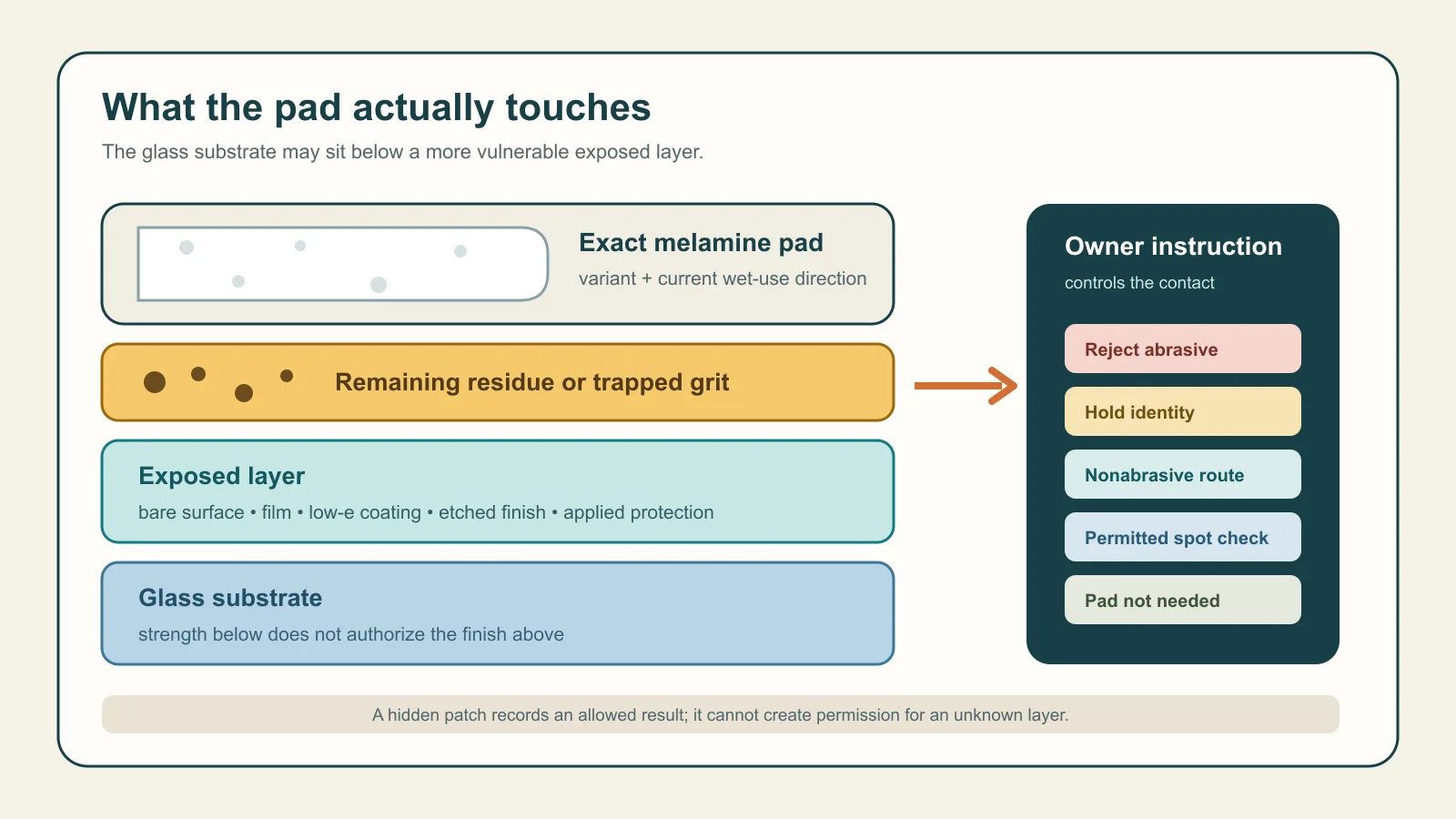
The proposed applicator belongs in the same record. A cloth, sponge, nylon pad and powered buffer are not interchangeable just because several seller pages mention them. This page keeps the decision to manual application. A machine introduces its own pad, pressure, heat, training and edge-control questions; a bottle sentence cannot close them for an unidentified pane.
A seller’s no-gloves sentence loses to the safety sheet
One current specialist page says Bio-Clean is safe for hands and that gloves are not needed. The Bio-Clean Products safety sheet currently linked by J. Racenstein says something materially different: its signal word is DANGER; it lists harmful-if-swallowed, skin-irritation and serious-eye-damage hazards, and calls for protective gloves plus eye or face protection.
The sheet is not new. It was issued on April 28, 2015, with no revision shown. That age should stay visible in the job file, not be hidden because the link is still live. Use the selected container’s current label and obtain the current manufacturer safety sheet. If a newer document exists, it controls. If the cart, label and safety document cannot be tied together, the product is not ready for a paid job.
| Record before acceptance | Why it changes the decision |
|---|---|
| Exact label product and container | Prevents the wrong variant’s instructions from being borrowed |
| SDS issue or revision date | Shows which hazard and storage record is being used |
| Gloves, eye or face protection and washing facilities | Lets the worksite owner close exposure controls rather than accepting seller reassurance |
| Occupant, food, drainage and storage route | Keeps the product inside the selected label and workplace plan |
The currently linked manufacturer SDS also restricts use to the label. That is the practical answer to conflicting merchant copy: the merchant can help identify the cart; it does not own the employee’s hazard assessment.
The label method creates an observation—not a guarantee
For an exact, permitted product and surface, the current Bio-Clean Products page begins by removing dirt and grime with a damp towel. That first pass matters because loose particles caught under an abrasive product can change the contact. The owner then describes applying the product with a named applicator, rubbing, rinsing until residue-free, drying and inspecting.
Use an inconspicuous area allowed by the glass owner before expanding the work. Record the applicator, the selected label method, the rinse route and the dry result. Do not turn “repeat as needed” into an unlimited escalation rule. A second pass is still the same surface and exposure decision, not evidence that more pressure, a rougher pad or a machine has become appropriate.
The outcome table is intentionally about evidence, not satisfaction:
| What the record shows | Outcome | What happens next |
|---|---|---|
| Cart, label, surface permission and controls agree; the manual label route is available | Exact variant eligible for label method |
The responsible job owner may accept the controlled area; no performance is promised |
| Cart code, container or label does not resolve to one product | Hold product identity |
Get the selected-container answer before purchase |
| Glass or coating owner is missing or rejects a mild abrasive | Owner rejects or surface unknown |
Choose an owner-permitted nonabrasive route |
| Label or SDS currency or worksite controls remain open | Safety-control hold |
Obtain the controlling document and close the workplace plan |
| The authorized area is rinsed and dry, but the deposit response is unclear | Deposit removal not confirmed |
Stop rather than increasing abrasion by assumption |
| Deposits are no longer the plausible surface condition and white haze or damage remains | Glass-condition route |
Send the pane to the owner or a documented restoration assessment |
Ordinary window washing is a separate choice. If the job only needs routine soil removal, use the product-role and dose record in the window-cleaning soap guide instead of dropping an abrasive stain remover into the bucket.
White haze can outlive the deposit
The current J. Racenstein page distinguishes light surface corrosion from a condition where deposits are no longer sitting on the surface and the glass is left etched or white. Its stated limit is blunt: Bio-Clean does not repair that later condition. CRL publishes a similar limit for its separate WSR1 product, but that corroboration does not make WSR1 and the WST family interchangeable.
Do not diagnose the stage from a photograph or from the number of years a stain has been present. First close the exact product and glass-owner method, then preserve what the residue-free, dry inspection actually shows. “Still cloudy” can mean remaining deposit, altered glass, coating damage or another condition the page cannot identify remotely.
If the outcome moves from surface deposit to damaged or etched glass, buying a bigger tub does not widen the product’s scope. Hand the glass record to the glass-polish and restoration-system decision, where coating, process class, training, heat and optical acceptance have their own owners. Keep Bio-Clean as one conditional line in the professional window-cleaning tool stack, not as a routine cleaner or a universal glass repair. If the pane stays in the Bio-Clean route, the order line should name one exact container and the job record should show why that specific surface and document set accepted it.