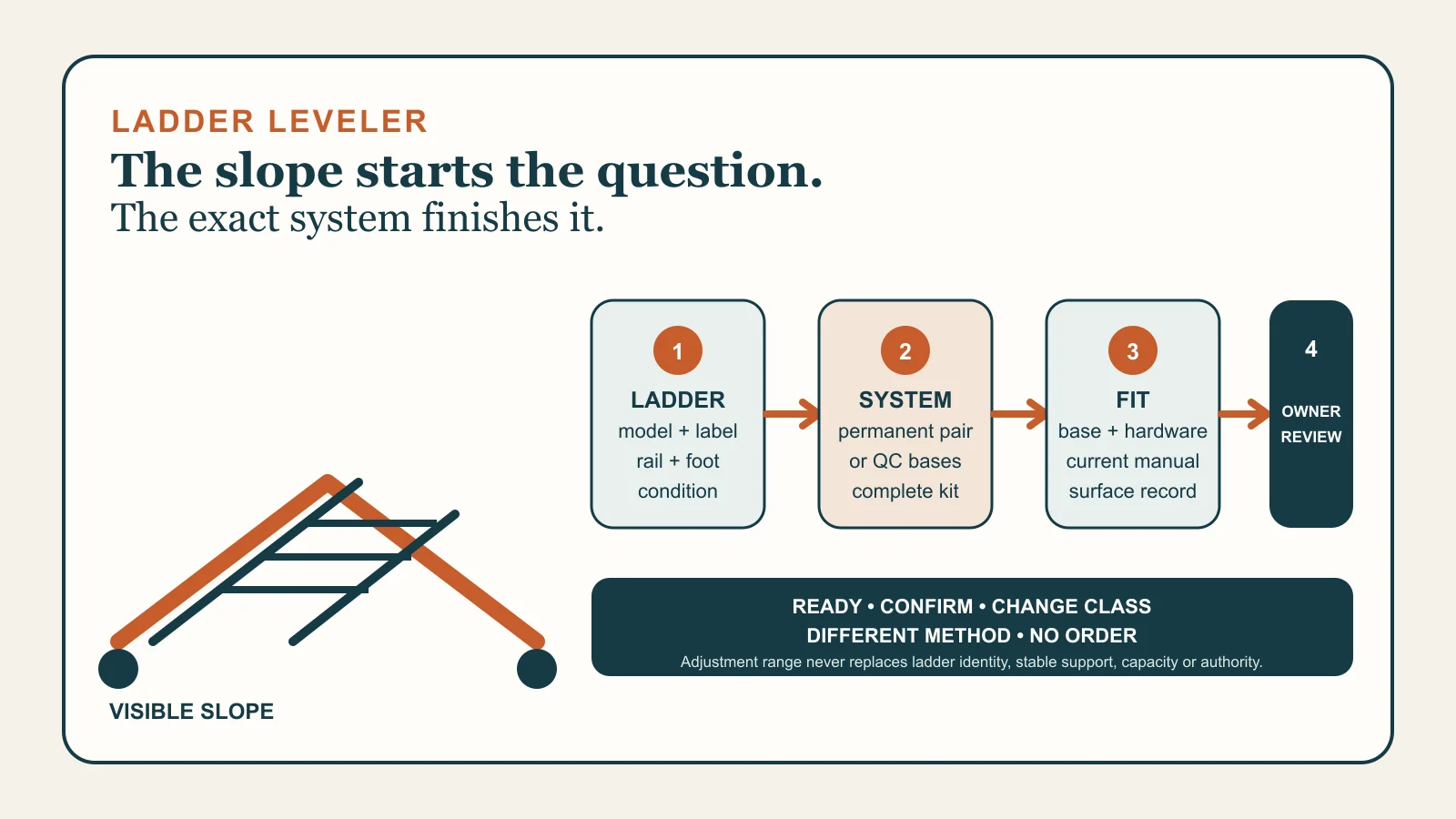
The slope is the part you notice. The expensive mismatch is usually hidden on the ladder: the rail profile, rung connection, existing foot, duty label, or mounting kit that the product page never asked you to name.
Do not shop by inches of correction first. Start with the exact ladder, then decide which kind of leveler you are buying. A permanently mounted pair, two quick-connect bases with one removable leg, a factory-integrated leveling ladder, and a portable under-foot tool can all appear under “ladder leveler.” They are not interchangeable solutions.
If the current manufacturer manual does not cover the observed ladder construction—or nobody qualified has accepted responsibility for installation and inspection—the purchase is not ready. A broad fit claim and a suitable slope do not close that gap.
The product name hides four different systems
The first useful comparison is not brand against brand. It is object against object.
| Search-result object | What changes on the ladder | What belongs in the purchase record | Decision owner |
|---|---|---|---|
| Permanent pair | A leveler stays on each rail | Exact two-leg kit, hardware, template/manual, ladder branch and installed handling effect | This page |
| Quick-connect system | Bases stay on both rails; a removable leg moves to the needed side | Exact full kit or every component, correct base variant, hardware and manual | This page |
| Factory-integrated ladder | The leveling mechanism is part of the ladder model | Exact ladder model, label and its own manufacturer instructions | Whole-ladder selection |
| Portable under-foot tool | No rail-mounted base; the ladder foot bears on another accessory | Exact foot geometry, surface, dimensions and one intended mode | Portable-tool fit |
The distinction changes the cart. Levelok’s current permanent-system specification identifies LL-STB-1AL as a kit with two levelers. Its quick-connect specification identifies LL-STB-2QC as two bases, one removable leveler, hardware and instructions. A base-only pair or a single replacement leg is not the full first-ladder system.
If you are still choosing the ladder itself, close the job, type, load, reach and access plan in the window-cleaning ladder guide first. If the existing foot is worn, loose or missing, use the replacement ladder feet decision instead; a defect is not permission to drill on an accessory.
The cart line is a system, not a leg
Retail pages routinely place complete kits beside components. That is convenient for an owner expanding an existing fleet and risky for a first purchase.
For the current Levelok quick-connect family, the manufacturer specification separates three objects: full kit LL-STB-2QC, leveler-only LL-STB-1QC, and base-only pair LL-QC-1. The current product page also describes LL-QC-3 Streamline bases as fiberglass-only and not for aluminum ladders. Similar names do not make those bases substitutes.
| Field | What closes it | What leaves it open |
|---|---|---|
| Exact ladder | Manufacturer, model, type, material, duty label and current condition | “24-foot extension ladder” or a photo |
| Leveler class | Permanent pair or named quick-connect system | “Adjustable legs” |
| Exact kit | Manufacturer kit ID and included legs, bases and hardware | A seller title without contents |
| Base variant | The base named for the ladder material/model and manual branch | Similar hole pattern or the cheaper base |
| Current manual | Manufacturer document covering the observed rail/rung construction | Installation video for another ladder |
| Responsible owner | The person or service responsible for installation and post-install inspection | “DIY capable” in a review |
A quick-connect approach can make sense across several ladders because the removable leg can travel while base units remain installed. That is a fleet-handling proposition, not proof that every rail accepts the same base. Count installed bases, carried legs, storage, and inspection ownership before treating less carried weight as an advantage.
Let the rail decide whether the manual applies
Levelok’s public manuals show why “fits most ladders” is a starting scope rather than an installation answer. The permanent document branches across aluminum rails and several fiberglass rung-to-rail or rung-to-plate constructions. The quick-connect document asks the installer to resolve clearance around the existing shoe, first rung, rivets, plates, fasteners, washers and spacers. Those are manufacturer controls, not optional details to recreate from a product photo.
Complete the record below without drilling or removing anything:
| Record field | Evidence to capture | Decision effect |
|---|---|---|
| Ladder identity and label | Readable maker, model, type, material and duty rating | Rejects borrowed compatibility |
| Current condition | Rail, rung, plate, foot/shoe and surrounding hardware condition | Sends defects to the repair-or-retire owner |
| Rail and rung construction | Exact construction named by the applicable manual | Selects or rejects the manual branch |
| Existing foot relationship | Whether the manual preserves, replaces or positions the system around the named foot assembly | Prevents foot assumptions crossing products |
| Leveler class and model | Exact manufacturer system and component IDs | Keeps permanent, quick-connect and portable routes separate |
| Base and hardware | Exact base variant, bolts, washers, spacers and other owner-listed parts | Exposes incomplete or mixed kits |
| Published adjustment | Range and increment for that model only | Screens travel without approving placement |
| Support surface | Material, slope/step difference, contamination, movement and bearing condition | Sends the real placement to site review |
| Current instructions | URL/version covering this ladder and system | Stops borrowed installation branches |
| Installation and inspection owner | Named competent person, manufacturer service or accepted ladder dealer | Creates a real closeout path |
This is deliberately not an installation worksheet. It is the evidence required to know whether an installation authority exists. The manufacturer manual remains the instruction owner.
Ten inches solves only the height difference
Both current Levelok specification sheets publish adjustment up to 10 inches in 3/16-inch increments for their named systems. That can answer a narrow catalog question: does this device have enough declared travel for the measured height difference?
It cannot answer whether soil bears the load, wet pavement resists displacement, a stair edge supports the shoe, traffic is controlled, or the ladder remains within its rated capacity.
On jobs governed by the federal construction ladder rule, 29 CFR 1926.1053 requires ladder rungs, cleats and steps to be level in position, limits ladders to their rated capacity and says ladders are used on stable, level surfaces unless secured against accidental displacement. OSHA’s adjustable-leveler interpretation is more precise than a green-light slogan: an adjustable leveler may sometimes be equivalent to placing a ladder on a level surface, but not always. The supporting surface, degree of unevenness and device capability can all reduce effectiveness.
So write the 10-inch figure in the product column, not the approval column. If the planned surface is moving, contaminated, unclassified or outside the current product/manual scope, choose another access method or send the placement to the responsible site owner. No accessory number overrides the ladder label.
A seller answer can reveal a mismatch—not close the fit
Window Cleaning Resource’s current Xtenda-Leg rubber-foot page is a useful warning against shopping by silhouette. The seller limits that listing to stackable ladders and explicitly redirects a question about a 20-foot Werner extension ladder to another product. It also routes grass or mud to a separate cleated model. The cleated listing, in turn, uses a different seller-declared extension-ladder duty-class scope.
Those answers reveal that the two listings are not universal twins. They do not supply manufacturer authority for an observed ladder.
If a specialist product is still attractive, send the ladder label and exact listing to the manufacturer or named service owner and ask one bounded question: which current kit, base, hardware set and manual apply to this exact ladder model, material, rail/rung construction and existing foot? Ask who is authorized to install and inspect it. A reply about another length, family, foot style or duty class leaves the order on hold.
End at the owner, not the Add to Cart button
| Result | Use it when | Next move |
|---|---|---|
| EXACT_SYSTEM_READY_FOR_OWNER_REVIEW | Exact ladder, complete kit/base/hardware, applicable manual, travel and responsible owner all agree | Give the record to the responsible installer/site owner before ordering |
| MANUFACTURER_CONFIRMATION_REQUIRED | Product class is plausible but exact rail, base, hardware or manual branch remains open | Obtain a model-specific written answer; do not improvise the match |
| CHOOSE_ANOTHER_LEVELER_CLASS | The task is real but the selected permanent, quick-connect or portable class does not fit the route or fleet | Compare the correct class without transferring specifications |
| DIFFERENT_ACCESS_METHOD | Ladder or surface authorization fails even with the accessory | Return to the complete tool stack and ground-based options |
| DO_NOT_ORDER | The ladder is defective, outside current product scope, missing a responsible owner, or requires an unsupported modification | Remove the item from the cart |
If a portable under-foot tool is the actual candidate, use the PiViT ladder-tool fit page; it owns foot geometry and surface-mode eligibility. If the final outcome is a rail-mounted system, attach this record to the professional window-cleaning tool stack. The order is ready only when the named owner can trace the exact ladder to the exact system without relying on the word “universal.”