A Magic Eraser does not meet “glass” first. It meets the cleaning-side surface: perhaps bare glass, perhaps window film, an exposed low-e coating, an etched finish or a protective treatment. Those layers can look equally clear and still carry opposite care instructions.
The useful answer is conditional. Melamine foam is an abrasive cleaning material. Use an exact pad on an exact glass product only when the owner of the exposed layer permits that contact. If the layer or the pad variant is unknown, keep it off the pane. A hidden patch may record a result after permission exists; it cannot create permission by itself.
For a paid job, the answer is not a floating “safe” or “unsafe” label. It is one named pad, one named surface owner and one allowed contact method. Anything less belongs on hold.
The foam cleans by wearing at the contact
The white block can feel soft and light; that does not make it nonabrasive. BASF describes Basotect as an open-cell melamine-resin foam and says its flexible microstructure produces a gentle abrasive effect. Window Cleaning Resource uses even plainer language for its Magic Foam Eraser: the melamine pads feel soft but are a “great abrasive.”
That classification matters more than arguments about a single hardness number. A scratch or finish change can involve the exposed coating, retained grit, construction debris, a dirty pad or repeated contact—not only the relationship between clean foam and a generic glass substrate. “Softer than glass” does not describe the whole interface.
“Magic Eraser” also does not identify one product. Keep the actual package and direction with the job:
| Pad record | What the current owner says | What it does not establish |
|---|---|---|
| Mr. Clean Whole Home Classic | Wet both sides, squeeze, erase, then rinse and reuse | Permission for architectural glass, film, tint or an exposed coating |
| Mr. Clean Extra Durable | A separate micro-scrubber variant; the current page names household shower glass among its uses | Equivalence to Classic, an off-brand pad or every shower-door treatment |
WCR Magic Foam Eraser, SKU 241-15-39 |
Ten melamine pads, approximately 5 × 2.5 × 1 inches; add water | A universal no-scratch result; WCR recommends microfiber instead for dry buffing after squeegeeing |
A formula-bearing kitchen or bathroom eraser adds another variable. Do not carry its ingredients, rinse direction or surface list onto a plain pad just because both are white. The selected package—not the category nickname—owns the method.
The clear surface may not be bare glass
Film and coatings are not side notes. They are the material under the pad. A clear pane may have an applied film on the room side, a factory treatment on one face, a low-e coating exposed by the glazing design or protection added after installation. The substrate can remain glass while the contact layer has a different scratch and chemical tolerance.
Start with the window, door, enclosure or glass-product record. Identify the manufacturer and product line, which side will be cleaned, and any film, tint, low-e coating, etched finish or protective treatment. If the only fact available is “tempered,” the site’s glass-identification guide explains why that mark still does not reveal the exposed finish or authorize an abrasive method.
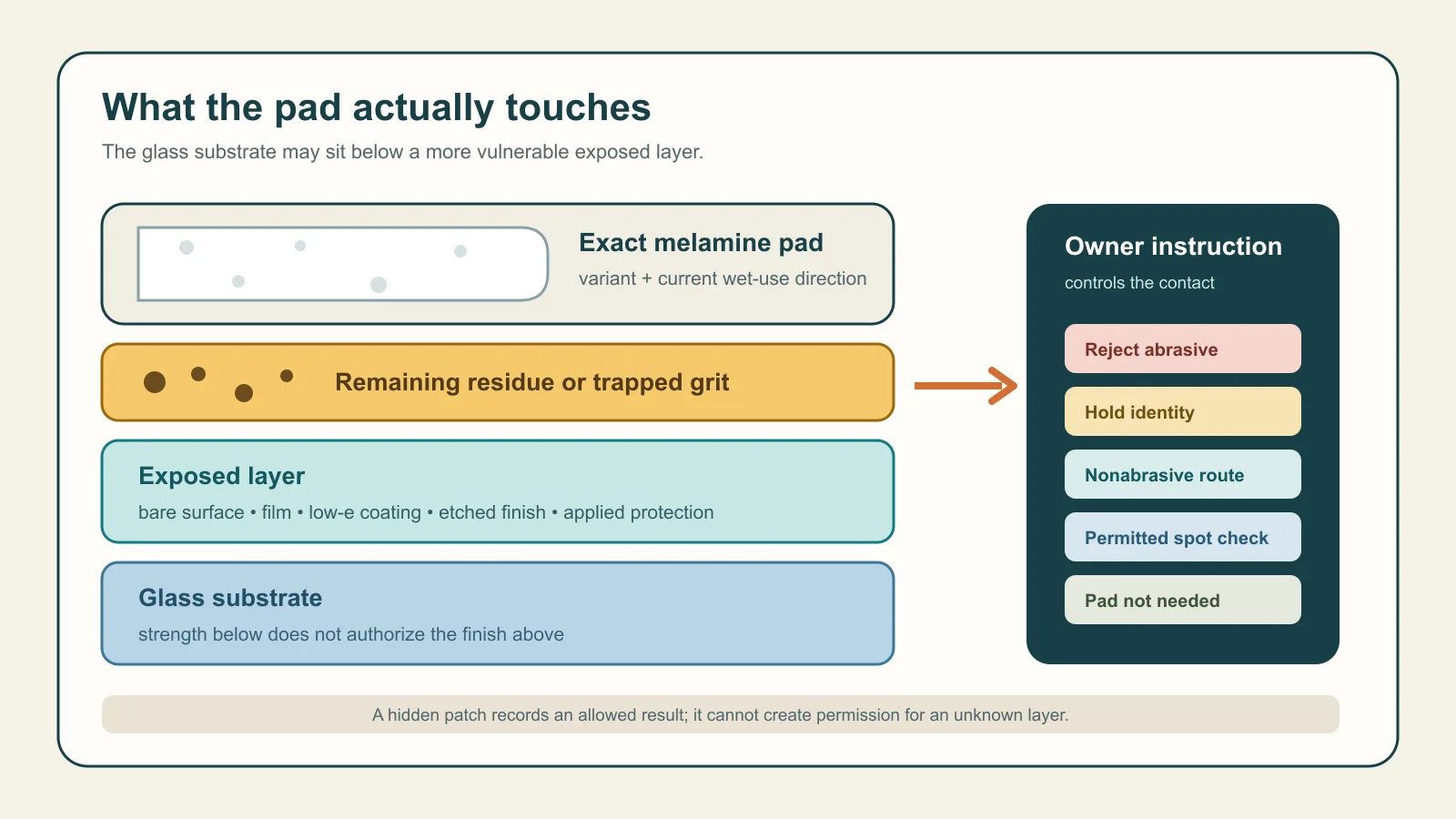
The contact stack keeps the decision at the surface. The pad does not skip a film to reach the stronger glass below it, and a seller’s general use claim does not erase a coating owner’s prohibition.
Permission can be narrow without being contradictory
Current owner documents produce different answers because they govern different products.
3M’s window-film care bulletin says not to use abrasive cleaning materials, knives, scrapers or brushes on its films and not to rub vigorously or apply heavy pressure. It offers nonabrasive paper, soft cloth or microfiber, and a clean synthetic sponge with water and a few drops of dish soap as owner-approved routes. The word sponge in that list does not transform an abrasive melamine pad into the specified nonabrasive material.
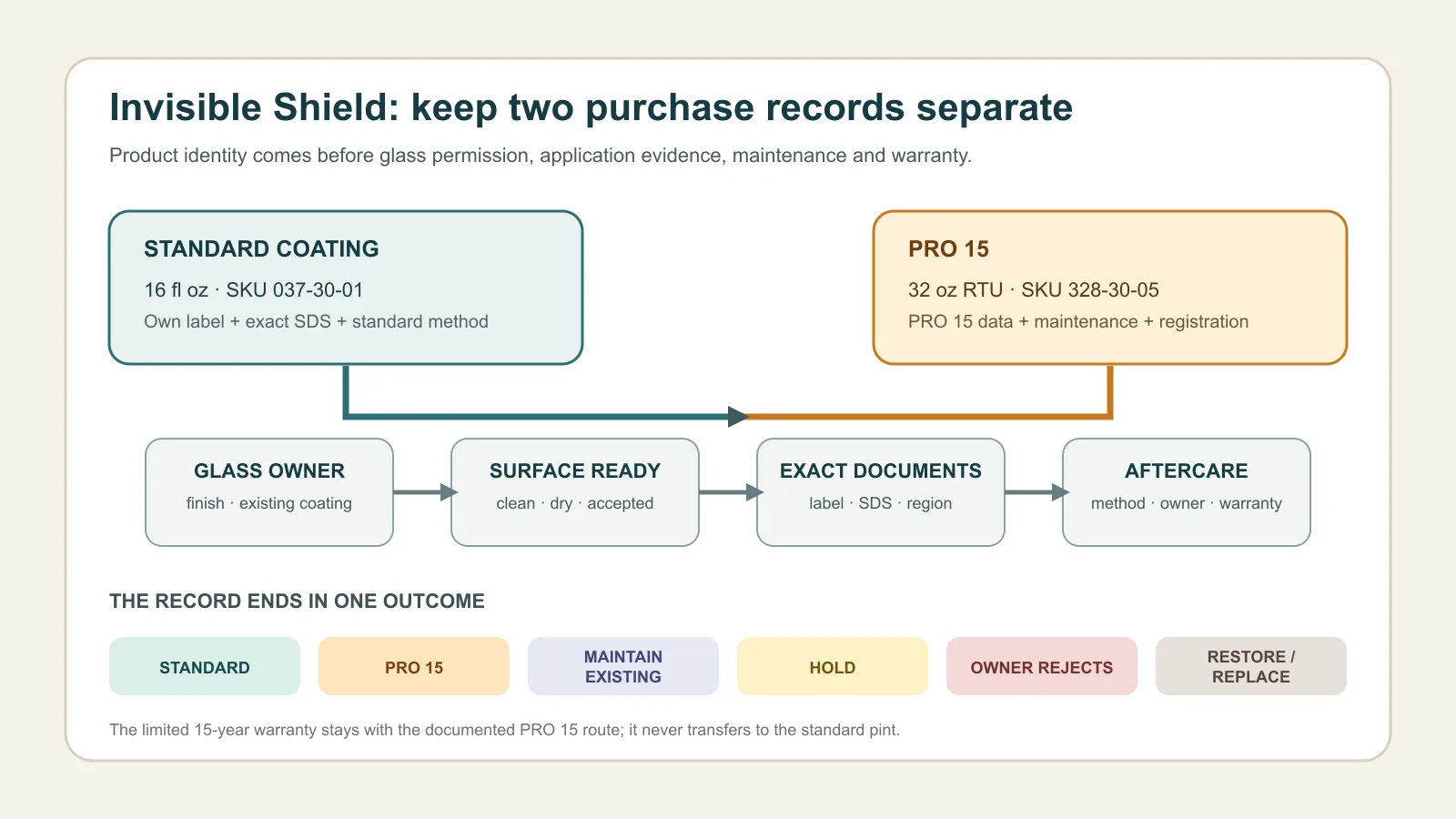
Precision Glass is more explicit for its protected Invisible Shield glass: its current care document names Mr. Clean Magic Eraser among the abrasive cleansers not to use. It directs the owner toward compatible cleaner and a soft cloth or paper towel. That is a closed rejection for the named protected surface, not a suggestion to try less pressure.
Vitro’s technical guidance supplies another reject branch. It says exposed Sungate and Solarban low-e coatings are more susceptible to scratch damage than uncoated glass and that abrasive cleaning must be avoided. If an exact unit exposes one of those coatings on the cleaning side, an ordinary-looking white pad does not belong there.
A narrow positive instruction is possible too. Premier Custom-Built’s care guide permits a lightly damp Mr. Clean Original Magic Eraser with light pressure for marks on its named LED glass shelves. The same section warns that aggressive cleaning on the etching side can polish away the etched finish. That permission belongs to that product, that variant and that method. It is evidence that the owner can say yes—not evidence that every window owner has said yes.
Do not average these documents into “probably safe.” Keep each instruction attached to the surface it names.
A small patch records a result; it does not grant permission
An inconspicuous area is useful only after the owner has allowed the contact class. The order matters. First use the ordinary cleaning route permitted for that product. Remove loose dust and particles rather than trapping them under a deformable pad. Then name what remains: adhesive, paint transfer, soap film, mineral deposit, rubber mark or an unknown change in the surface.
Unknown residue is not an invitation to scrub harder. Construction debris can carry mineral particles. White haze may be etching or coating damage rather than removable soil. A mark that sits inside an insulated unit is unreachable from the cleaning side. Those conditions need their own diagnosis or service owner.
If the exact surface owner permits a melamine pad, the limited-contact record should include:
- exact glass product, cleaning side and exposed layer;
- exact pad brand and variant, with its current direction;
- ordinary clean completed and the remaining residue named;
- a new, clean pad and how loose particles were removed;
- water or another owner-approved lubricant, with no improvised chemical mix;
- the small location, light contact, rinse/dry method and reflected-light observation.
That observation answers what happened in that area. It does not prove that the whole pane has the same coating, that another pad is equivalent, that grit will never enter the contact or that repeated service cannot change the finish. WCR’s own product answer is useful here: for dry touch-up after squeegeeing, it recommends a microfiber cloth rather than the Magic Foam Eraser.
Put one contact method on the job record
The result should select a method, not simply label the pad good or bad.
| Evidence at the pane | Contact decision | What happens next |
|---|---|---|
| Film, coating, etched finish or protection owner rejects abrasive contact or names Magic Eraser as prohibited | Owner rejects abrasive |
Use the named nonabrasive care route; do not perform a patch |
| Pad variant, installed product, cleaning side or exposed layer is unknown | Hold surface or pad identity |
Obtain the package direction and glass/film/coating record before contact |
| Owner supplies a nonabrasive method for the remaining soil | Use owner-approved nonabrasive route |
Keep the melamine pad out of the work order |
| Owner permits the exact pad/contact class and ordinary cleaning leaves a defined residue | Limited owner-permitted spot check |
Record the small-area observation before any separately authorized expansion |
| Ordinary owner-approved washing removes the soil | Melamine pad not needed |
Finish with the normal rinse, squeegee or cloth method allowed for that product |
Keep neighboring decisions in their own lanes. Grade-0000 steel wool has a separate product, rust and glass-permission record. Bio-Clean has an exact mild-abrasive product and deposit-versus-etch decision. Existing Invisible Shield protection has its own maintenance rules. A melamine pad is not a shortcut through any of those records.
In a professional tool setup, this is a conditional spot-contact item, not a universal scrubber. The complete job entry can be short: exact pane and exposed layer, exact pad, remaining residue, owner instruction, loose-particle control, permitted method and observed result. If one of those fields stays open, the honest tool choice is the owner-approved alternative—or no contact at all.