Open a complete Unger squeegee on the bench and it stops being one product. It becomes a handle, a release, a channel, two channel ends or clips, a strip of rubber and—if the tool will work from a pole—a connection that still has to match the pole tip.
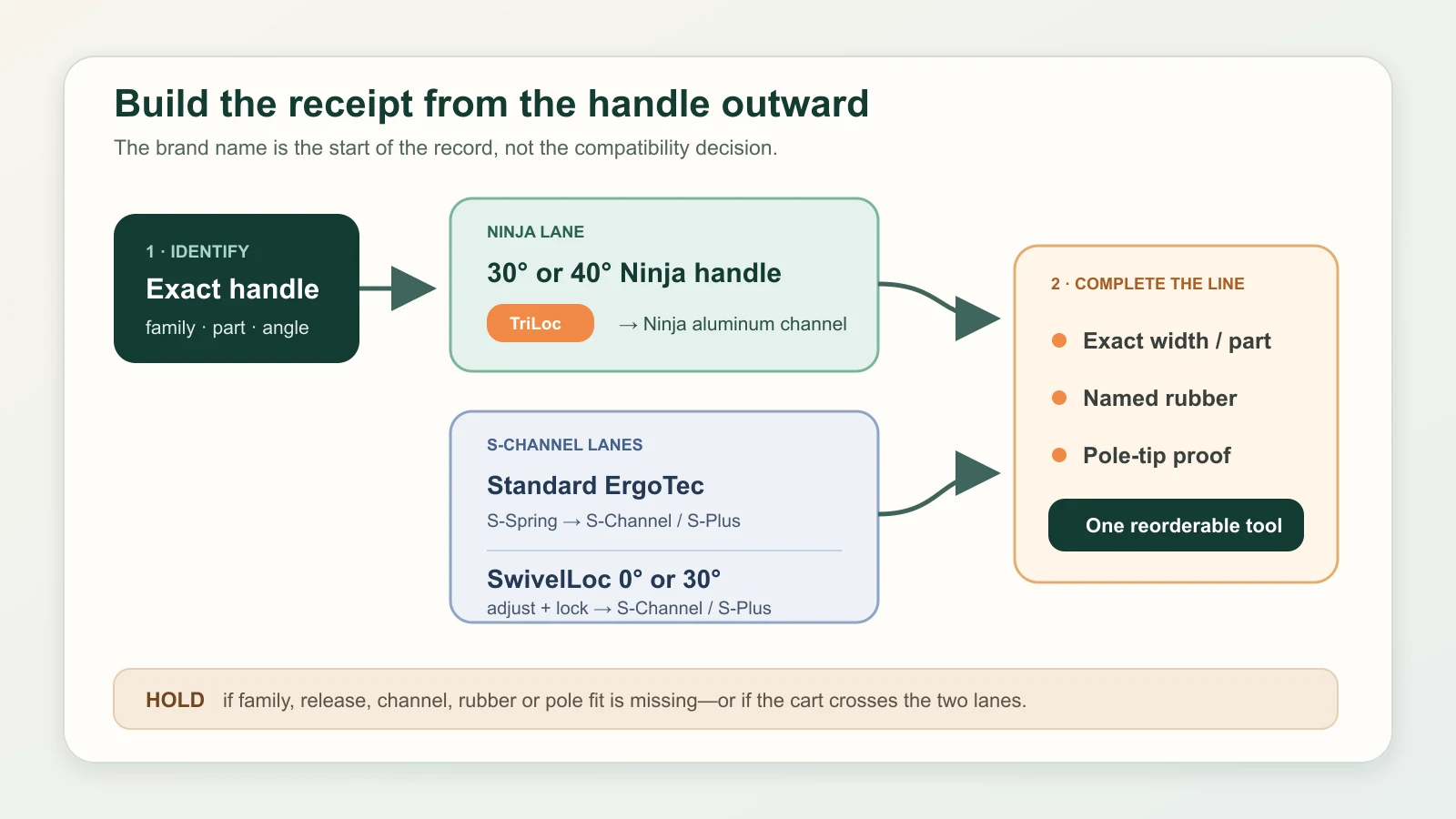
That is why “Unger squeegee” is not a complete order. The current range contains at least two materially different component routes. ErgoTec Ninja handles use Unger’s Ninja aluminum channel and TriLoc retention. Standard ErgoTec and SwivelLoc handles use documented S-Channel or S-Channel Plus routes instead. Angle, width and rubber come after that fork, not before it.
The useful purchase record is therefore an assembly, not a logo: exact handle or complete model; release method; named channel family and width; rubber class; and confirmed pole interface. If one of those fields is missing, hold the component order rather than assuming every Unger-marked part belongs together.
The handle name opens the parts list
Start with the exact text and part number on the handle or complete-tool listing. “ErgoTec” alone is too broad because the name appears across standard ErgoTec, ErgoTec Ninja and ErgoTec SwivelLoc products. Those products can share a manufacturer and still take different channel routes.
The current official Unger category comparison is useful because it places handle angle, swivel, channel fitting and rubber in separate fields. Read those fields as an assembly record. Do not compress them into “professional model” or “premium handle”; neither phrase identifies the replacement channel.
| Field | What belongs there | What does not close it |
|---|---|---|
| Handle | Exact family, model or part number and angle | Unger, ErgoTec or a product photo |
| Release | TriLoc, S-Spring or the named mechanism on that handle | “Quick release” without the exact system |
| Channel | Ninja aluminum, S-Channel or S-Channel Plus, plus exact width and part | Width by itself |
| Rubber | Named family or class and cut or supplied length tied to the channel | “Unger rubber” |
| Pole interface | Exact handle connection and identified pole tip | Locking Cone shown on one side only |
This page owns that Unger assembly fork. If the unresolved choice is the width that fits recurring panes, use the site’s window-cleaning squeegee guide. It starts from pane geometry rather than from a brand family.
Ninja stays in the aluminum-channel lane
Unger currently documents the ErgoTec Ninja with a 180-degree swivel, TriLoc mechanism and its T6 aluminum channel. The current global product assortment lists a 30-degree E3000 handle and a 40-degree EN000 handle. It also lists Ninja aluminum channels under AC part numbers, from 20 cm through longer channel-only variants.
Those rows should not be blended into one universal store shelf. For example, the exact E3300 technical sheet identifies a 30 cm complete with a 30-degree handle. A current US specialist Ninja 40-degree cart uses inch-labelled options. That difference is a regional-cart warning, not a conversion exercise: preserve the unit and exact part number shown by the source you intend to buy from.
TriLoc and “Ninja aluminum channel” are the important family locks. If a cart contains a Ninja 30-degree or 40-degree handle plus an S-Channel merely because both items say Unger, stop and correct the channel route. A current Window Cleaning Resource S-Plus page explicitly excludes those Ninja handles from its tested handle list. That statement belongs to that merchant’s current tested scope; it is enough to reject the displayed mix, but it is not permission to invent compatibility for other brands or unlisted parts.
For a new complete Ninja order, save the complete model, handle angle, supplied channel width and rubber identity on the same line. For a replacement channel, start from the handle and existing channel part, not from the desired width alone.
S-Channel creates a different handle fork
The standard ErgoTec route is mechanically different. Unger’s current ErgoTec product page names an S-Spring release and supports S-Channel and S-Channel Plus. The handle uses Unger’s Locking Cone interface for its named pole system. This is the lane to check when an existing standard ErgoTec handle needs a new channel, not the Ninja aluminum-channel table.
SwivelLoc creates a branch inside the S-Channel side. Unger currently lists LS000 at 0 degrees and LA000 at 30 degrees, with an adjustable, lockable joint and S/S-Plus channel fitting. That makes SwivelLoc a position choice inside a documented channel family; it does not turn it into a Ninja handle.
Other current handles, including Pro and S families, also appear in Unger’s comparison with their own release details and S/S-Plus fittings. Treat each named handle as the owner of its release and approved channel route. Similar silhouettes do not merge the mechanisms.
| Exact handle route | Documented channel lane | Cart result |
|---|---|---|
| Ninja 30-degree or 40-degree handle | Ninja aluminum channel with TriLoc | Keep within the exact Ninja part-number route |
| Standard ErgoTec | S-Channel or S-Channel Plus with S-Spring | Build the exact S-channel assembly |
| SwivelLoc 0-degree or 30-degree | S-Channel or S-Channel Plus | Record angle and adjustable joint before selecting the channel |
| Family, release or channel is unclear | None yet | Hold and identify the part; do not solve it with the brand name |
Choose the angle from the working position
Zero, 30 and 40 degrees are not a quality ranking. They describe different handle geometry. The useful question is where the operator’s hand or pole will be relative to the glass and whether the joint must swivel, lock or remain fixed during the named work.
Define that position before choosing an angle. A hand tool used close to accessible glass, a pole-mounted tool working higher panes and a swivel handle working around an obstruction do not create the same geometry. Current product pages can tell you which angle and joint a model has; they cannot decide which position your route repeats or promise that the operator will prefer it.
Pole fit is a separate record. “Locking Cone” identifies Unger’s named locking interface on the handle side, but it does not prove that an unknown threaded, tapered or third-party pole tip will lock to it. The site’s extension-pole guide owns the exact head-to-tip-to-pole check. Close that connection with both part identities before treating “pole compatible” as an order fact.
If the intended work position is not yet known, a handle-angle comparison is premature. Keep the assembly open at the angle field instead of letting a product name choose the route.
Rubber belongs to this assembly
Unger currently exposes soft, hard and green rubber options across parts of its range. Those labels are manufacturer product classes, not universal predictions about glide, durability or streaking on a particular route. Temperature, glass condition, technique, detergent and channel condition can all affect the field result.
Keep the rubber identity beside the channel family and exact length. When a replacement is needed, inspect how the existing rubber is retained, whether the channel or clips are damaged, and whether the listing supplies a cut piece or a longer strip. The detailed squeegee-rubber replacement guide owns that diagnosis and measurement step across product families.
The first purchase can make the next one easier. Record the supplied rubber and the replacement part or profile named for that assembly while the documents are open. If the only evidence is “fits Unger,” the replacement path is not closed. Move back to the exact channel and handle record.
Reorder the receipt, not the logo
The line that survives a new buyer, a changed merchant page and a worn label is specific enough to reconstruct the tool. Three honest examples show the level of detail:
| Receipt state | Decision | Next action |
|---|---|---|
| Exact Ninja complete/model, 30-degree or 40-degree handle, Ninja aluminum channel width and named rubber agree | Order the exact Ninja complete or documented replacement | Preserve source region, units and part numbers on the receipt |
| Exact standard ErgoTec handle, S-Spring, S/S-Plus channel width and rubber agree | Build the exact S-Channel system | Keep the handle and channel identifiers together for service |
| Exact SwivelLoc LS000 or LA000, intended work position and S/S-Plus channel agree | Build the exact SwivelLoc system | Close the pole-tip identity separately if pole use is planned |
| Handle family, release, channel, rubber or pole fit is missing or contradictory | Hold or correct the mixed cart | Ask for the exact part number or choose a documented complete assembly |
Once that line closes, place the tool inside the broader professional window-cleaning setup instead of treating the squeegee as the whole system. Bucket, washer, solution, towels, pole connection and service stock still have their own owners.
An Unger squeegee is reorderable when the receipt can name every working connection. Until then, the logo tells you who made the parts, not whether the parts make one tool.