The tube and the bottle can share the search term without sharing the job. A liquid sold to window cleaners may be intended to leave a protective treatment across the face of the pane. A cartridge sold for glazing belongs in a joint between parts of the window assembly. A small bottle promising better wet-weather visibility may belong on exterior automotive glass.
Classify the application location before comparing price, coverage or durability. Across the pane means the architectural surface-coating lane. Inside the frame-to-glass or perimeter joint means the glazing/weatherseal lane. A product expressly presented for exterior vehicle glass stays in the automotive lane. If the product record does not resolve that location, hold it.
Only the first lane can become a window-cleaning coating service, and even that is not automatic. The exact glass, existing treatment, preparation state, product directions, safety record, application authority and aftercare owner still have to agree.
Start with where the product goes
| Proposed location | Product record to look for | Responsible authority | Purchasing result |
|---|---|---|---|
| Across the face of architectural glass | Named surface-protection coating, exact container, directions and safety document | Glass/coating owner plus the manufacturer’s named application path | Architectural surface-coating candidate |
| Inside a glass-to-frame or perimeter joint | Named glazing or weatherseal joint product and current technical documents | Window-system, glazing or building-envelope owner | Route out of the cleaning-chemical cart |
| On exterior automotive glass | Named vehicle-glass treatment, directions and matching safety record | Automotive glass and exact product owners | Automotive product lane |
| Unknown, mixed or supported only by seller wording | No complete matching record | The person who can identify the object, location and exact product | Hold the line item |
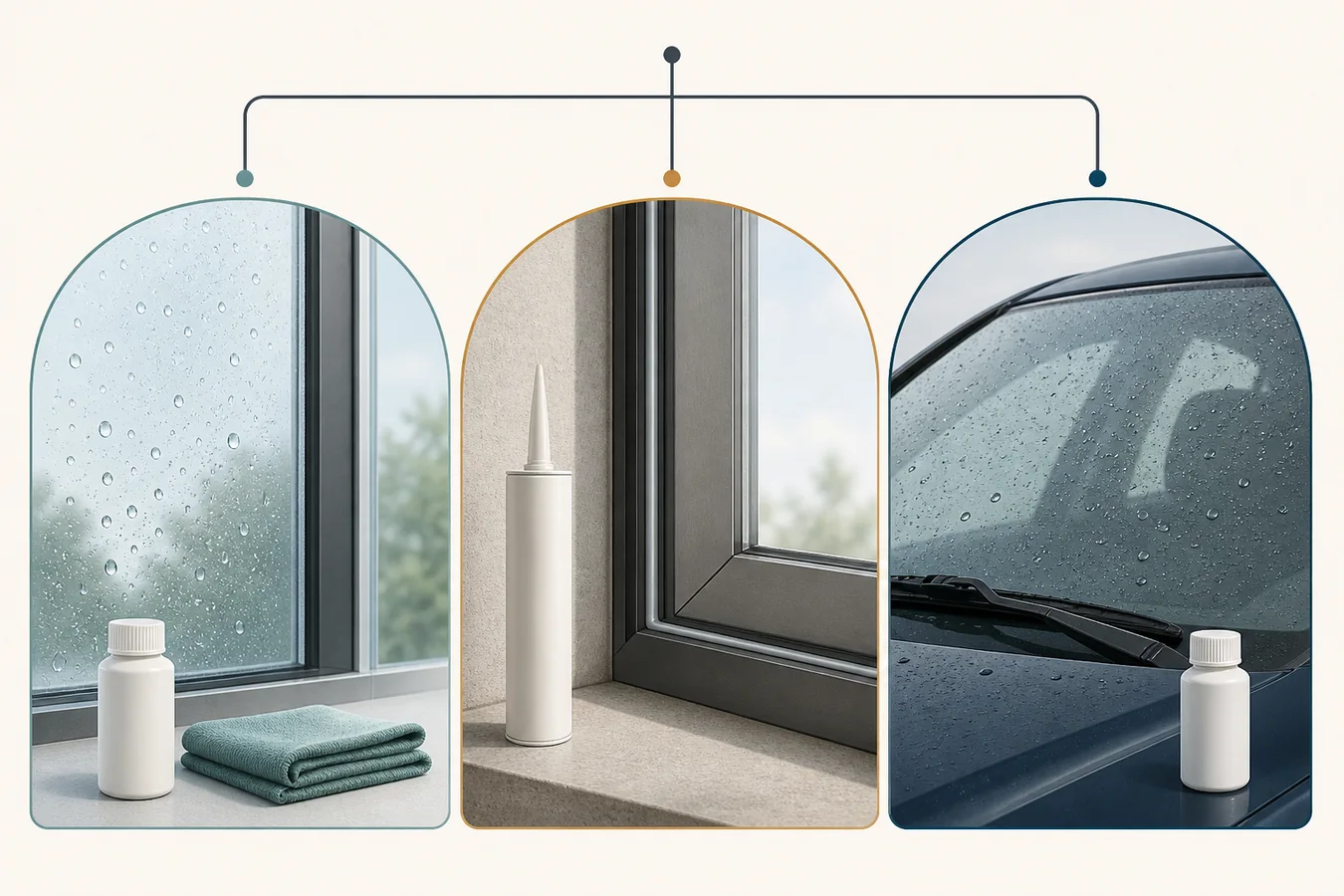
Product form is a clue, not authority. A bottle can still belong to automotive glass, and a cartridge can serve several building-joint contexts. Location plus an exact public record closes the role.
This first cut prevents three category errors. A cleaning company does not buy a joint compound to create an easy-clean surface. A leaking or failed window joint is not repaired by wiping a hydrophobic treatment over the pane. An automotive visibility claim does not become architectural-glass permission because both products bead water.
A pane coating is a service line, not a tube
DFI currently presents Diamon-Fusion as a protective treatment for glass, and its window page names windows among the surfaces it protects. Its public product material also separates manufacturer-owned application paths rather than treating every bottle and applicator as interchangeable. That makes it a surface-coating example, not a generic definition of every product called glass sealant.
Unelko likewise presents glass-protection products across architectural and professional industries. These manufacturer pages establish that a real surface-treatment category exists. They do not make every pane eligible or every applicator interchangeable.
For a window-cleaning business, the sale begins with a named pane and a named product record. Identify the glass product and exposed side, any film or factory treatment, visible damage or deposits, and the preparation state the exact coating requires. Keep the current product directions and exact safety document with the container being quoted. If an applicator program, registration or warranty is part of the offer, preserve the owner and obligations of that exact route.
Current specialist categories from J. Racenstein and WindowCleaner.com confirm that sealers and protectors are bought in this trade. They are useful category evidence. They are not the glass manufacturer, coating manufacturer or warranty owner, so their taxonomy cannot close an unknown surface.
When the proposed product is Invisible Shield, the exact standard-versus-PRO 15 decision belongs on the site’s Invisible Shield glass coating page. If the pane still has mineral damage, haze or a material-removal question, coating shopping is premature; the cerium-oxide decision separates cleaning from trained polishing and replacement review.
A glazing sealant belongs to the assembly
Dow’s current page presents DOWSIL 794F as an alkoxy sealant for glazing and weathersealing windows and window materials. The product belongs in a joint. It is not a wipe-on cleaning chemical, and the word glass in its application context does not move it into a surface-protection quote.
That distinction matters when the original query began with a leak, a loose lite, a failed perimeter bead or a gap at the frame. Those conditions identify an assembly problem, not a request for a glass-care bottle. The responsible glazing, window-system or building-envelope owner must identify the joint, substrates, movement, existing material, design and exact current technical documents. A cleaner should not diagnose the failure from a shopping result or treat a general product page as installation authority.
Do not use product form as a shortcut. Many joint products arrive in cartridges, but a cartridge shape cannot prove compatibility with a particular frame, glass edge, spacer, finish or old sealant. Likewise, a surface treatment may be sold in a small bottle without being safe for every glazing material it can contact. Location plus exact record closes the role; packaging alone does not.
The commercial outcome is a route, not an improvised add-on. Keep glass cleaning or an approved surface treatment on the cleaning quote. Put joint investigation and repair under the owner qualified to accept that window assembly.
Windshield visibility is a separate promise
Rain-X currently describes Original Glass Water Repellent for exterior automotive glass and ties the product to wet-weather driving visibility. That is a clear product-role record. It does not establish permission for an architectural window, applied film, shower enclosure, coated façade or the adjacent sealants around any of them.
The distinction survives even when the surface behavior sounds similar. Water beading, repellency and easier cleaning are outcomes manufacturers may discuss within their own products and test scopes. Similar words do not establish the same formulation, substrate, preparation, optical requirement, maintenance or warranty.
Keep the live product directions and the current linked Rain-X safety data sheet with the exact automotive product. The document identity matters because a brand family can contain cleaners, de-icers, washes and treatments with different instructions. A current automotive record can support an automotive purchase. It cannot be edited into an architectural application method.
If a customer or worker proposes an automotive bottle for building glass, return the question to the window, film, coating and product owners. Approval must name that use. Silence is not cross-market compatibility, and an online anecdote is not an owner record.
Put the authority beside the line item
| Closed evidence | Disposition | What belongs on the record |
|---|---|---|
| Exact architectural glass, exposed side, coating product, directions, safety record and application owner agree | Surface-coating candidate | Product/container, treated area, preparation boundary, authorized path, aftercare and any exact warranty obligations |
| The need is in a glass-to-frame, perimeter or other window-assembly joint | Glazing route | Joint and assembly owner, observed condition and the person qualified to select or accept the repair path |
| The product’s current owner names exterior automotive glass and matching documents are available | Automotive lane | Exact vehicle-glass use and exact product documents; no architectural claim |
| Application location, object, product identity, current directions or responsible owner is missing or mixed | Hold | The missing fact and the owner who can close it |
| The pane still has unresolved deposits, damage, prior film or factory treatment | Close the glass condition first | Restoration, replacement or existing-treatment decision before a new coating is compared |
Write the surviving record in one sentence: [exact object] at [pane surface, assembly joint or automotive exterior glass], using [exact product and current documents], authorized by [named owner], results in [surface-coating candidate, glazing route, automotive lane or hold].
Only a supported architectural surface-coating candidate returns to the professional window-cleaning equipment plan. The other outcomes are complete precisely because they prevent the wrong product, promise or responsibility from entering the cart.