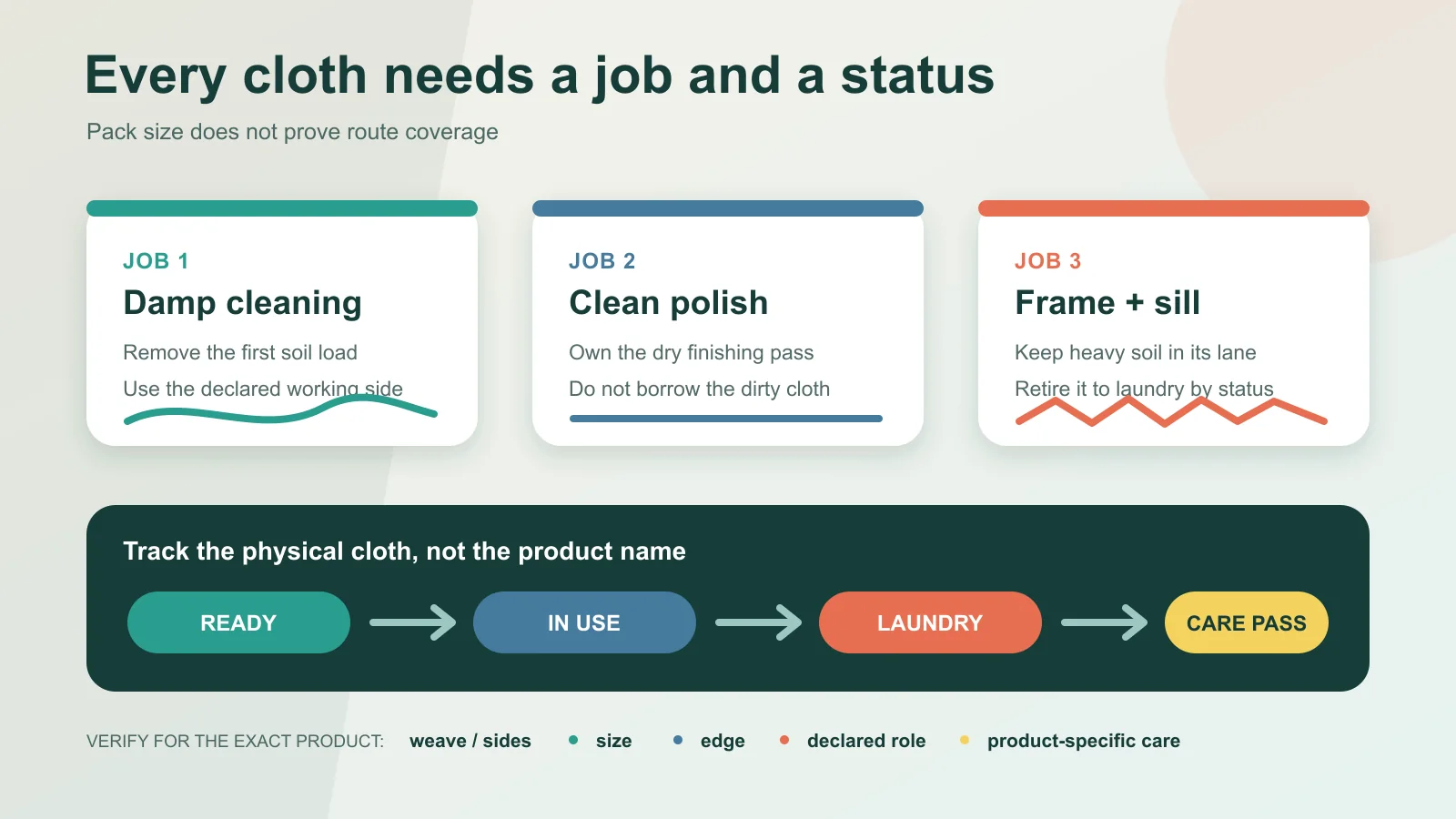
A large pack can still leave you one cloth short. If every cloth enters the same wet, dirty part of the route, none of them is reserved for the clean finishing pass. The piece count is high, but the missing job is still missing.
Before comparing brands, write three verbs beside the cart: damp clean, polish or detail, and wipe frames and sills. Assign an exact physical cloth to each job, then track whether that cloth is ready, in use or waiting for laundry. A product belongs in the cart only when its declared construction and care instructions support the job you gave it.
This is a narrower decision than building a complete professional window-cleaning tool setup. It also starts after a starter-kit contents audit: the question here is whether the cloth part of that kit covers distinct work instead of repeating the same item.
Give the first cloth in the cart a verb
Start with the work, not a color or a bundle name.
Damp clean means owning the first wet pass for the product system you selected. Polish or detail means keeping a clean cloth available for the finishing work declared for that cloth. Wipe frames and sills means giving heavier, transferred soil a separate destination so that cloth does not drift back into the clean finishing stack while it is still in use.
These are inventory roles, not performance promises. A manufacturer may declare that one cloth has a cleaning side and a polishing side. That establishes two intended uses for the model; it does not make one physical cloth simultaneously clean, dirty and ready for every part of a route.
Write the exact model next to each verb. If the same unit appears twice, decide whether the work happens at different times with a completed care cycle between uses. If not, the cart needs another physical owner for one of the roles. Do not solve that conflict by assuming a bigger pack is automatically diverse.
Let specifications change a job, not create a score
Microfiber specifications are useful when they change an assignment. They are weak when they are turned into a universal ranking.
- Weave or working sides: use the manufacturer’s declared working surfaces to decide which job the cloth can enter. Do not promote a generic weave label into an independent streak, lint or safety guarantee.
- Dimensions: size changes how a cloth can be folded, handled and carried. It does not prove how many panes it will finish or how many cloths a route requires.
- Fabric weight: grams per square meter describes construction. It is not a quality score and does not establish cleaning output by itself.
- Edges, pockets and corners: these features can change grip, placement or the spot-work functions declared for the exact model. They do not make two products interchangeable.
- Pack configuration: two identical cloths repeat an item; a two-cloth system with separately declared jobs adds complementary roles. Neither arrangement proves coverage beyond what the current product page states.
- Care instructions: these decide whether the cloth has a documented path back to ready. Instructions for one product cannot fill a blank on another product page.
Keep “not published” visible when a field is absent. A missing fabric weight is not a low score, and a missing care path is not permission to borrow another brand’s laundry recipe.
Track the cloth and the job separately
Use one row for each real cloth, not one row for the product name. A two-pack therefore gets two rows. A dual-sided single cloth still gets one row because it can occupy only one current physical state.
| Job | Exact physical owner | Declared working surface or role | Current state | Product-specific care found? | Decision |
|---|---|---|---|---|---|
| Damp clean | Model and unit number | Copy the manufacturer’s damp, wet or cleaning wording | Ready, in use or laundry | Yes, no or not published | Assign the role or verify care |
| Clean polish/detail | Model and unit number | Copy the finishing, glass or polishing wording | Ready, in use or laundry | Yes, no or not published | Assign the role or add a separate cloth |
| Frame and sill work | Model and unit number | Record only a declared use you can support; otherwise label this as your route assignment | Ready, in use or laundry | Yes, no or not published | Assign separately or hold the product |
Read across, not down. The role column says what the cloth is for. The state column says whether that exact unit is available now. A cloth marked in use for a dirty frame or sill is not also ready for clean polishing. Move it to laundry, follow its own care path, and return it to ready only after that process is complete.
This ledger also prevents a carrying mistake. Once you know which cloth must stay clean and which accepts dirtier work, give them separate positions in the window-cleaning tool belt layout instead of treating every pocket as shared storage.
The table does not prescribe a route-wide cloth quantity. Actual turnover depends on the work, soil and the operator’s observed usage. Record when a role runs out of ready owners, then adjust that role rather than copying an arbitrary pack recommendation.
Three current products solve different parts of the route
The products below are not ranked. They show three different pack structures and why the exact model page has to remain attached to the role card.
| Exact current product | What the manufacturer declares | What that closes | What remains open |
|---|---|---|---|
| Unger ErgoTec Ninja MicroWipe MN40H | 40 × 40 cm; 400 g/m²; 70% polyester and 30% polyamide; a coarse side for cleaning and a smooth side for polishing; four scrubbing corners, pocket corners and a reinforced overlock edge. Unger says it is machine washable up to 500 times. | One exact cloth has separately declared cleaning and polishing surfaces plus a manufacturer wash-count claim. | One physical MN40H still has one current state. Its declared two-sided use does not prove that a single unit can own conflicting clean and dirty roles at the same moment. The stated wash count is a manufacturer claim, not observed route life. |
| Unger Microfiber Glass & Mirror Cloths 966910 | A two-pack of 12 × 12-inch specialty-weave cloths declared for wet or dry use on glass and mirrors. Unger says they can be washed up to 100 times. | The pack provides two physical units of the same declared product. | The page does not turn those units into separate frame, damp-clean and clean-polish roles. Assign the two units yourself and keep the manufacturer wash statement separate from a service-life prediction. |
| E-Cloth Window Cleaning Kit 10615 | A damp waffle-weave Window Cloth followed by a dry Glass & Polishing Cloth; 80% polyester and 20% polyamide; listed sizes of 15.5 × 15.5 inches and 16 × 20 inches. | The package explicitly pairs two different physical cloths with damp cleaning and dry polishing steps. | That two-role pairing does not establish professional route capacity or supply a separate dirty-frame owner. The product’s own care instructions still govern its return to ready. |
The useful contrast is not 400 g/m² versus an unpublished weight, or 500 versus 100 manufacturer-stated washes. The products are not presented under the same claim scope, and those numbers do not answer the same operating question. Compare whether the exact package gives each required job a physical owner and a maintainable return path.
If a seller page lists only a generic “microfiber cloth,” identify the model before treating any specifications or care instructions as closed. If the model cannot be identified, hold that line of the cart rather than attaching convenient facts from a similar product.
Care instructions belong to the product
Laundry is not a footnote here; it is the transition from laundry back to ready. That transition fails closed when the exact product has no verified care path.
For E-Cloth 10615, the current product page says to rinse and wring the cloth after use, wash it up to 90°C with a small amount of detergent, avoid fabric softener and dryer sheets, and tumble dry or hang dry. E-Cloth’s microfiber care guidance also says its Glass & Polishing Cloth may need washing less often than cleaning cloths because it is used for the final step. Those instructions and that observation belong to the E-Cloth product family; they are not a default recipe or schedule for the Unger products above.
Record the product URL or supplied care label beside each model. When a manufacturer changes the instructions, update that row before the next care cycle. When the instructions are missing, the result is verify the care, not “wash it like the other cloths.”
A declared wash-count claim should be stored the same way: exact model, exact publisher and claim wording. It does not tell you when a route cloth will stop meeting your operating standard. Replacement timing remains an observation from the actual cloth, work and care history.
Remove duplicate roles from the cart
Look at the completed role card and make the smallest change that closes it:
- Assign the role when every required job has an exact physical owner, the declared use supports that assignment and the owner has a verified care path.
- Add a separate cloth when two simultaneous jobs point to the same physical unit or dirty frame/sill work would consume the only clean polishing owner.
- Verify the care when the product and role are identifiable but the return from laundry to ready is not documented for that exact product.
- Hold the product when the model, declared role or care path is too vague to maintain the rotation.
Now delete any extra pack count that merely repeats a covered role without solving an observed turnover problem. Keep an additional unit when it owns a real job or when your route record shows that role runs out of ready cloths. The cart is finished when every required verb has a named owner and every owner has a credible path back to ready—not when the piece count looks generous.