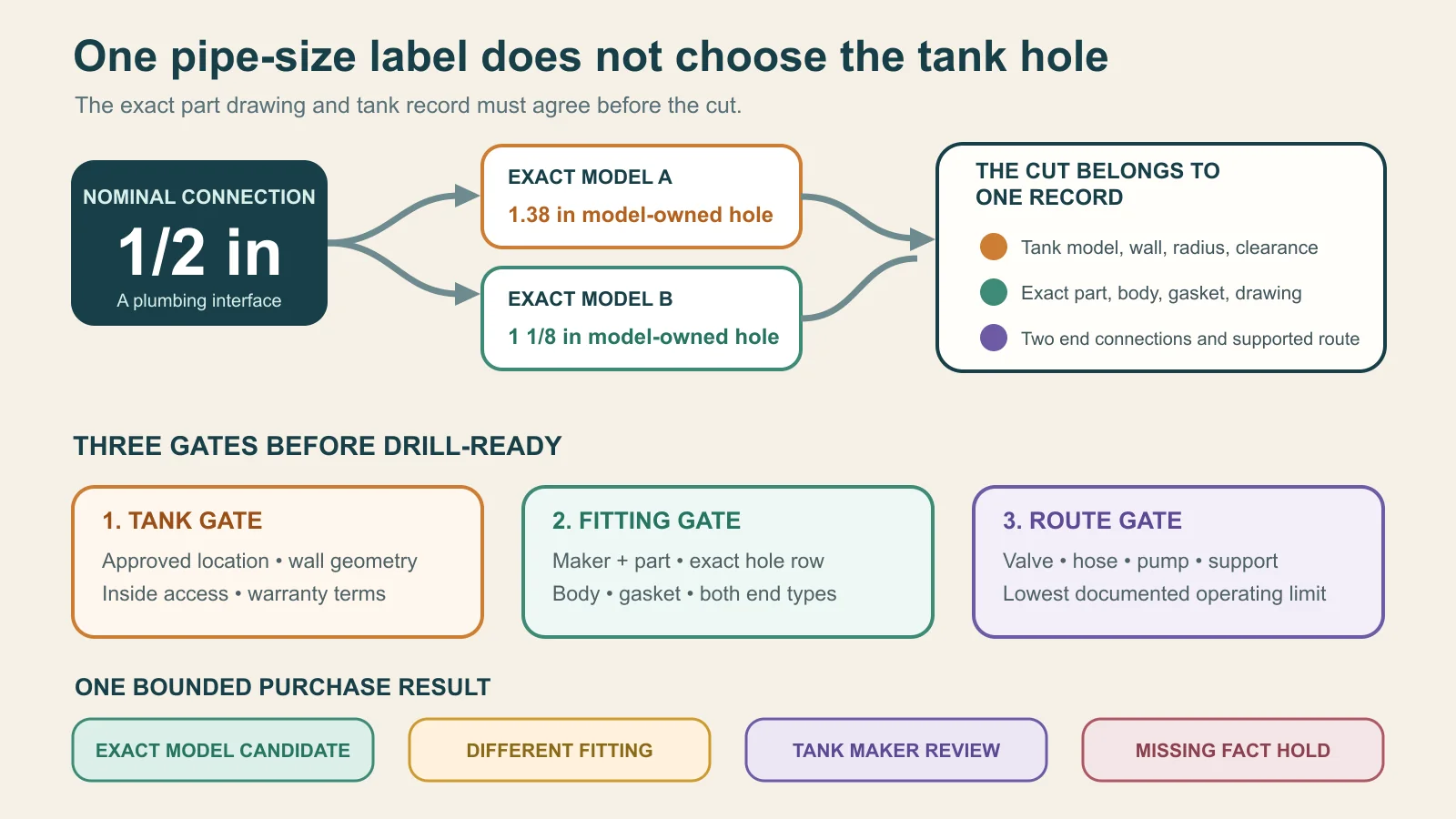
A current Hayward 1/2-inch bulkhead model specifies a 1.38-inch installation hole. Banjo’s current catalog lists a 1 1/8-inch hole for its TF050, another 1/2-inch bulkhead fitting. The nominal connection is the same; the exact parts, materials and holes are not.
That is the purchase problem. “1/2-inch PVC bulkhead fitting” can start a search, but it cannot choose the hole saw, approve the tank wall or identify what connects on either side. Those facts belong to one exact part drawing and one named tank.
Keep the tank uncut until three records agree: the tank manufacturer permits the location, the fitting manufacturer supplies the applicable dimensions and materials, and the downstream route will not hang an undocumented load from the wall connection.
This is one outlet decision inside the complete water-fed pole system. It does not select the tank, pump or hose system by itself.
The pipe size and the tank cut answer different questions
Nominal pipe size identifies the intended plumbing connection. The installation hole clears the fitting body through the tank wall. The flange, gasket and nut need their own contact area and clearance. Wall thickness and tank curvature can add another limit.
Those dimensions may sit beside one another on a drawing, but they are not interchangeable. A larger hole cannot be justified by averaging two seller pages, and a smaller hole cannot be enlarged safely just because another 1/2-inch fitting used it.
| Current record | What “1/2 inch” names | Published hole information | What remains open |
|---|---|---|---|
| Hayward BFA1005TFS | Threaded x threaded connection on one PVC/FPM model | 1.38-inch installation hole | Named tank, approved location and downstream support |
| Banjo TF050 | Double-sided female NPT connection on one poly/EPDM part | 1 1/8-inch catalog hole | Named tank, liquid, wall geometry and complete route |
| J. Racenstein SKU 74-81381 | Seller-described 1/2-inch FNPT PVC offer | Seller says 1 3/8- or 1 1/2-inch hole | Complete manufacturer part, controlling drawing and tank permission |
Hayward’s exact BFA1005TFS record owns the first row. Banjo’s current tank-accessories catalog owns TF050. The J. Racenstein seller page owns only its offer and seller wording. It does not reveal a complete manufacturer part that could resolve the alternative hole sizes in that listing.
Do not convert any of these examples into a 1/2-inch hole chart. Their value is the opposite: they prove that the exact model chooses the row.
The tank gets a vote before the fitting does
A technically documented fitting can still be wrong for the tank. Record the tank manufacturer and model, whether it is approved for the intended stationary or mobile use, and whether its current documentation permits a field-installed outlet. If the tank manufacturer prohibits modification or does not identify an acceptable location, a fitting catalog cannot overrule it.
The planned location needs real geometry:
- wall material and measured thickness at the location;
- flat, curved or transitioning surface;
- inside radius when the fitting family specifies one;
- clear room for the inside flange or body, gasket and nut;
- outside clearance for the connected valve, adapter or hose;
- access for the exact inspection and service procedure;
- a support plan that does not turn downstream plumbing into a lever on the tank wall.
Hayward’s current BFAS technical data publishes minimum inside tank radii and maximum wall thickness by size for that family. Those fields show why a flat product photo is not enough. They do not approve another Hayward family, another brand or the proposed tank.
If the outlet belongs on a mobile stored-water rig, close the tank’s use, support, venting and vehicle load first. The 100-gallon water-tank decision owns that larger question. A bulkhead fitting cannot make a stationary storage tank suitable for transport.
Read both sides of the bulkhead, not just 1/2 inch
A bulkhead fitting passes through a wall, so it creates two plumbing faces. Write each one separately.
| Interface | Record before ordering | Common unresolved field |
|---|---|---|
| Inside the tank | End type, nominal size, thread/socket standard and any internal pickup named by the tank or system documentation | A generic “female” label without the thread standard or exact mating part |
| Through the wall | Exact body, installation hole, wall allowance, gasket position and flange/nut clearance | A hole copied from another size, family or seller |
| Outside the tank | End type, nominal size, thread/socket standard and first attached component | A hose barb, valve or reducer selected only from a product photo |
| Supported route | Valve, hose, pump/reel path, component support and lowest documented operating limit | The tank fitting is expected to carry pipe, pump or vibration without documented support |
Hayward’s current BFAS specification offers different end-connection patterns by body material. Spears’ Schedule 80 tank-adapter sourcebook likewise separates socket, female pipe thread and reinforced-thread variants by exact part. “PVC” and “1/2 inch” therefore do not tell you whether the inside is socket or threaded, whether the outside is the same, or which seal belongs at the next junction.
Use the garden-hose quick-connect fitting record when the route leaves the bulkhead and crosses adapters, valves or a quick-release family. This page records the immediate faces; it does not guess the rest of that chain.
The first pump is also a separate model decision. If the route uses a stored-water delivery pump, preserve its real inlet, required feed and supported plumbing. The Aquatec DDP 5800 decision shows why a family name or seller headline is not enough to close that component.
Body, gasket and liquid travel as one material decision
PVC is one body material, not a universal compatibility statement. Hayward’s current BFAS specification describes PVC, CPVC and polypropylene bodies, EPDM or FPM gaskets, and material-dependent end configurations. Banjo lists poly fittings with EPDM or FKM options in its own family. Spears publishes its own PVC/CPVC parts and gasket records.
Keep five entries on the same line: stored liquid, body material, gasket material, temperature range and the exact manufacturer statement that admits the combination. Do not transfer an EPDM result to FPM/FKM, a water-service statement to a chemical route, or a PVC limit to polypropylene because the parts share a nominal size.
For the pure-water route covered here, record whether the tank will carry source water, treated water or another documented liquid. A tank that also carries detergent, bleach, solvent or an improvised mixture leaves this page’s decision boundary and requires compatible tank, fitting, pump and chemical-system documentation for the complete material path.
Pressure numbers also stay with their component and conditions. A fitting listed at a particular pressure and temperature does not raise the rating of the tank, valve, hose, pump inlet or adapter. Use the lowest applicable documented boundary for the assembled route, and leave vehicle motion, vibration and unsupported plumbing to the person or company responsible for the installation rather than inventing a derating here.
Finally, record the replacement gasket by manufacturer and part. A loose seal with a similar diameter is not automatically the material or geometry specified for the selected body.
Build the order around one manufacturer’s drawing
Use this receipt for one tank and one exact fitting. If a field comes from another product family, the receipt is not complete.
| Receipt line | Exact entry | Controlling record | Route if unresolved |
|---|---|---|---|
| Tank identity | Manufacturer, model, use and current warranty/installation document | Tank manufacturer | Stop before selecting the cut location |
| Outlet location | Approved zone, wall material, shape, inside radius, thickness and access | Tank document or written tank-manufacturer response plus measurement | Obtain tank-manufacturer review |
| Fitting identity | Manufacturer, family, full part number and current drawing | Fitting manufacturer | Reject a family-only or seller-title-only record |
| Nominal connection | Pipe size and what that size applies to | Exact fitting drawing | Do not use it as the hole dimension |
| Installation hole | Manufacturer dimension for the exact part and drawing revision | Exact fitting drawing | Leave the tank uncut |
| Wall and clearance envelope | Maximum wall, flange/body/nut dimensions and required inside/outside clearance | Exact family/item data plus tank measurement | Choose another part or location |
| Body and gasket | Body material, seal material and replacement-gasket identity | Fitting manufacturer | Hold material compatibility and service planning |
| Stored liquid | Source water, treated water or other documented liquid | Tank, fitting and system records | Move the route to the responsible material review |
| Inside connection | End type, size, thread/socket standard and mating component | Exact part documents | Recover the missing mate or choose another configuration |
| Outside connection | End type, size, thread/socket standard and first valve/adapter/hose | Exact part and downstream component documents | Close the connection chain before ordering |
| Operating envelope | Applicable pressure, temperature and stated service limits | Tank, fitting and downstream records | Use the lowest documented limit or hold |
| Downstream support | Valve, hose, reel/pump route, restraint, service access and responsible party | Complete system and installation plan | Keep the fitting from carrying an unsupported load |
The receipt intentionally does not contain a universal torque, sealant, hole saw or leak-test instruction. Those actions depend on the exact tank, fitting and current installation documents. If the manufacturer does not publish them, obtain a written instruction or use a competent installer who will own the work.
A drill-ready order has one verified record at every boundary
The completed receipt produces four useful outcomes.
Exact model candidate. The tank permits the location, every dimension belongs to the selected part, body and gasket suit the documented liquid, both plumbing faces are known, and the downstream route has its own support and limits.
Different fitting or material. The outlet is valid, but the selected part conflicts with wall geometry, clearance, connection type, liquid or downstream route. Re-open the choice with the failed field visible.
Tank-manufacturer review. The fitting is documented, but the tank location, wall, mobile-use permission or warranty effect is not. No fitting specification can close that authority gap.
Missing-fact hold. The manufacturer part, applicable drawing, hole, gasket, mating connection or operating condition is absent. Do not replace it with the nearest catalog row.
After the outlet is approved and installed under current manufacturer instructions, actual route flow remains a measurement rather than a promise from the fitting size. The garden-hose GPM record can preserve that later observation at the relevant point without turning it into permission to drill.
A drill-ready order carries three matching records: the named tank and approved location, the exact fitting drawing and materials, and the supported downstream route. Until all three identify the same physical opening, the most useful state of the tank is still uncut.