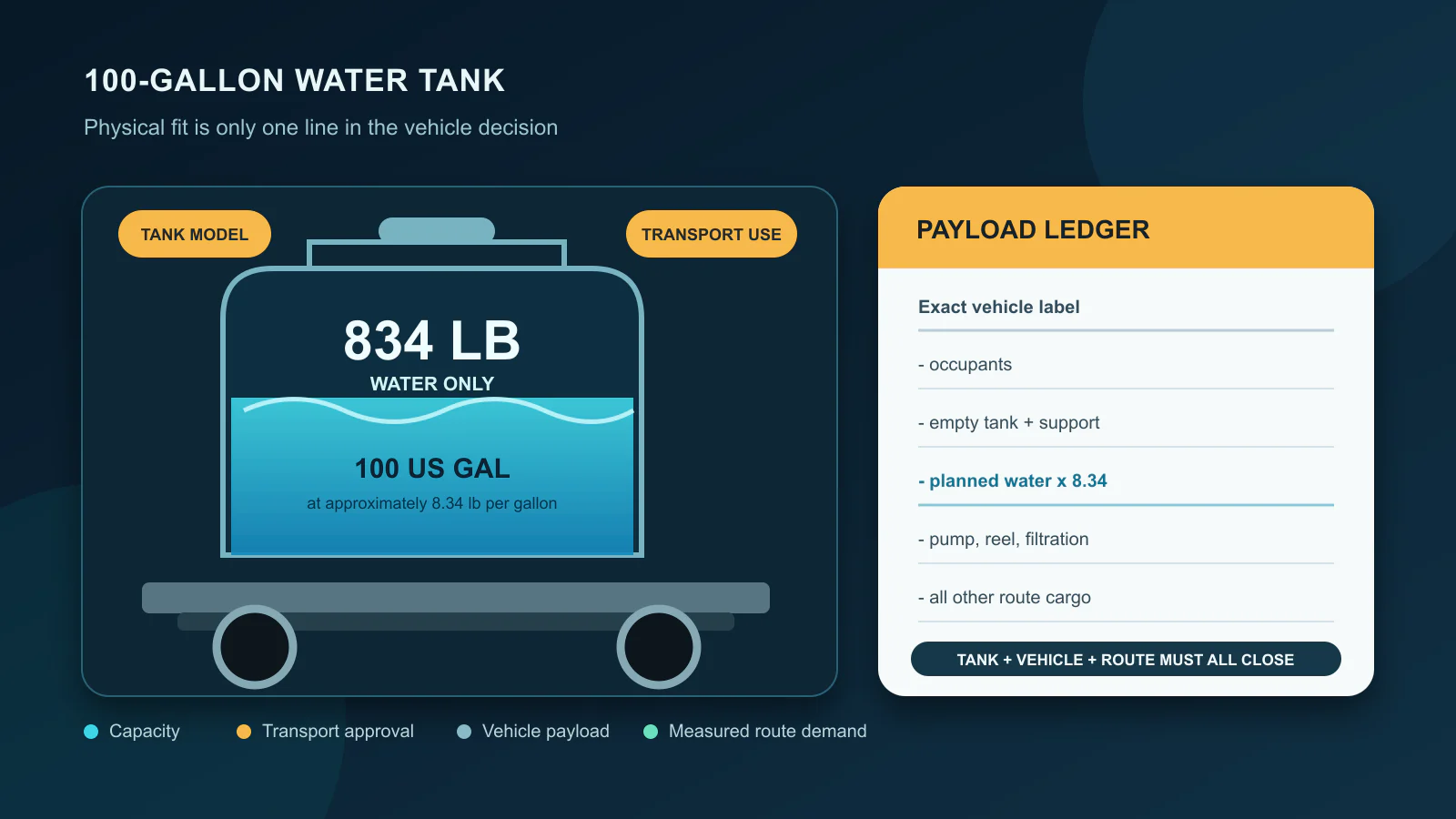
One hundred US gallons of water weighs about 834 pounds. The tank, pump, hose reel, filtration equipment, driver and every other tool are additional. That is why a tank can fit between the wheel wells and still be the wrong tank for the vehicle.
Start with the exact vehicle’s occupants-and-cargo label, not a generic payload advertised for the model line. Then require an exact tank whose manufacturer documents the intended stationary or transport use, empty weight, support and venting. If any of those fields is missing, the tank is not ready to become mobile equipment.
This page assumes the broader water-fed pole system has already been chosen. It deals only with bulk storage, vehicle fit and the path from stored water to the working system.
One hundred gallons is an 834-pound cargo line
The U.S. Geological Survey uses 8.34 pounds per US gallon as a practical water conversion. Multiply the planned fill by 8.34 before looking at pumps or fittings. A full nominal 100 gallons therefore contributes about 834 pounds of water alone.
| Load line | Value to record | Why it stays separate |
|---|---|---|
| Water | Planned gallons x 8.34 lb | The fill may be lower than the tank’s nominal capacity |
| Empty tank | Exact model weight from its current specification | Another 100-gallon tank may have a different shape and mass |
| Installed hardware | Frame, support, fittings, pump, battery, reel and retained water | None of these is included in the water-only calculation |
| Other vehicle load | Occupants, filtration, poles, hose, tools and job supplies | Payload is shared by the whole route, not reserved for the tank |
For scale, one current transport model below weighs 86 pounds empty. Filled to 100 gallons, that tank and its water total about 920 pounds before its support, pump, reel or any cleaning equipment is counted. That 86-pound figure belongs to that model only; it must not be borrowed for a different slimline tank.
A slim footprint does not make a road tank
The current Water Dragon WD-CMT100SL page publishes a useful narrow envelope: 48 inches long, 13 inches wide and 40 inches high. It also lists a 0.19-inch wall and a 7-inch vented lid. The captured page does not declare its empty weight, vehicle-transport use, bottom or side support, restraint method, outlet or pump interface.
Those omissions do not prove that the product lacks a transport solution. They mean the current page does not supply enough authority to design one. Ask the seller or manufacturer for the exact mobile-use and installation documents before treating the narrow footprint as a vehicle recommendation.
By contrast, the Den Hartog SSPU0100-70 product record expressly describes stationary or transportable pickup-bed use. It publishes an 86-pound empty weight, a 12-inch vented lid, full-bottom support, a minimum bed envelope and overall dimensions of 69.5 by 16.25 by 41.16 inches with the lid. It also tells the buyer to check the vehicle manufacturer’s load-capacity recommendation before installation.
| Purchase field | Water Dragon WD-CMT100SL | Den Hartog SSPU0100-70 |
|---|---|---|
| Nominal capacity | 100 US gal | 100 US gal |
| Published envelope | 48 x 13 x 40 in | 69.5 x 16.25 x 41.16 in with lid |
| Empty weight | Not published on the captured page | 86 lb |
| Transport statement | Not published on the captured page | Stationary or transportable pickup-bed application |
| Support statement | Not published on the captured page | Bottom must be fully supported |
This is not a best-tank ranking. It shows why “100 gallon” and “slim” are not enough to establish road use. It also keeps fuel-transfer products out of the comparison: a steel tank designed for diesel is not a substitute for a documented water tank simply because both appear for the same capacity search.
Build the load around the vehicle you actually own
The governing number is printed on the installed vehicle. In its vehicle-load guidance, NHTSA starts with the placard statement for the combined weight of occupants and cargo. Passenger weight is subtracted first; the result is the available cargo allowance. Trailer load transferred to the vehicle also has to be handled through the exact owner manual.
Photograph that label and record the vehicle year, configuration and VIN with the calculation. Do not replace it with a website’s “maximum payload,” a number for another trim, or a tire-sidewall load rating. Upfitters and accessories can also change the real configuration, so the vehicle manufacturer or qualified upfitter must close the installation when the owner’s documentation does not.
Now list the route as it will actually leave the yard:
- driver and every regular passenger;
- empty tank, support structure and permanently installed plumbing;
- planned water fill, calculated at 8.34 pounds per gallon;
- filtration cart or pressurized DI vessel, if carried separately;
- pump, battery, reels, hoses, poles, brushes and connectors;
- traditional tools, ladders where applicable, chemicals, personal gear and consumables; and
- any trailer load that the vehicle manual says transfers to the vehicle.
Passing the combined payload check is necessary, but it is not an axle-load, handling or securement approval. Physical location matters, and liquid moves. The tank manufacturer, vehicle documentation and installer have to agree on support, anchoring and placement; this article cannot produce that design from a capacity number.
Keep the pump and hose off the tank fitting
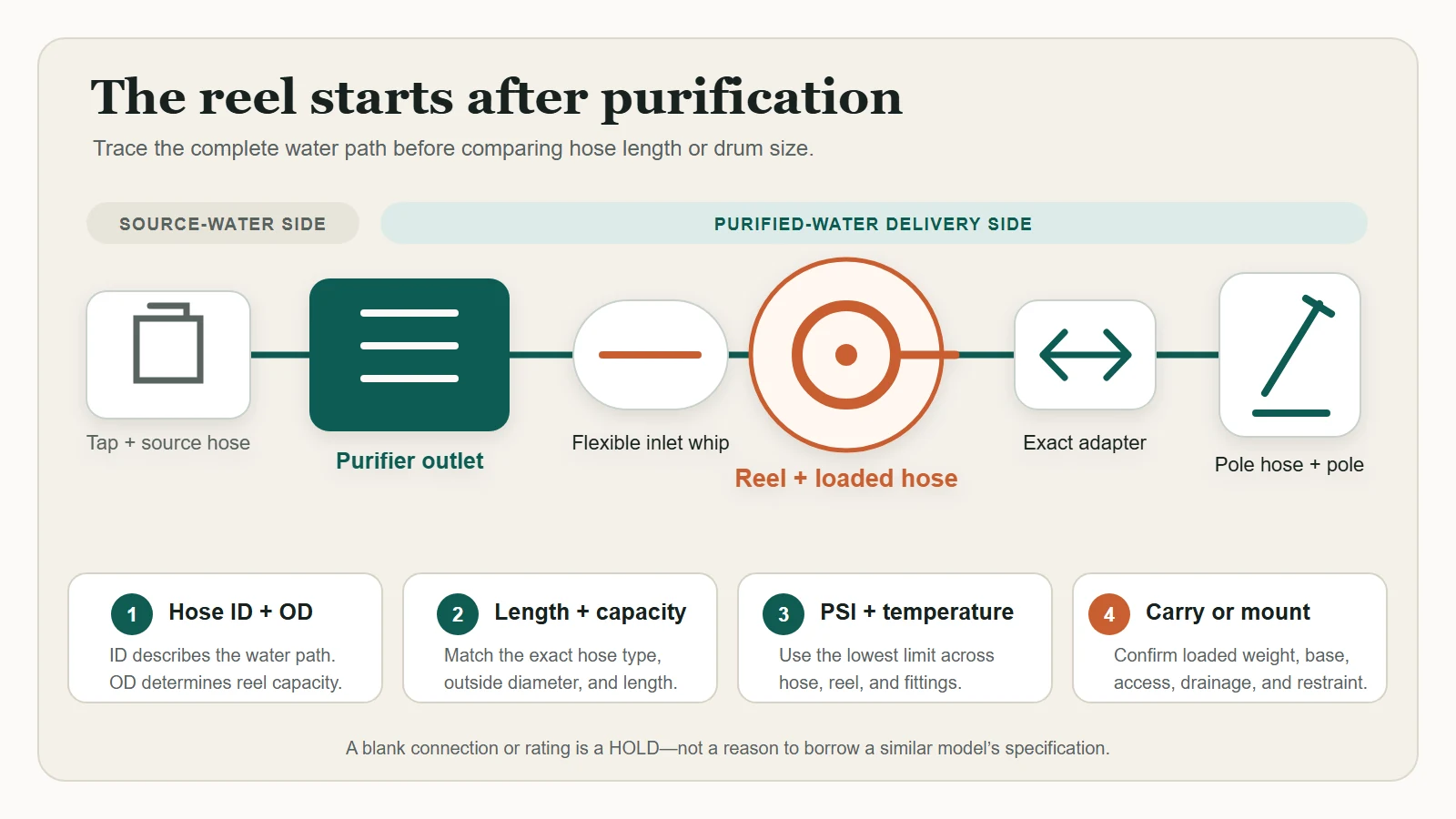
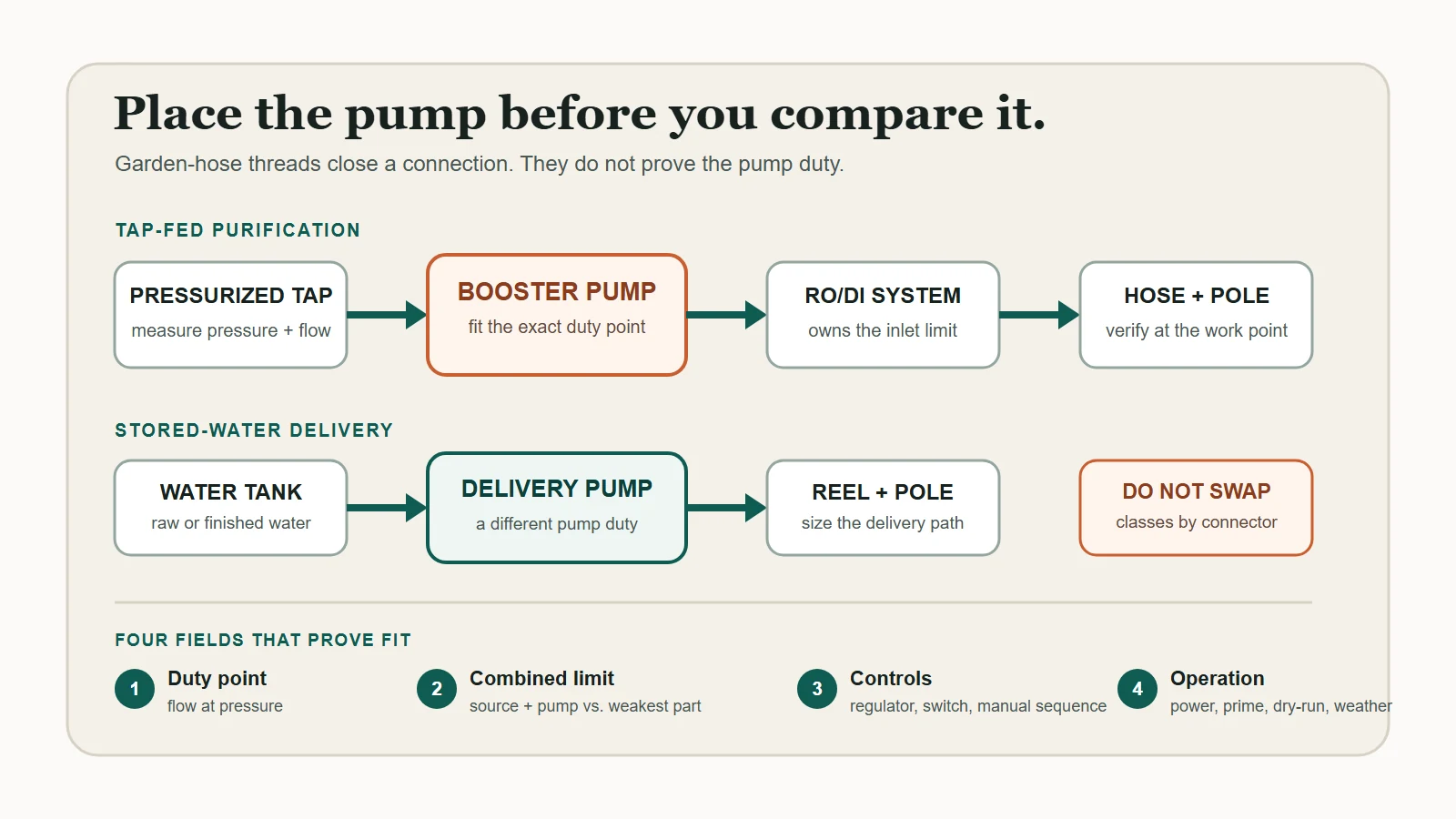
A storage tank does not automatically deliver usable flow to a water-fed pole. The exact outlet size and location, vent, supported plumbing, pump duty, electrical supply, reel and hose route all have to be named. If the tank page shows a cap and an outlet in a photo but does not publish their specifications, the delivery path is still open.
Den Hartog’s current polyethylene-tank application guide says tanks must have adequate venting while filling and emptying. It also warns that long hose, pipe, filters, valves and couplings need their own support so their weight and vibration are not transferred to the tank fitting. Heavy equipment should not be mounted on the tank walls.
That turns a vague “tank with pump” search into a short chain of owned specifications: tank outlet, supported isolation valve, supported suction line, pump inlet, pump output, reel, route hose and pole hose. Use the connector record from faucet to tool to verify every thread, seal and quick-connect pair. Do not make an adapter solve a pump, support or pressure problem it was never designed to solve.
If the tank will feed a complete cart such as the Tucker 4060 bundle, confirm whether the planned water is raw feed or finished pure water, where the pump belongs, and which inlet conditions the exact cart requires. The answer changes filtration, TDS sampling and the plumbing order.
Carry the gallons the route can justify
A 100-gallon shell does not prove a full day of work. Brush flow, hose loss, operator count, flushing, rejected water and time at the glass vary by system and route. Community estimates cannot replace measurements from the equipment that will be used.
Measure gallons consumed over representative work with a defined start and finish. Keep raw-water production and delivered pure-water use separate. Record the same route basis each time: property, glass area or time at the brush. Pair those measurements with the feed, product and brush-end TDS points so a larger reserve does not hide a water-quality problem.
The useful calculation is deliberately simple:
Planned gallons = measured route demand + documented startup/flush demand + the operator’s stated operating reserve.
Then recalculate water mass from the planned gallons, not from the 100-gallon label. If 70 measured gallons covers the route and its declared reserve, the water line is about 584 pounds rather than 834. That difference may help the load calculation, but it does not turn a storage-only tank into a transport tank or approve an installation. For system-level capacity and DI-versus-RO consequences, use the RO/DI system selector.
Let the missing field choose the outcome
| Outcome | Use it when | Next move |
|---|---|---|
| Exact tank and vehicle fit | Transport use, dimensions, full load, support, vent, delivery and route demand are all documented | Have the authorized installer close placement and securement |
| Reduce the planned fill | Measured demand is below 100 gal and the lower load fits, while the tank and installation remain approved | Freeze the fill limit in the route record |
| Choose a transport-rated tank | The current candidate is storage-only or its mobile-use contract is unpublished | Compare exact transport models, not tank shapes |
| Use a different vehicle or trailer | The complete route load exceeds the current vehicle or cannot be placed as required | Restart with that vehicle’s own label and manual |
| Hold for upfitter approval | Support, anchor points, axle distribution or installation authority is unresolved | Take the exact tank and load record to the vehicle manufacturer or qualified upfitter |
The right tank is not the one that merely holds 100 gallons. It is the one whose documented use, loaded mass and delivery path fit a route the vehicle is actually allowed to carry.