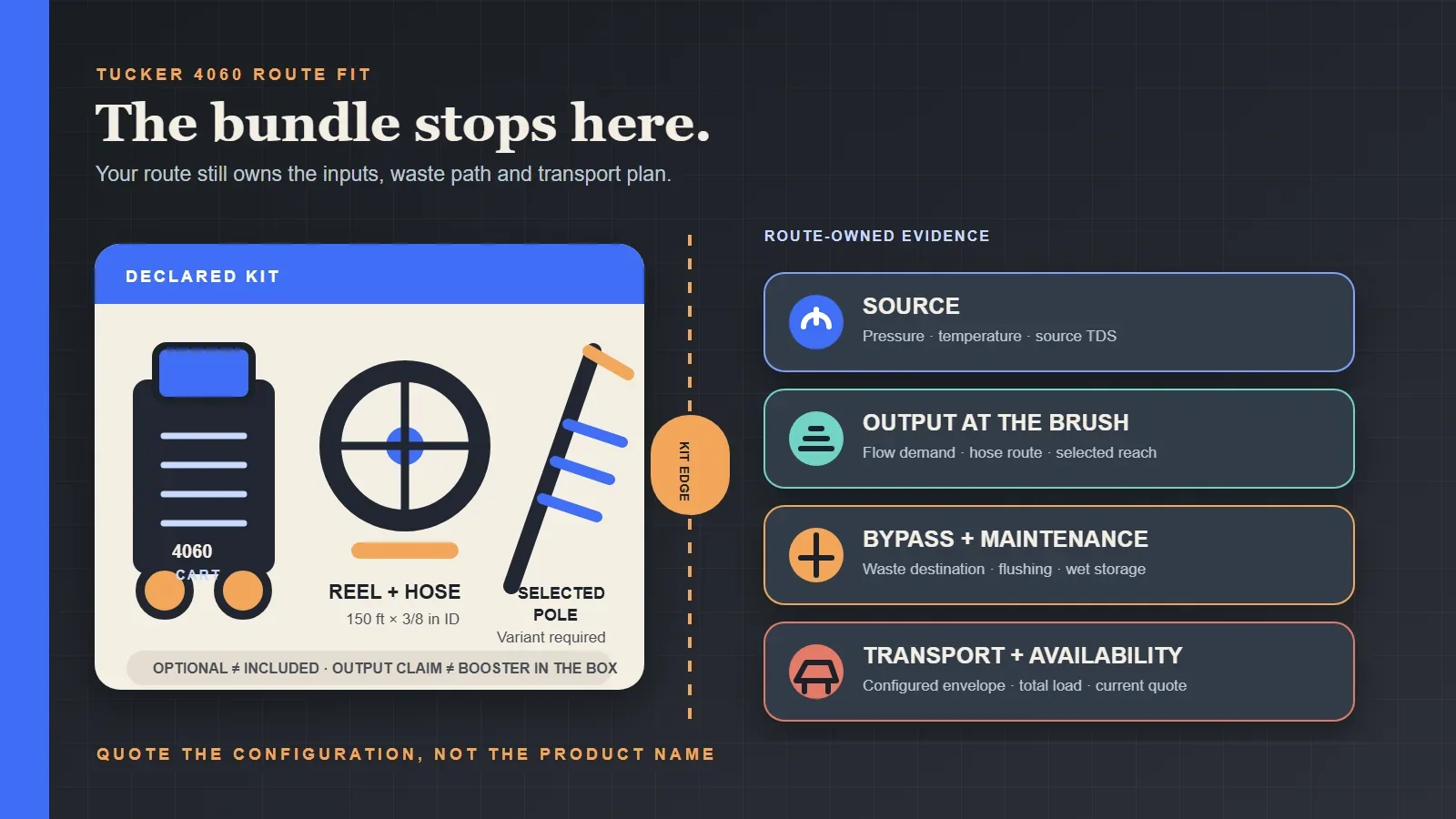
The current Tucker 4060 kit appears to connect the major pieces in one order: a mobile RO/DI cart, a reel with 150 feet of hose, and a water-fed pole selected by the buyer. That is a meaningful bundle. It is not yet proof that the system fits the faucet, output demand, building reach, waste-water path or vehicle on a particular route.
Treat the purchase as two joined records. Tucker owns the exact kit, manual and options. The buyer owns measured source pressure and temperature, required brush flow, hose path, pole reach, handling, service time and a final availability check. A missing field on either side makes the configuration incomplete.
If the filtration architecture itself is still open, begin with the full water-fed pole system decision or compare measured inputs with the DI versus RO/DI selector. This page starts later: after the 4060 kit has become a real candidate.
The kit has a clear edge
The current Tucker 4060 kit page lists a 4060 mobile cart, a Tucker hand-carry hose reel with 150 feet of 3/8-inch-ID hose, and one selected Tucker water-fed pole. It describes a GLIDE brush, 100 feet of pole tubing, male and female quick connects and a reach-around gooseneck with the standard pole selections. The screen cleaner is optional.
| Line | Current declared position | What must still be closed |
|---|---|---|
| 4060 cart | Included; approximately 95 lb; conditional output points published | Measured input, required output, waste destination and configured dimensions |
| Reel and route hose | Included reel with 150 ft of 3/8-in-ID hose | Actual path length, pressure/flow at the tool and every mating connection |
| Water-fed pole | One selectable Tucker pole with declared brush, tubing, quick connects and gooseneck | Exact variant, working/collapsed reach, weight basis and replacement path |
| Screen cleaner | Optional | Do not count it in the base configuration unless selected |
| 110V booster | Named in one output claim; not listed in the base bundle | Whether it is required, ordered, powered and compatible with the planned setup |
The displayed product state was unavailable when checked on August 8, 2026. That is a dated page observation, not a permanent stock claim. Recheck the exact pole option, SKU, availability and delivery terms when the quote is requested; do not build the decision around an old price or a different configuration.
“Four-stage” needs the 4060 manual
The stage count does not authorize a generic sediment–carbon–RO–DI diagram. The current 4060 manual linked by Tucker describes carbon prefiltration, two reverse-osmosis membranes and mixed-bed DI. Rejected water leaves through the bypass while the product stream continues to DI and the cleaning outlet.
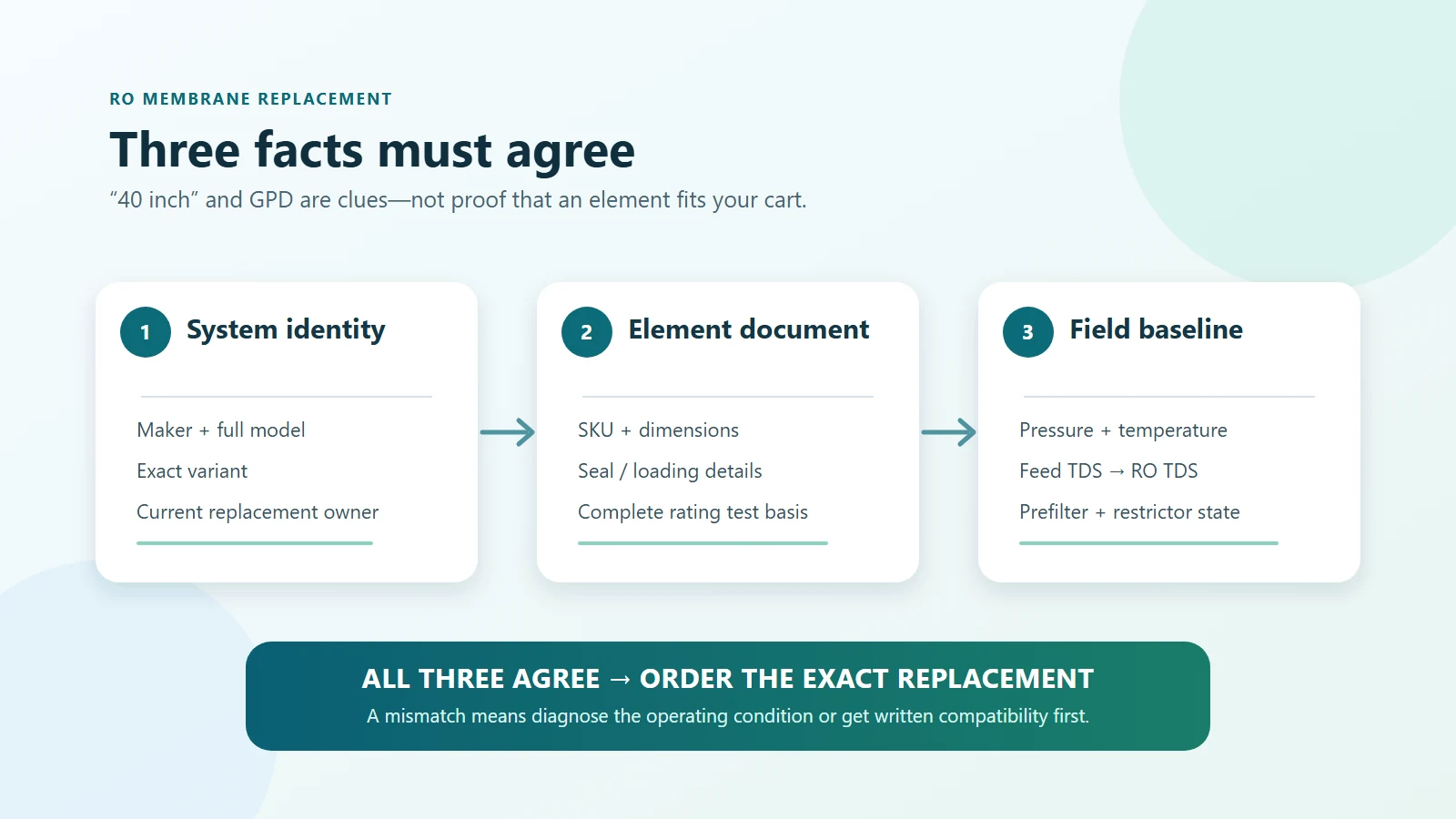
This distinction changes replacement parts, flushing and the planned water path. Do not order a generic sediment cartridge merely because another four-stage cart uses one. Match service items to the exact 4060 document. If the unit’s installed hardware differs from that document, stop and resolve the model/version instead of normalizing it to the product name.
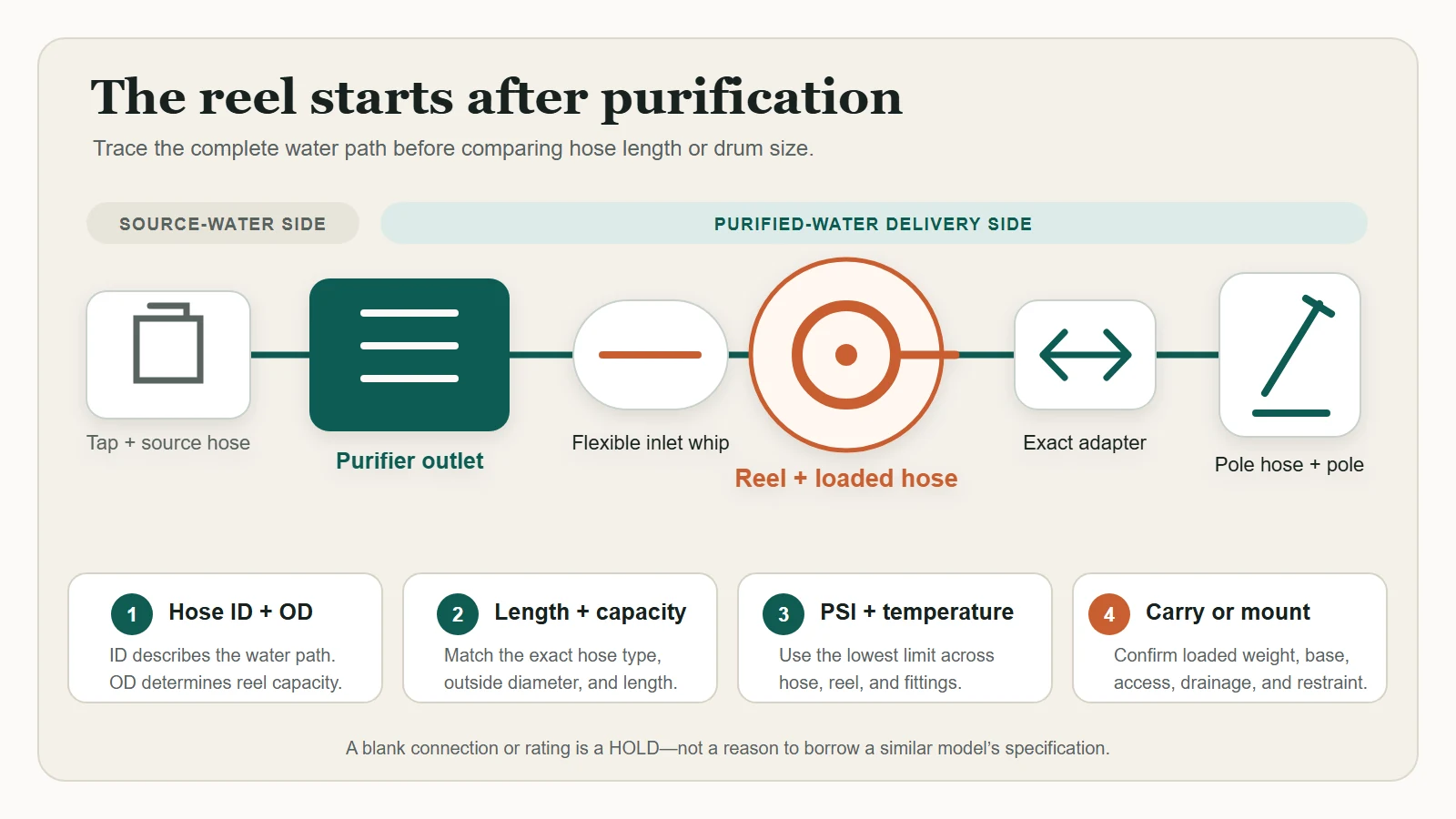
The manual terminates the purifier in a 3/4-inch male garden-hose thread for the next documented hose or adapter. The bundled Tucker reel page publishes 3/4-inch brass inlet and outlet connections and 150 feet of 3/8-inch-ID hose. Those facts begin a connection record; they do not identify every mating half or prove pressure and flow through the complete route. Map the transitions with the faucet-to-tool connector record.
Run the route backward from the brush
Tucker publishes three output points for the 4060: 1.5 gpm at 60 psi and 70°F; 1.91 gpm at 80 psi and 70°F; and 2.3 gpm with its named RHG 110-volt booster pump at 70°F. These are manufacturer declarations at specified conditions, not a performance curve that can be interpolated for any faucet.
Begin at the furthest actual pane. Record the selected pole’s working configuration, pole tubing, reel, hose route and connection changes. The complete-pole comparison explains why reach, collapsed length, material and included assembly must stay attached to the exact variant. Then record the brush-flow requirement and whether one or more operators must work. Finish at the source with measured pressure, temperature and a TDS sampling plan.
| Route field | Record | Why it changes the decision |
|---|---|---|
| Source | Pressure, temperature, source TDS and supply reliability at representative properties | Published output points apply only at their stated conditions |
| Demand | Required brush flow, simultaneous users and furthest working point | One selected pole does not establish a multi-user output requirement |
| Delivery | Cart-to-reel-to-pole path, hose IDs, lengths and exact connector pairs | Headline hose length is not verified flow at the brush |
| Bypass | Waste-hose path and acceptable destination during production and flushing | RO production creates a continuous rejected-water stream |
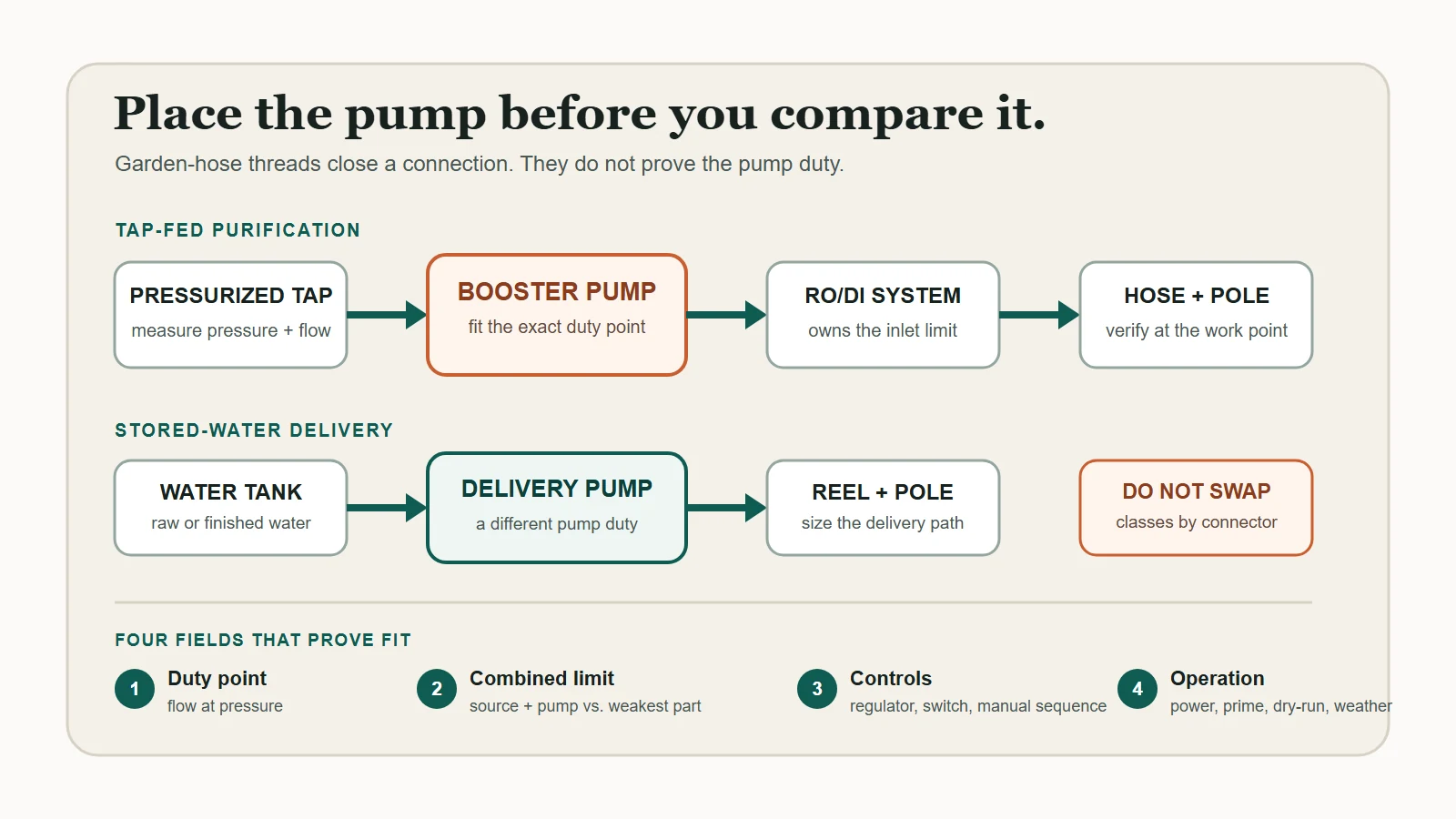
| Power | Whether a booster is needed and the exact electrical path | The highest declared point names a booster that is not in the base bundle list |
| Output proof | Actual outlet flow and TDS using defined sample points after documented setup | The route has to meet its own brush and water-quality requirement |
If the source does not match a published point, ask Tucker for the expected configuration or plan the named compatible booster and power path. Do not silently borrow the nearest number. The RO-before-DI decision remains the place to compare membrane economics and reject-water consequences rather than assuming this exact kit is the only route.
Ninety-five pounds is only the cart line
The product page describes the 4060 system as approximately 95 pounds. That does not close the weight of the chosen pole, reel and hose, optional screen cleaner, retained water, loose fittings or other route cargo. It also does not publish the configured cart’s stored envelope in the captured text.
| Obtain before order | Do not substitute |
|---|---|
| Assembled cart width, depth and height in the intended configuration | Product-photo scale |
| Total handling plan for cart, reel, selected pole and optional equipment | The cart-only approximate weight |
| Shop doorway, vehicle opening, stow position and unloading path | A general “mobile” description |
| Manufacturer-approved orientation or separation method where handling depends on it | Assuming the frame may be tipped or disassembled |
If transport depends on tipping, separating or lifting the cart, obtain the permitted method from Tucker. An approximate product weight cannot become a handling instruction, and a bundle that does not fit the real vehicle is not made complete by selecting a shorter pole.
Flush time is part of ownership
The 4060 manual assigns work before and after glass cleaning. It calls for an isolated carbon flush on a new system or after a carbon change, a first-use flush, daily startup flushing, an end-of-job bypass flush, air purging before pumps run, output-TDS checks and regular wet storage/operation of the RO membranes.
Those duties change water access, waste capture, job time, off-season planning and the replacement-parts record. They also belong to the exact 4060; a procedure from a Rival, Compact, DIY or another four-stage system should not be substituted because the stage count matches. Tucker’s manuals index keeps those systems separate.
Price the owner time and site needed to perform the current sequence. If the route cannot provide an acceptable bypass-water destination or periodic operation during slow periods, the system is not ready just because its production rate is attractive. When DI service becomes due, use the exact 4060 cartridge and instruction rather than applying a generic DI resin refill method.
Give the configuration one disposition
| Disposition | Use it when |
|---|---|
| Route-matched 4060 kit | Exact variant, measured inputs, output, pole, hose, waste, transport, maintenance and availability are all closed |
| Configure the pole or accessories | The system fits but the selected pole, booster, reel base or optional screen equipment is unresolved |
| Obtain a missing specification | Pressure expectation, configured dimensions, connection, handling or service part is unpublished |
| Recheck current availability | The exact selected configuration cannot be quoted from the current page state |
| Compare another system | The source, output, waste route, vehicle or maintenance reality conflicts with the 4060 |
The useful result is not “good kit” or “bad kit.” It is a named configuration that fits the measured route—or a specific reason not to order it yet.