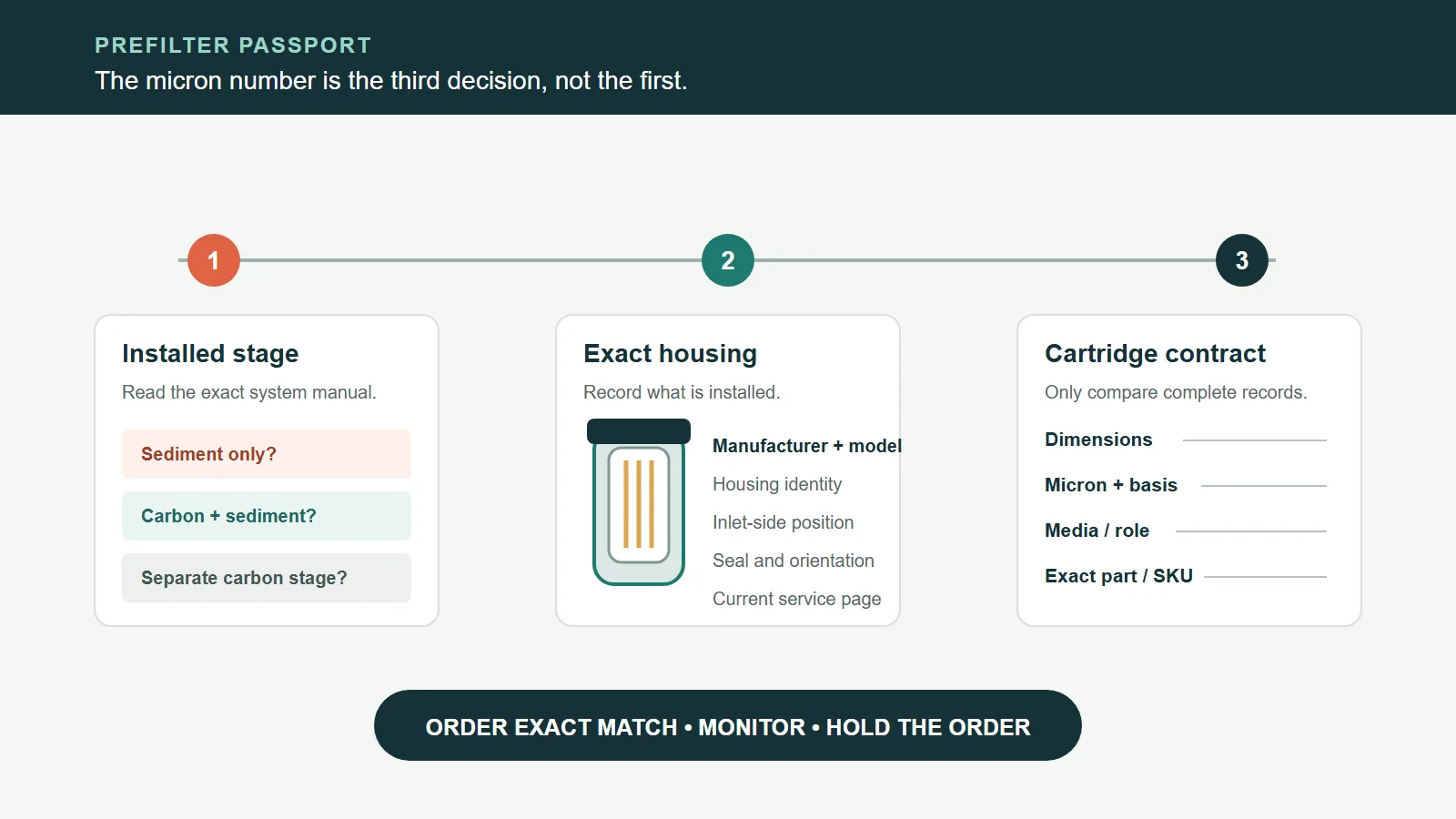
Two cartridges can both say “5 micron” and still belong to different jobs. One may be a sediment-only prefilter. Another may combine sediment and carbon treatment. A third may have the right nominal length but the wrong diameter for the housing in front of you.
For a pure-water window-cleaning system, the buying order is system and stage → housing → cartridge dimensions and ends → media and micron declaration → exact part and service instructions. Starting at the micron number skips the compatibility fields that decide whether the filter can do the documented job.
This is one maintenance decision inside a complete water-fed pole system. If the system path itself is unsettled, use the RO/DI system selector before ordering service parts.
The shelf label hides two different jobs
The word sediment describes only part of the decision. The current IPC HydroCart Jr manual calls for a “5 Micron Carbon/Sediment” cartridge in its prefilter housing. The HydroCart Compact manual likewise places a combined carbon/sediment cartridge first in the water path. Replacing either with an unidentified sediment-only cartridge would preserve the particle-rating number while dropping a documented stage role.
Current XERO records show why even one product family cannot be generalized. The XERO Pure filter page describes a combined sediment-carbon filter. The current XERO Pure Plus page lists a dedicated 10-inch, 5-micron sediment filter and a separate chloramine filter. The stage map changed; a familiar brand name did not make the cartridges interchangeable.
| Exact documentation | Declared prefilter role | What the label does not close |
|---|---|---|
| IPC HydroCart Jr manual | Combined carbon/sediment, 5 micron | Exact fit for another IPC or non-IPC housing |
| XERO Pure filter support | Combined sediment/carbon | Cartridge dimensions on that support page |
| XERO Pure Plus page | Dedicated sediment stage plus separate chloramine stage | Diameter, end style or fit in an unidentified 10-inch housing |
Write the role exactly as the current system document states it. If the old cartridge is the only evidence and its label is unreadable, the decision is not “buy the closest 5-micron filter.” Pause the order until the machine and its service document agree.
Photograph the installed stage before removing anything
A useful cartridge record begins while the system is still assembled. Photograph the manufacturer label, exact model, housing position, inlet direction, cap or head, and the old cartridge label if it can be read safely. Then retrieve the current service page for that exact variant.
Use the record below before searching a catalog:
| Passport field | Record | Hold when |
|---|---|---|
| System identity | Manufacturer, family, model/variant and current manual | The cart, tank or frame is not positively identified |
| Stage role | Sediment-only, carbon-only or combined carbon/sediment | Role is inferred from color, location or a seller category |
| Housing identity | Housing model or exact system position, nominal size and known seal/end details | Only an approximate canister height is known |
| Existing cartridge | Exact label, part number, dimensions, media and micron wording | The record borrows fields from a similar cartridge |
| Service control | Shutoff/pressure, seating, orientation, O-ring and tightening directions | The current exact instructions are unavailable |
Position is evidence only when the manual makes it evidence. The HydroCart Compact document identifies the combined prefilter beside the feed-water inlet. That does not authorize “right-hand housing” as a universal rule; another machine may face the opposite way or use a different plumbing order.
If the housing itself is a DI vessel rather than a prefilter canister, stop this purchase path. Use the DI tank guide for vessel hardware and the DI resin refill guide for loose media, refillable cartridges or sealed packs.
A 10-inch cartridge can still be the wrong cartridge
“Ten inch” normally names length, not a complete fit contract. Diameter, end construction, center opening, gasket or washer, and the housing’s actual acceptance still matter.
Pentair’s current Pentek DGD family is a useful counterexample. It is made for Big Blue housings and uses a 4.5-inch diameter in 10- or 20-inch lengths. The exact DGD-5005 page identifies a 4.5-by-10-inch spun-polypropylene cartridge. That product is not proof that every 10-inch window-cleaning prefilter housing accepts a 4.5-inch cartridge. It proves why the diameter cannot be omitted.
| Catalog phrase | What it closes | Still required |
|---|---|---|
10 inch |
A nominal length statement | Diameter, housing, end/seal and exact system mapping |
4.5 x 10 inch |
Declared cartridge envelope for that exact product | Housing acceptance and stage role |
fits standard housings |
A compatibility claim in its stated scope | The installed housing identity and any named exclusions |
| Similar photo or color | Nothing reliable | Exact label, dimensions and current documentation |
Do not solve a missing diameter by measuring the outside of an opaque housing and guessing wall clearance. Retrieve a current housing or system specification. If it publishes only length, leave diameter and end construction unresolved and do not order yet.
Micron belongs beside its basis and media
A micron number needs two neighbors in the record: its rating basis and the cartridge media. Pentair describes the DGD family’s 1-, 5- and 25-micron options as nominal ratings. The current IPC and XERO pages cited here publish values for named cartridges but do not state nominal versus absolute basis on those pages. The honest record is therefore “5 micron; basis not stated,” not an invented performance equivalence.
Media closes a different question. Pentair declares polypropylene for the sediment-only DGD family. IPC declares a combined carbon/sediment role for the named HydroCart cartridges. Matching 5 micron does not replace a missing carbon function, and a carbon claim does not prove the particle rating, dimensions or housing fit.
This is also why a prefilter change should not be judged by TDS alone. Sediment media addresses particulate loading; the complete TDS measurement plan belongs at defined source, treatment-outlet and point-of-use locations. A stable TDS number does not certify that a prefilter is unclogged, correctly seated or still performing every documented treatment role.
The order line should now read like this: exact system; exact prefilter stage; exact housing; cartridge dimensions and ends; micron value plus published basis; media/role; exact part reference; current service instructions. If a blank can change fit or treatment, the order stays on hold.
Close the service record after the housing is back together
Use one system’s service instructions from shutdown through restart. The HydroCart Jr manual specifies its cartridge with the seal washer up and includes O-ring lubrication. The HydroCart Compact manual uses its own center-hole seating and warns against overtightening. XERO’s current Pure support tells the operator to clean particulate from the housing, lubricate seals and O-rings, and tighten the housing by hand. Those are named-system controls, not a menu of steps to mix together.
After the documented restart, record what can actually be observed:
| Closeout field | Record | If abnormal |
|---|---|---|
| Cartridge installed | Exact part and orientation | Stop and recheck the manual/part match |
| Housing and seal | O-ring condition, seating and visible leaks | Shut down under the exact service procedure |
| Water path | Inlet open, expected routing and stable flow observation | Check seating, blockage and valves before blaming media |
| Measurement | Meter, sample point and reading only where the system procedure calls for it | Repeat the same sample method; do not convert one reading into a cartridge diagnosis |
| Next trigger | Current manual trigger or a recorded condition requiring review | Do not replace only because a universal calendar or color rule says so |
The correct result is now one of five plain outcomes: order the exact documented cartridge; keep the current stage and monitor it; identify the housing first; verify the stage role first; or wait for the missing specification.
That may feel slower than buying the first matching micron number. It is faster than opening the system twice because the new cartridge had the wrong job, wrong diameter or wrong service controls.