A bag of loose DI resin can be the correct refill for one window-cleaning system and the wrong product for another. XERO sells loose media for its DI and RO/DI equipment. Unger’s current HydroPower Ultra manual says never to use loose resin because overfill and expansion can damage that system. The label DI resin does not resolve the difference.
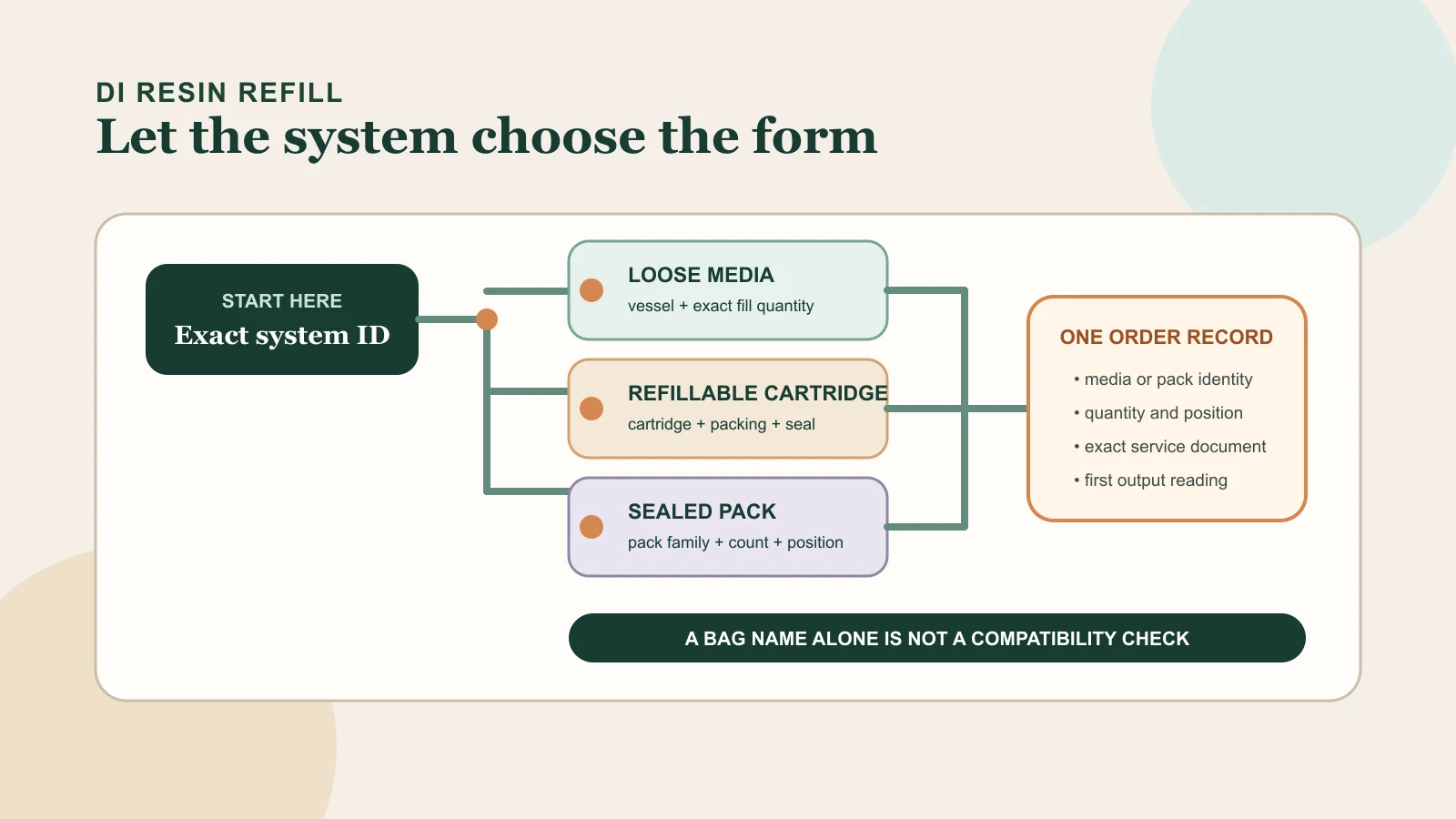
Identify the manufacturer, exact model and service opening before comparing resin. The equipment will put you on one of three paths: loose media poured into a refillable vessel, loose media packed into a removable cartridge, or a premeasured sealed pack. Only then do mix, quantity and price become comparable.
This is one maintenance decision inside the complete water-fed pole system. If DI-only versus RO/DI is still unsettled, make that system choice before buying replacement stock.
The service opening decides the product form
Start at the component you will actually open. A pressure vessel with a removable head is not automatically a loose-resin tank. A filter housing can contain a disposable cartridge, a refillable cartridge or a proprietary assembly. A sealed-pack system may use a tank-shaped housing while deliberately controlling resin expansion inside a fabric pack.
Current manufacturer documentation gives three useful examples. The named XERO half-cubic-foot DI Tank accepts a fresh half cubic foot of loose resin. The current XERO Pure uses a refillable DI cartridge holding just under one eighth of a cubic foot, with its own packing, arrow and O-ring directions. Unger HydroPower Ultra uses factory-filled packs and assigns different pack configurations to its small and large units.
| Exact system example | Refill form | What closes the order | What does not transfer |
|---|---|---|---|
| XERO half-cubic-foot DI Tank | Loose resin in a refillable vessel | Exact tank variant plus 0.5 ft³ media quantity | Another tank’s fill volume or head procedure |
| Current XERO Pure | Loose resin inside a refillable cartridge | Exact cartridge, just-under-1/8-ft³ amount, arrow and seal directions | A generic cartridge tutorial or nominal housing length |
| Unger HydroPower Ultra | Premeasured sealed Ultra Resin Pack | Exact unit, pack family, count, color and position | Loose resin, a different color pack or another unit’s layout |
The product form is therefore a compatibility field, not a preference. A bulk bag cannot replace a required pack merely because both contain mixed-bed ion-exchange media. Nor does a cartridge tutorial establish how far to fill a pressure vessel.
A resin label cannot overrule the system manual
Once the system permits loose media, the resin product still needs an identity. XERO’s current Virgin Resin page names SKU 209-26-13-XP, describes a 60/40 cation/anion mix and offers quarter-, half- and full-cubic-foot quantities. That is useful for the systems XERO names. It is not proof that 60/40 is the universal window-cleaning ratio or that the same media belongs in every cartridge, tank or pack system.
“Virgin” is another product fact, not a compatibility shortcut. It tells you the manufacturer says the resin has not been used or regenerated. It does not supply the missing vessel volume, cartridge orientation, seal condition, pressure-release procedure or post-service test.
Treat broad compatibility claims carefully. The exact system manual should name the acceptable form and any required component family. If the seller says “fits all systems” but the equipment manual requires a named pack or forbids loose media, stop at the manual conflict rather than averaging the two statements.
Write the order line before opening the system
Use one record for the product and the service job. It should identify the machine strongly enough that a second operator could retrieve the same current instructions, then capture only the fields that choose the refill.
| Field | Record | Hold when |
|---|---|---|
| System identity | Manufacturer, family, exact model/variant and current manual | The vessel or cartridge cannot be identified |
| Service form | Loose vessel, refillable cartridge or sealed pack | A seller category is the only evidence |
| Media or pack | Exact resin SKU/formulation or exact pack/cartridge family | Compatibility is inferred from appearance or bag wording |
| Quantity and position | Documented volume, pack count/color/position or cartridge amount | The value belongs to another variant |
| Service controls | Pressure release, packing, orientation, seal and reassembly directions | The current exact instructions are unavailable |
| Closure | Post-service check, meter/point and observed result | The system cannot be verified after service |
For a current XERO half-cubic-foot DI Tank, a closed line can read: exact half-cubic-foot variant; loose media permitted; 0.5 ft³ refill; current XERO tank instructions; fresh-output check required. XERO’s current tank-package page owns that refill quantity. The DI tank hardware guide owns the head, fittings, upright space and transport questions; do not infer those from the refill bag.
For current XERO Pure, the line changes to refillable cartridge; just under 0.125 ft³; pack tight to the top; arrow up; lubricate the O-ring; then follow the named system’s reassembly and output checks. Those details come from the current XERO Pure maintenance section. “Ten-inch cartridge” from another seller would still be incomplete without exact housing and cartridge identity.
For HydroPower Ultra, the order line is a pack configuration rather than a volume of loose resin. The current US manual maps one green pack to UHP01. For the large UHP3C it specifies one green pack in the top position and two red packs in the middle and bottom positions. The handle faces upward. A green pack, red pack and loose bag are not interchangeable purchase units.
If the quantity question is really “how soon will I need the next refill?”, keep it out of this order line. Use the separate DI tank resin-life estimate so source TDS and water use remain visible instead of being buried inside a compatibility decision.
Change the media under one set of instructions
There is no safe universal refill sequence for all three forms. Use the current document for the exact system and do not splice the easiest steps from another guide into it.
Unger treats HydroPower Ultra as pressurized equipment. Its current US manual requires the feed water to be shut off and disconnected, the tank drained and pressure released before the cap is opened. It then gives the pack removal, exact replacement positions, cap reinstallation, reconnection, repressurization and trapped-air release sequence. The quick-start guide also directs disposal according to local regulation. Those controls belong together; a short merchant description is not a substitute.
XERO’s current DI-system guidance allows old loose resin to be removed and fresh media added to named refillable tanks or canisters, while the XERO Pure page adds cartridge-specific packing, direction and O-ring details. Follow the instructions for the component in front of you. If the head will not open as documented, a riser or screen is damaged, the cartridge cap or foam is missing, an O-ring is cut, or the required pack is unavailable, the job has become a parts/service problem rather than permission to improvise.
Opened resin also needs the exact product’s current storage direction. Do not invent a universal shelf life or rescue method from a different brand. Retain the product label, lot or order reference, close the packaging as directed and record any storage limitation you can actually source.
The first output reading belongs to the refill record
A refill is not closed when the lid goes back on. The record needs the first meaningful output check made under the named system procedure. Unger’s current quick-start directs a 000 reading after the HydroPower Ultra is reconnected and vented. XERO publishes its own named-system service wording. Neither number should be detached from its equipment and turned into a universal threshold.
| Record together | Why it matters | If the result is unexpected |
|---|---|---|
| Date, exact system and service document | Preserves the procedure and model scope | Confirm the manual/model match |
| Resin SKU, quantity or pack configuration | Preserves what was actually installed | Check form, amount, position and identity |
| Meter, measurement point and first stable reading | Makes the number reproducible | Repeat the same sampling method before assigning cause |
| Leak, flow or air observation | Separates water-path trouble from a media claim | Stop and inspect under the exact service document |
A high or unstable reading after service does not prove the new resin is defective. It can also point to wrong media, wrong pack position, channeling or packing, a seal or cartridge problem, trapped air, sampling error or an upstream condition.
The TDS meter guide separates source, treatment outlet and point-of-use measurements so the first unexpected change can be located. Keep that diagnosis separate from the purchase record.
The useful ending is concrete. Buy the exact loose refill, buy the exact cartridge, buy the exact pack configuration—or pause because the system identity and service document do not agree. A bag name alone is never the finished order.