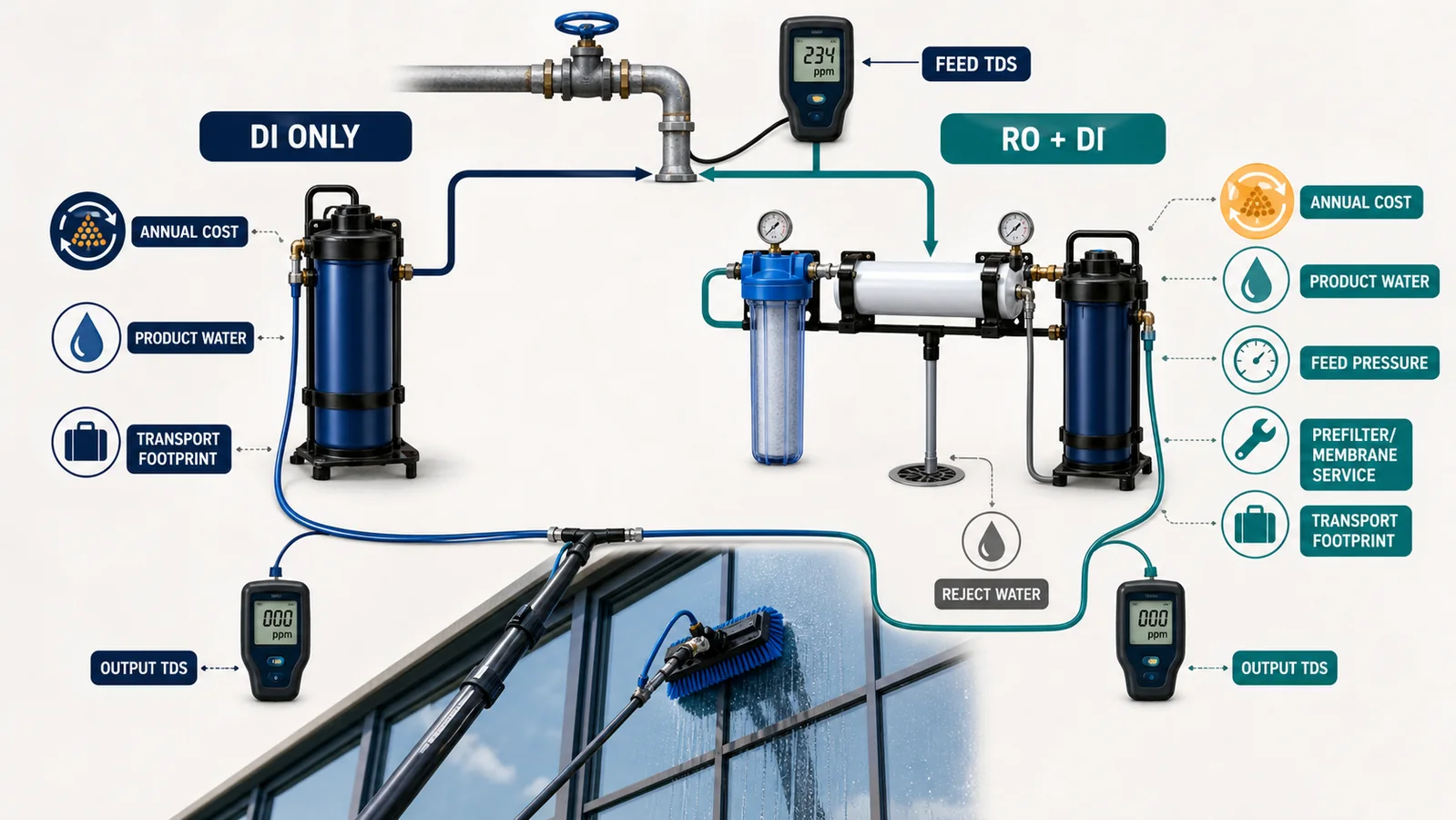
Reverse osmosis can make DI resin last longer, but that does not make an RO/DI cart automatically cheaper. The RO stage adds equipment, prefilters, membrane care, feed-pressure requirements and a reject-water stream. Its job is to reduce the dissolved-mineral load that reaches DI; the DI stage still polishes the product water.
The purchase case begins with one comparison: your measured DI-only cost per gallon versus the complete RO/DI cost per gallon at your workload. If the variable saving is positive, calculate how many product-water gallons are needed to recover the annualized equipment cost. If the saving is zero or unknown, a TDS threshold is not a buy signal.
RO does not replace the DI decision
A common mobile RO/DI path sends feed water through a protective prefilter, an RO membrane and then DI resin. The membrane sends a lower-TDS product stream forward and a reject stream to drain. The DI vessel removes the remaining ionic load before the water reaches the pole.
Current supplier guides from Window Cleaning Resource/XERO and J. Racenstein describe that sequence and use feed TDS plus frequency as selection signals. Those signals are useful for screening, not proof of payback. Two operators with the same feed TDS can have different outcomes because their annual gallons, resin prices, measured yield, water charges, pressure, downtime and transport limits differ.
RO is therefore an investment in lower DI load. It is not a substitute for output-TDS checks, and it is not a universal remedy for low flow. A candidate must first produce enough water under the actual feed conditions, leave a manageable reject-water path and preserve the service routine the operator can maintain.
Start with your DI-only cost per product gallon
Do not start with a resin-capacity promise. Start with a small operating log from the DI setup already doing the work. For each resin charge, record:
| Field | Use in the baseline | Do not substitute |
|---|---|---|
| Feed TDS | Describes incoming mineral load for this period | A regional average |
| Product-water gallons | Denominator for actual media yield | Time connected to the tap |
| Output-TDS readings | Identifies when the charge stopped meeting the operating rule | Visual glass appearance alone |
| Resin quantity and landed cost | Direct media cost | An old list price |
| Labor and disposal time | Exposes the operating burden of a change | Zero because no invoice exists |
| Abnormal events | Marks channeling, bypass, contamination or measurement failure | Silent deletion from the average |
Use more than one normal charge when possible. Divide the landed media cost plus attributable change labor by the verified product-water gallons. The result is the DI-only variable cost per product gallon for this setup and period.
If no measured yield exists, the next action is a log, not an RO purchase. The DI or RO/DI selector can provide a transparent planning estimate from feed TDS and demand, but an estimate remains separate from the operating baseline used for a capital decision.
Use a break-even volume, not a TDS cutoff
Put both paths on the same annual and per-gallon basis.
DI-only variable cost per gallon = resin + change labor + attributable water handling, divided by verified product-water gallons.
RO/DI variable cost per gallon = prefilters + membrane reserve + polishing DI + feed/reject water + power + routine service labor, divided by verified or conservatively rated product-water gallons.
Annualized RO fixed cost = equipment and required accessories divided over a conservative service period, plus financing, storage or other fixed ownership cost that actually applies.
The decision boundary is:
Break-even product-water gallons = annualized RO fixed cost ÷ (DI-only variable cost per gallon − RO/DI variable cost per gallon)
Calculate it only when the amount in parentheses is positive. If it is zero or negative, more volume does not rescue the current candidate. If it is positive but the break-even gallons exceed a conservative annual workload or acceptable payback period, DI-only is still plausible.
Keep taxes and business accounting separate from this operating comparison unless a qualified adviser supplies the treatment. The worksheet is for equipment choice, not a claim about depreciation or tax savings.
Make the membrane claim survive the job
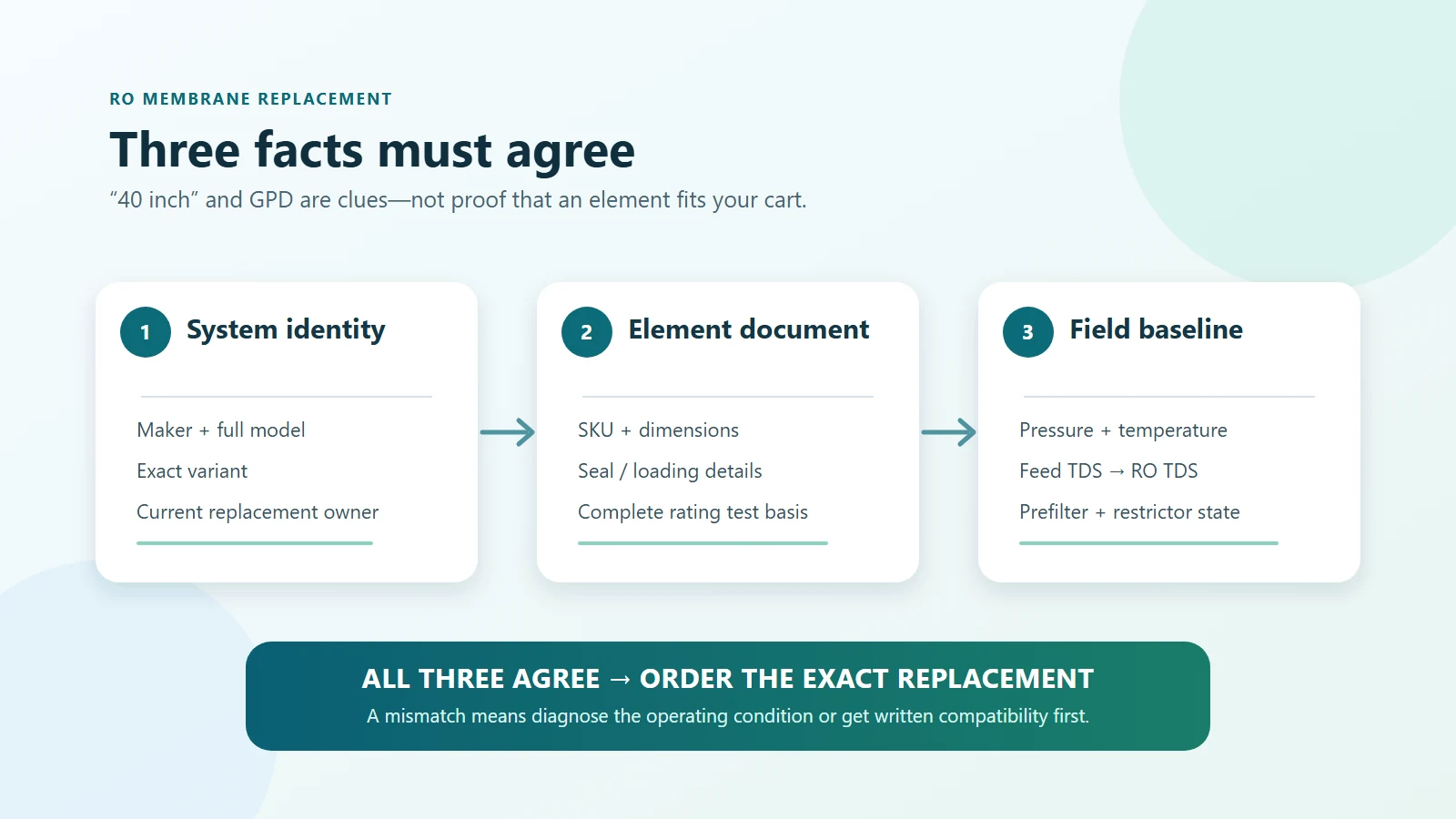
An RO membrane’s rejection and product-water output are not free-standing constants. Exact model documents may condition ratings on feed pressure, water temperature, outlet hose, counterpressure and membrane arrangement. Copy the complete condition beside every advertised figure.
Unger’s current product catalog, for example, documents a named HydroPower RO M configuration and states the conditions attached to its published production figure. Its current RO materials also show the protective prefilter, membrane, DI polishing and TDS-monitoring path. Those facts describe the named equipment; they do not establish the output of another cart or a cold, low-pressure job site.
For each candidate, collect four measurements or bounded specifications:
- feed TDS and any source-water constituent the prefilter must address;
- static and working feed pressure, plus the relevant temperature range;
- product-water flow and reject-water flow under those conditions;
- TDS before RO, after RO and after DI.
Calculate observed membrane rejection only from matched readings taken under a stable setup. Do not use the number to postpone a failed output-TDS rule or required service. Its purpose is to explain DI load and detect a changing membrane path.
Count the water, pressure and service path
The lower resin bill is only one line. A workable cart also needs a compatible site.
| Operating field | Evidence to collect | Hold the candidate when |
|---|---|---|
| Feed-water protection | Exact prefilter purpose, replacement interval and source-water compatibility | Chlorine, chloramine or sediment protection is assumed |
| Pressure and flow | Model requirement and measured working pressure at the intended outlet | Rated product flow depends on unavailable pressure or an unpriced pump |
| Reject water | Product/reject measurement and an acceptable discharge route | Drain volume or location is unknown |
| Output capacity | Conservative product-water rate at the pole demand and hose arrangement | The system cannot support the active pole count |
| Power and controls | Pump, power source, protection and weather limitations | An electrical dependency has no field plan |
| Transport | Filled mass if published, dimensions, loading path and secure storage | The unit does not fit the vehicle or daily lift routine |
| Service | Flush procedure, winter/storage steps, prefilter, membrane and DI replacement access | The operator cannot perform or source a required task |
| Downtime | Spare consumables, fault isolation and fallback water plan | One failure stops committed work with no response |
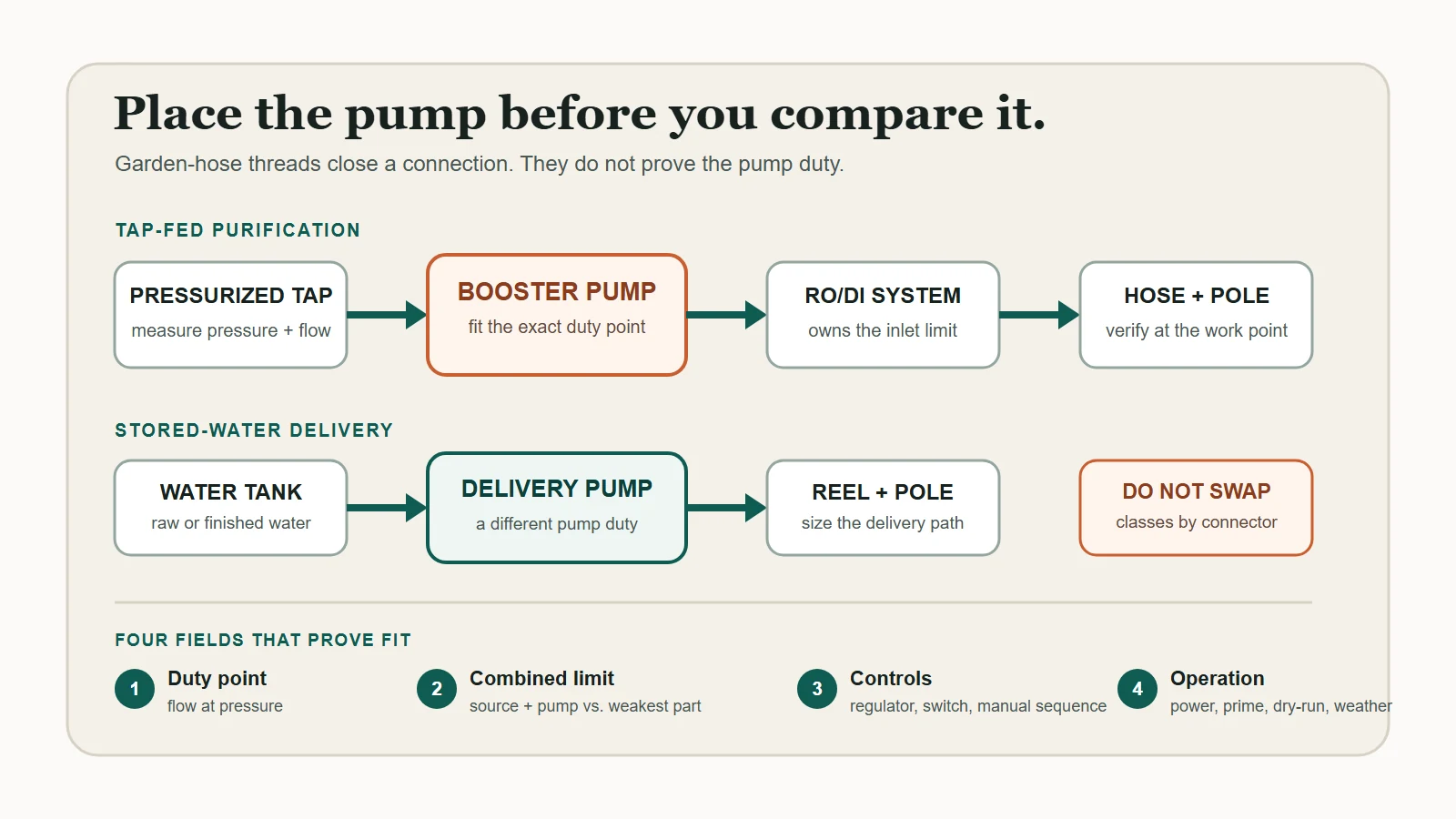
Reject water is not the same as product water used at the brush. Record both. If local rules or the property owner constrain discharge, resolve that path before price comparison. If a booster pump is necessary, put the pump, power, protection and maintenance into the same candidate—not into a later surprise budget.
The complete filtration, delivery, hose and pole dependencies belong in the water-fed pole system guide. RO economics cannot compensate for a system that lacks usable brush-end flow or a documented connection path.
Choose the outcome before the model
Finish the worksheet with one state:
- DI-ONLY STILL PLAUSIBLE: measured DI variable cost is manageable, the RO saving is not positive or the break-even volume is beyond conservative demand.
- RO/DI EARNS A MODEL COMPARISON: the variable saving is positive, break-even fits the acceptable period, and feed water, pressure, reject path, transport and service constraints are closed.
- HOLD FOR MEASUREMENT: actual DI yield, annual gallons, model conditions or an operating constraint is still unknown.
Only the second state justifies comparing exact RO/DI systems. Carry the worksheet into that comparison and replace every catalog assumption with a current model document or measurement. The Pure Water Systems library connects this decision to the rest of the filtration and operating path. A useful RO purchase starts with a positive denominator—not with a seller’s cutoff.