One current seller page describes a 4-inch suction cup on a long handle and rates it for 2 pounds. A current manufacturer sheet gives an 8-inch hand cup a 125-pound maximum load capacity. Those are not small and large versions of the same purchase.
The first product creates extra reach for light contact with smooth material. The second is a manual material-handling cup whose number belongs to one model, surface and environmental envelope. A powered lifter is another equipment class again. Starting with diameter or the largest number lets three jobs collapse into one search result.
Write four entries before comparing products: the job the handle must perform, the object that remains supported by an approved handling plan, the exact contact surface, and the direction of the load against the cup. A suction cup can add a temporary contact handle. It does not create access, fall protection or permission to move a pane.
This is one accessory decision inside a broader professional window-cleaning tool setup. If the work method itself is unresolved, return to that plan before adding a suction cup to the cart.
The handle name hides three different purchases
Suction-cup listings mix three equipment roles.
| Role | What the cup is being asked to do | Product evidence needed | First veto | Cart route |
|---|---|---|---|---|
| Light contact or extended-reach handle | Touch, guide or manipulate a light smooth item while another approved method supports the job | Exact seller/manufacturer line, pad, handle length, release and stated load | Body support, unknown load or a surface outside the product statement | Keep in the light-contact family or leave blank |
| Manual vacuum hand cup | Add a temporary handhold for a load already inside a documented manual-handling plan | Exact model, instructions, capacity conditions, pad, indicator, inspection and release | Weight, surface, orientation or condition outside the instructions | Compare one exact hand-cup model |
| Powered or specialist lifter | Control a large, heavy, awkward or otherwise specialist load | A complete lifting plan and exact powered-equipment owner | Trying to multiply small hand-cup ratings into a system | Leave the hand-cup page and use the specialist route |
The current WPG hand-cup catalog makes the differences visible. It filters products by weight band and by flat, curved or textured surfaces, then identifies exact models. The current J. Racenstein suction-cup category places basic cups, repair parts, extended-reach handles, heavy-duty cups and dual-cup products beside one another. That is useful category evidence, but it is not a product-selection rule.
Reach belongs to the role, too. A long handle may move the operator’s hand without changing the permitted load or contact surface. It cannot replace a documented ladder or other access choice.
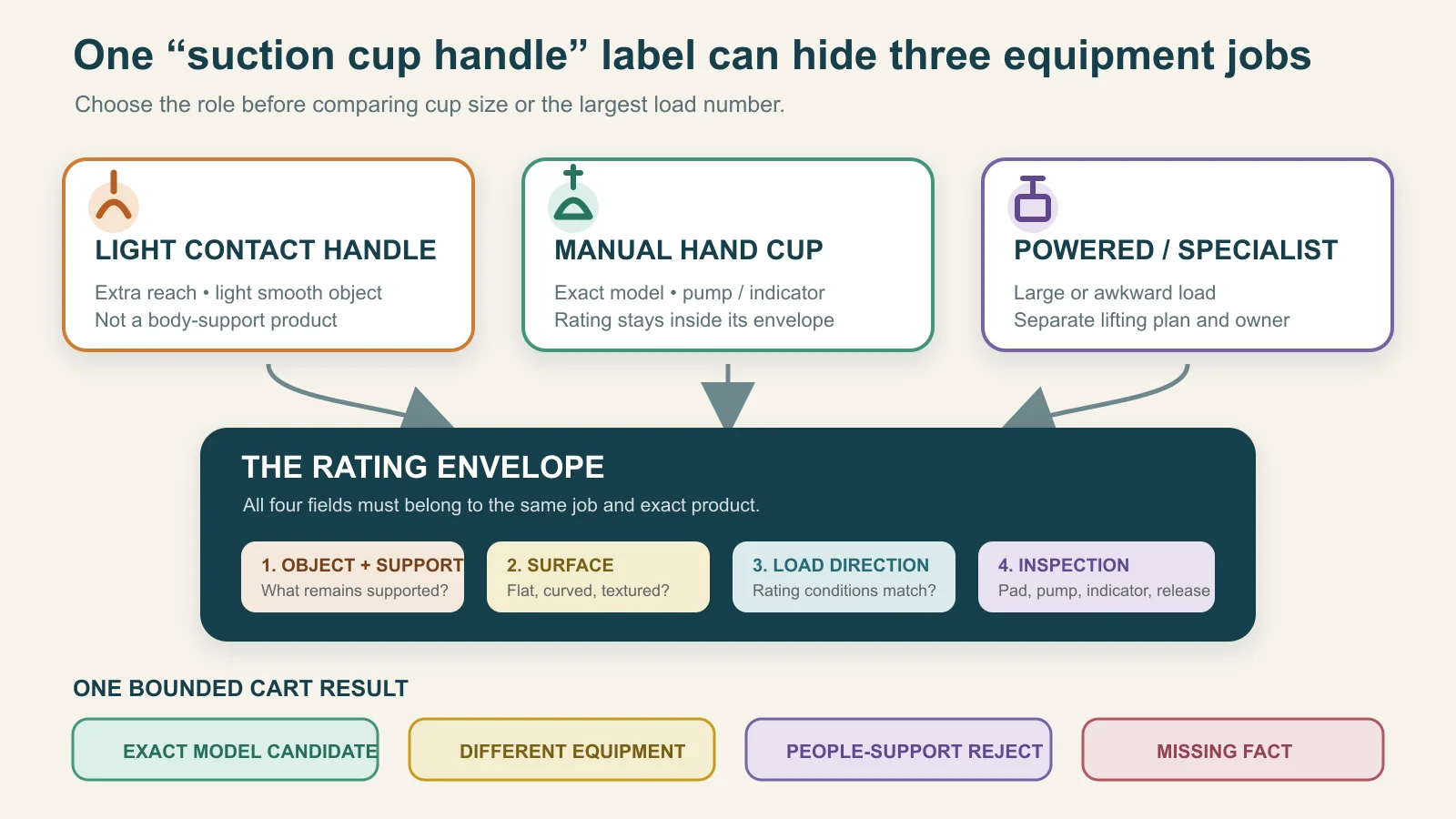
The picture is not a lifting plan. It shows why the same search label must enter three routes before one exact product can be considered.
A load number belongs to one model and one envelope
The current WindowCleaner.com All-Vac Straight Handle record describes a 4-inch rubber cup pressed into a steel body, a push-button release, 12-, 18- and 36-inch handle choices, and a 2-pound seller rating for light loads on smooth, nonporous materials.
WPG’s current N4950 sheet describes something different: an 8-inch metal-handle hand cup with a 125-pound maximum load capacity, red-line indicator and protective case. The same sheet binds that number to smooth, nonporous, flat surfaces, a maximum elevation of 5,000 feet, and a material and ambient temperature range of 10 to 120°F.
| Current record | Product role | Contact envelope | Published number | What the number does not decide |
|---|---|---|---|---|
| All-Vac Straight Handle, current seller record | Light-load extended-reach contact handle | Smooth nonporous material; 4-inch cup; 12/18/36-inch handle variants | 2 lb seller rating | Body support, installed glazing condition or a material-handling plan |
| WPG N4950, current manufacturer sheet | Manual hand cup | Smooth, nonporous, flat; 8-inch VPFS8L pad; 10–120°F; up to 5,000 ft | 125 lb [57 kg] maximum load capacity | Another model, curved/textured surface, a leveraged load or the actual job method |
| WPG hand-cup catalog | Manufacturer model family | Separate flat, curved and textured products across several weight bands | Model-specific | A universal capacity by diameter or cup count |
The 125-pound figure cannot upgrade the extended handle, and the 2-pound figure cannot derate a WPG model. Each number stays on its own record. Two cups also do not automatically create twice the permitted capacity; load distribution, attachment geometry, product instructions and the handling system remain unproved.
Treat orientation as a named field. Pulling away from a horizontal surface, resisting slip on a vertical pane and applying leverage through a long handle are different load relationships. If the exact instructions do not close the proposed relationship, do not invent a derating percentage. Ask the product owner or move to a designed lifting system.
The contact surface can veto the cup before weight matters
“Glass” is not a complete surface entry. Record whether the contact area is flat, curved or textured; porous or nonporous; clean and dry or contaminated; coated, filmed or otherwise finish-sensitive; and large enough to keep the entire sealing edge clear of frames, gaskets, labels, chips and damage.
WPG’s current hand-cup maintenance guide warns about contaminants, cuts or scratches in the pad face or load surface, porous material and pressure against the pad edge. It also warns that a visible red line is not an accepted lifting state. Those facts make pad and surface condition purchase fields, not after-use housekeeping.
The product can fail the purchase even when its catalog capacity is higher than the load. A flat-surface pad does not inherit the scope of a curved-surface model. A cup described for smooth nonporous material does not gain permission for a textured coating. A bumper, soft rubber or “low marking” label does not prove the installed finish accepts the contact.
Keep the object supported while the surface is being classified. This page does not tell a reader to press a candidate onto installed glass as a compatibility test. Surface identity, glazing condition and the responsible handling plan must already exist before product use is considered.
A handhold is not an anchor or body support
Some specialist seller pages place suction cups near high-rise or fall-protection products, and one current straight-handle listing uses wording about steadiness while aloft. Do not turn category placement or a short seller phrase into personal-support approval.
For the WPG hand cups covered by its current maintenance guide, the manufacturer explicitly says not to use the cup to support a person. The same guide says not to exceed capacity, lift with the red line visible, interfere with the plunger or touch the release lever while lifting.
That boundary matters even if the cleaner already uses a bosun chair or another descent method. A chair is one component in an authorized rope-descent system, and complete fall protection keeps separate anchorage, connectors, load, inspection, training and rescue owners. A suction cup does not become one of those owners because it touches glass.
S101 therefore has no worker-positioning-cup outcome. If the proposed use includes body weight, arresting a fall, anchoring, leaning out or holding position, reject that cart line here and send the complete method to the responsible access-system owner.
Put one exact product through the purchase ticket
A useful record fits one proposed cup on one recurring job. “Heavy-duty suction handle for windows” does not.
| Decision record | Cup-specific evidence | Purchase consequence | Route if unresolved |
|---|---|---|---|
| Role | Light contact, manual material handling, or powered/specialist lifting | Selects the equipment family before capacity | Do not compare products |
| Object and support | Exact pane, panel, frame part or other item, plus how it remains supported | Separates a temporary handle from the lifting system | Recover the handling plan |
| Contact surface | Material, finish, texture, porosity, curvature and usable pad area | Decides whether the exact pad can seal within scope | Hold for surface identity |
| Load relationship | Object weight owner; horizontal, vertical, inclined or leveraged relationship | Determines whether the published capacity conditions apply | Do not invent a derating |
| Exact identity | Manufacturer, model, stock/part number, pad and handle variant | Keeps claims and service parts attached to one product | Reject family-only listings |
| Rating envelope | Capacity, test/orientation statement, elevation, temperature and exposed friction or surface assumptions | Prevents a large number from migrating to another job | Ask the manufacturer or change equipment |
| Vacuum and warning | Lever or pump method, indicator, minimum-vacuum statement and monitoring instruction | Changes attachment feedback and stop behavior | Choose a documented model |
| Condition | Pad edge, face, filter, handle, pump, release, load contact area and contamination | A damaged or contaminated cup cannot borrow the new-product rating | Service or replace before use |
| Release and closeout | How the load is supported before release and how the control is protected | Prevents the release step from being left to improvisation | Keep the line on hold |
| Care and parts | Cleaning owner, allowed cleanser, drying/storage, case, pad and service path | Preserves the exact product’s inspection state | Confirm the current instructions |
The completed ticket returns one of four actions.
Keep the exact candidate. The role, object, supported plan, surface, load relationship, model, rating conditions and inspection state all agree.
Use different equipment. The job is valid, but a light contact handle, manual cup or powered/specialist lifter is the wrong family.
Reject people support. The proposed task asks the cup to carry, arrest, anchor or position a person.
Recover the missing fact. The load, surface, orientation, exact model, condition or responsible work owner is not known.
The cart line stays blank until the cup can be inspected and released
An exact model is not a permanent pass. Before purchase, recover the current inspection and service path. WPG’s guide identifies pad-edge damage, handle or pump damage, a red line that reappears soon after attachment, unusual pump action and a slick or stiff pad as faults requiring correction. It also keeps harsh solvents and unauthorized rubber treatments out of its cleaning route.
The owner of another brand may use different parts, intervals and cleaning instructions. Preserve that difference. Do not transfer WPG’s maintenance language to All-Vac, or a seller’s replacement part to a WPG pad.
Record the protective case or pad cover when the product supplies one, the exact replacement pad or service route, and who can withdraw a damaged cup from the loadout. A generic bin labeled “suction cups” loses the model, rating envelope and inspection owner that justified the purchase.
The smallest useful cart line reads: exact product, exact role, exact contact surface, exact load relationship and exact current condition. If the line cannot name all five, leave it blank.