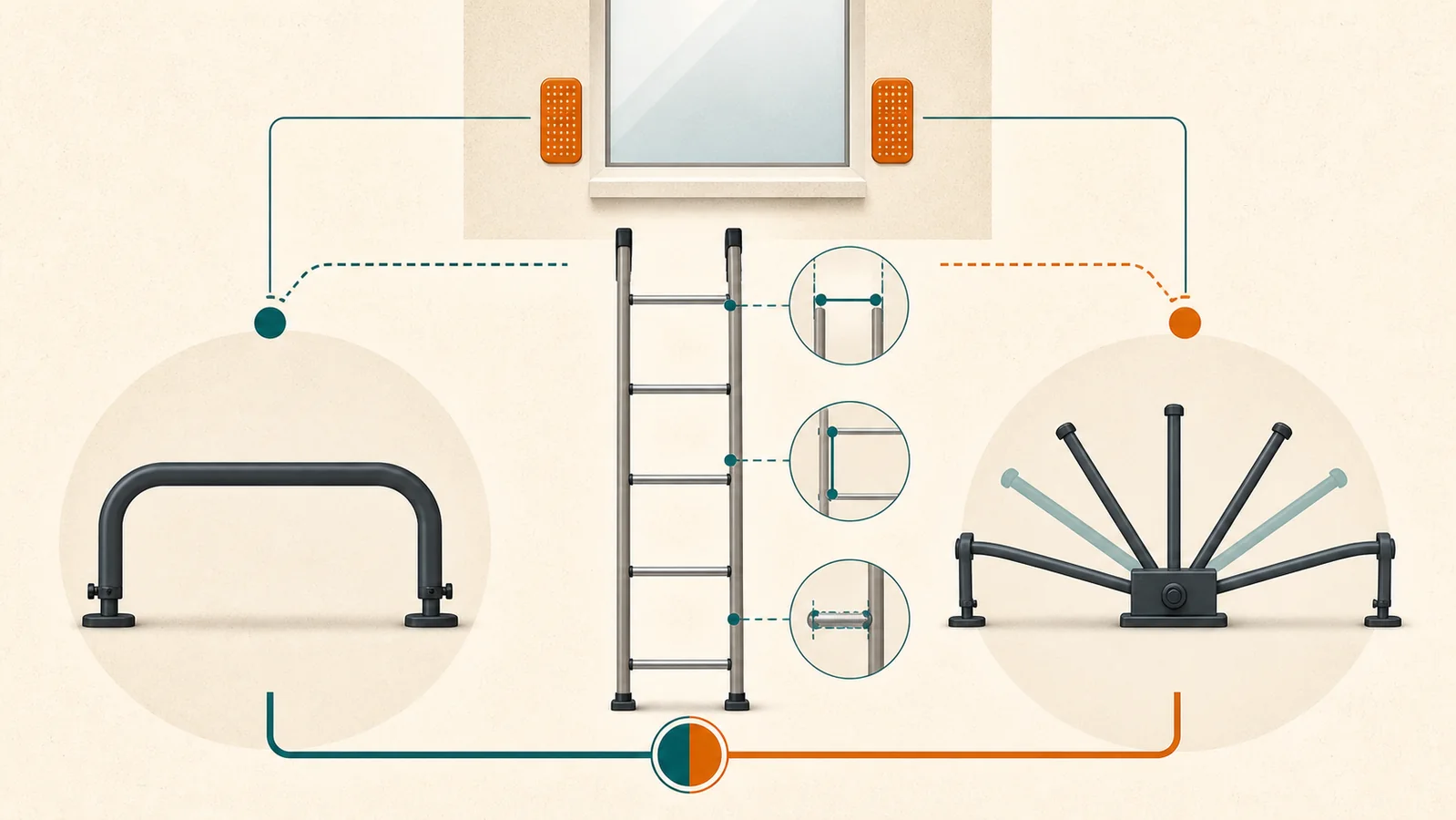
Draw the route from the worker to the glass before opening a roof-harness cart. If an authorized ground-based method completes the pane, frame and rinse work, the harness has no job. If a separately approved ladder route closes the task, that decision belongs to the ladder plan—not to a roof kit.
When the route reaches a roof edge, elevated surface or rope descent, “buy a harness” is still too early. The employer first has to name the work method and the rules and people that govern it. That choice determines whether the system is travel restraint, personal fall arrest, work positioning, rope descent or something that needs a qualified-person design.
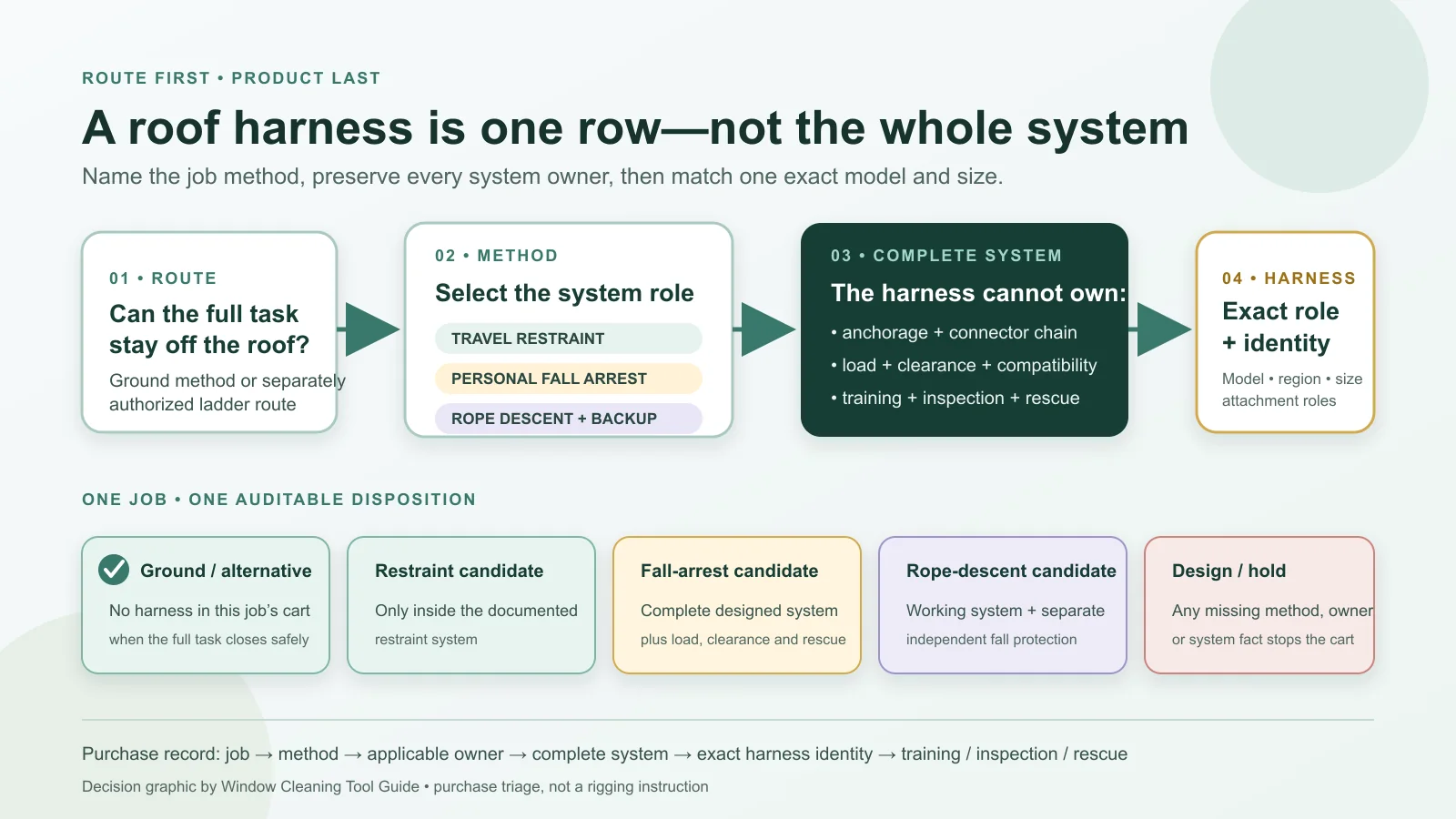
A harness can fit the worker and still be the wrong purchase. It is the body-support component inside a larger system. The anchorage, connectors, lifeline or deceleration components, clearance, total load, inspection, training and prompt-rescue plan keep their own owners.
This guide is purchase triage, not a rigging plan. It does not select an anchor, calculate fall clearance, identify a tie-off point, approve a job or decide whether a general-industry or construction rule applies. Missing job authority sends the cart to a hold.
The first purchase question is whether anyone needs to leave the ground
Start at the glass and work backward. Record where the worker would stand, how the full task is completed and what changes between setup, cleaning and retrieval. A tool that reaches the pane but cannot finish the edges, frame or rinse does not prove a ground-based route; a roof hatch that exists does not prove roof access is authorized.
Use the ground-based high-window guide when poles or another authorized method can complete the whole task. Use the ladder decision when an employer-approved ladder route is genuinely under consideration. Neither page authorizes a roof surface or a rope system, but each can remove an unnecessary harness purchase before a seller’s kit enters the discussion.
| Recorded route | What it does to the harness decision | What still needs an owner |
|---|---|---|
| The full window task is completed from stable ground | Remove the roof harness from this job’s cart | Exact pole/tool route and ground controls |
| A separately authorized ladder route completes the task | Move to the ladder type, load and support decision | Exact ladder, job load, surface, access and site owner |
| The planned system prevents the worker from reaching the fall hazard | Compare only a documented travel-restraint system | Applicability, anchor, connectors, compatibility and competent owner |
| The worker remains exposed to a fall hazard | A personal fall-arrest system may be part of the plan | Complete designed system, clearance, total load, training, inspection and rescue |
| The worker descends on rope | Treat the working rope-descent system and independent fall-arrest system separately | Building-owner anchor information, employer method, both systems and rescue |
| The route or governing owner is unknown | Hold the purchase | Qualified or competent review appropriate to the job |
The names in that table are not interchangeable product labels. They describe different work and system roles. The employer and responsible safety professionals have to select the applicable route before a product page can supply useful model facts.
A roof harness occupies one row in the system
OSHA’s current general-industry rule defines a personal fall-arrest system as a body harness, anchorage and connector. Depending on the design, the connector may include a lanyard, deceleration device, lifeline or a suitable combination. That definition is the simplest reason not to treat the harness as the system.
| Purchase record row | Evidence needed before one harness becomes a candidate | Why the cart cannot supply it alone |
|---|---|---|
| Work method and applicable owner | Exact task, surface/edge, employer method and applicable standard or site plan | A product category cannot decide which system the job requires |
| Body support | Exact manufacturer, model, region/certification, size and intended attachment roles | “Roof harness” is not a complete product identity or role map |
| Anchorage | Current job-specific anchor record and responsible design/approval owner | A harness rating or kit description cannot create an anchor |
| Connector chain | Every compatible connector, lifeline, lanyard or deceleration component named by the system owner | Similar-looking hardware and mixed brands are not proof of compatibility |
| Load and clearance | Worker, clothing, tools and other system-relevant load plus the qualified clearance/swing-fall determination | Size and catalog capacity do not calculate the fall path |
| Inspection, training and rescue | Named people, current instructions, inspection/removal criteria, training and prompt-rescue plan | Buying new equipment does not create operational readiness |
OSHA’s non-mandatory selection guideline adds a procurement lesson: select the system for the specific work situation and environment, obtain supplier performance information before purchase and do not assume all components are interchangeable. A change or substitution needs evaluation by the competent person who owns that decision; a retailer’s “fits most” language cannot do that work.
Current roof-kit pages help reveal what sellers group together. One J. Racenstein cart, for example, names a harness, lanyard, anchor and rope adjuster among its kit choices, while FallTech maintains roofers-kit categories. Those pages prove that “kit” is a commercial package. They do not prove that the package matches this building, method, anchor, worker, connector chain or rescue plan.
This distinction changes how you question a supplier. Do not ask only whether the harness is OSHA compliant. Ask for the exact current product identifier and regional documentation, its intended system role, compatible components, size method, rated user range and manufacturer performance information. The employer’s system owner then decides whether those facts fit the planned system.
Rope descent adds a second, independent protection system
Rope descent is where a one-kit mental model breaks most clearly. The working system that supports the descent is not the same object as the separate personal fall-arrest protection required for covered work.
Under OSHA 1910.27, the building owner supplies written information that the identified rope-descent anchorages have been identified, tested, certified and maintained as required before the employer uses them. The employer cannot replace that record with a roof photo, a parapet guess or an anchor included in a cart.
The same rule requires a separate, independent personal fall-arrest system for covered rope descent. Keep the two records apart:
| Record | What it owns | What it cannot borrow from the other record |
|---|---|---|
| Rope-descent working system | Employer-approved descent method, applicable anchor information, working components, operating limits, inspection and trained use | It cannot turn the working line into the independent fall-arrest system |
| Independent personal fall-arrest system | Separate body-support, anchorage and connector chain plus its own compatibility, inspection, clearance/load and rescue ownership | It cannot authorize the descent method or supply missing building-owner anchor evidence |
That separation does not tell a crew how to rig either system. It tells the buyer which documents must exist before exact hardware can be compared. If the building record, independent system or prompt-rescue plan is missing, the useful outcome is a qualified-person hold—not a more complete-looking bundle.
Product families advertise different jobs
Once the method and complete system are owned, manufacturer pages become useful. Their differences show why padding, price or the number of attachment points is a poor first filter.
Petzl currently presents NEWTON as a fall-arrest harness family. It presents AVAO for work positioning and rope descent, and ASTRO for rope-access technicians and progression. These are scoped role examples from current product owners, not a three-product ranking and not a statement that any of them is approved for a particular window-cleaning job.
| Current product-family example | Published role signal | Purchase question it creates |
|---|---|---|
| Petzl NEWTON international version | Fall-arrest body-support role | Is personal fall arrest actually the selected method, and does this exact regional model match the complete system? |
| Petzl AVAO international version | Work-positioning and rope-descent context | Does the employer’s method require those roles, and are the exact attachment functions owned by the plan? |
| Petzl ASTRO international version | Rope-access progression/ascent context | Is rope access an authorized task with the full working and independent-protection systems, or is this extra functionality irrelevant? |
After role comes identity. Preserve the exact manufacturer and model, regional version and applicable markings, current instructions, size selected from the manufacturer’s method, declared user range, worker-plus-tools record and every attachment point’s system-owned purpose. A family name without its size and regional document is not an orderable conclusion.
Fit also remains a real-person gate. A size chart can narrow a candidate; it cannot prove adjustment, movement, suspension comfort or post-event behavior for a worker the publisher has never assessed. The employer’s trained process and current manufacturer instructions own that decision. If the actual worker and exact model are unavailable, report a candidate or hold—not “best fit.”
Finally, keep accessories in their lane. A compatible equipment loop or holder may manage tools, but it is not automatically a fall-protection attachment. A connector’s strength or a harness marking does not transfer to an unapproved combination. Preserve the manufacturer’s role language and the complete-system compatibility decision together.
Send the seller a system record, not a size request
One job should finish with one disposition. If two outcomes seem possible, the missing fact belongs in the hold row.
| Disposition | Evidence that closes it | Purchase action |
|---|---|---|
| Keep ground-based or use an authorized alternative | The full task closes from stable ground or through a separately approved non-rope route | Remove the roof harness from this job’s order |
| Travel-restraint system candidate | Employer-selected restraint method, applicable owner, complete anchor/connector record, exact compatible harness role and operational plan | Preserve the exact system record for final owner approval |
| Personal fall-arrest system candidate | Fall-arrest method, complete designed system, job-specific anchorage, compatible connector chain, load/clearance, exact harness identity, training, inspection and rescue all close | Request the exact named components; do not substitute from a generic kit |
| Rope-descent full-body-harness candidate | Authorized rope-descent method, required building-owner information, complete working system and separate independent fall-arrest system, exact body-support role and rescue ownership all close | Request the exact model only inside both approved system records |
| Qualified-person system design or hold | Method, applicability, anchorage, compatibility, clearance, load, model/region/size, training, inspection or rescue remains unknown | Do not place the harness order; route the named gap to its responsible owner |
The seller-facing request should therefore identify the job and method; applicable employer or site owner; each system’s role; anchorage record; connector/lifeline/deceleration components; total worker-and-tools load; clearance and swing-fall owner; exact harness manufacturer, model, regional version, size and attachment roles; current instructions; training; inspection; and rescue owner.
That request is intentionally harder to write than “medium roof harness kit.” Its value is that a wrong product, incomplete system or unowned job cannot hide behind a familiar label.
Place the final record beside the business’s professional window-cleaning equipment plan, not in a separate safety-shopping list. If the system owner cannot complete the record, the page has still produced a decision: the harness is not ready to buy.