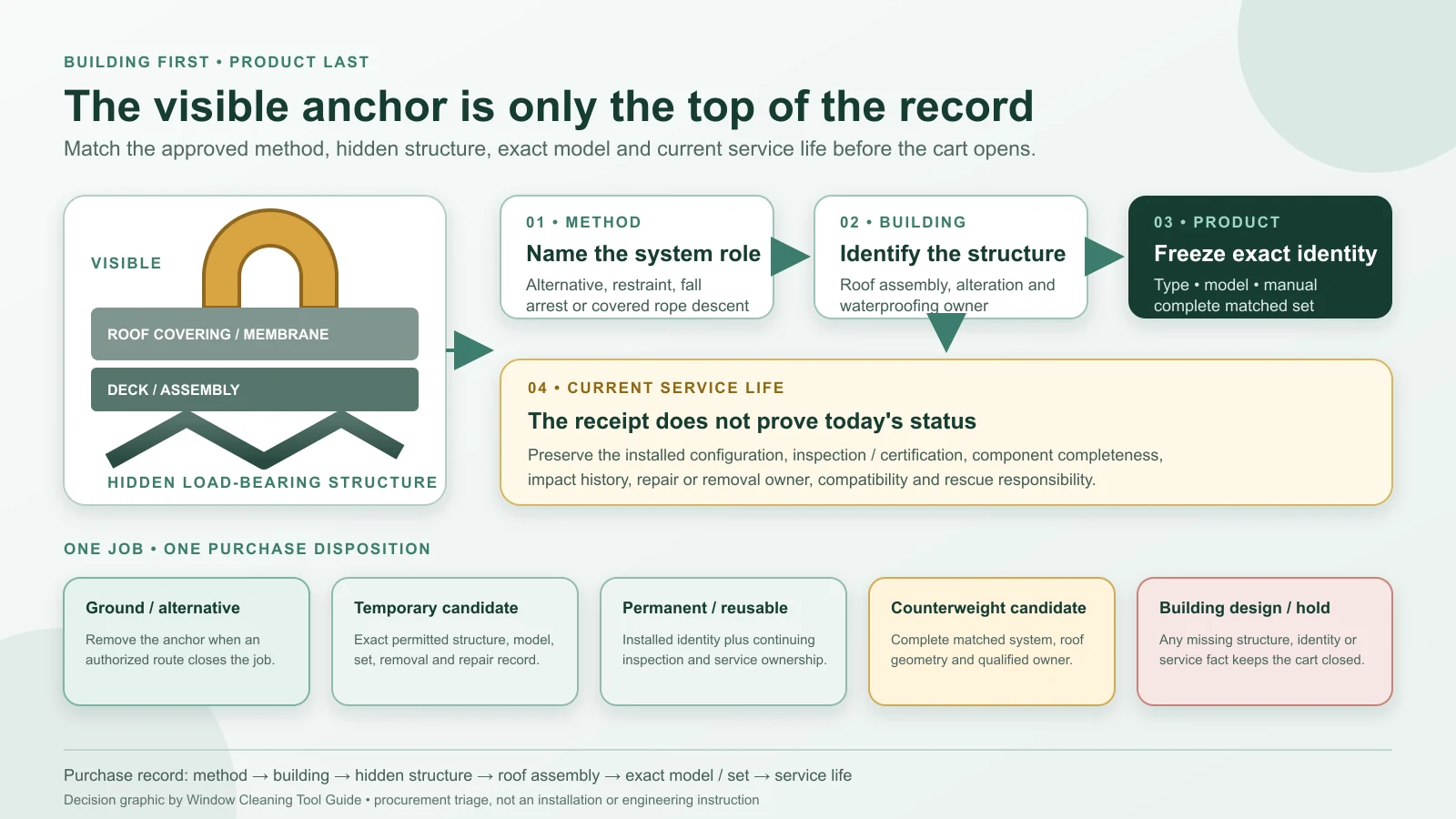
The D-ring is visible. The structure expected to carry the event is hidden under the roof assembly. That mismatch is why a roof-anchor purchase cannot begin with shape, finish or a familiar strength number.
First freeze the access method. If an authorized ground-based route completes the window, the anchor leaves this job’s cart. If the plan still involves roof exposure, fall protection or rope descent, the employer and the people responsible for the building and system must identify the actual structure, roof assembly and applicable record before a product type becomes useful.
The roof-harness decision owns the earlier method-to-complete-system choice. This page begins one step later: it asks whether one anchor type and one exact model can enter that already approved system. It does not identify a tie-off point, design an anchorage, approve a penetration, calculate clearance, certify a building anchor or teach installation.
The short answer is to match the same job across six records: approved method, applicable owner, hidden load-bearing structure, roof assembly, anchor type, and exact current product and service-life record. If any record describes a different building, model, system role or inspection state, hold the order.
The roof surface is not the structure you are buying
A membrane, metal panel, tile or shingle is what the buyer can see. The load-bearing object may be framing, a deck, concrete or another structure below it. A product photo cannot prove which layer is present, what it can support or whether the building owner permits a penetration or permanent alteration.
OSHA 1910.140 defines an anchorage as a secure attachment point for equipment such as lifelines, lanyards or deceleration devices. It does not turn an arbitrary point on a roof into one. The purchase record therefore has to begin with the building rather than the hardware.
| Record | Evidence that belongs in it | What cannot replace it |
|---|---|---|
| Approved method and system role | Exact window task, employer-approved access method, applicable owner, restraint/fall-arrest/RDS role and number of users | A roof-anchor search or kit label |
| Building and roof identity | Address, roof area, current drawings or records and the person authorized to speak for the building | A photo of the roof covering |
| Hidden load-bearing structure | Owner- or qualified-person-identified structural object and the design path that applies to it | Membrane, sheathing or a seller’s fastener list |
| Roof assembly and alteration authority | Membrane/deck/seam/framing record plus penetration, waterproofing and repair responsibility | The words reusable, permanent or non-penetrating |
If the full task can stay on stable ground, use the ground-based high-window guide and do not buy a roof anchor for this job. If roof work remains, a missing drawing, unidentified layer or unresolved waterproofing owner is not a prompt to choose a broader-looking product. It is a building-owner or qualified-person hold.
One strength number cannot select the anchor
The 5,000-pound number is real, but it is often detached from the rule that gives it meaning. Under OSHA 1910.140, covered personal fall-protection anchorages follow one of two criteria paths. One path requires capacity of at least 5,000 pounds for each employee attached. The other allows an anchorage designed, installed and used under the supervision of a qualified person as part of a complete personal fall-protection system that maintains a safety factor of at least two.
Those are not two claims a cart can award itself. The first is an anchorage-capacity requirement for the actual attachment point. The second is a complete-system design path with a qualified owner. Neither means that a hardware marking, accessory capacity or isolated product test has certified the selected roof.
The same rule keeps personal fall-protection anchorages independent from anchorages used to suspend workers or platforms. It also assigns compatibility, inspection, impact-removal and prompt-rescue requirements. A buyer therefore needs more than a strength field.
| Purchase shortcut | Why it fails | Record that closes the gap |
|---|---|---|
| “The anchor says 5,000 pounds” | A number on one object does not identify the hidden structure, installation or complete-system path | Job-specific anchorage and structure record |
| “A qualified-person path means a lighter product is fine” | The alternative criterion belongs to a designed, installed and supervised complete system—not to a shopping shortcut | Qualified-person system design and exact model/manual |
| “The same point can carry the work line and backup” | Covered personal fall-protection anchorage is independent of suspension or platform anchorage | Separate working and protection system records |
OSHA’s non-mandatory Appendix C reinforces the purchasing boundary: select for the specific work situation, obtain supplier performance information and have changes or substitutions evaluated by the competent person. This is a reason to preserve exact identities—not a set of article-created installation instructions.
Product type is really an installation-and-removal contract
Temporary, reusable, permanent and non-penetrating are not convenience tags. Each name carries a different relationship to the building, exact instructions, complete hardware set, inspection history and removal or repair responsibility.
Current manufacturer owners illustrate the separation:
| Current example | Published role | Purchase record it creates | What remains outside this page |
|---|---|---|---|
| FallTech 7410 | Hinged reusable temporary anchorage for named wood roof structures | Exact model, current manual, permitted wood structure and complete fastening contract | Selected-roof approval, attachment steps and waterproofing |
| 3M DBI-SALA 2103676 | Temporary hinged anchor for wood-frame structures; one user up to 310 pounds; not an HLL endpoint | Exact model/manual, one-user role, declared load and restraint/fall-arrest record | Current sale, structural fit, installation and job approval |
| MSA roof anchors and Workman model | Current category separates permanent and reusable models; Workman states one person and a 400-pound combined maximum including user, clothing and objects | Exact part/market, permanent or reusable identity, load record and current approvals/instructions | Transfer to another MSA model or building |
| 3M rooftop counterweight system | Non-penetrating counterweight anchorage for a flat-roof contract with a complete set and qualified-person/inspection controls | Exact system/manual, every counterweight/component, roof geometry and surface record | A universal no-hole answer or permission for any flat roof |
These are scoped examples, not rankings. FallTech’s wood-roof statement does not authorize an unidentified deck. The 310-pound limit in the cited 3M manual does not transfer to FallTech or MSA. MSA’s Workman limit does not establish the strength of the building beneath it. “Non-penetrating” does not remove roof geometry, surface, set-completeness or responsible-design gates.
A specialist cart can still be useful for identity. J. Racenstein currently lists a disposable/knock-down roof anchor as SKU 99-301 / MPN RF-1034-2 and names included fasteners. That can help freeze the item being discussed. It cannot tell a buyer that this structure accepts those fasteners or that the resulting roof and waterproofing work is authorized.
The practical type question is therefore not “Which style looks easiest?” It is “Which exact current product contract matches the building record and the planned life of this anchorage?” A temporary product needs installation, inspection, removal and repair owners. A permanent product needs an installed identity and continuing inspection or certification owner. A counterweight system needs its complete matched set and roof limitations preserved.
Window-cleaning rope descent has a different building record
Covered rope-descent work adds a building-specific record that a general roof-anchor search does not supply. OSHA 1910.27 requires the building owner to give the employer written information that each anchorage has been identified, tested, certified and maintained as required before the employer uses it.
For those covered rope-descent anchorages, the rule states a 5,000-pound capacity in any direction for each employee attached, inspection annually and as necessary, and certification as necessary and at least every 10 years. It also requires a separate, independent personal fall-arrest system.
| Record | What the buyer must receive | What it cannot borrow |
|---|---|---|
| Rope-descent building anchorage | Written building-owner identity, test/certification/maintenance status, current inspection and the exact anchorage assigned to the work | A portable product manual, roof photo or generic 5,000-pound claim |
| Independent personal fall-arrest system | Its own anchorage, body support, connector chain, compatibility, load/clearance, inspection and rescue ownership | The working descent line or its anchorage record |
This distinction is a procurement boundary, not a rigging diagram. The building owner and employer retain their named responsibilities; the qualified owner handles design and certification. If the written information is missing, the employer cannot repair the gap by bringing a familiar temporary anchor to the roof or by treating a suspension point as the independent fall-protection point.
Service life decides whether the anchor is still a candidate
An anchor is not identified only by manufacturer and model. Its current identity includes the installed configuration, matching components, instructions, inspection history, certification when applicable, exposure or damage, impact history and any permitted removal, repair or recertification action.
That matters even when the product started as the correct choice. A missing fastener or counterweight changes the set. An undocumented relocation changes the installation record. Corrosion, deformation, roof work around the anchor or an impact event can change its service status. The current manual and responsible inspector—not the original receipt—own the next action.
One purchase record should end in one disposition:
| Disposition | Evidence that closes it | Purchase action |
|---|---|---|
| Keep ground-based or use an authorized alternative | The complete window task closes without this roof exposure, or another approved method owns the job | Remove the roof anchor from this order |
| Temporary penetrating candidate | Approved method, permitted structure/roof alteration, exact temporary model/manual/set and installation/removal/repair owners all close | Request only the exact recorded product for final owner approval |
| Permanent or reusable candidate | Building plan names the structure, exact model/installed identity, system role, load and ongoing inspection/service owner | Preserve the asset and service record with the order |
| Non-penetrating counterweight candidate | Exact current system/manual, complete matched set, compatible flat-roof geometry/surface and qualified-person/inspection record all close | Request the complete system; do not substitute weights or components |
| Building-owner and qualified-person design or hold | Method, applicability, structure, roof assembly, model/set, geometry, inspection/certification, impact state or rescue remains unresolved | Do not place the anchor order; route the named gap to its owner |
The final request should identify the building and roof area; approved access method and system role; applicable rule and responsible owners; hidden structure and roof assembly; alteration/waterproofing authority; exact manufacturer, model, market and current manual; every included component; user count and total worker-plus-tools load; geometry and compatibility owners; installed or removal state; inspection, certification, impact and repair history; and rescue responsibility.
Keep that record beside the professional window-cleaning equipment plan. The cart opens only after the building, system and service-life records agree. When they do not, a documented hold is the correct purchase decision.