A parapet wall clamp is not a universal roof-edge anchor. The same search can place a one-person manual-descent clamp beside suspended-platform clamps, fall-arrest anchors and guardrail hardware. Those products do not become interchangeable because they all grip a parapet.
Name what will hang from the clamp before comparing openings, reaches or capacities. Then open a second file for the building: the exact parapet, structural verification, written anchorage information and the people who own tieback, fall-arrest and rescue. A product can fit its catalog and still fail the building file.
If the job has not yet established whether it belongs on the ground, a ladder or a suspended system, return to the window-cleaning ladder and ground-access decision. A clamp search should not choose the access method by accident.
Name the suspended system before the clamp
The MIO MTBC manual describes one suspended worker using a manual bosun’s chair or saddle. It also gives attachment A and attachment B different roles: A is identified for a tieback line or safety lifeline, while B is identified for the worker’s work line or a safety lifeline. That is a specific one-person manual-descent product record.
Power Climber’s current Winsafe page describes PC2201 and PC3601 as suspension points for a suspended platform from a structurally adequate parapet wall. Those are not longer or heavier versions of the MTBC. They belong to a different system.
| Search-result label | Evidence that must identify the product | Purchase disposition |
|---|---|---|
| One-person manual-descent clamp | Exact worker system, manufacturer, model, current manual and permitted attachment-point role | Continue with the MTBC record only if that is the intended system |
| Suspended-platform parapet clamp | Exact platform system, manufacturer model, reach, load basis and current documentation | Continue with the matching PC-family record only if the platform plan owns it |
| Parapet fall-arrest anchor | Exact anchor standard, intended use, connector and structural owner | Do not substitute it for a suspension clamp unless the system’s authorities expressly make that connection |
| Guardrail parapet clamp | Exact guardrail system and receiver | Remove it from this purchase; it solves a different edge-protection task |
| Product class still unknown | No defensible model comparison exists | Send the access plan back to the employer, qualified person or system designer |
The broader professional window-cleaning tools plan still owns the job-ready equipment stack. This page begins later, when a named high-access system has made a parapet clamp a possible component.
The MIO and Winsafe numbers answer different questions
The current MIO MTBC manual lists a maximum 24-inch parapet opening, a 7-inch outreach for attachment B, a 37-pound steel unit and a 310-pound attachment-B basis expressed as one 250-pound person plus 60 pounds of tools. The same MPN appears under different merchant SKUs, so record the MPN and manual rather than relying on a cart number.
The current Power Climber parapet clamp page publishes a different model table. PC2201 has a 22-inch maximum reach, a stated 1,500-pound capacity and a 60-pound unit weight. PC3601 has a 36-inch maximum reach, a stated 1,000-pound capacity and a 68-pound unit weight. The page says both open to 24 inches and have a rear safety tieback point.
| Product passport | Declared system | Opening / reach | Declared load figure | Unit weight |
|---|---|---|---|---|
| MIO MTBC | One suspended worker with manual bosun’s chair or saddle | Wall up to 24 in; attachment-B outreach 7 in | Attachment B: 310 lb, stated as 250 lb person plus 60 lb tools | 37 lb |
| Winsafe PC2201 | Suspended-platform clamp family | Opens to 24 in; maximum reach 22 in | 1,500 lb manufacturer-declared capacity | 60 lb |
| Winsafe PC3601 | Suspended-platform clamp family | Opens to 24 in; maximum reach 36 in | 1,000 lb manufacturer-declared capacity | 68 lb |
This is not a ranking. A 1,500-pound platform-model figure does not upgrade the MTBC, and the MTBC worker-and-tools line does not describe a suspended platform. Even within the PC family, the longer-reach model carries the lower published capacity. Preserve the exact row instead of turning three numbers into one “parapet clamp rating.”
A purchase passport should therefore contain the manufacturer, model, current manual, intended system, each permitted attachment-point role, opening, reach or outreach, declared load figure with its stated basis, unit weight and seller-to-MPN match. Any blank field stays blank until its owner supplies it.
A 24-inch opening passes only the caliper test
Both current product owners publish a 24-inch maximum opening, but that agreement closes only one physical screen. It says the clamp can open around a wall of that thickness. It does not say the wall, coping, cap, masonry, reinforcement or load path is suitable for the intended system.
The MIO manual says parapets directly supporting suspended equipment must be structurally analyzed under the conditions it cites, and it assigns named design or verification work to a registered professional engineer. Power Climber describes its suspension point as being on a structurally adequate parapet. Neither statement lets a buyer infer adequacy from wall width, material appearance or building age.
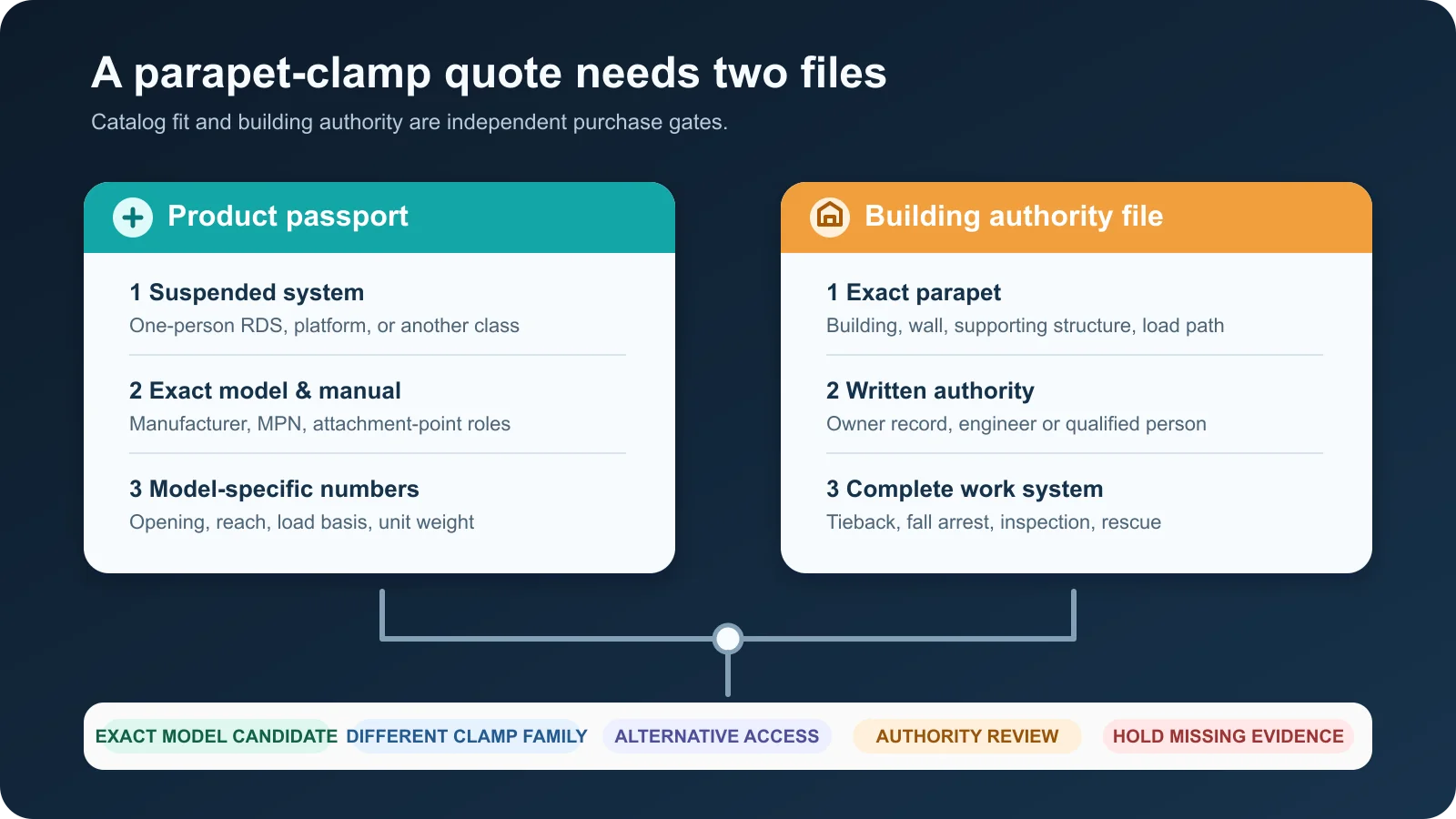
| Product passport can establish | Building authority file must establish |
|---|---|
| Whether the exact clamp opens far enough for the measured geometry | Whether the identified parapet and supporting structure can accept the intended loading |
| Which attachment points the exact manual names | Which point and load application are authorized for this building and system |
| Model-specific reach, outreach, weight and declared capacity basis | Structural verification, building-owner information and any site-specific restrictions |
| That a rear tieback point exists on the named PC models | The actual tieback arrangement and responsible qualified owner |
| That the catalog model remains a candidate | Whether the job may use it at this location |
A ladder-standoff contact-zone drawing can help a crew understand why geometry and bearing surfaces are not synonyms. It cannot be reused as structural evidence for suspended access. The loads, system and authority are different.
Do not fill the building column with “concrete,” “looks solid,” an architectural elevation or the clamp’s published capacity. Ask for the exact building record and the responsible person who can interpret it for the proposed use.
Keep each capacity number attached to its object
The largest number on the screen is often the least useful one when its object has been lost. The MTBC’s 310-pound line belongs to attachment B and its stated person-plus-tools basis. The PC2201 and PC3601 values belong to those manufacturer models in a suspended-platform product table.
For rope descent systems within its scope, OSHA 1910.27 assigns other numbers and duties to other objects. Before use, the building owner must give the employer written information that each anchorage has been identified, tested, certified and maintained to support at least 5,000 pounds in any direction for each employee attached. The employer must obtain that information before allowing use and keep it for the job. The regulation also addresses manufacturer instructions, inspection at the start of each workshift, tiebacks for non-permanent anchorages, a separate independent personal fall-arrest system and prompt rescue.
| Number or duty | Object it belongs to | What it cannot prove |
|---|---|---|
| MTBC 310 lb person-and-tools basis | MTBC attachment B under the exact manual | Building anchorage certification, platform capacity or permission for another attachment |
| PC2201 1,500 lb / PC3601 1,000 lb | Exact Winsafe platform-clamp model | Suitability of the parapet or approval of the complete platform arrangement |
| OSHA 5,000 lb anchorage information | Each RDS anchorage for each attached employee under the cited rule | That a merchant listing or catalog clamp has been accepted for the building |
| OSHA minimum rated load for RDS components, with the stated seat-board exception | The components named by the regulation | A substitute for the manufacturer’s model limits or structural analysis |
| Separate fall-arrest and prompt rescue duties | The employer’s complete RDS work plan | A feature supplied automatically by buying the clamp |
This page does not decide whether a particular federal, state or local rule applies to the job. It keeps the federal source from being reduced to a marketing badge or an arithmetic comparison. The employer and applicable authority still own that determination.
A tieback lug shown in a product drawing is not the tieback plan. A model described as a temporary anchor is not the building owner’s written anchorage record. A capacity statement is not an inspection, a rescue plan or a separate fall-arrest system.
Ask for two files, then ask for a price
A useful quote request has two attachments. The first is the product passport; the second is the building authority file. If a seller or access-system specialist cannot identify the exact model and manual, stop before discussing substitutions. If the building file is absent, do not ask the product to fill it.
| Quote file | Minimum contents | Owner who must answer | Result if incomplete |
|---|---|---|---|
| Product passport | System, manufacturer, model, manual revision, attachment roles, opening, reach, load basis, weight and included hardware | Manufacturer and exact seller; system designer where needed | Different model/family or hold |
| Building authority file | Building and parapet identity, structural verification, written anchorage information and site restrictions | Building owner, engineer, qualified person and applicable authority | Engineering/authority review or alternative method |
| Complete work-system file | Work line, safety line, tieback, independent fall-arrest, edge protection, inspection, training, weather controls and rescue ownership | Employer and qualified work-system owner | Hold; product purchase cannot close the work plan |
| Commercial line | Exact MPN, seller SKU, quantity, lead time, return/warranty terms and approved substitution rule | Current merchant after the first three files close | Quote exact candidate only |
Quote the exact parapet-clamp model for the named one-person RDS or suspended-platform system at the identified building. Return the current manufacturer manual, attachment-point roles, model opening/reach/load basis and included hardware. Do not substitute another clamp family. The building owner and responsible engineer or qualified person will supply the parapet and anchorage authority record separately; pricing is not approval to use the product.
That wording gives a supplier something concrete to answer without asking the seller to certify the building. It also makes a substitution visible: a different system, attachment role, reach or load basis reopens the product passport instead of slipping into the order.
Only when the product passport and building authority file agree is there an exact model candidate worth pricing. If the system changes, choose the correct clamp family. If the parapet or anchorage record does not close, route the job to engineering review or another authorized access method. A 24-inch catalog opening never gets the final vote.