The expensive mistake can happen before a bottle is opened. A quote promises to brighten a gutter, but nobody has established whether the visible change is ordinary dirt, oxidation in a sound finish, or a finish that is already failing.
Gutter Butter is sold as a concentrated cleaner for oxidation on gutters and other exterior surfaces. That describes a marketed product role. It does not identify the material and finish on the building, diagnose the mark, or decide what surrounding glass, siding, roofing and landscaping may be exposed.
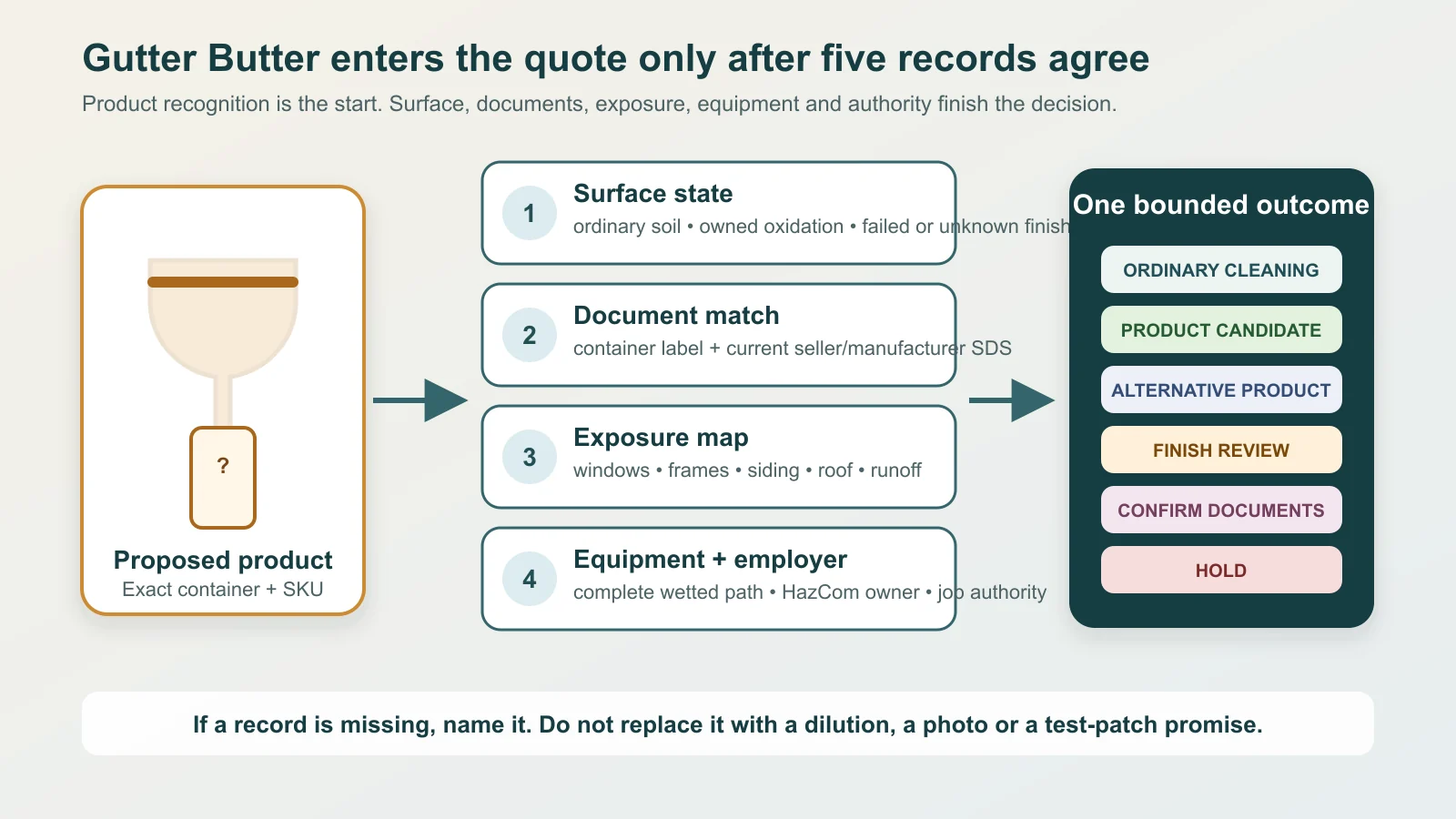
Keep the product out of the order until five records meet: the exact container, the gutter face and its condition owner, a label and SDS that match the container, the complete exposure path, and the equipment and workplace controls that will own the chemical. If one record is missing, the honest result is a named hold—not a guessed ratio or a reassuring test patch.
A gutter face can be dirty, oxidized or losing its finish
The phrase black streaks describes an appearance, not a purchase specification. Three jobs can look similar in a phone photo and require different decisions.
| Observed job state | What must be established | Purchase direction |
|---|---|---|
| Loose soil or ordinary organic buildup | The gutter owner accepts an ordinary cleaning route and the finish is sound | Use the ordinary owner-approved cleaning plan; an oxidation remover may be unnecessary |
| Suspected oxidation or tiger striping on a sound finish | Exact gutter material and finish, responsible diagnosis, current product scope and a permitted contact boundary | Gutter Butter can remain a candidate after every other record closes |
| Chalking, peeling, bare metal, color loss or unknown coating failure | The finish owner, installer or restoration professional determines whether cleaning, coating repair or replacement is responsible | Route to finish or installer review; a brighter patch does not prove restoration |
The current PowerWash product page and J. Racenstein listing describe Gutter Butter as an oxidation-removal cleaner for gutters and other exterior surfaces. Those seller statements can identify the product’s advertised lane. They cannot classify a particular gutter finish from a photo or transfer permission from vinyl siding, a metal roof or another job.
Start the quote with the installed surface: gutter manufacturer or material, factory or field-applied finish, approximate age if known, repairs, damaged areas and the owner responsible for the coating. Then record what is actually observed without converting the observation into a chemical diagnosis.
This distinction also changes what success could truthfully mean. Removing ordinary soil, changing the appearance of oxidation and repairing a failed coating are not interchangeable deliverables. A cleaning product should not be sold as repainting, coating renewal or proof that the original finish will be uniform.
The public SDS dates do not currently tell one story
The publicly hosted Gutter Butter SDS identifies the product as GUTTER BUTTER, uses SDS number TCC-018 and describes its recommended use as a cleaning compound. The PDF displays an issue date in 2012 and a revision date of April 10, 2015. Its hazard section classifies serious skin and eye effects.
A separate SoftWash Systems SDS Sheets Book 2026, published through a document platform in June 2026, presents a Gutter Butter sheet with an April 2026 revision date. That is evidence that a newer document may exist. It is not enough to decide which sheet controls the container being ordered.
Do not average the dates or silently promote the easier-to-find file. Ask the selected seller or manufacturer for the current SDS tied to the exact shipped product, and compare its product identifier, supplier, revision and hazard information with the container label. Save both with the purchasing record. If the label, seller document and public PDF do not converge, the result is MANUFACTURER_CONFIRMATION.
For a US workplace, OSHA’s Hazard Communication standard places labels, safety data sheets, the workplace program and employee information and training with their responsible owners. A web article cannot choose site-specific protection, emergency measures or disposal controls. The employer’s current program and the exact product documents must do that work.
This date mismatch is not a reason to declare the product bad. It is a reason to make document identity part of the purchase instead of downloading any file with the right brand name after the order arrives.
Windows are part of the purchase even when glass is not the target
The gutter face is only the target. The proposed contact zone may also include windows, frames, sealants, siding, soffits, fascia, roofing, fasteners, painted trim, landscaping and the path followed by runoff.
The current PowerWash page tells buyers to pay particular attention to windows when preparing surrounding areas. Current J. Racenstein guidance also says not to use the product on polished aluminum and to use caution on stucco and Dryvit because color may change. Preserve those cautions as seller-owned restrictions. Do not turn them into a complete compatibility list for every adjacent material.
Draw the exposure map before adding the product line to the quote:
- Name the gutter face and its finish.
- List every nearby material that could receive direct spray, drift, a brush edge, a splash or runoff.
- Name the current owner that permits or rejects contact for each material.
- Record how the site owner handles drainage, containment and environmental obligations.
- Reject or hold the route when an exposed material, finish or authority is unknown.
Glass does not become eligible because the gutter is the intended target. If the proposed alternative is Cleansol BC for glass and frames, use the separate Cleansol BC decision and its exact surface owner. That record does not authorize Gutter Butter on glass, and a Gutter Butter seller page does not authorize the surrounding window assembly.
A small trial area can support the responsible owner’s evaluation for one identified finish. It cannot prove another gutter, a repaired section, a nearby coating or an entire building. It also cannot turn visible color change into a diagnosis of oxidation or a warranty decision.
Make the product and sprayer one compatibility question
A seller may state that a product can travel through a pressure-washer pump or low-pressure delivery method. That statement is useful only inside the seller’s exact scope. It does not identify every tank, seal, piston, hose, shutoff, wand, filter, nozzle or previous residue in the equipment you plan to use.
The site’s chemical-sprayer guide owns that second purchase. It matches one exact liquid and use concentration to one exact current sprayer model and its entire wetted path. Acid-resistant, chemical-resistant and a familiar seal material are not universal approvals.
Send the equipment owner a complete question rather than a product nickname:
Does current model [manufacturer, model and suffix] permit the exact Gutter Butter product on this container, under the product owner’s current conditions, through the complete wetted path? Which current compatibility document controls, and does the unit need dedicated use?
Keep the answer with the model label and product document revision. If the manufacturer answers only for one seal or says to check the chemical supplier, the path remains open. Both the chemical owner and the equipment owner must accept their part of the same route.
The same rule applies to storage, transport and leftovers. A larger container may change handling and business exposure even when the surface decision is unchanged. Those controls belong to the current SDS, employer plan and applicable authority—not to a cost-per-gallon shortcut in a buyer’s guide.
Put a boundary on the quote
A useful quote line names what is known and refuses to sell what is not:
[exact Gutter Butter container and seller SKU] — [current matching label/SDS revision] — [gutter material and finish] — [condition and responsible owner] — [adjacent surfaces/runoff authority] — [delivery equipment compatibility] — [employer chemical owner] — [one outcome].
Choose one outcome:
ORDINARY_CLEANING_ROUTE— the owner identifies ordinary soil and does not establish a need for an oxidation-removal product.EXACT_PRODUCT_CANDIDATE— container, current documents, sound finish, condition owner, exposure path, equipment and employer controls all converge.ALTERNATIVE_PRODUCT— another current-owner product has the required surface scope while this one does not.FINISH_OR_INSTALLER_REVIEW— coating failure, polished aluminum, damage or an unresolved finish keeps chemical selection behind the responsible owner.MANUFACTURER_CONFIRMATION— product identity, document revision, surface scope or equipment answer conflicts.HOLD— an exact surface, document, exposure, equipment or authority record is missing.
Do not copy an outcome from another chemical. The F9 BARC decision, for example, resolves a different product and a different current-source conflict. Its restriction, SDS and possible non-glass routes do not transfer here.
Only an admitted product belongs inside the broader professional window-cleaning equipment plan. The full plan still owns access equipment, ordinary glass tools, transport, storage and job-specific controls.
When the quote cannot name the gutter finish, the controlling label/SDS or every surface in the exposure path, ask for that record before ordering. The most useful Gutter Butter decision may be a product candidate, an ordinary wash, a finish review—or a precise reason not to promise a brighter gutter yet.