The live F9 BARC product page gives glass a five-word verdict: “DO NOT USE ON GLASS.” That answer matters more to a current purchase than the fact that an older F9 document still describes a window process.
For a window-cleaning business, the useful distinction is between the stained material and the window beside it. Rust-colored staining on concrete, pavers or another surface does not turn the nearby glass into an eligible surface. If glass is the target—or the proposed job gives the liquid a credible path to glass—F9 BARC does not enter the cart under the current published scope.
An exact non-glass target can remain under consideration, but “not glass” is not enough. Preserve the exact stain, every surface the product can reach, the live product page, the current container label and SDS, the exact equipment path and the responsible employer’s chemical plan. An unknown in any of those fields is a hold, not an invitation to borrow an older recipe.
This is a purchasing boundary, not an application guide. It supplies no dilution, mixing, dwell, rinse, neutralization or exposure-response instruction.
The current product page ends the glass comparison
Front 9 Restoration’s current F9 BARC product page positions the product for rust, fertilizer and orange battery stains and names non-glass exterior surfaces in its scope. The same page explicitly excludes glass. Keep both facts together: a named masonry or exterior target may create a candidate, while the glass row remains rejected.
The relevant documents do different jobs. Treating them as one interchangeable pile is how an old process can outrank a current restriction by accident.
| Record | What it owns | Purchase effect |
|---|---|---|
| Current live F9 BARC product page | Present published stain and surface scope, including the explicit glass exclusion | Reject glass; test only an exact named non-glass target against the remaining owners |
| Current Front 9 technical-data index | The current home for instructions, technical data and safety documents | Recover the live document set rather than relying on a saved search excerpt |
| Current container label and F9 BARC SDS | Exact-container identity, current hazard communication and product-use record | Require the current label/SDS and employer plan; the SDS does not authorize a surface by itself |
| 2021 F9 cookbook | Evidence that an older window process existed and carried a glass-haze caution | Exposes a conflict; does not reopen glass under the current live product scope |
The current F9 BARC SDS identifies the product use as concrete cleaner and rust remover. It also carries corrosive and other serious hazard statements. Those facts are reasons to keep the exact SDS, label and employer controls attached to the product; they are not a procedure and they do not expand the surface list.
If the label on the container in hand, the live page and a current manufacturer answer do not agree, stop at the disagreement. Record the lot/container identity and ask the manufacturer which current document controls that exact product. Do not settle the question by choosing the source with the most convenient answer.
The old window process is evidence of a source conflict
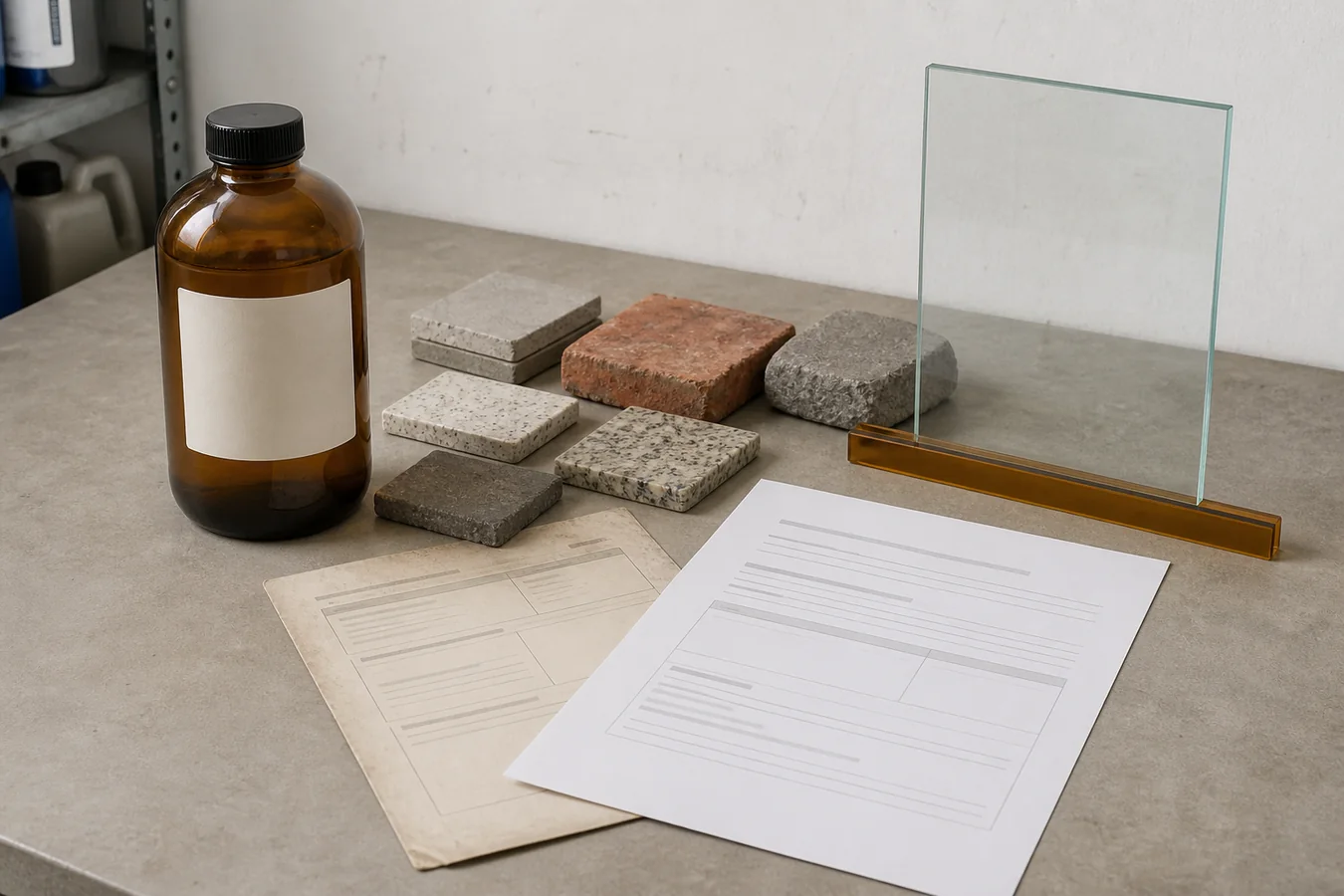
The older F9 cookbook explains why the query can feel contradictory. Its 2021 edition includes a process associated with windows and warns that glass can haze under stated conditions. That historical material is relevant because a buyer may still encounter it through an old link, downloaded copy or seller conversation.
It is not relevant as a current workaround. This page gives the live product owner’s current glass exclusion priority over an older process. Reproducing the old ratios or steps would obscure the only decision this article can responsibly close: the current published route to glass is no.
The difference between “this once appeared in manufacturer material” and “the manufacturer currently permits this use” should stay visible in the purchasing record. Save the document title and date beside any claim taken from it. A screenshot without its date, a search snippet or a merchant paraphrase cannot resolve the conflict.
Tin-side language can make the old process sound more precise without making it current. The site’s tin-side detector guide explains what that measurement can and cannot establish. Identifying a tin or air face answers an orientation question; it cannot overrule a live instruction not to use this product on glass.
The same limit applies to past successful use. A remembered result does not prove the glass construction, coating, product revision, concentration, exposure path or current manufacturer scope. This article makes no field-performance inference from an anecdote, whether favorable or unfavorable.
Separate the stain from every surface the liquid can reach
A plausible F9 BARC job may begin with an orange stain on a concrete sill, brick facade or paver below a window. The purchase question is not just “Is concrete listed?” It is “What surfaces belong to the proposed contact zone?”
Write the job in one sentence before comparing containers or sellers:
[identified stain] on [exact target surface], beside [glass, frame, coating, sealant and other adjacent surfaces], with [current owner] responsible for the complete exposure boundary.
That sentence forces three different outcomes.
- If glass is the stained target, the product is rejected under the current live page.
- If a non-glass target is named but the proposed route can credibly contact glass, keep the purchase on hold until the current manufacturer and responsible employer own an exact acceptable boundary—or choose another product route.
- If the target is a surface named by the current product page and every adjacent surface, current document and responsible owner is closed, the product may remain a qualified non-glass candidate. It is not yet an application plan.
Frames, hardware, coatings, films, sealants, painted finishes and landscaping keep their own material identities. The phrase “for concrete” does not convert an entire window opening into concrete. Likewise, “exterior use” does not mean every exterior assembly accepts the same chemistry.
If the actual task is treatment of glass, compare a product whose current owner addresses glass rather than trying to rescue this one with an old document. The site’s separate Cleansol BC glass-and-frame decision shows why even a current glass listing still needs the surrounding frame and product documents to agree. Its permissions and limits do not transfer to F9 BARC.
A sprayer cannot widen the product scope
Equipment compatibility begins after product and surface eligibility. A sprayer listing may mention acid-resistant seals, a broad chemical family or a familiar tank material; none of those statements authorizes F9 BARC on glass or resolves an adjacent-glass path.
Once a non-glass use survives the current-source gate, the exact product at the exact owner-approved concentration must still match every wetted part of the exact equipment. The site’s chemical sprayer compatibility guide owns the tank, seal, valve, hose, wand and nozzle record. It deliberately does not decide whether a cleaner belongs on a surface.
Keep the order of questions intact:
- Does the current product owner include the exact stain and target surface?
- Can the proposed job keep every contacted surface inside that current scope?
- Do the current label, SDS and responsible employer close the chemical plan?
- Does the exact equipment owner confirm the complete wetted path for that exact product and concentration?
A “yes” at step four cannot repair a “no” at step one or two. An unknown equipment answer does not create permission for hand application, a substitute container or an improvised transfer. It leaves the equipment path unresolved.
Only a non-glass, current-owner record reaches the cart
There are five useful endings to this F9 BARC comparison.
Reject for glass. The target is glass, or the proposed job relies on intentional glass contact. The current live product page closes that route.
Reject outdated-only permission. The only support for the proposed use is the 2021 cookbook, a saved snippet or remembered practice that conflicts with the current page.
Hold for the current owner. The exact stain, target surface, adjacent-surface path, container label/SDS, equipment compatibility or employer chemical plan is unknown. The hold should name the missing answer and who can supply it.
Keep one qualified non-glass candidate. The exact stain and target surface sit inside the current manufacturer scope; glass and other adjacent surfaces have a current-owner disposition; and the current label, SDS, equipment and employer records agree. This outcome qualifies a purchase comparison. It does not supply use instructions.
Choose another current-product route. The job is genuinely about glass, an excluded/unknown surface or an exposure path the current owner does not close. Compare another product under its own current documents rather than transferring an F9 procedure or merchant category.
Attach only the surviving record to the professional window-cleaning equipment plan. If the line item cannot name a non-glass target and the current documents that support it, the most useful purchasing result is still a rejection or a named-owner hold.