Three brushes can all be sold as soft and still belong to three different jobs. One may be a hand brush for dry screen dust, another a garden-hose washdown block, and the third a pure-water head that needs a matching pole, adapter, tubing and jets. Bristle feel does not make those products interchangeable.
Start with four facts: what the brush will touch, what it must move, whether water passes through it, and what the brush must connect to. Pick the role first. Then compare width, bristle construction, bumper, block and care instructions inside that role.
This is a category decision inside a broader professional window-cleaning tool setup. It does not replace the detailed route for a track, screen or water-fed head. Its job is to keep those roles from being mixed in the same cart line.
Name what the brush touches and what it has to move
“Window” is not a useful surface entry. Write glass, coated glass, painted frame, vinyl track, metal rail, mesh screen, flexible glazing, sill or another exact part. Add the current product line or care instruction when the finish is not obvious. A brush sold for screens is not automatically admitted to coated glass, and a brush that reaches a frame is not automatically a track tool.
Now name the soil. Loose dust, cobwebs and grit suggest dry collection. A bonded film may require a permitted wet method. Mineral deposit, paint, adhesive or sealant is not ordinary brush soil; it belongs to a different surface and removal decision. If you cannot name the material, do not make stiffer bristles the diagnosis.
The water entry needs equal precision. “Wet brush” can mean a hand brush dipped in a controlled solution, a block fed by a garden hose, or a pure-water head supplied through small-bore pole hose. Those are different routes with different connectors, flow controls and closeout work.
Five brush roles look alike only on the shelf
WindowCleaner.com’s current brush department places track brushes, screen brushes, dusters, flow-through blocks and water-fed heads in the same broad category. That is useful for browsing, but the product shelf does not decide which one belongs on a particular job.
| Brush role | First contact it must own | Delivery and connection | Purchase boundary | Where the detail belongs |
|---|---|---|---|---|
| Handheld track/detail brush | A named groove, sill or frame area and identified loose or bonded soil | Hand use; dry first unless the window instructions allow moisture | Head shape and bristle claim follow the finish, drainage and nearby hardware | Use the window-track cleaning route |
| Screen dusting brush | A screen whose frame, mesh and release condition are already known | Hand or a documented pole connection; normally no through-brush water | Screen condition and care method decide whether brushing is the right branch | Use the screen-cleaning route |
| Pole-mounted dry-detail brush | Dust, cobwebs or debris on a named screen, frame, ledge or architectural detail | Exact handle or pole tip, plus angle or pivot if present | The product’s stated surface scope and connection must both match | Keep as a dry-detail role |
| Garden-hose flow-through block | A surface whose instructions permit hose-fed washdown | GHT size and gender, handle, shutoff or valve, brush block and bumper | A hose connection does not make the product a pure-water-system head | Keep as a separate GHT route |
| Pure-water brush head | Exterior glass and frame work already assigned to a pure-water method | Pole tip, angle adapter, socket, tubing, jets or rinse bar and brush block | Exact system fit and water path close before bristle choice | Use the water-fed brush owner |
The rows are roles, not a shopping quota. A route that never accepts hose-fed washdown does not need a flow-through brush. A route that removes screens for flat hand washing may not need a dedicated screen dust brush. The smallest good set is the set that can name its jobs without borrowing a contaminated or incompatible tool.
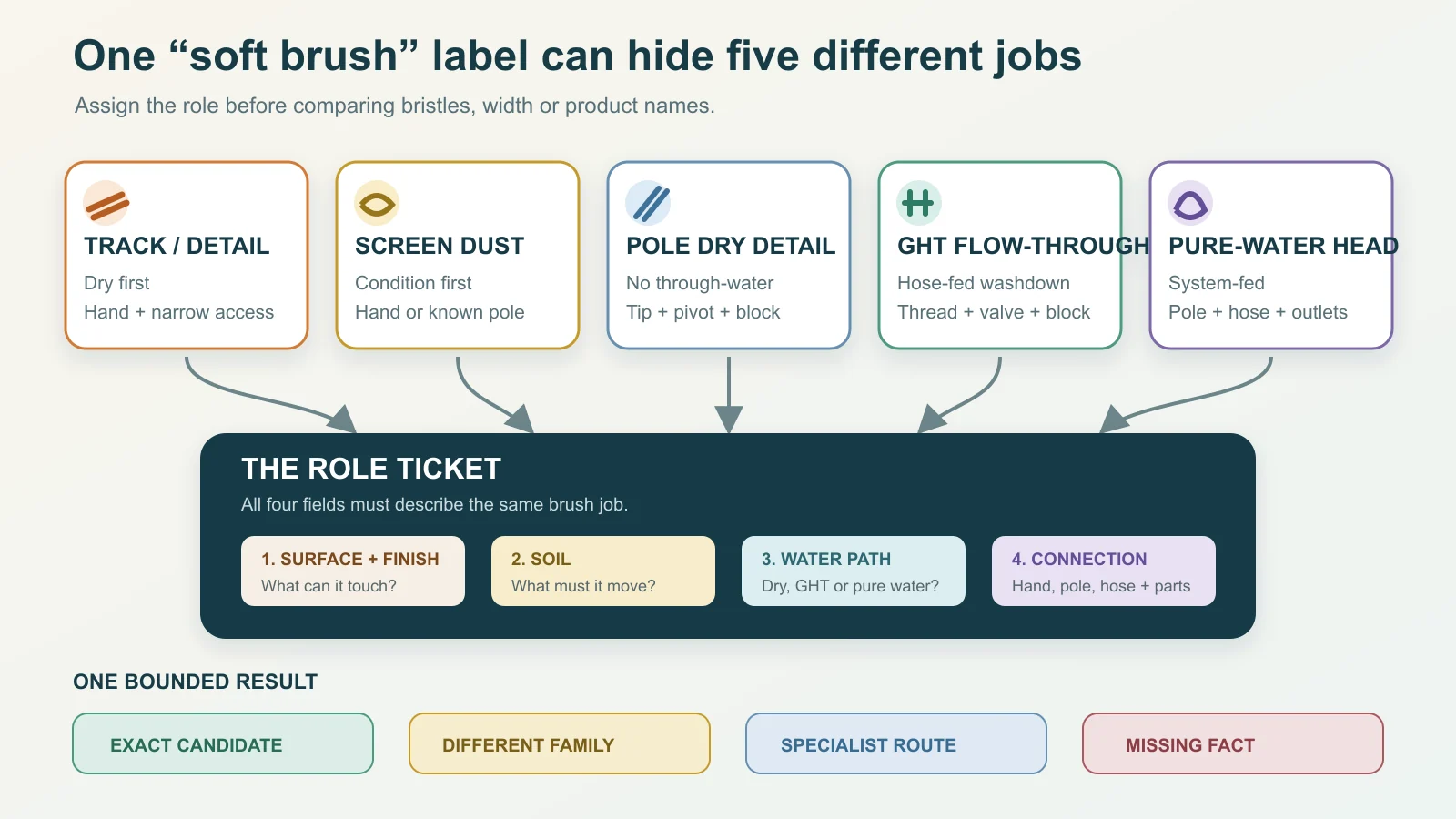
The picture is not a brush ranking. It shows why five shelf labels must pass through the same role ticket before one exact product can enter the cart.
Water delivery creates a second compatibility chain
A dry-detail brush has one physical chain: hand or pole tip to handle, pivot and brush block. A garden-hose brush adds thread size and gender, hose routing, shutoff and the installed window’s water limits. A pure-water head adds the pole generation, angle adapter, socket, small-bore tubing, branch fittings, jets or rinse bar and the filtration system’s working flow.
Current product pages show why the word brush cannot carry that information by itself.
| Current product record | Declared role | Connection and geometry | Water path | What still has to be proved |
|---|---|---|---|---|
| Ettore Cobweb Brush 48220 | Dry dust and cobweb work; the maker also names window screens | Threaded handle for a compatible extension pole | None through the brush | Exact pole interface, screen condition and permitted contact |
| Ettore Super Brush 1947 | Dry screen, frame, vent and high-detail work in current copy | Pivoting click-lock handle; REA-C-H/Pro+ route; 5 × 14.25 × 5 in; 1.3 lb | None through the brush | Exact pole or tip and the installed surface instruction |
| McMaster extended-reach configurations | Soft-bristled hand or pole blocks, with separate flow-through styles | Listed blocks and telescoping handles; some styles use 3/4 GHT female and a bumper | GHT flow-through on Style B; some rows add a flow-control valve | Exact listed configuration and permission for hose-fed washdown |
| Unger Radius NFR28 / NFR41 | Pure-water head for large glass, sills and ledges in current product copy | Flagged nylon; 11 or 16 in; published at 1.1 or 1.5 lb | Water-fed system connection | Pole, adapter and tubing fit plus the exact surface method |
| Unger current nLITE catalog families | Soft, power, radius and hybrid water-fed choices | Exact family, part, 11 or 16-in width, bristle and system hardware vary | Center jets and rinse-bar features vary by listed model | One complete variant rather than a family name |
The Ettore pages own the claims for their exact dry-detail products. McMaster owns the industrial configurations in its current table. Unger owns the named nLITE parts and features in its current product and catalog material. None of those records proves that another brand’s pole, hose or surface accepts the product.
This is where the dedicated water-fed pole brush guide takes over. It traces pole tip, adapter, socket, tubing and outlets for one exact head. Keeping that work separate prevents a broad brush page from turning “Euro thread,” “compatible” or “water-fed” into a universal fit claim.
Soft bristles do not make adjacent contact disappear
Softness is useful only inside a defined product and contact. A brush block can touch a frame before the bristles reach the glass. A pivoting head can sweep a seal. A rinse bar can carry water above the target. Soil trapped in a brush can move onto the next pane or screen. A bumper can reduce one exposed edge without removing every adjacent material from the path.
Treat wording on a retailer page as a product claim, not a building-wide permission. The current brush category usefully distinguishes track, screen and dust, pole and water-fed products, but it also shows how many surfaces and purposes can be grouped under one shelf label. Recover the exact product page and the current window or surface instructions before turning “multi-purpose,” “soft” or “safe” into a route rule.
The same discipline applies to aggressive language. “More scrubbing” or “stiff” cannot diagnose paint, adhesive, mineral deposit or construction debris. If the material is not ordinary soil admitted by the current care method, change the task rather than escalating the brush.
Put one exact product on each accepted role
Use one row for one brush on one recurring job. A building-wide line such as “soft brush for windows” is too broad to reorder and too vague to protect the next surface.
| Card field | Entry to record | Why it changes the purchase | Result if missing |
|---|---|---|---|
| Paid job and surface | Exact window, screen or product line, part, finish and contact area | Selects the care instruction and excludes look-alike surfaces | Leave the role unfilled |
| Soil | Loose dust or grit, cobweb, ordinary film or another identified material | Separates dry collection from a permitted wet or agitation route | Identify the material before changing bristles |
| Delivery mode | Dry, separately wetted, 3/4 GHT flow-through or pure-water | Determines whether the brush needs no plumbing, hose plumbing or pole-system plumbing | Do not compare water features |
| Reach and access | Hand use, exact pole, working angle, recess and usable width | Changes handle, pivot, block width and contact control | Measure the route |
| Connection chain | Handle or tip, thread or click-lock, adapter or socket, hose size and gender and fittings | Proves the selected product can be installed and fed | Recover every interface |
| Brush geometry | Exact part, block width and depth, bristle length, splay, pivot and published mass | Changes clearance, reach behavior and surrounding contact | Reject family-only listings |
| Materials and product claims | Bristle, block, bumper and the exact surfaces the maker names | Keeps “soft” or “non-scratch” attached to the right item and scope | Do not infer compatibility |
| Adjacent contact | Frame, seal, coating, mesh, drainage, glass edge and water or soil transfer path | Exposes materials or openings that can veto the proposal | Shrink or change the route |
| Care and service | Cleaning, drying, storage, replacement bristles or parts and current support path | Keeps the brush available for the same role on the next job | Confirm the maker’s method |
| Cart result | Exact candidate, different family, specialist route or missing-fact hold | Turns the record into one bounded buying action | No product enters the cart |
Four plain outcomes are sufficient.
Keep the exact candidate. The job, surface, soil, water mode, connection and complete contact path all agree with the current product record.
Choose a different brush family. The role is valid, but the proposed product has the wrong delivery mode, width, connection or contact claim.
Use the specialist route. Tracks, screens and pure-water heads need the narrower decision already documented for that task; the broad category page stops here.
Recover the missing fact. The surface, soil, connector or exact model is not known. Leave the line blank instead of buying the most versatile-sounding option.
A brush stays assigned after the job
A role is not finished at checkout. Record how the exact product is cleaned, dried and stored, and whether the bristles rest free or the maker names another position. Keep a dry screen or dust brush away from wet track soil. Keep a pure-water head’s hose and fittings with the system record. If a product has replaceable bristles or parts, record the exact service line rather than assuming a whole-brush replacement.
After use, write what changed: soil collected, contact completed, contamination found, connection loosened, bristle or block damage observed, or another method required. That observation does not become a universal service interval, but it tells the next operator whether the assigned brush is still available for its job.
Return the accepted line to the professional tool setup with a real label: exact brush, exact role, exact connection and exact care path. The set is complete when every brush can name the job it belongs to—not when every empty pocket in the bucket has been filled.