A spray can make one contact point feel slicker and still be the wrong repair. A vinyl sash may drag because grit remains in its channel, a tilt sash was not seated correctly after cleaning, a roller or balance is damaged, hardware is loose, or a part that the window maker actually names has become dry. Only the last branch starts a lubricant purchase.
Start with the exact manufacturer, product series and operating type. Clean and dry the track or hardware by the current care instructions, confirm that removable sashes are back in their operating position and record where resistance remains. If the manual then names a lubricant and a component, compare one exact product with that line. If it does not, the word vinyl is not permission to spray.
This decision belongs inside a broader professional window-cleaning tool setup, but lubricant is not a default item in every tote. It earns a place only when one documented window and one documented contact point require it.
A sticking sash is a symptom, not a lubricant order
The first useful observation is not “hard to open.” Record when the resistance begins, whether it is gritty or smooth, whether the sash sits square, whether it stays in position and what changed after loose debris was collected and the area dried.
| What remains after inspection? | First owner | What closes this branch? | Shopping result |
|---|---|---|---|
| Loose grit, paste or bonded soil is still in the travel path | Window-care and cleaning instruction | Finish the soil-first cleaning route without flooding drainage or hardware | No lubricant comparison yet |
| A tilt sash became difficult after washing or does not sit in its operating position | Exact unit manual | Reposition it exactly as that owner directs | Re-seat before buying anything |
| The sash is crooked, will not stay open, or a roller, balance, track, weatherstrip, screw or operator is loose, torn or damaged | Manufacturer or qualified repair owner | Identify and correct the mechanical fault | Lubricant cannot close the job |
| A clean, correctly seated unit has dry friction at a component the current manual names | Window owner plus exact lubricant owner | Match the named method, component and exact product | One lubricant candidate may enter comparison |
| The unit, component or instruction is unknown | Product label and manufacturer record still missing | Recover the identity or obtain owner guidance | Hold the bottle line blank |
The registered window-track cleaning route owns the dry collection, bonded-soil and drainage sequence. Complete that route first. New lubricant over old soil creates a new mixture; it does not prove that friction was the original cause.
Pella’s current owner manual illustrates why this split matters. For some named products, dirt on a vinyl jambliner or track can make a sash hard to operate. For other named hung products, difficulty after washing may come from the sash not being repositioned correctly. Those are different corrections even though both windows can be described as vinyl.
Find the friction line before you read the can
“Window track” is often used for every groove around an opening. The manufacturer may instead distinguish a jamb liner, sill track, weatherstrip, roller, pivot, balance, hinge, lock or operator. A product can be compatible with one material and still be misplaced on the unit.
Write the operating type beside the symptom. A horizontal slider, a hung sash, a casement and an awning window do not travel through the same components. Then trace the smallest proposed contact: the named moving surface, the applicator, any carrier or overspray, the glass edge, paint, gasket or flexible plastic nearby, and the cloth that will remove excess.
Flexible vinyl glazing is another object entirely. If the clear panel is an Eze-Breeze product, its dedicated vinyl-panel care route applies; a frame or hardware lubricant article does not authorize contact with the panel. The same separation applies to cloths: reserve a clean role-specific cloth for the owner-approved contact and closeout rather than moving track soil onto glass or weatherstripping.
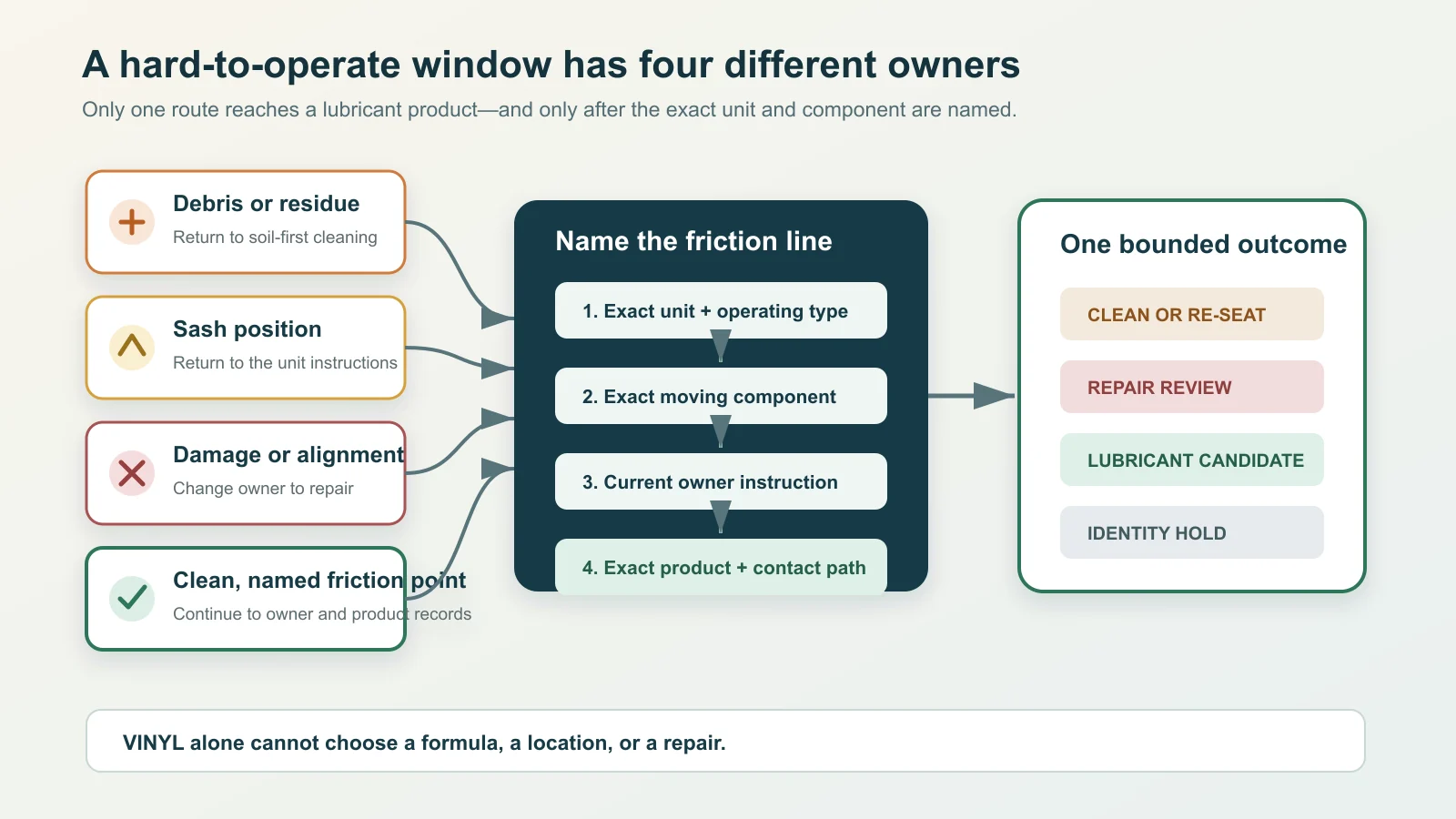
The useful drawing is therefore not a spray pattern. It is a path from symptom to component: debris returns to cleaning, a displaced sash returns to assembly instructions, visible damage changes to a repair owner, and only a clean owner-named friction point reaches product comparison.
The owner may prescribe wax, dry spray—or no lubricant at all
Current manufacturer documents do not support one material-wide formula.
| Current owner record | What it actually says | What it owns | What it does not release |
|---|---|---|---|
| Pella Owner’s Manual: named Reserve, Lifestyle and related hung-window cases | Clean dirt from the vinyl jambliner or track; a thin layer of paraffin or another dry lubricant may help; do not use oily lubricants | Those named products, liner or track and troubleshooting condition | Every Pella series, every vinyl surface or a generic silicone spray |
| Pella Owner’s Manual: named 250 Series, Encompass, 150 Series and ThermaStar hung products | A sash that is not correctly repositioned after washing may be hard to operate | Sash position on those named products | A lubrication diagnosis |
| Andersen article 000006902 | Inspect screws, remove debris, clean and dry the hardware, then use dry lubricant on the operator, lock mechanisms, hinges or other moving hardware; avoid lubricant containing acetone | Andersen hardware inside that article’s scope | Whole-frame spraying or a competing product chosen only by vinyl-safe wording |
| JELD-WEN Care & Maintenance for vinyl windows and patio doors | Clean hardware first; use silicone sprays cautiously and sparingly, avoid overspray and wipe excess; the document warns that silicone may make some hard plastic parts brittle | The named JELD-WEN maintenance scope | A universal rule that silicone is harmless to all vinyl-window components |
Andersen currently sells Dry Lubricant Spray part 2903608 and describes it as clean and non-oily. That is a useful exact identity when an Andersen instruction calls for it. It is not evidence that part 2903608 belongs on a Pella jambliner, an Eze-Breeze panel or an unidentified sliding window.
The difference is practical. “Use dry lubricant” still needs the exact unit and contact point. “Use paraffin” does not authorize an aerosol. “Silicone is safe for vinyl” does not overrule a manufacturer warning about hard plastic or overspray. A current unit instruction is the first product filter, not a footnote after checkout.
“Safe for vinyl” answers only one question
An exact lubricant has its own owner. Record the full product name and part or model, the current label, technical data sheet and safety data sheet, and the formulation or carrier those documents actually state. Then read the compatible and prohibited materials, application method, amount, drying or residue behavior, required controls and cleanup.
Do not turn a chemistry family into a product identity. A silicone aerosol, a PTFE suspension, a paraffin application and a proprietary dry spray can have different carriers, contact rules and overspray consequences. A retailer’s plastic-safe bullet proves only what that seller or manufacturer states for that exact item; it cannot locate the correct friction surface inside the window.
The contact path matters as much as the advertised substrate. If the proposed application can reach glazing, an exposed coating, paint, a gasket, weatherstrip, hard-plastic hardware or a drainage opening that the current documents do not admit, shrink the path or reject the product. If the exact label or safety sheet is missing, the product remains a category name.
Write the purchase line at the component level
Use one friction card for one window and one proposed product. Do not fill it once for a building or for “vinyl windows” as a class.
| Card field | Entry to record | Why it changes the decision | Result if missing |
|---|---|---|---|
| Unit | Manufacturer, series, label or order record and operating type | Selects the care and troubleshooting owner | Hold unit identity |
| Symptom | Direction, point and feel of resistance; whether the sash sits square and stays in position | Separates friction from balance, alignment or assembly problems | Observe without forcing |
| Clean and re-seat result | Soil removed, area dry and removable sash returned to the documented position | Prevents lubricant from masking dirt or incorrect assembly | Return to cleaning or unit instructions |
| Component | Exact track, liner, roller, weatherstrip, hinge, lock, operator or other part named by the owner | Defines where a product could be admitted | Hold component identity |
| Window method | Current instruction, permitted lubricant class or part, amount and prohibited contact | Creates the window side of the purchase line | Ask the manufacturer or repair owner |
| Exact product | Name, part or model, label, TDS, SDS and current formulation | Replaces silicone, PTFE or dry spray as a vague category | Do not compare or buy |
| Contact path | Applicator, target, adjacent materials, overspray, excess removal and drainage boundary | Exposes materials that can veto the proposal | Reject or redesign the path |
| Closeout | Agreed small area if the owner permits one, operating observation and any residue or change | Determines whether the maintenance route closes or changes owner | Stop; do not add dose |
Four outcomes are enough.
Clean or re-seat. Soil, residue or sash position owns the problem, so complete that instruction and reassess before introducing a product.
Hardware or alignment review. Damage, a failed balance or roller, a bent track, torn weatherstrip, a loose operator or a sash that will not sit correctly belongs to the manufacturer or repair owner.
Owner-named lubricant candidate. The exact unit document names the component and method, and one exact product admits the complete contact path. The record can now name the item worth buying without claiming that it will repair an unknown fault.
Hold identity or product. The manufacturer, series, component, current instruction or exact product documents are missing. The useful next action is to recover that one fact, not choose the most popular can.
If operation still fails, close the bottle and change owners
A permitted application that does not resolve the documented dry friction is not permission for more product, greater force or a second chemistry. Wipe and close out exactly as the product and window owners require, record the remaining resistance and move the unit to the manufacturer or repair path.
Keep the finished record with the broader professional equipment plan: exact window, exact component, exact method, exact product and one observed result. That makes the purchase repeatable without turning the bottle into a standing answer for every future unit.
The lubricant line is ready only when it can name the window, the moving part, the permitted method and the exact product. If it can name only vinyl and silicone, the decision has not reached the can.