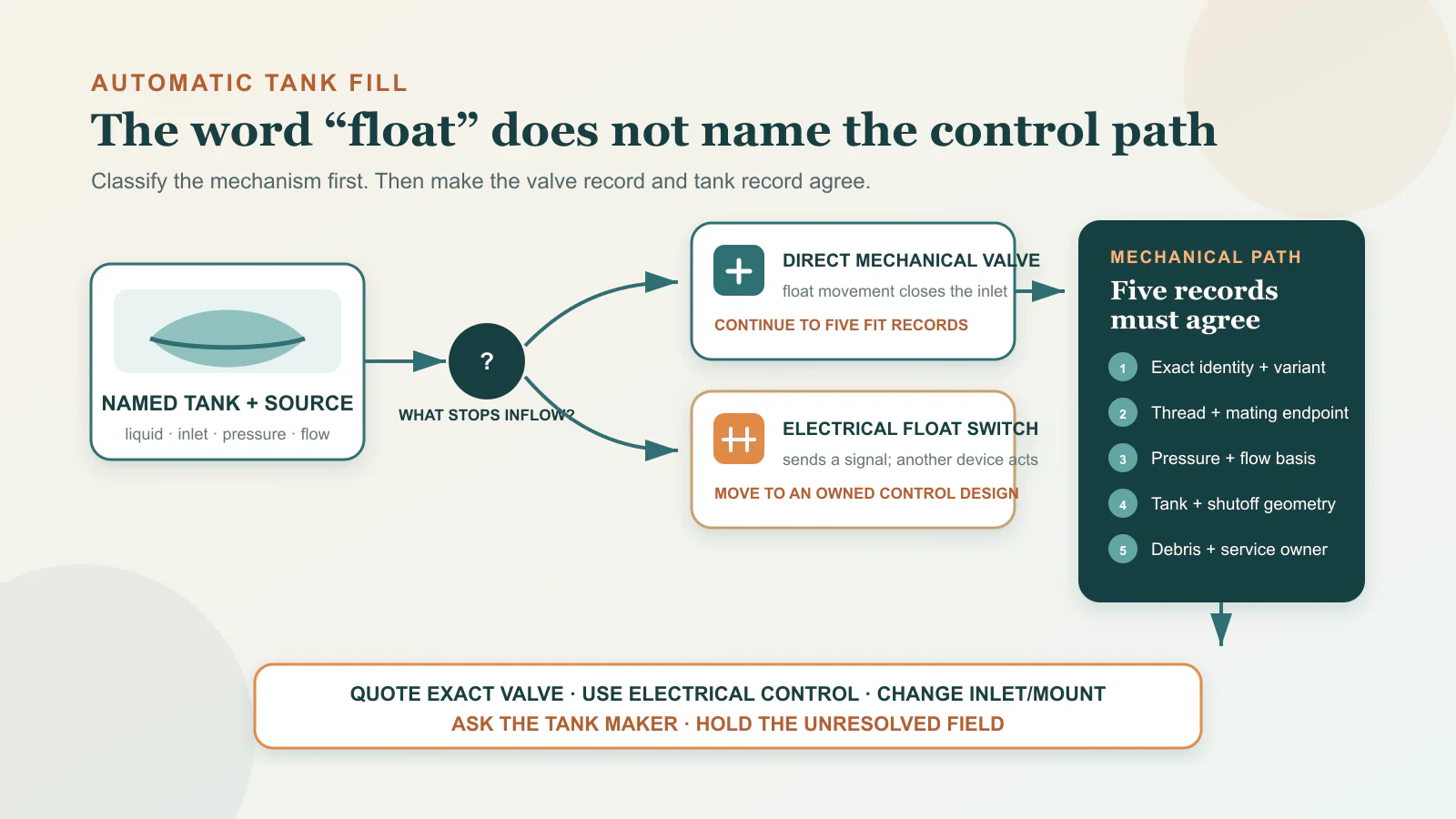
The word float changes jobs in the middle of the search results. One product uses buoyancy to close the incoming water mechanically. Another product is an electrical level switch: it changes a circuit state, but it still needs an owned relay, solenoid, controller or pump-control arrangement to stop the water.
Those are different purchases. Before comparing thread size or body material, write one line at the top of the quote: direct mechanical inlet valve or electrical level-control path. If the seller cannot tell you which one is in the cart, the cart is not ready.
A mechanical candidate still needs an exact model, source conditions and a tank record. The valve seller can describe the part. The tank manufacturer or responsible installer owns the opening, support, sealing, clearance and overflow plan. Neither record can replace the other.
The first split is mechanical versus electrical
A direct mechanical valve places the shutoff mechanism in the water path. The float moves with the water level and the valve closes the inlet according to that product’s design. It may need pressure and adequate incoming volume to work as specified, but it does not need an electrical level signal to tell a separate device to close.
An electrical float switch senses level and changes an electrical contact. J. Racenstein’s current 150-1355 listing, for example, publishes electrical power and switching-current values. That is enough to show that the product belongs in an electrical control design, not enough to select the rest of that design. The exact switch, relay or controller, actuated valve or pump, protection and wiring still need their own current owners.
| What the product does | What must appear on the quote | What sends the purchase elsewhere |
|---|---|---|
| Closes the inlet mechanically | Exact valve model, liquid, inlet, pressure/flow, mount, shutoff geometry and service path | Any missing valve or tank fact |
| Reports level electrically | Exact switch and complete owner-approved control chain | No relay/solenoid/controller design, or an unnamed electrical load |
This fill-control decision sits inside the complete water-fed pole system. Filtration selection, delivery-pump fit, pole flow and job demand remain separate from the tank’s automatic-fill quote.
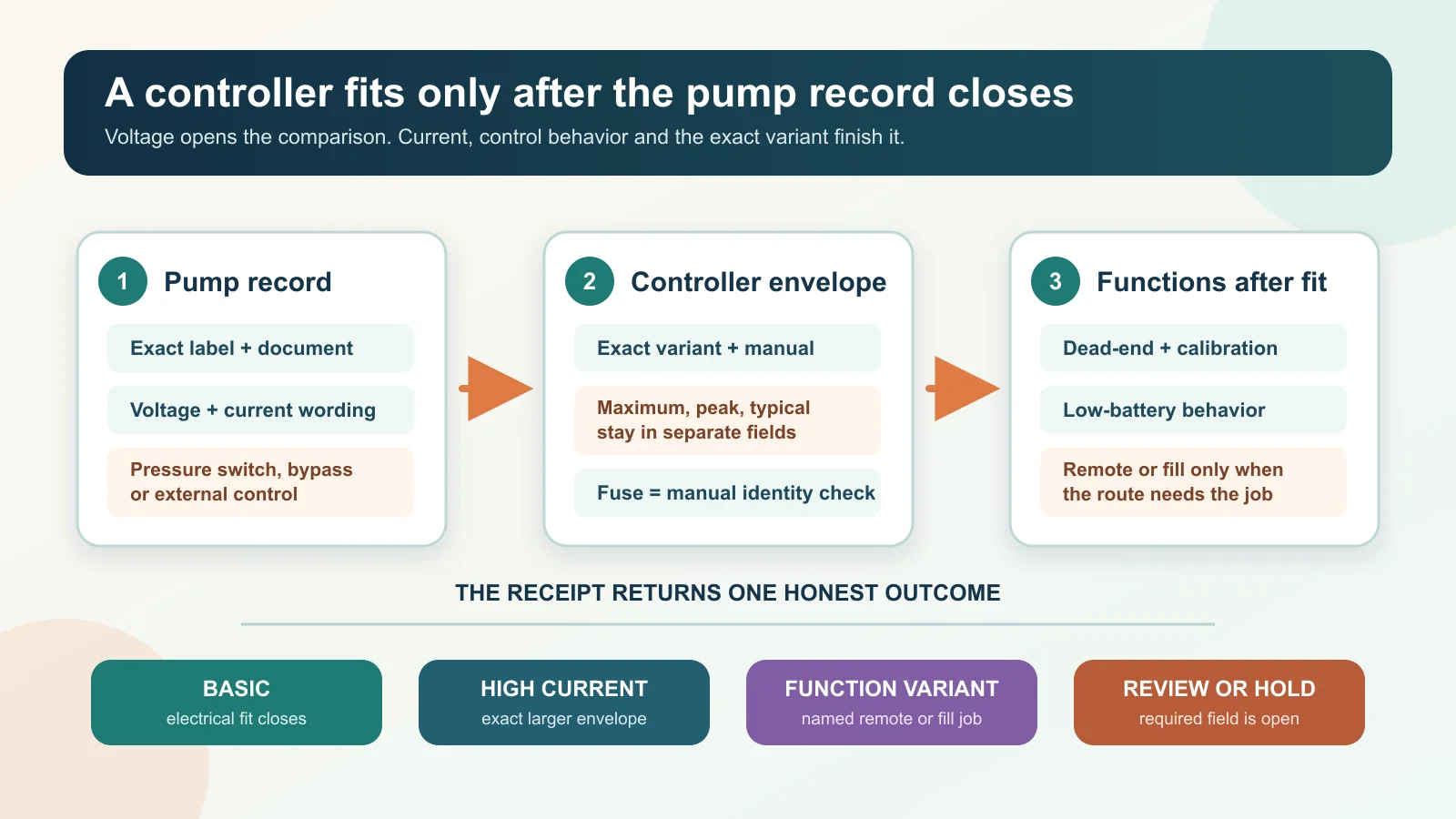
If the system needs an electrical path, keep the level device separate from the pump-control decision. The pump-controller guide shows why voltage alone cannot select a controller; this page does not add wiring or controller rules to a float-switch listing.
One live listing proves why the receipt matters
The current J. Racenstein page for the ProTool Water Level Hudson Valve gives a useful identity: seller SKU 150-1351 and MPN H4095012V. It also calls the connection 1/2-inch NPT female, lists a total length of 6 inches and puts 15 gpm in the product name and description.
Hudson’s current manufacturer specification presents the 1/2-inch valve differently. Its row shows a 1/2-inch female thread, a 5-inch height, a 3-inch diameter, an operating range of 4–100 psi and flow of approximately 80% of the flow supplied to the valve.
| Field | Current seller page | Current Hudson page | Purchase treatment |
|---|---|---|---|
| Identity | SKU 150-1351; MPN H4095012V | Current 1/2-inch valve row | Ask Hudson or the seller to bind the MPN to the current row |
| Inlet | 1/2-inch NPT female | 1/2-inch female | Confirm the complete thread standard and mating part |
| Body envelope | 6-inch total length | 5-inch height; 3-inch diameter | Do not choose tank clearance from either number until the exact revision is confirmed |
| Source pressure | Not the headline claim | 4–100 psi | Record the source at the valve, not the building’s nominal pressure |
| Flow | 15 gpm seller wording | About 80% of supplied flow | Installed gpm remains unproved |
This is not a reason to average five and six inches or to turn 15 gpm into 80%. It is a reason to send one precise question: Does H4095012V correspond to the current 1/2-inch Hudson row, and which current drawing and flow basis control the delivered unit?
Until that answer arrives, the valve may remain a candidate, but the tank opening and fill-time calculation should not be frozen around it. A seller identity is valuable because it makes the question exact. It is not permission to hide a conflict.
A thread match can still leave the wrong valve
The connection needs four entries: thread standard, nominal size, gender and the exact mating endpoint. “1/2 inch” fills only one of them.
J. Racenstein’s current 150-1353 page describes a 1/2-inch NPT male top-port valve made of plastic and limited by the seller to clean water. The current 150-134M page offers 1/2- and 3/4-inch stainless variants and states a 0.02–0.8 MPa pressure range, but it does not publish an exact flow row. The same page first says vertical mounting and later says vertical or horizontal. That orientation stays unresolved for the selected variant.
These products are not upgrade steps on one ladder. One may match the upstream fitting but lack the needed flow record. Another may offer a different material while leaving its exact wetted path or mounting direction open. Stainless wording does not establish drinking-water approval, and a plastic clean-water statement does not admit detergent or another liquid.
Use the garden-hose quick-connect fitting record when the incoming route crosses adapters, valves or quick-release families. It owns the connection chain; the float-valve receipt owns only the valve’s immediate inlet and the evidence that the source can operate it.
Pressure and flow also travel with the exact model and conditions. Hudson’s current troubleshooting guidance says a low-pressure source or a trickle may not let its valve open or close properly. That warning explains why a nominally matching thread cannot close the order. Record pressure and available flow at the proposed valve location, then compare them with the current manufacturer specification. Do not estimate valve flow from pipe size.
The tank owns the hole and the shutoff line
A shutoff valve determines more than whether the tank eventually stops filling. Its body has to fit inside the tank, remain in the permitted orientation and place the final water line where the tank and operating plan can accept it.
Hudson’s current troubleshooting page says its valve must be fixed and mounted vertically. It says the water shuts off roughly 1–2 inches above the bottom of the valve, with pressure affecting that position. Those statements belong to Hudson’s current family; they do not create geometry for 150-1353, 150-134M or a generic float valve.
Before a tank is altered, obtain the exact valve drawing and ask the tank owner to close:
- permitted location and opening;
- wall shape and thickness at that location;
- support and sealing method owned by the tank or installation authority;
- internal clearance through the full float movement;
- shutoff water line, usable volume and required headspace;
- overflow and applicable supply/backflow responsibility.
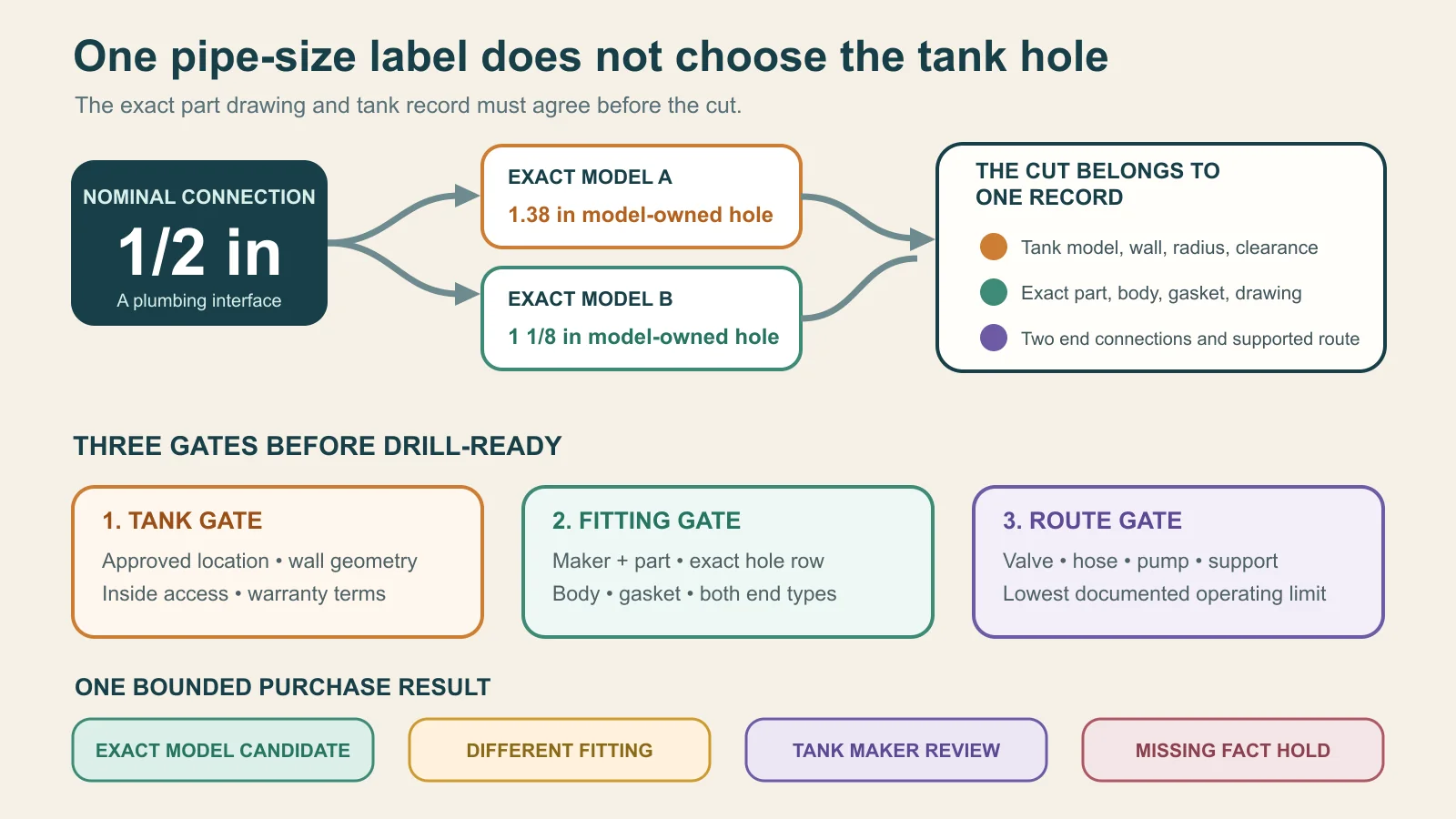
The PVC bulkhead fitting guide explains why a nominal plumbing size is not a tank-hole dimension. The 100-gallon water-tank guide owns tank use, support, route demand and vehicle load. A float-valve product photo cannot settle either question.
The illustration below keeps the two control paths separate and then brings a mechanical candidate through the five records that have to agree.
Debris belongs in the buying decision
Automatic does not mean maintenance-free. Hudson’s current maintenance page says cleaning frequency depends on the water source and gives a range of two to six cleanings per year for its valve. It identifies silt, rust, moss, algae and other debris as material that can clog small passages. The page also calls for checking the shutoff pad because damage there can prevent closure.
Keep that range attached to Hudson. It is not a universal interval for every float valve, and it does not predict service life in the proposed tank. The purchase question is narrower: Does the exact model have a current cleaning procedure, obtainable service parts and a source-water condition the owner is willing to maintain?
If the valve relies on small internal passages, include upstream debris control and inspection access in the tank plan. If the manufacturer supplies a repair kit, record the kit for that exact valve. If the seller cannot identify maintenance instructions or service parts, the cheaper cart may create a replace-on-failure dependency that belongs in the quote.
For Hudson specifically, the current manufacturer support says repair kits contain the internal filter, diaphragm, retainer ring and float. That fact helps evaluate serviceability. It does not authorize repair work on another valve or promise that a clogged or damaged installed unit can always be restored.
Send one complete specification request
Put the valve seller and the tank owner on separate columns. The order is ready only when their answers describe the same physical installation.
| Required record | Seller or manufacturer supplies | Tank/system owner supplies |
|---|---|---|
| Control path | Direct mechanical valve or exact electrical switch | Complete electrical design if the switch path is chosen |
| Product identity | Manufacturer, model, seller SKU, selected variant, current drawing | Delivered-unit match |
| Water interface | Liquid scope, wetted materials, inlet standard/size/gender, pressure and flow basis | Source measurement and exact mating endpoint |
| Geometry | Permitted orientation, body envelope and shutoff reference | Opening permission, wall/support/seal, clearance, water line and headspace |
| Service | Cleaning/inspection instructions and exact service parts | Access, debris control and maintenance owner |
| Safeguards | Product limits | Overflow and applicable supply/backflow authority |
Send this with the quote request:
Quote the exact automatic-fill product for the named tank. State whether it is a direct mechanical inlet valve or an electrical level switch. Return the manufacturer, model, seller SKU, selected size, current drawing, liquid and wetted-material scope, inlet thread standard/size/gender, operating-pressure range, flow with its test basis, permitted mounting orientation, body envelope, shutoff-level reference, maintenance instructions and service parts. Do not substitute a different mechanism or variant. The tank owner will approve the opening, support, sealing, clearance, water line, overflow and applicable supply requirements separately.
A complete answer supports an exact mechanical-valve quote. An electrical switch moves the work to an owned electrical-control path. A failed thread, pressure or mounting row means a different inlet or valve. Missing tank authority goes to the tank manufacturer or responsible installer. A seller/manufacturer conflict with no current resolution stops the order at that exact field—without turning the rest of the research into guesswork.