A water-fed pole can carry an impressive length in its product name and still be wrong for the work. The number may describe the pole itself, an advertised reach assumption or a maximum configuration that is awkward to transport and difficult to control on the jobs you repeat.
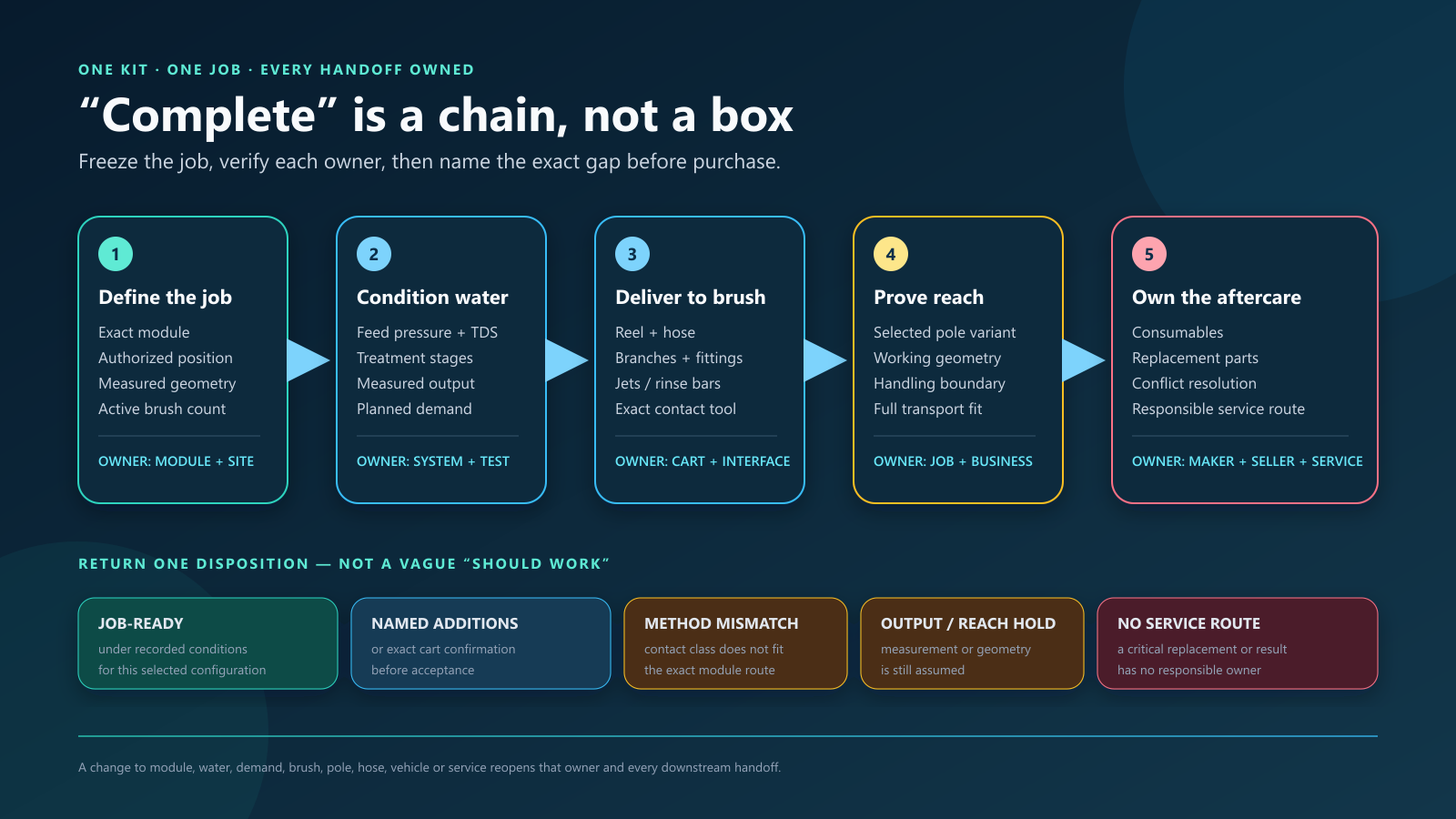
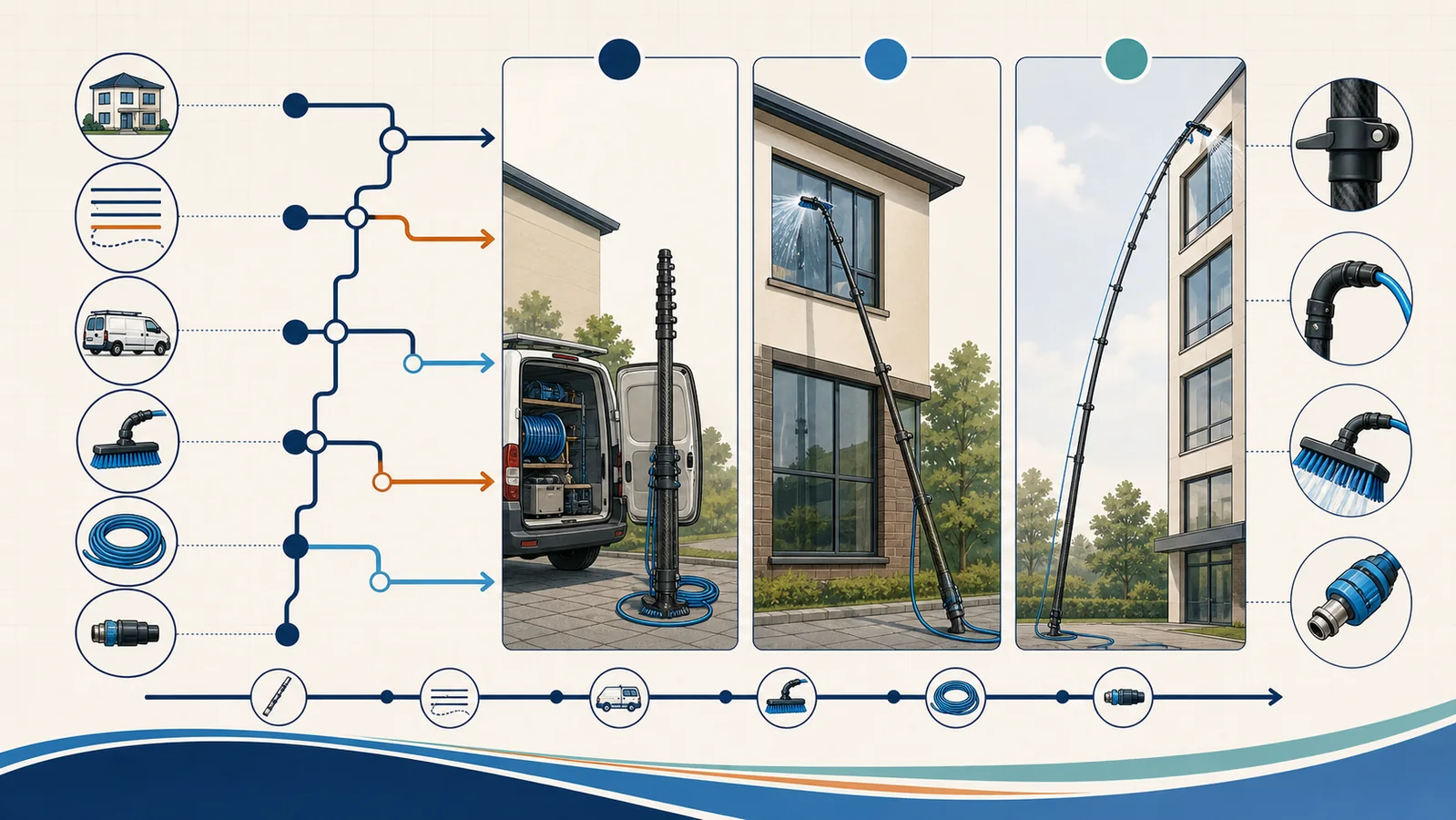
Choose from the job backward. Record the highest glass, horizontal setback, usable standing area and transport limit. Then compare the complete working assembly: pole, sections, clamps, gooseneck, brush, hose and fittings. A candidate belongs on the shortlist only when the manufacturer documents the configuration you intend to use.
A 30-foot pole is not a 30-foot decision
Keep three measurements separate. Extended pole length is the physical pole in a defined configuration. Working reach is the glass an operator can reach from a real standing position. Working height is a manufacturer’s planning term and may include an allowance that differs between ranges. Never add operator height twice or transfer one brand’s convention to another.
The highest pane is only the first input. A deep porch, planted bed or roofline can move the operator away from the wall and increase the required pole angle. That adds distance while changing brush pressure and control. Conversely, a clear approach can make a shorter, stiffer configuration more useful than a longer pole extended to its limit.
The intended method also needs a boundary. Water-fed work from the ground does not make every facade suitable. Overhead lines, people or vehicles in the hose route, unstable standing areas and work beyond the operator’s competence can change the access method. OSHA’s IWCA alliance resources and current manufacturer safety guidance are starting references, not approval for a particular site.
Turn the job into a reach envelope
Build the envelope from a repeated job, not the rarest building you might accept one day:
- Record the highest glass and the lowest point from which the brush must work.
- Measure the horizontal setback created by porches, landscaping, signs or restricted ground.
- Mark the standing zone that remains usable after allowing for doors, pedestrians, vehicles and the hose route.
- Note the brush angle needed at the top and bottom of the pane.
- Record the largest collapsed assembly that fits the vehicle, rack, doorway and storage routine.
Do not convert those numbers into a pole length with a universal formula. Use them to ask each manufacturer how its named length and working-height guidance apply to that geometry. If the answer depends on an undocumented operator-height allowance or a configuration not shown in the current range, keep the field open.
The output should be a range rather than a boast: the shortest configuration that covers most paid work with useful control, plus a clearly documented extension path for occasional higher jobs. If the extension path changes the material, base diameter, brush control or permitted setup, treat it as another configuration.
Let material follow the highest repeated work
Material matters because a long pole is also a lever. Mass, stiffness and diameter affect how precisely the brush can be placed and how much movement the operator must correct. Those effects increase as the pole extends, but a material name alone does not quantify them.
Hybrid or composite constructions can make sense where moderate reach, vehicle knocks and purchase cost dominate. Carbon constructions usually target lower mass or greater stiffness at longer working configurations. High-modulus labels describe a material class, not a guarantee that every pole with the label handles the same way.
Unger’s current nLite material explains how its pole form, contact surfaces and anti-twist design are intended to improve control. Its current catalog also publishes range-specific configurations and accessories. Use those documents for the named nLite products only. Another range may use different layups, section diameters, clamps and working-height definitions.
The practical question is therefore not “Is carbon better?” It is “What is the lightest, stiffest documented configuration that covers the highest work I repeat without breaking the transport and budget limits?” Occasional edge cases should not force every daily job through the longest and most expensive configuration.
Compare the whole pole, not the tube
Copy this matrix once for every exact candidate. Do not let a blank become an assumed match.
| Field | Record for the candidate | Evidence that closes it | Hold when |
|---|---|---|---|
| Length convention | Extended pole length and stated working height or reach | Current model page or manual defining both | The catalog number is the only measurement |
| Repeated-job fit | Highest glass, setback and usable standing zone covered | Real job dimensions plus manufacturer guidance | Reach depends on an unsafe or unavailable position |
| Material and control | Construction, stated stiffness information and intended configuration | Exact range documentation | Only a generic carbon or hybrid label is available |
| Sections and clamps | Sections, extension order, clamp adjustment and stop marks | Matching instructions | An added section has no documented limit or connection |
| Complete assembly | Pole, gooseneck, brush, hose and fittings included or selected | Component list and interface documents | “Complete” does not name the brush-end parts |
| Transport | Collapsed length and complete stored dimensions | Manufacturer dimensions plus vehicle measurement | The rig will not fit or cannot be secured |
| Service | Clamp parts, hose, brush, jets and replacement sections | Current parts path | A routine wear item has no source |
A candidate is ready to compare when the job envelope and every controlling field have a current source. It is on hold when one missing definition or interface could change the choice. It needs a different access path when the intended work cannot be reconciled with the ground position, route or current safety requirements.
Build the brush-end connection before checkout
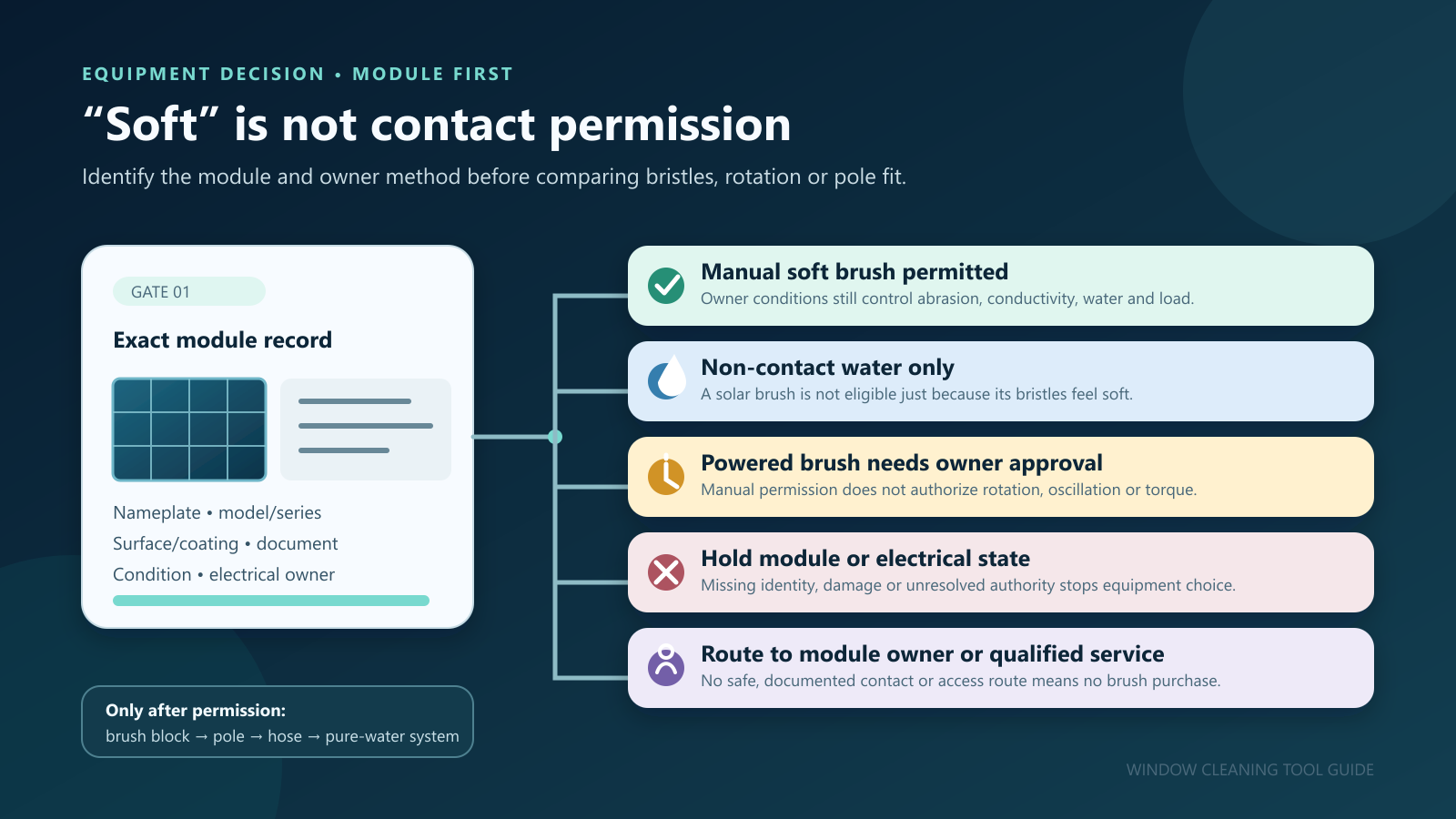
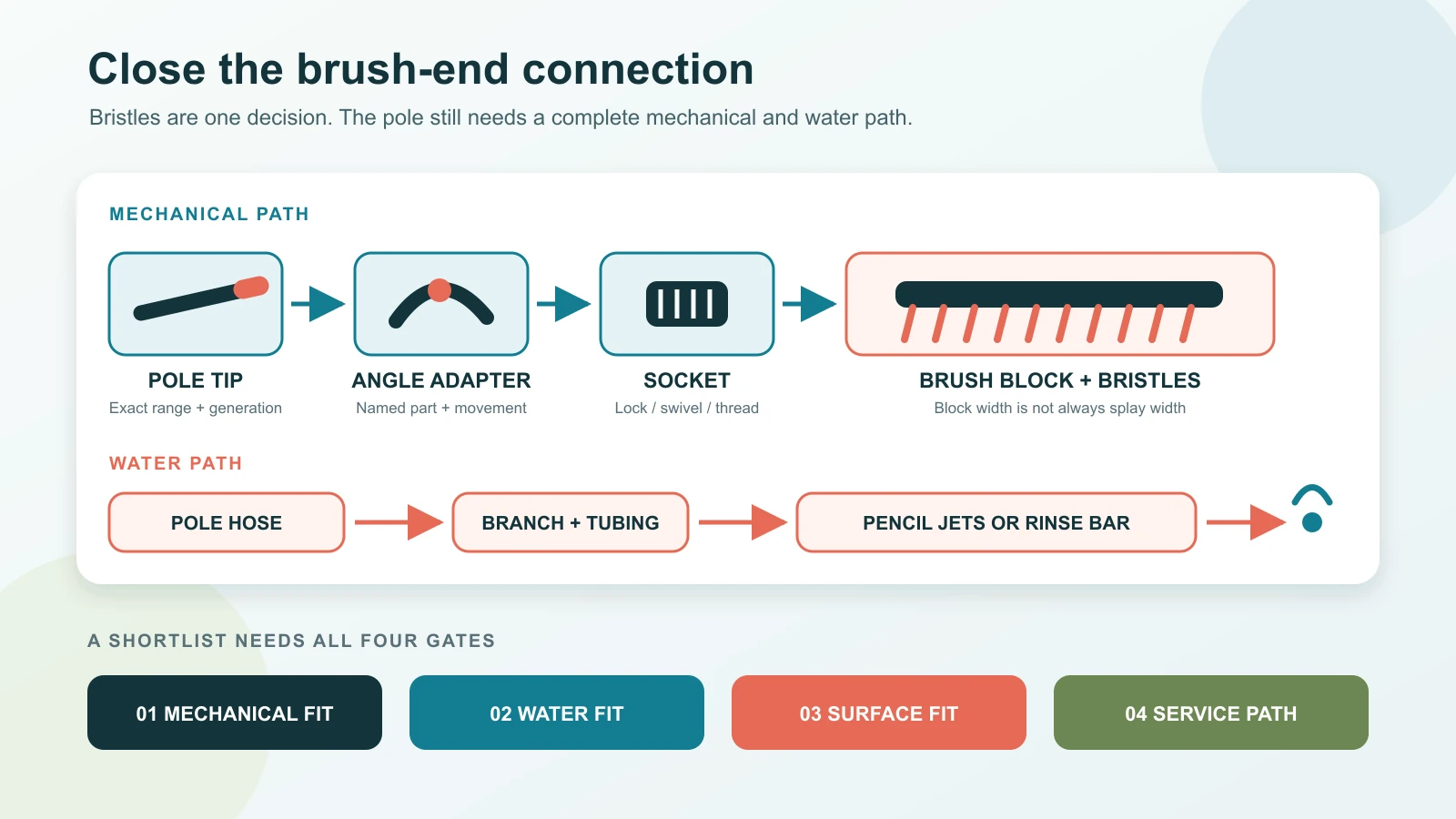
The brush is where pole selection becomes system selection. Freeze the connection path in order: pole tip or cone, gooseneck or angle adapter, brush thread or quick connection, jet type, pole hose and the fitting that joins the delivery hose.
Manufacturer catalogs show why “universal” deserves proof. Unger lists named adapters and accessories for specific nLite configurations. A compatible thread does not automatically establish hose diameter, jet arrangement, shutoff, angle range or the water output available at the brush.
Record whether the brush, gooseneck and hose are included. If they are optional, write the exact part identities. Check that the brush can reach the required lower and upper frame angles without placing the pole in an uncontrolled position. For a longer hose run or multiple-pole system, return to the complete filtration and delivery path in the water-fed pole system guide rather than assuming the pole can correct low brush-end output.
Make transport and service part of the shortlist
Measure the vehicle before choosing the pole. Use the narrowest door or rack path, not the longest empty cabin dimension. Allow for the attached brush or protective case if that is how the rig will actually travel. A pole that must be forced diagonally through the vehicle every day has a real operating cost even when the glass is within reach.
Ask how sections are cleaned, dried and inspected, how clamp tension is adjusted and which parts can be replaced separately. Dust or grit at telescoping surfaces, damaged hose and worn clamps change the working assembly. Follow the current instructions for the chosen range; do not import a maintenance routine from a different construction.
Keep one lower-work configuration available when the pole is modular. Removing unnecessary length can reduce mass and make brush placement easier, but only if the manufacturer permits that section arrangement. Record the shortest and longest approved configurations you expect to use.
Write one purchase specification
Finish with a sentence a supplier can answer without guessing:
I need a pole for glass up to [measured height] from a standing zone [setback or obstruction], normally used [frequency], with a collapsed assembly no longer than [vehicle limit]. Quote the exact pole configuration, material, sections, complete mass if published, gooseneck, brush, jets, hose and connection to [documented delivery setup], plus the current replacement-parts path.
Attach the job measurements and mark any missing model field as unresolved. The Water-Fed Poles library will hold the narrower length, material and brush decisions as they are published. Until then, the useful shortlist is the one with fewer assumptions—not the one with the biggest reach label.