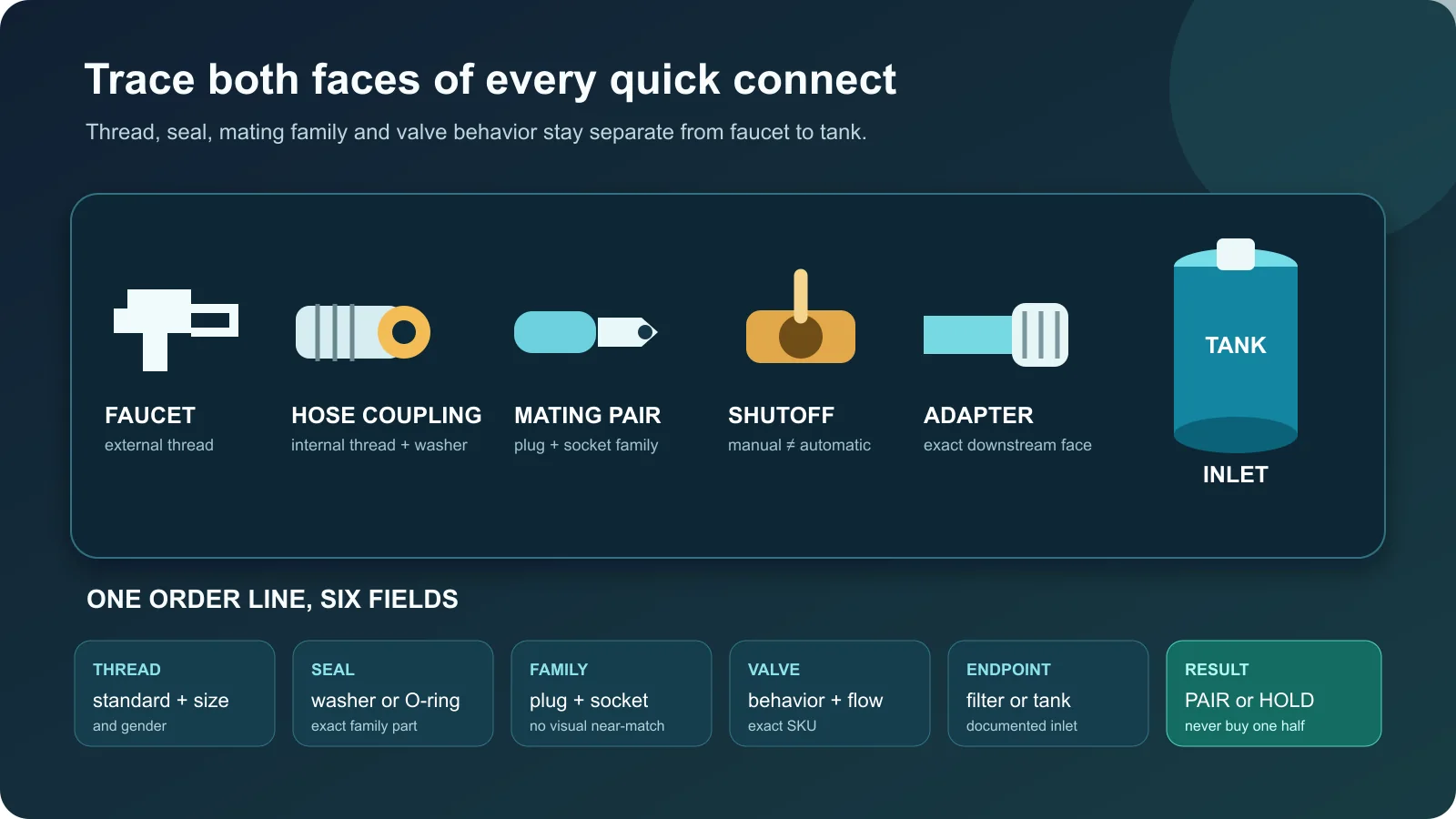
The brass piece in your hand may screw onto the hose and still be useless at the tank. The threaded face can be correct while the quick-release face belongs to another family. A set can include a valve but omit the mating half already fitted to the filter. Two parts can both say 3/4 inch and still name different thread standards or seals.
Build the order from the water path, not from a product photo. At each junction record the upstream object, thread standard, size, gender and seal. Then record the quick-connect family, each mating half, release method and whether the component actually controls water. Finish with the exact filter or tank inlet.
If one field is missing, buy the missing adapter, mating half or service seal—or hold the order. A useful result is order the exact chain, add a thread adapter, add the mating coupler, add the correct seal, hold the connector family, or hold an unresolved specification.
Draw the line as six connection faces
Begin at the faucet and draw water moving toward the purification equipment. The first face is normally the faucet’s externally threaded nipple. The second is the internally threaded coupling on the supply hose, including its seal. The hose’s other end creates a third threaded face. A valve or hose-end adapter creates the fourth. The plug and socket or bayonet pair creates the fifth. The final face is the documented inlet on the filter or DI tank.
“Quick connect” describes only part of that chain. The hose can attach by thread while the tool changes by collar, bayonet or push-to-fit. Write each mechanism on a separate line. If the product page calls something a connector but never identifies its mate, the order is incomplete.
Two quick-connect families can exist in one route only when each remains inside its own documented pair and a fully specified transition joins the pairs.
| Connection face | Record before ordering | Missing-field result |
|---|---|---|
| Faucet or hose bib | External endpoint, thread standard, nominal size and condition | Hold the thread adapter |
| Supply-hose inlet | Internal thread, face washer or other exact seal | Add the exact seal or verify the thread |
| Supply-hose outlet | Thread standard, size and gender on the route end | Add a documented adapter |
| Valve or hose-end body | Passive coupling, manual shutoff, automatic water-stop or external valve | Hold valve behavior and flow direction |
| Quick-connect pair | Exact family, plug model, socket model and release action | Add the mating half or hold the family |
| Filter or tank inlet | Exact receiving port and lowest documented component pressure | Hold the downstream specification |
This page begins after the water-fed pole system guide has chosen the water path. It does not decide DI versus RO/DI or the pole itself. Its job is narrower: make the physical source-to-system line orderable.
The number 3/4 does not name the thread
ASME B1.20.7 covers threaded hose couplings, valves, nozzles and fittings. Its public summary describes the normal flow sequence as an externally threaded nipple entering an internally threaded coupling. That gives two fields—gender and direction—but an exact product still has to state the thread standard and seal.
Parker’s current hose guide lists Garden Hose Thread as a washer-sealed connection and separates it from pipe-thread families. A face washer and a tapered pipe thread do not create a seal in the same way. “3/4 inch” is a nominal size, not permission to join GHT, NPT, NPSH, BSP or an unnamed thread.
When a manufacturer says only “standard household garden hose,” preserve that wording but keep standard, gender and seal open. When a page explicitly states 3/4-inch GHT, record GHT and the exact washer or O-ring family. When two current documents for one product use different thread language, do not pick the convenient label. Verify the exact counterpart or use a documented adapter.
The release mechanism has its own family
Current products make the difference visible. This is not a ranking: each row shows what the named product closes and what remains unresolved.
| Exact product | Declared endpoint and mechanism | Fields closed | Keep open |
|---|---|---|---|
| Ettore 9038 | Standard household garden hose → AquaClean EZ1PRO+; single-press release | Equipment family, endpoint, brass, release action | Exact hose thread standard, gender, seal and pressure |
| Hoselink US2260WG | Four-part point-and-twist set with manual flow control | Included pieces, nylon, 3/4-in hose fitting, 1-in/3/4-in tap reducer, 550-psi component maximum | Exact counterpart where current product and FAQ thread wording must be reconciled |
| Gorilla QCBVF-1M | 3/4-in GHT threaded end → Gorilla family quick connect through quarter-turn valve | GHT, family, valve, brass, 200-psi test and exact O-ring dimensions | Required mating-half SKU and correct flow-direction variant |
| XERO 209-24-703-XP | 10 mm XERO High Flow Hose → on/off valve via push-to-fit reducer | Hose family, 10 mm size, reducer and release action | Valve SKU; hose and valve are not included |
The Gorilla manufacturer support page is unusually direct: its current quick-connects use 3/4-inch GHT, cross-brand mating is generally not supported, and replacement washers and O-rings belong to the family. That is the right evidence pattern—threaded face, mating face and service seal each receive their own line.
A shutoff is a separate function
A coupling releases two parts. A valve controls water. Those functions may share one body, but they are not synonyms.
The Ettore coupling instructs the operator to turn on the water supply separately, so the coupling is not the water-control decision. The XERO fitting attaches to an on/off valve, which remains another component. The Hoselink set includes a manual lever at the hose end. The Gorilla product integrates a ball valve and is offered in flow-direction variants. The exact SKU and direction must match the planned water path.
Do not assume a collar stops water when disconnected. Some families sell a separate water-stop or shutoff component; others are passive. Write none, manual shutoff, automatic water-stop or external valve from the exact source. If the page does not say, record unknown.
Pressure works the same way. A 550-psi or 200-psi connector declaration applies to that exact component under its manufacturer’s conditions. It does not raise the rating of the hose, reducer, filter head or tank inlet. The assembled line cannot be treated as having a higher ceiling than its weakest documented component.
A leak points to one boundary
Before replacing a connector, identify where water appears after the supply is off and pressure is relieved according to the equipment instructions.
| Observed boundary | Verify first | Do not substitute |
|---|---|---|
| Threaded hose face | Thread standard, gender, face washer and damaged threads | Extra torque or tape for the wrong standard |
| Plug-to-socket face | Exact mating family, collar condition and family O-ring | A visually similar cross-brand half |
| Valve stem or body | Exact valve SKU, direction and manufacturer service instruction | A generic quick-connect seal |
| Filter or tank port | Receiving port, adapter and equipment-head instruction | A hose-end repair without locating the actual leak |
More torque cannot convert the wrong thread standard, and PTFE tape cannot replace a missing face washer. A random O-ring with similar diameter is not an exact service part. Gorilla, for example, publishes an O-ring size for its current product and sells family washers; that record does not transfer to Ettore, Hoselink or XERO.
The correct result may be ADD_SEAL_SERVICE_PART, ADD_THREAD_ADAPTER or HOLD_CONNECTOR_FAMILY. Do not disconnect or diagnose a live pressurized line, and do not reuse a damaged fitting merely because it can still be forced together.
Write the order as paired halves
The finished purchase line should be readable without a product photo:
faucet — thread standard/size/gender — face seal — hose coupling — supply hose — valve behavior and flow direction — quick-connect family — plug model + socket model — release method — downstream thread/adapter — exact filter or tank inlet — lowest documented component pressure — spare washer/O-ring — date
The complete pure-water system remains in the system guide. If the line ends at a DI vessel, copy its documented inlet from the deionized water tank order record rather than assuming the two included fittings reveal port direction. If the connection continues to pole hose, the water-fed pole guide owns the downstream equipment choice.
Return ORDER_EXACT_CHAIN only when every field is closed on exact current models. Use ADD_MATING_COUPLER when only one half is present, ADD_THREAD_ADAPTER when standards or genders require a documented bridge, and ADD_SEAL_SERVICE_PART when the correct family seal is missing. If the family or endpoint cannot be proved, the order line ends in HOLD.