Write this line before comparing reels:
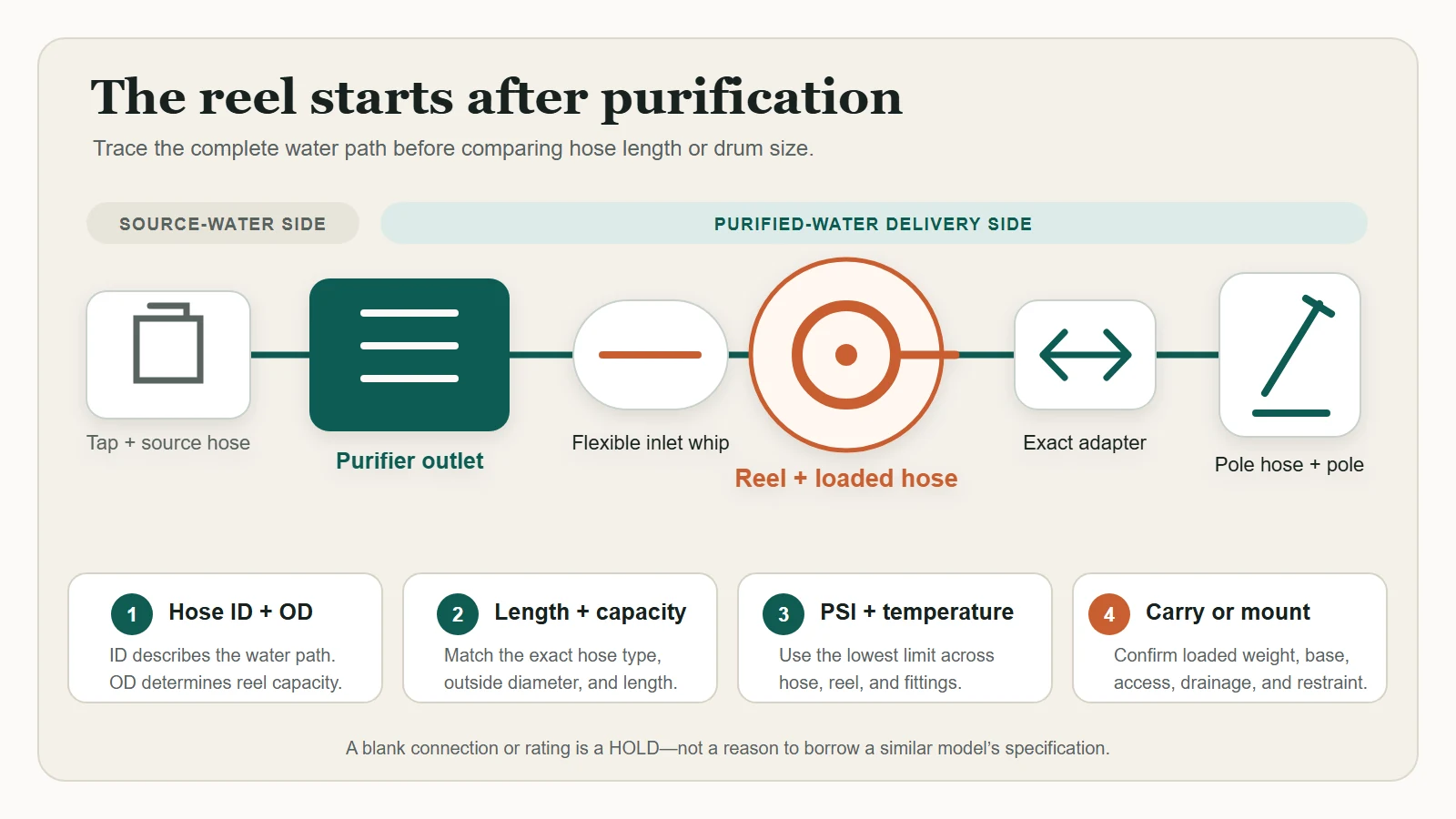
purification-system outlet → flexible inlet whip → reel swivel → loaded reel hose → outlet fitting → pole-hose adapter → water-fed pole
That order matters. XERO’s current hose-reel guidance places its HD 150 and Portable reels after the purification system and before the pole hose. It specifically separates that run from the wider source-water hose feeding the purifier. A reel advertised for 150 or 250 feet does not close either end of the line, prove that your actual hose fits the drum, or tell you where the loaded assembly belongs.
A reel is ready to buy only when every arrow has a named mating connection, the capacity applies to the actual hose outside diameter and length, the hose and reel stay inside their pressure and temperature ratings, and the portable or mounted position is workable at full weight. Leave one field blank and the honest result is to verify, change the assembly, or hold the order.
One reel has seven connection faces
Start at the outlet of the exact DI or RO/DI system. Do not start with a reel photo. The complete path has seven places where a plausible-looking purchase can stop the water.
| Position in the path | Record from the current owner or label | What an empty field means |
|---|---|---|
| Purification outlet | System model, outlet thread or coupler, gender, maximum permitted pressure | The reel cannot yet be connected to the named system |
| Inlet whip | Exact hose type, length, fitting at each end and working rating | Add the documented whip; do not substitute rigid pipe at a swivel |
| Reel inlet and swivel | Reel model, inlet size/standard, swivel material and rating | Hold the reel identity or rating |
| Loaded reel hose | Hose type, ID, OD, length, working pressure and temperature | The capacity and operating limit are not established |
| Reel outlet | Thread or installed fitting, size, gender and seal | Add the exact mating part |
| Pole-hose transition | Adapter or quick-connect family, both halves and any shutoff behavior | The reel hose and pole hose do not yet form one line |
| Pole hose and brush | Exact hose OD or push-fit size, valve and downstream connection | Return to the pole owner before ordering the transition |
The water-fed pole system guide owns the larger filtration and delivery architecture. This page begins after that system is named. If a plug and socket, GHT face or seal is unresolved, use the garden-hose quick-connect route to identify both halves instead of writing “standard fitting.”
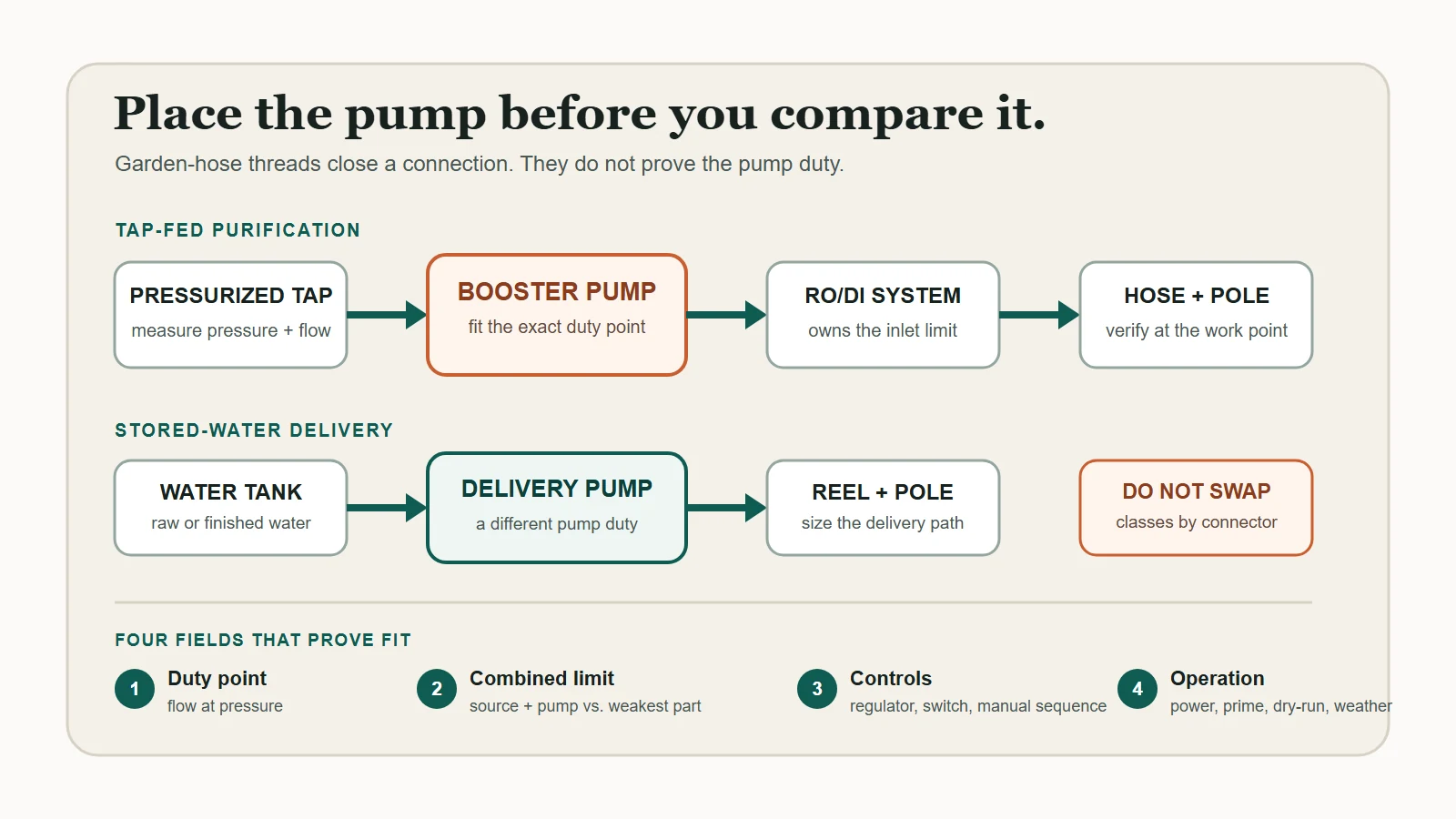
The source side deserves a separate line. A garden-hose booster pump may sit between a tap and a purification system when the exact owner permits it. That does not turn the post-filtration reel hose into a source hose. XERO’s current hose-reel guidance warns that putting its water-fed reel before the purifier can restrict the inlet and reduce output; it calls for a thicker, wider garden hose on that side.
The product name hides three different assemblies
Current products show why “water-fed hose reel” is not a complete specification. This is not a ranking. Each row records what the named page establishes and what still has to be closed for your route.
| Current assembly | What the page establishes | What remains open before purchase |
|---|---|---|
| XERO HD 150 Reel | Loaded with 150 ft of 3/8-in-ID hose; steel frame; brass and steel fittings; short whip; rubber feet for free-standing use or holes for mounting | Exact end-fitting standard and gender, hose OD, working pressure and temperature, loaded weight, mounting hardware and the pole-hose transition |
| Tucker Hand Carry Hose Reel, SKU 70009-150 | 150 ft of 3/8-in-ID hose; 3/4-in brass garden-hose inlet and outlet; powder-coated steel and machined aluminum; braking system; optional mounting base | Hose OD, pressure and temperature ratings, dimensions, loaded weight, the exact system outlet and the 3/4-in-to-pole-hose transition |
| XERO Portable Hose Reel, 150- or 250-ft listing | 3/8-in ID and 5/8-in OD hose; up to 300 PSI; three-foot inlet whip with female garden-hose fitting; male garden-hose fitting at the other end; listed dimensions for both lengths | Confirm the exact SKU, included counterpart and loaded weight. The same current page says 30 lb for the 150-ft unit in its table but 45 lb in its Q&A |
That weight conflict changes a real decision. Thirty and forty-five pounds are not interchangeable when a reel must be lifted out of a vehicle repeatedly or secured to a shelf. The page supplies enough evidence to identify the conflict, not enough to choose the convenient number. Ask the seller to confirm the current loaded weight for the exact SKU and keep the transport plan on hold until it does.
The comparison also prevents borrowed specifications. Tucker’s 3/4-in inlet and outlet belong to Tucker SKU 70009-150. The WCR pressure and OD figures belong to the listed XERO Portable assembly. XERO’s official HD 150 page does not inherit either set merely because all three carry 150 ft of 3/8-in-ID hose.
Capacity follows hose OD and length
Hose ID describes the water passage. Reel capacity depends on the space occupied by the wound hose, so OD and length matter directly. Hose construction and flexibility also affect how it winds and operates.
The COXREELS 100W hand-crank manual tells users not to install a different hose from the one intended for the reel. It says changes in diameter, weight per foot, length or minimum bend radius can affect operation. It also states that variations in hose OD affect capacity, and its troubleshooting section names excessive length or OD as reasons a hose will not fit the drum.
“Holds 200 ft” is therefore incomplete unless the reel owner states the hose size and type used for that capacity. A preloaded assembly can close the drum-and-hose relationship for the supplied configuration. A bare reel plus a replacement hose requires a fresh match.
| Capacity and rating field | Acceptable evidence | Purchase result |
|---|---|---|
| Reel model and label | Exact model/SKU and current manual or label | Continue only on that model |
| Hose identity | Exact type plus ID, OD, length and construction | Use the owner’s capacity row for that hose; otherwise verify with the manufacturer |
| Pressure ceiling | Reel maximum, swivel/plumbing maximum, hose working pressure and every connected component | Use the lowest documented limit; never raise it by averaging |
| Temperature range | Exact reel/swivel/seal and hose ranges | Planned water and storage conditions must remain inside all ranges |
| Inlet hose | Flexible whip of the exact size and connection | Add it if omitted; do not side-load the swivel with rigid plumbing |
| Fully loaded condition | Hose installed as the owner directs, with room for an even wrap | Change hose or reel if the specified length/OD cannot fit |
Pressure receives the same treatment. COXREELS says a reel must not run above its rating and should not run above the installed hose rating. It also requires the proper size, length and type of outlet hose. The result is a lowest-limit rule, not a generic “high pressure” badge.
Consider two hypothetical orders. In the first, an exact preloaded assembly lists the hose ID, OD, length, pressure, inlet whip and both ends; the route uses those exact connections within the owner’s instructions. Capacity is closed. In the second, a bare reel is marketed with a length but the intended replacement hose has no published OD. Even if the ID is 3/8 inch, capacity remains unresolved. The correct action is to get the reel maker’s capacity for that exact hose or choose a documented assembly.
Portable, mounted, or wrong side of the purifier
Placement changes the equipment burden. A free-standing reel travels to the work area and shortens the moving pole-hose run, but its loaded weight must be reasonable for the person and route. A fixed reel keeps the assembly in the vehicle, but the mount, hose exit and parking position must support the route without pulling across unsafe traffic paths or sharp edges.
| Route condition | Better candidate to evaluate | Evidence that still has to exist |
|---|---|---|
| Purifier is unloaded at each job and the reel moves with it | Portable or free-standing assembly | Confirmed loaded weight, handle, stable feet, vehicle opening and storage restraint |
| Purifier stays on a truck, van or trailer and the hose reaches every planned work face | Mounted assembly | Owner-permitted mounting position, hole pattern/base, structural fasteners, access to crank and swivel, hose exit and restraint |
| The proposed reel sits between the tap and purification inlet | Neither post-filtration candidate yet | Return to the source-hose and purifier requirements; do not use a small delivery hose by assumption |
| The route exceeds the loaded hose length | Different reel/length or a documented system move | Required distance, safe routing, exact larger assembly capacity and pressure/flow effect |
| Winter freezing or long storage is expected | Assembly with a documented drain/winterization path | Owner instructions, removable or accessible position, and protected storage |
XERO’s current HD 150 page permits either free-standing use on rubber feet or mounting to a rig. Tucker offers an optional base that lets its hand-carry reel lock in and be removed for transport or winterization. Those statements authorize options for the exact models; they do not design the vehicle mount.
If a tank is part of the rig, settle its load and restraint separately in the 100-gallon water tank guide. A lighter reel does not fix an overloaded vehicle. At the other end, the water-fed window-cleaning pole guide owns working reach and the final pole configuration. Extra hose cannot compensate for an unsuitable pole or an unsafe site boundary.
The order line has to survive one read-back
Read the planned assembly aloud from upstream to downstream:
system manufacturer/model and outlet → flexible inlet whip with both ends → reel manufacturer/model/SKU → swivel and reel rating → loaded hose type, ID, OD, length, pressure and temperature → reel outlet → exact adapter or quick-connect pair → pole-hose size and valve → portable or mounted position → confirmed loaded weight → mounting, drainage and storage instructions → evidence date
If that sentence is complete and every limit covers the intended use, the result is ORDER_DOCUMENTED_ASSEMBLY. Use ADD_DOCUMENTED_ADAPTER when the only gap is a proven mating transition. Use CHANGE_HOSE when the intended hose does not match the capacity or ratings. Use CHANGE_PLACEMENT when the loaded reel cannot be carried or mounted as planned. Use VERIFY_CURRENT_LOADED_WEIGHT when current seller facts conflict.
Any unnamed thread, missing hose OD, borrowed pressure figure or unapproved mounting method ends in HOLD_RATING_OR_INTERFACE. A 150-foot label is useful only after the rest of the line can be read without guessing.