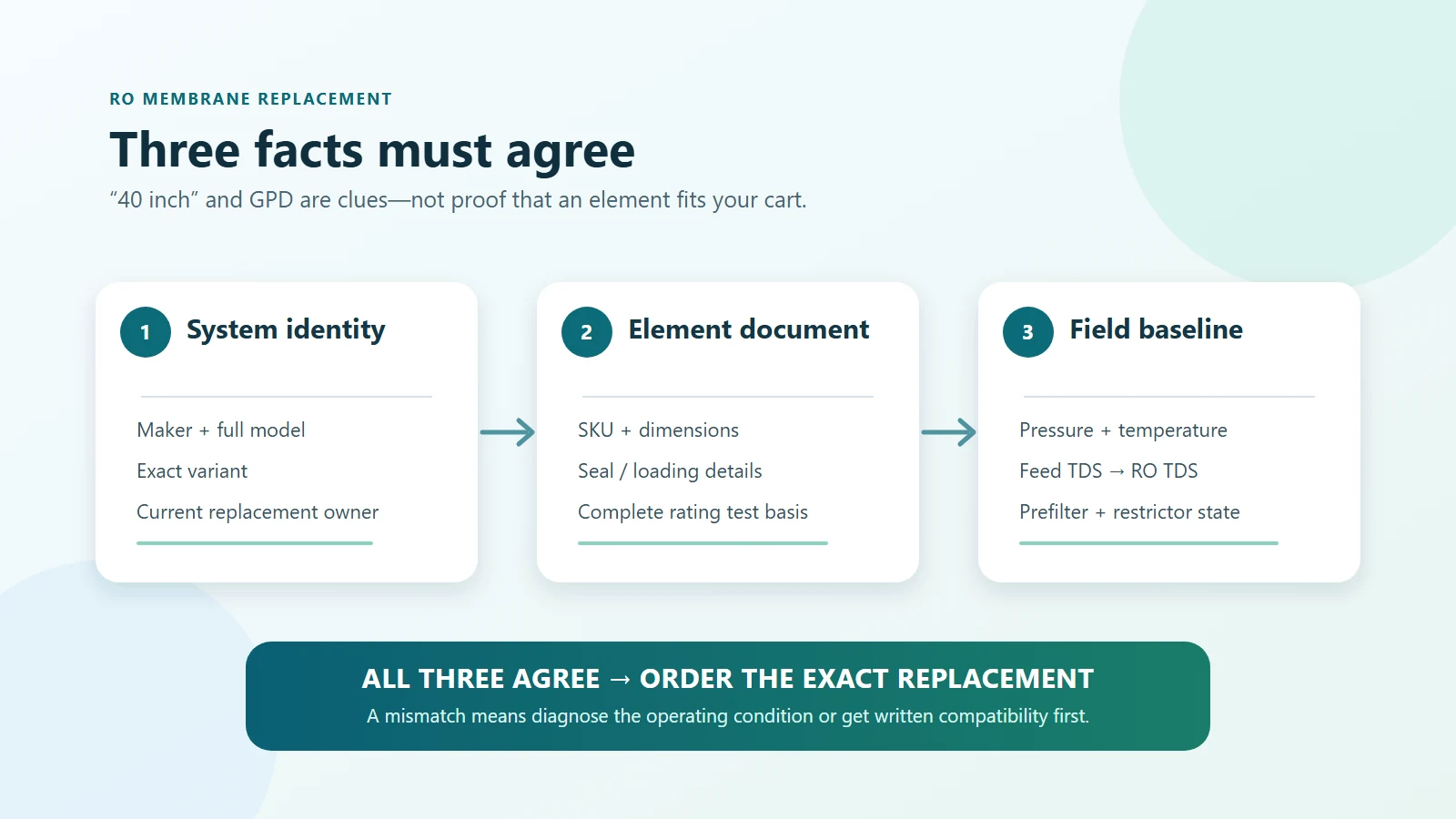
A 40-inch RO membrane is not a part number. Tucker’s current 4 × 40-inch replacement page makes that plain: the membrane is offered for Tucker RO/DI systems and the H2Pro, yet the same page explicitly says it is not the replacement for the Tucker 4060. That system needs a 4 × 30-inch element.
So the first question is not “Which membrane has the highest GPD?” It is “Which exact element does the owner of this exact system permit?” After that, copy the element dimensions, test conditions and service directions. Only then compare them with feed pressure, temperature and TDS readings from the RO stage—not the polished water after DI.
If the filtration path itself has not been chosen, start with the water-fed pole system guide and the separate RO-versus-DI operating-cost decision. This page begins with an RO system that already exists.
Begin with the system label, not the membrane listing
Photograph the system manufacturer label and record the complete model or variant while the cart is assembled. Then open the current replacement page or manual for that model. An old element label can corroborate identity, but it does not prove that the previous replacement was correct.
Current product documents illustrate four different levels of authority:
| Current document | What it establishes | What it does not establish |
|---|---|---|
| XERO Super Max Flow SKU 209-24-778-XP |
A 40-inch replacement with a named list that includes XERO Pure, Pure Plus, Pure MAX variants, Triple Pure and Wall Mount systems | Fit in an unlisted or historical system |
| Tucker Max Flow 40-inch RO | A 4 × 40-inch option for named Tucker routes, with the H2Pro mentioned | Fit in the Tucker 4060; the page points that system to 4 × 30 inches |
| AXEON HF5-4040 Part 200394 |
A technical 4040 identity with published dimensions and a nominal 4-inch housing statement | Authorization for a particular window-cleaning cart |
| DuPont FilmTec BW30 PRO-4040 | A 40-inch element with a 3.9-inch body and published coupler/seal information | Compatibility with an unnamed housing, end cap or service procedure |
The current XERO membrane page is useful because it names the replacement SKU and compatible systems. The current Tucker page is even more useful as a warning: its specific 4060 exception outranks any generic promise that a 40-inch element works in every system.
“4040” is a form-factor description, not a complete fit contract. The element body, permeate tube, seals, couplers, flow direction, housing, end caps and owner’s loading instructions still belong to one exact assembly. If the system owner does not publish the replacement, ask for written compatibility tied to the model and element part number.
GPD numbers live inside a lab sentence
Nominal gallons per day are meaningful only with the conditions used to produce them. Two current 4040 documents show why a larger headline number cannot be ranked in isolation.
| Element document | Published permeate flow and rejection | Test basis attached to the rating | Useful interpretation |
|---|---|---|---|
| AXEON HF5-4040 | 2,500 GPD; nominal 98.5% salt rejection | 80 psi, 550 ppm filtered and dechlorinated municipal water, 77°F, pH 7, 15% recovery; data after 60 minutes | A low-pressure element rating under one defined feed |
| DuPont BW30 PRO-4040 | 2,600 GPD; 99.7% stabilized and 99.5% minimum salt rejection | 225 psi, 2,000 ppm NaCl, 77°F, pH 8, 15% recovery | A brackish-water element rating under a very different feed and pressure |
The figures come from the current AXEON R1 manual and DuPont’s BW30 PRO data sheet. They do not say that the DuPont element will make more water on a low-pressure window-cleaning cart. The test feeds and pressures are too different for that conclusion.
Copy the whole rating sentence into the candidate record: flow, rejection, applied pressure, temperature, feed concentration and chemistry, pH, recovery and stabilization time. If one field is missing, the GPD number remains a catalog identifier rather than a route forecast.
Field conditions move in the opposite direction from a neat lab row. AXEON notes that colder water or higher feed TDS can require more pressure to produce the specified permeate flow in its system. A low reading in winter does not become proof of a failed membrane merely because the catalog was tested at 77°F.
Measure rejection before blaming the element
Membrane rejection needs two matched TDS samples:
Observed rejection % = (feed TDS − RO-permeate TDS) ÷ feed TDS × 100
The second sample must come immediately after the RO membrane and before DI. Final product water after DI answers a different question because fresh resin can hide a weakening RO stage. The TDS meter guide shows why feed, RO-permeate and point-of-delivery readings need distinct sampling points.
For a simple arithmetic example, 400 ppm feed and 40 ppm RO permeate equal 90% observed rejection. The same feed and 8 ppm permeate equal 98%. Those numbers illustrate the formula; they are not universal replacement thresholds.
Take the readings after the exact system has reached the stable condition required by its owner. Keep the same sample points, meter, feed source and operating arrangement when comparing dates. Record working pressure, water temperature, product flow, reject flow and any recent prefilter or restrictor change beside the TDS pair. Without those conditions, a percentage can look precise while comparing two different systems.
Tucker’s current 40-inch page says to consider replacement when its membrane removes less than 80% of the impurities. Treat that as a Tucker product signal, not a rule for every membrane. Even on the Tucker route, confirm that the samples isolate the RO stage and that pressure, temperature, pretreatment and flow controls are not the first problem.
Low output is not a membrane diagnosis
Flow and rejection can fail in different ways. Work from the symptom rather than assuming that every slow brush needs a new element.
| What you observe | What to verify before ordering a membrane | Related owner |
|---|---|---|
| Low product flow, but rejection remains near the established baseline | Working feed pressure, water temperature, source flow, closed valves, hose restrictions and prefilter condition | The garden-hose booster pump guide separates an actual feed-duty problem from a pump-by-label purchase |
| More waste flow than the system’s normal product/reject relationship | Exact restrictor position, size and owner troubleshooting sequence | XERO’s current Pure support page routes excessive waste toward restrictor diagnosis |
| Both flow and rejection changed after neglected prefilter service | Exact sediment/carbon stage, housing, oxidant protection and replacement instructions | Use the sediment cartridge record and chloramine-filter decision separately |
| RO permeate TDS rises across comparable stable runs | Recheck the meter and sample points, then use the exact owner’s membrane diagnostic and service criteria | A membrane problem becomes plausible only after the comparison is valid |
| No historical RO-stage reading exists | Establish a baseline before declaring a trend | One current reading cannot prove deterioration |
XERO’s current Pure support page sends insufficient-pressure problems toward the source and booster path, while an excess of waste over pure water can point to the flow restrictor. Those checks do not prove that the membrane is healthy; they prevent an unrelated fault from being mislabeled as membrane failure.
Pretreatment is not a generic checkbox. AXEON lists zero chlorine tolerance for the HF5 element in its current manual and calls for oxidants to be removed upstream. DuPont lists free-chlorine tolerance below 0.1 ppm for the BW30 PRO and recommends pretreatment. Those values belong to the named documents; they should not be averaged into a home-made operating limit.
Do not improvise a chemical-cleaning or preservation recipe from another membrane family. Oxidant exposure, scaling, biological fouling and storage damage require different responses. Use only the procedure and compatible chemicals published for the exact element and system, or send the question to the manufacturer.
The replacement record needs two signatures
The first half identifies the part to order. The second half shows why replacement is the right action and preserves a baseline for the new element.
| Field | Order identity | Operating baseline |
|---|---|---|
| System | Manufacturer, complete model/variant, serial range if relevant, current manual | Water path and sampling points used for this cart |
| Element | Exact replacement SKU or written approval; length, body diameter, permeate tube, seal/coupler and flow direction where published | Installed element label and service history |
| Rating | Flow and rejection with every published test condition | No conversion into promised field output |
| Feed | Owner’s permitted pressure, temperature, chemistry and pretreatment | Measured working pressure, temperature and feed TDS |
| RO stage | Owner’s diagnostic or replacement criteria | Matched feed TDS, RO-permeate TDS, observed rejection, product/reject flow and timestamp |
| Protection | Exact sediment/carbon or other upstream requirement | Installed prefilters, service date and any known oxidant event |
| Restart and storage | One owner’s loading, O-ring, flush, startup and preservation directions | Date, readings and observations after the owner-defined stabilization period |
Both signatures must refer to the same system and the same element. A seller’s compatibility sentence cannot replace a system-owner exclusion. A laboratory GPD number cannot replace a field baseline. A zero-TDS reading after DI cannot replace RO-permeate TDS.
DuPont and AXEON both instruct operators to keep their elements moist after initial wetting and publish model-specific startup or preservation controls. XERO also directs owners to use a preservation solution during long inactivity. Choose the instructions belonging to the selected route; do not assemble a hybrid procedure from whichever steps appear easiest.
Consider two carts. A current XERO Pure owner can see the Super Max Flow membrane on XERO’s compatibility list, then confirm the exact variant, instructions and baseline before ordering. A Tucker 4060 owner reaches a different result immediately: Tucker’s 40-inch page says that product is not the replacement and directs the 4060 to a 4 × 30-inch element. A more attractive 40-inch GPD claim does not reopen that decision.
The membrane is ready to order when the system owner, element document and measured RO-stage baseline all point to the same part and the same reason for changing it. If one of those three disagrees, the honest next purchase is none.