Lay a filtration unit, a reel, a long pole, a hose and a solar brush on the shop floor. The purchase looks complete because every object is visible. The first job can still stop at an invisible gap: the module does not permit that contact method, the feed water does not support the stated output, the selected brush is unclear, the pole does not deliver the required working reach, or nobody owns a replacement part.
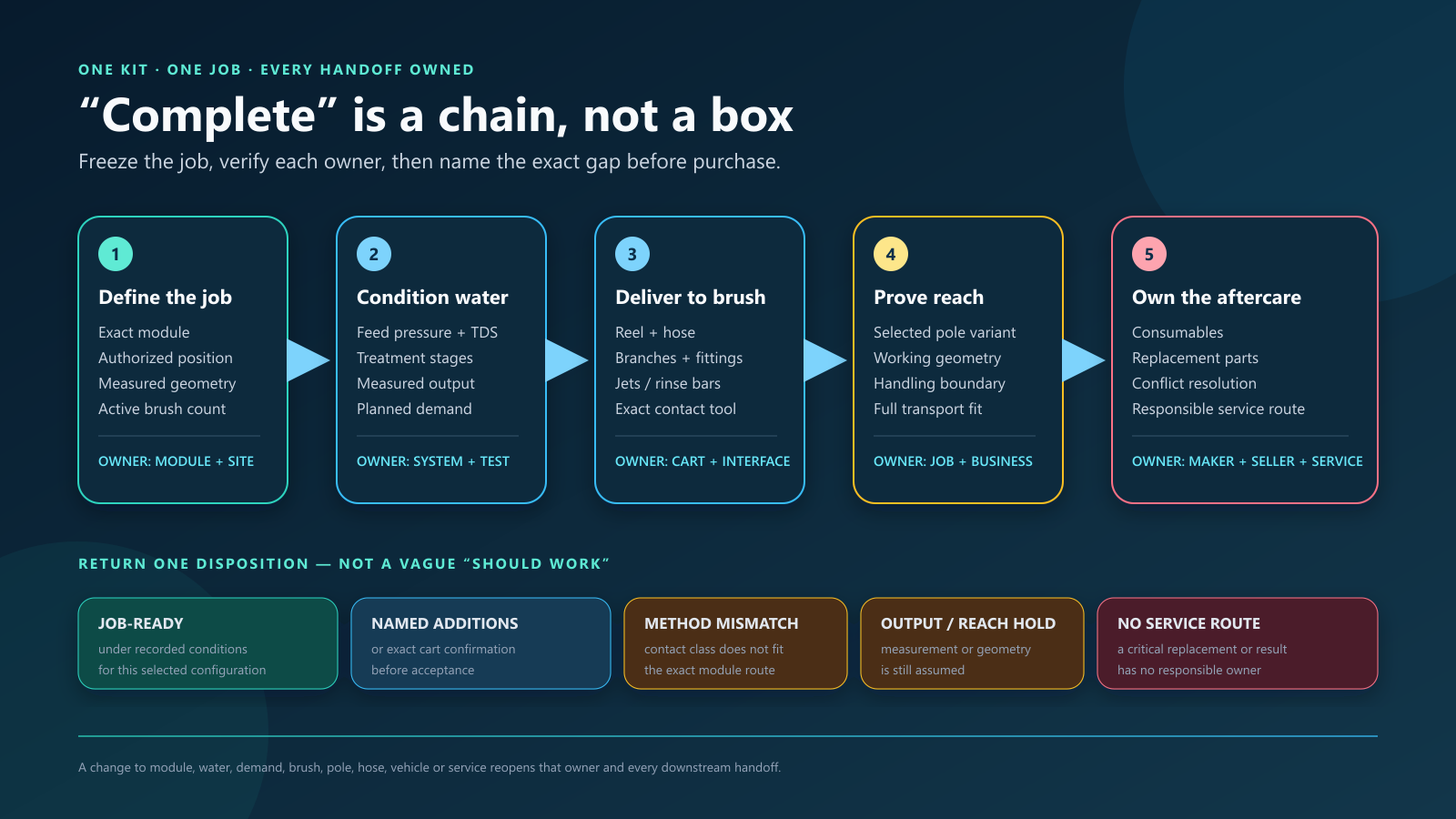
A useful solar panel cleaning kit is therefore not a list of objects. It is a chain of named owners and measured handoffs for one job. The test is simple: can you trace the exact module method, water, treatment, delivery, contact tool, reach, transport and support without borrowing an assumption from a different product or site?
| Job-chain field | Evidence that closes it | A missing field means |
|---|---|---|
| Module contact method | Exact model and current owner document | Method mismatch or hold |
| Feed and product water | Job measurements and tested system output | Output hold |
| Delivery path | Exact reel, hose, fittings, shutoff, jets and brush | Named addition or confirmation |
| Working reach | Measured geometry and selected pole configuration | Reach hold |
| Transport and service | Full loaded envelope, consumables, replacement and service owner | Addition or no-service route |
A green result does not mean a product is universally safe or complete. It means that one selected configuration is ready only under the conditions recorded for that job.
Start with one job, not the biggest package
Do not begin with the tallest pole or the system with the most stages. Begin with a short job record: exact module manufacturer and model, the current cleaning-method disposition, array layout, ground position, furthest work point, water and power locations, drainage route, number of brushes expected to run at once, and the vehicle that has to carry everything.
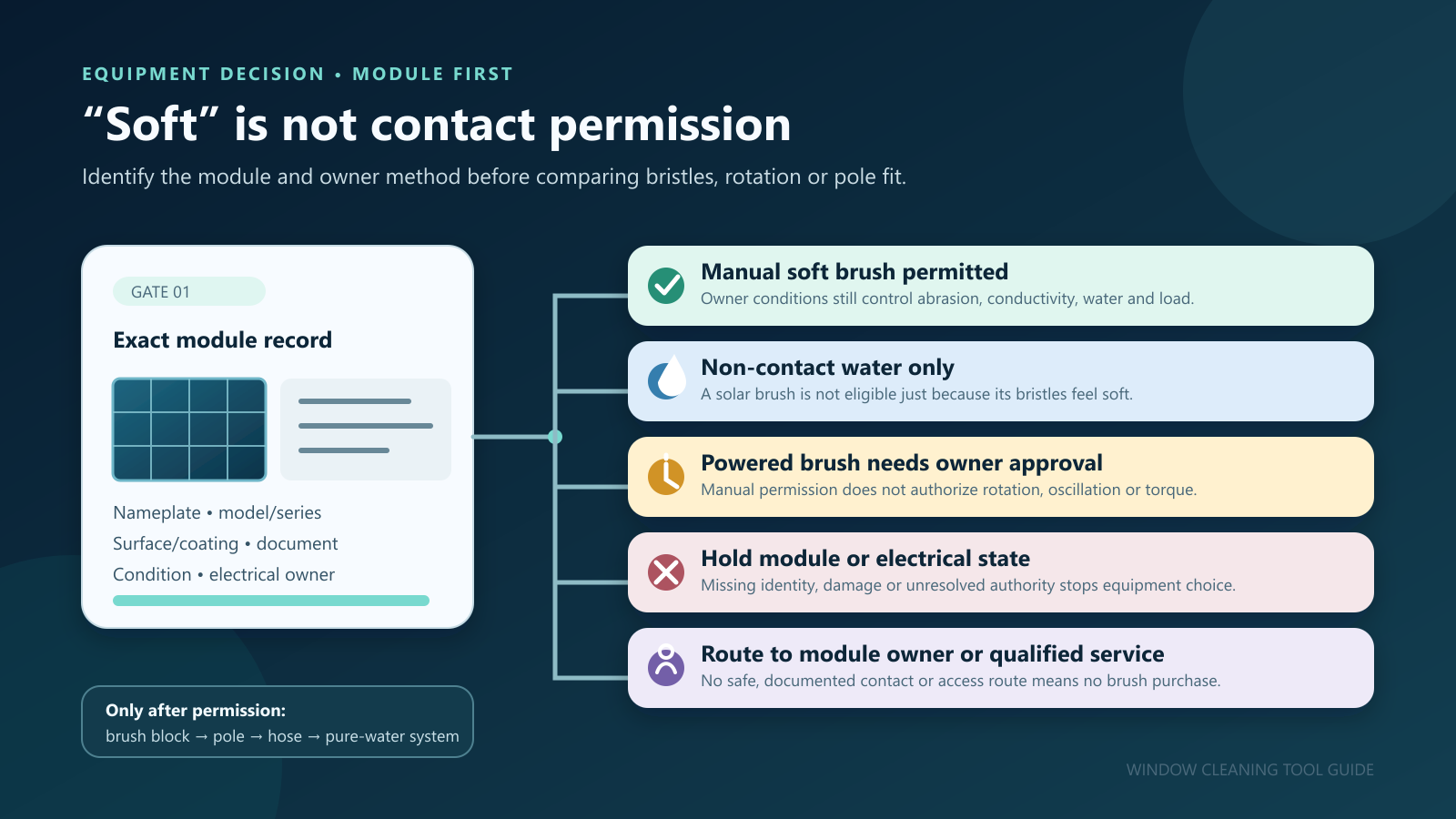
The module line comes first because a complete water-fed package cannot create surface permission. Use the soft-brush solar-panel guide to bind the exact module to manual contact, non-contact water, powered-method review, a condition hold or a qualified-service route. Bring only a permitted contact class into this kit audit. If the result is non-contact water only, a bristle brush remains the wrong component even if it fits every connector.
The job geometry comes next, but it is not a roof-access plan. Record the owner-authorized working position and measured geometry without turning a longer pole into permission to cross an electrical, fall or access boundary. If no responsible party can define that position, the kit has not failed as a collection of products; it has failed as a route for this job.
Finally, freeze simultaneous demand. “Up to three poles” and “one pole now, a second later” are different configurations. The number of active brushes changes water demand, branch fittings, hose layout, pump use, crew control and the parts that must be included. Decide that field before using a vendor output statement.
Follow the water through every connection
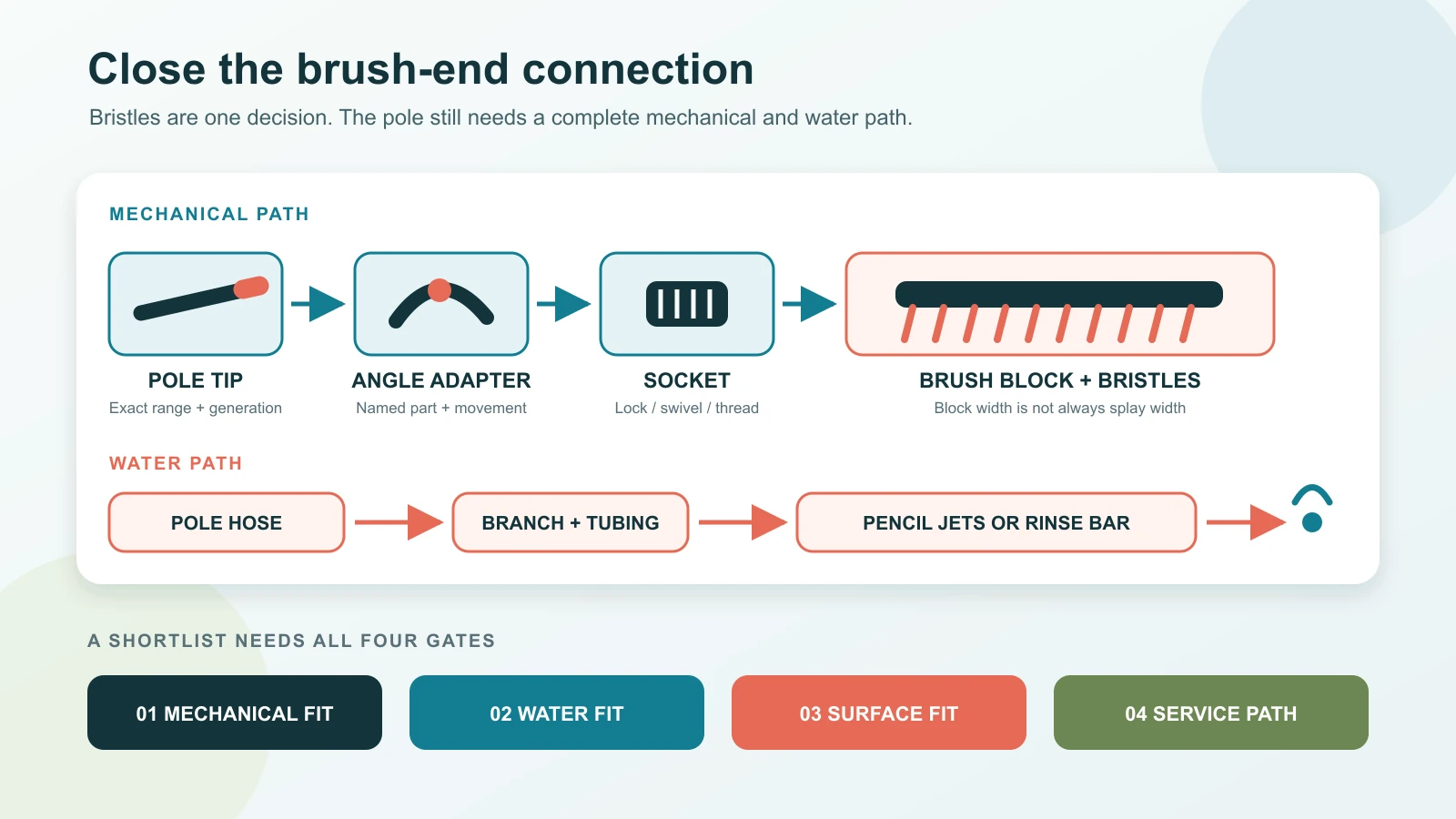
Trace the water in its actual order: tap or tank, measured feed conditions, sediment and carbon stages, RO and DI treatment, product-water measurement, pump if used, reel, main hose, branches, pole hose, brush block, jets or rinse bars, and the shutoff point available to the operator. A missing adapter in the middle makes the treatment plant irrelevant at the glass.
The current Pure Water Power Solar Kit listing provides a useful exact example. For displayed SKU 272-27-64, it describes a 10-inch sediment filter, a 10-inch carbon filter, two 40-inch RO membranes, a 20-inch DI filter and a dual inline TDS meter. It declares about 1 GPM at 50 PSI from an efficient tap and up to 2.5 GPM through the included 115V booster pump for as many as three poles.
Those are vendor-declared points, not the job result. Feed pressure, temperature and TDS, membrane condition, elevation, total hose, fittings, branch count and the selected brush outlets can change the delivered result. Record the product-water reading and output at the end of the configured path under the same simultaneous demand planned for work.
| Water-path checkpoint | Record before purchase or acceptance | Do not substitute |
|---|---|---|
| Source | Pressure, temperature, TDS, supply type, drainage and power | “A garden tap is available” |
| Treatment | Exact filters, membranes, DI stage, meter and replacement path | Stage count alone |
| Output | Measured quality and flow at planned demand | A maximum seller point |
| Delivery | Reel, every hose length, inside diameter, branch, fitting and shutoff | A photo of connected parts |
| Contact end | Exact brush block, jets or rinse bars and their demand | A generic “high flow” label |
Use the water-fed pole system guide to size the purification and delivery system against measured inputs. Use the water-fed pole brush guide to close how the brush block joins the angle connector, pole clamp and water-delivery outlets. This page asks whether those two completed records connect; it does not replace either decision.
A long pole is not a working-reach answer
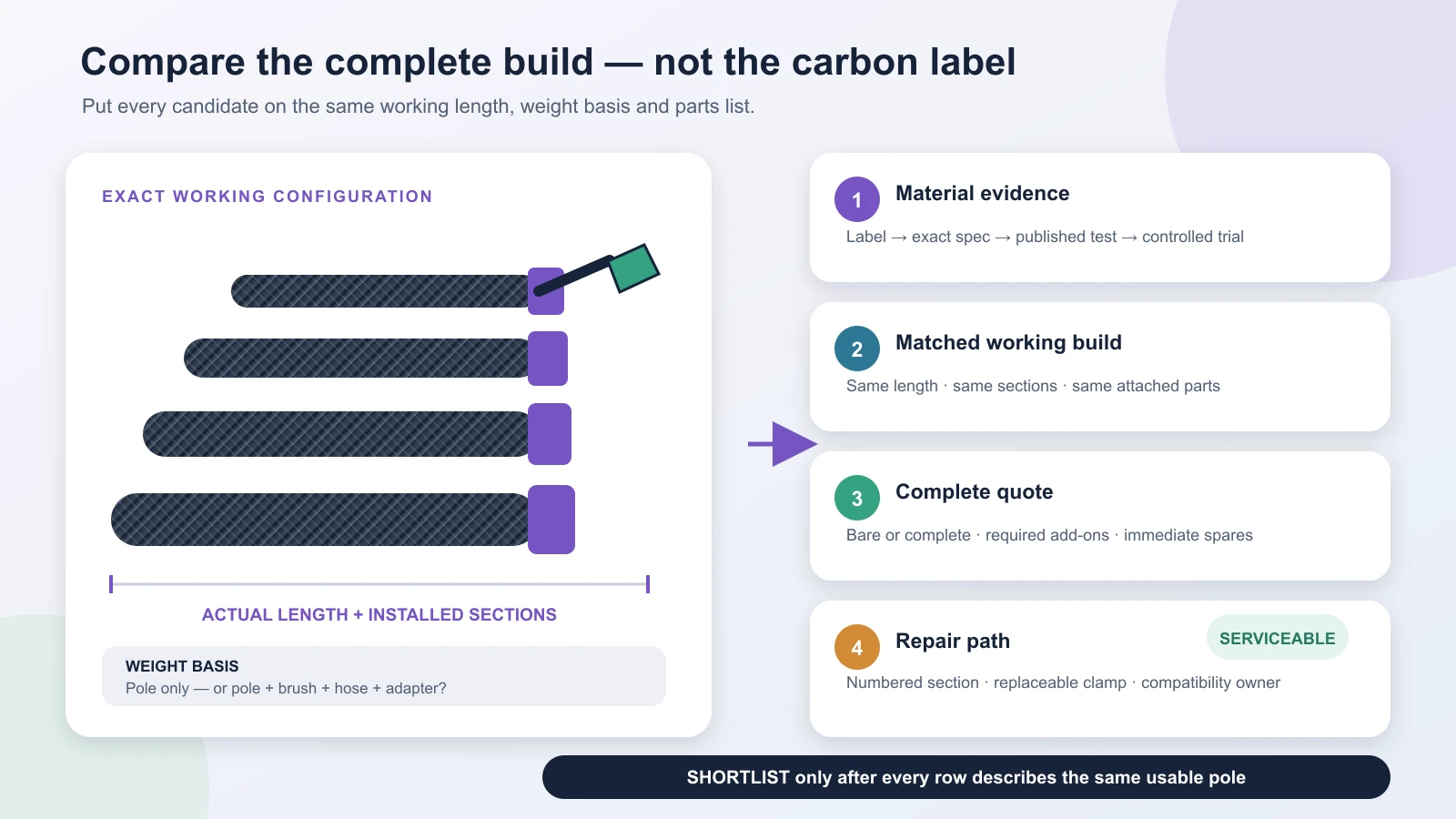
Published pole length is an order attribute. Working reach is a job result. It depends on the selected configuration, usable section arrangement, brush and angle adapter, owner-authorized position, setback, obstructions and the operator’s handling boundary. Adding the operator’s height to a catalog number is not a field check.
The PWP kit currently offers 50-, 55- and 60-foot high-modulus carbon-fiber pole selections. Its 50-foot description names nine sections and 60 feet of pole hose; the longer choices add five-foot extensions and hose described as pole length plus 10 feet. Those options affect more than reach. They affect collapsed pieces, extension storage, hose routing, setup sequence and which exact variant must appear in the cart.
| Pole question | Close it with | Hold when |
|---|---|---|
| Which variant is ordered? | Selected cart, SKU and included sections or extensions | The page default and cart differ |
| What working point is reachable? | Measured job geometry from an authorized position | Only advertised pole length is known |
| Can the operator handle it? | Site-specific handling assessment with the chosen brush and hose | A material adjective is the only evidence |
| Will it travel and store? | Longest collapsed item, all extensions, reel, brush and system envelope | Only the purification unit footprint is known |
The PWP listing publishes the Solar Beast unit as 57 inches tall with a 15.75-by-17-inch ground footprint and says it may be mounted vertically or horizontally in a vehicle. That does not close the full load. The pole pieces, extensions, 150-foot reel, pump, brush, hoses, filters, spares and restraints need their own transport drawing. Send the reach, section, material and handling decision to the water-fed pole guide; bring its selected result back to the kit map.
Read “included” like a purchase order
A package page can change, repeat copy from an option or describe more than one configuration. Treat each “included” claim as an order line with a name, quantity, interface and selected variant—not as prose that can be averaged together.
The current PWP page contains a material conflict. Its pole section describes a 16-inch hybrid brush with Fast Lock and four pencil jets. The package description and highlights describe a 23-inch boar-hair brush with Fast Lock, six pencil jets and additional tee fittings. The optional second-pole description adds a same-size pole, two 23-inch brushes and a brass garden-hose Y valve. These descriptions cannot all be silently combined into the base kit.
Before ordering, save or obtain the selected-cart configuration and ask the seller to identify the exact base brush, quantity, jets, fittings and effect of the second-pole option. The answer must then return to the module-method record and water-demand calculation. A larger brush or more outlets can change both contact and delivery decisions.
| Current listing | What it closes | What it leaves outside the package |
|---|---|---|
| PWP Solar Kit Displayed SKU 272-27-64 |
Named multistage system, pole choices, reel, booster branch and current component descriptions | Exact included-brush conflict, job measurements, module permission, full transport envelope and service acceptance |
| XERO Solar Pole SKU 209-20-726 |
Listed pole configurations, 23-inch hybrid brush, Fast Lock, 100-foot hose, six jets or two rinse bars | Purification system, measured job output, module permission and full-kit service chain |
That comparison is not a ranking. It shows why “solar kit” has no fixed boundary. One listing combines treatment and delivery but contains an unresolved order line; another intentionally begins at the pole and brush. The buyer has to define the boundary and name what is supplied elsewhere.
The missing owners decide whether the kit is ready
Finish the map with the parts most package cards omit: filter and resin replacements, membrane and pump service, brush and jet parts, fitting standards, hose repair, meter calibration or replacement, who answers a configuration conflict, and what happens when measured output misses the job requirement. The current J. Racenstein solar equipment category spans pure-water packages, powered brushes, robots and replacement components. That breadth is evidence that equipment classes and support paths differ; it is not proof that every required part will remain available for your selected configuration.
Assign each line to a real owner: module manufacturer or array owner for contact, seller or cart for included parts, job measurement for inputs and output, equipment maker or service provider for maintenance, and the business for transport and acceptance. An email address without a confirmed responsibility is not a service route.
| Final disposition | Use it only when | Purchase action |
|---|---|---|
| Job-ready under recorded conditions | Every field closes for the same selected configuration and defined job | Preserve the record and recheck changed inputs |
| Compatible after named additions or confirmation | The method fits and each gap has an exact part, answer and owner | Add or confirm those lines before acceptance |
| Method mismatch | The exact module route excludes the selected contact class | Reject that contact configuration |
| Output or reach hold | Water delivery or working reach is assumed rather than measured | Test or redesign before ordering around the claim |
| No responsible service route | A critical consumable, replacement, conflict or maintenance result has no owner | Choose a supportable route or decline the setup |
Put the final disposition on the purchase record beside the exact selected cart and job inputs. If a field changes—module model, brush, pole variant, feed water, simultaneous demand, hose run, transport vehicle or service path—reopen only that owner and every downstream handoff. That is what turns a promising box of solar equipment into a defensible first-job decision.