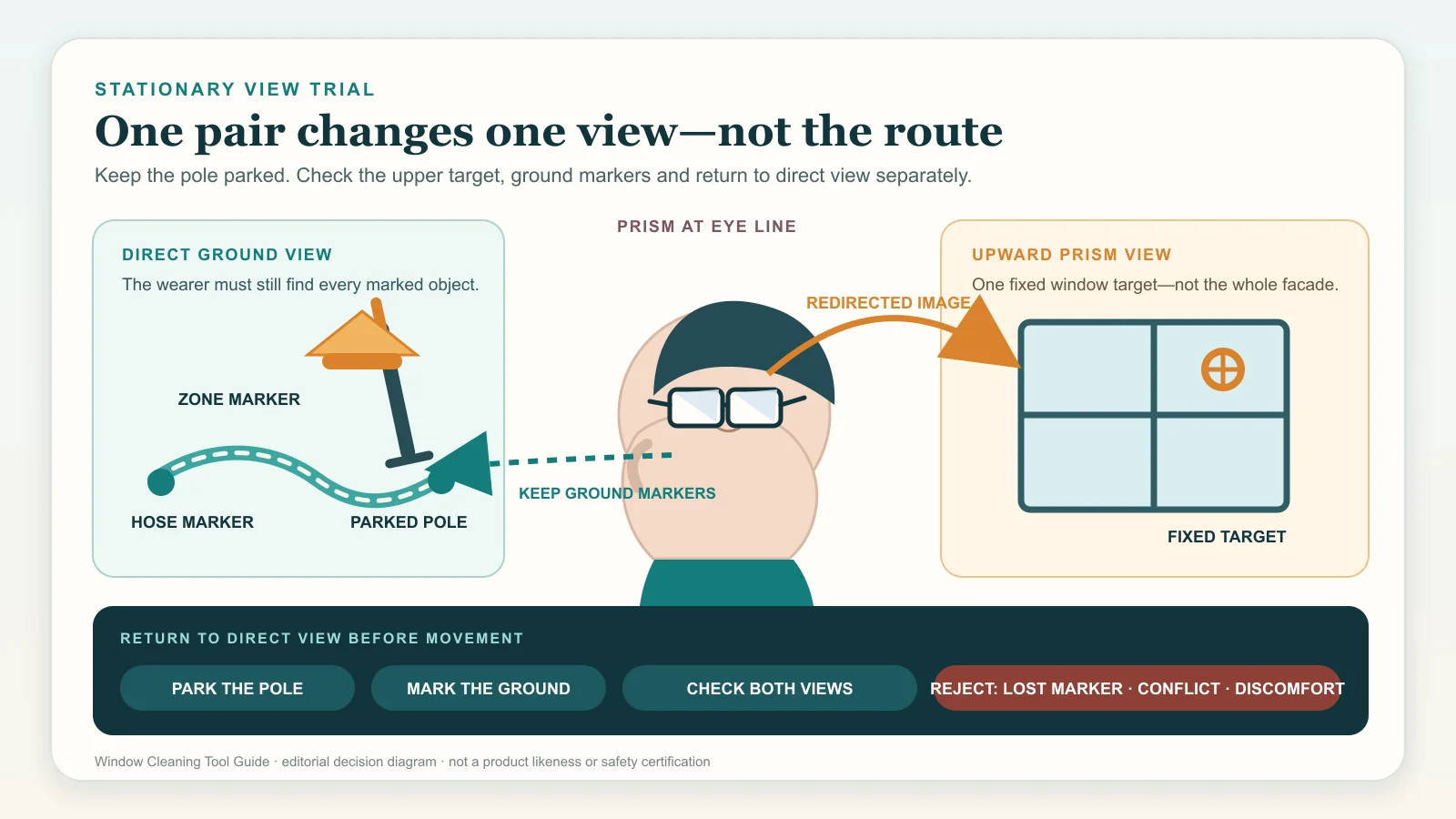
A prism can put the upper glass in the center of your view while your face points forward. It cannot also tell you where the hose is at your feet, whether a customer has entered the work zone, or whether two pairs of eyewear fit together. Those are separate parts of the job.
For water-fed-pole work, buy only after one exact pair earns a narrow role on clear ground. First choose a standalone or clip-up form around the glasses and eye protection already required. Then, with the pole still parked, compare the upward prism image with the ground, hose and pole markers visible outside it. Return to direct view before changing position.
Any disorientation, lost marker, unstable attachment, eyewear conflict or unclear task-owner permission ends the trial. A pass has a narrow meaning: the named model served one wearer at one marked position, with a documented return to direct view.
One prism view does not replace the route view
Belay glasses were designed around a climbing problem: watching a person above without holding the head in the same upward posture. Their prisms redirect that upper image. The wearer still sees some of the surroundings directly around the prism frame, so there are two visual channels to manage rather than one ordinary view.
That distinction gets blurred in window-cleaning sales copy. WindowCleaner’s current NICE listing identifies manufacturer part CSA-21114US-1 and SKU 209-48-10, calls the pair suitable for window cleaners and says it works with water-fed cleaning. That is useful evidence that professional cleaners shop this category. It is still a seller statement, not proof that the glasses preserve awareness on every facade or fit every wearer.
The manufacturer pages used for the model comparison below name climbing and belaying as the intended activity. They describe how a frame, clip and prism are built; they do not approve a window-cleaning route. Keep both facts. A specialist seller establishes the use case. The exact product owner establishes the model. Your ground trial and site procedure decide whether the two can meet on this job.
The same boundary keeps the accessory from taking over decisions it cannot close. The water-fed pole guide owns the pole, brush, hose, filtration and working-reach path. The glasses do not add reach, stabilize a pole or make an obstructed ground position acceptable. They can only become a visual aid inside a method that already passed those tests.
Choose the frame from what is already on your face
Start with the eyewear stack, not the prism marketing. A worker who wears no glasses has a different fit problem from someone who needs prescription lenses, sunglasses or task-specific protective eyewear. A model that sits over one frame may crowd another; a clip-up needs a base frame that can accept it without moving.
| Candidate branch | Current owner says | What it changes | What stays open |
|---|---|---|---|
| NICE exact specialist cart | Prismatic glass lenses redirect an upward view; the seller offers model CSA-21114US-1 / SKU 209-48-10 for window cleaners and says it may be worn over sunglasses | Proves a current US window-cleaning use case and preserves an exact cart identity | Manufacturer task scope, selected-eyewear fit, peripheral awareness, visual comfort, current availability and service path |
| YY Classic | Flexible stainless-steel standalone frame, adjustable temples and nose bridge, BK7 indirect view, designed to sit over most prescription glasses or sunglasses | Adds adjustability when a complete second frame is acceptable | Fit over the actual optical or protective frame and the wearer’s usable view |
| Plasfun First | Polycarbonate standalone frame, BK7 upward view, declared 36 g weight, and a thin form intended to sit over prescription glasses or sunglasses | Creates a lighter, simpler over-eyewear trial candidate | Whether its prism and frame provide enough view and clearance for this wearer |
| Plasfun Evo | Polycarbonate standalone frame with extended BK7 prisms and over-prescription-eyewear compatibility | Puts a manufacturer-described wider prism on the trial list | A wearer-specific comparison; “wider” is not a measured route result or an automatic winner |
| YY Clip Up | Clips to most prescription or sunglass frames; trapezoidal BK7 prisms tilt up or down | Keeps the user’s base eyewear in place and adds a deliberate direct/prism transition | Attachment to the exact frame, stability, protection compatibility and a clean transition during the stationary task |
These are trial branches, not a best-to-worst list. The current YY Classic owner documents an adjustable complete frame. Plasfun First documents a lightweight polycarbonate alternative. Plasfun Evo changes the prism description, while Clip Up changes the attachment and transition. None of those pages has seen your prescription frame, safety program or route.
Write the selected manufacturer and model before the trial. “Belay glasses” is not a serviceable receipt line. A future replacement frame, prism or screw has to return to the same family, and a product change can alter the fit you approved.
Run the trial with the pole still parked
This trial is intentionally dull. It happens before water flows, before a pole is raised and before the wearer needs to move. The object is to discover a bad view while the cost of stopping is zero.
- Freeze the eyewear stack. Use the exact prescription glasses, sunglasses and any eye protection required for the real task. Do not test over a convenient frame and assume another one will fit later.
- Build two views. Pick a fixed target above—a marked upper-frame corner works—and a clear ground zone with visible markers for the coiled hose, parked pole, curb or boundary cone. Nothing moves during the trial.
- Record direct view first. Without the prisms in front of the eyes, confirm that the wearer can identify every marker, the target and the direct-view transition they will use. If direct view is already compromised by the eyewear stack, stop there.
- Bring the prism into position while stationary. Identify the upper target through the prism. At the same time, ask the wearer to locate each ground and pole marker in the surrounding direct view. Do not coach by pointing after the trial begins; a missed marker is useful evidence.
- Return to direct view before any position change. Remove or reposition a standalone frame, or tilt the Clip Up clear. The wearer confirms every marker again. Walking, pulling hose, moving the pole and vehicle use are outside this trial.
- Repeat only if the first pass was comfortable and complete. Change one thing—frame adjustment, base eyewear or model form—then run the same target and markers. Stop on visual discomfort, disorientation, unstable attachment or any lost awareness.
| Trial field | What earns another stationary pass | What redirects or rejects the pair |
|---|---|---|
| Exact identity | Manufacturer, model and current owner are recorded | Unidentified pair, copied listing or no current instructions/service owner |
| Base eyewear | Selected frame remains correctly seated and usable | Crowding, slipping, pressure, scratched frame or required protection no longer fits as approved |
| Prism target | Wearer can acquire and follow the fixed upper target without ambiguity | Blur, double image, unstable target or visual discomfort |
| Surrounding markers | Wearer independently locates every ground, hose and pole marker | One marker disappears, requires a guess or is seen only after coaching |
| Direct-view return | Prisms clear and all markers are reacquired before movement | Transition snags, shifts the base frame, uses both hands when the task cannot allow it, or leaves the view uncertain |
| Retention and storage | Cord/attachment and hard case have a named route position | Loose clip, unprotected prism or nowhere to store the pair during direct-view work |
A pass here does not approve a facade. It earns a conversation with the person who owns the task and site procedure. A fail is not a failed purchase process; it is the purchase process doing its job before a fragile optical accessory reaches a paid route.
A larger prism is only a candidate advantage
YY Vertical describes Plasfun Evo’s extended BK7 prisms as providing a wider view. That statement belongs to that exact current product page. It does not supply a common measurement against Classic, Plasfun First, NICE or Clip Up, and it does not say how much surrounding ground a window cleaner sees outside the prism.
Separate two observations. Prism view is the redirected image of the upper target. Peripheral direct view is what the wearer can still see around the prisms and frame. A larger prism may make the upper image easier for one wearer while occupying more of the area another wearer uses for ground awareness. The result cannot be predicted from “wider” alone.
Frame geometry matters too. Classic provides adjustable temples and a nose bridge. Plasfun First uses a lightweight polycarbonate frame. Clip Up sits on another pair of glasses and introduces a hinge. Those are observable differences, not comfort scores. If two candidates survive the same stationary trial, choose using the exact wearer’s view, transition, fit and service path—not the number of promotional adjectives on the page.
Do not turn neck language into a medical claim. Manufacturers and retailers explain why climbers or cleaners seek an upward-view aid. This article does not promise to prevent pain or injury, and a comfortable first minute cannot forecast a full route. Discomfort or disorientation is a rejection signal; its absence is only one field in a bounded trial.
Eye protection and visual aids are different purchase lines
A prism frame is not automatically protective eyewear. None of the product owners used here gives these models a task-specific impact, splash or chemical rating for window cleaning. If the job’s hazard assessment requires protective eyewear, that exact protection remains in control.
For an over-glasses model, confirm that the belay frame does not displace the required frame, break its seal or move it out of its designed position. For Clip Up, confirm that the base frame is an allowed attachment surface and that the clip does not interfere with its fit or function. “Fits most glasses” is a shopping statement; it is not a substitute for the protection owner’s compatibility instruction.
This is also why the trial cannot rescue a poor access plan. Before the glasses are considered, the working height, setback and pole choice must already make sense. Use the earlier water-fed pole length decision for that geometry. If the site requires frequent walking, traffic monitoring or rapid position changes, direct view may own the whole block even when the prism image looks excellent.
The case, cord and spare parts decide whether it survives the route
Prisms add a storage problem that ordinary route glasses may not have. A pair dropped loose into a tool bucket can meet scraper holders, keys, grit and wet cloths. A clip-up left on the base frame can be crushed when the wearer changes tasks. The purchase needs a protected position before it needs a second wearer.
Current YY model pages list hard or protective cases, cords, microfiber cloths and selected spare screws or nose pads. The manufacturer’s current service collection also names frame kits, cases and prism kits across specific model families. That is a useful ownership signal: exact identity matters after the sale. It is not a durability promise, and live part availability still needs to be checked when ordering.
Give the case a dry, protected route position. Record who inspects the frame, attachment, prisms and cord before use, and return to the exact manufacturer instructions for cleaning or adjustment. If the prism is chipped, the frame no longer holds its position or the clip moves on the base eyewear, the pair leaves the viewing block until the exact service path closes.
A shared pair also needs a new trial for each wearer and eyewear stack. An adjustment that works over one set of sunglasses can move the prism or pressure point for the next person. Do not inherit another worker’s pass as though it were a model specification.
The permission ends at the marked position
Finish with a sentence that a crew lead can understand without seeing the product page:
Stationary view record: exact manufacturer and model; wearer and base eyewear; required protection; fixed upper target; marked ground position; visible hose, pole and boundary markers; method used to return to direct view; protected case location; and one result.
Use stationary candidate only when the exact model, eyewear stack, upper target, every surrounding marker, transition and storage position are closed without discomfort. Use alternate form when the idea remains useful but a standalone frame, over-eyewear fit or clip-up attachment failed. Use direct view when the route or wearer needs an ordinary field of vision for that block.
Return to the manufacturer or task owner when the intended-use boundary, protective-eyewear stack or site procedure is unclear. Reject the pair for that task when awareness, comfort, attachment or direct-view recovery fails. Do not soften a rejection to “probably fine with practice.”
Only after that result should the case and service path enter the broader professional window-cleaning tool stack. Everywhere beyond the marked position, return to direct view and let the pole plan and site procedure—not the prisms—set the work.